When I was 22, my first CEO had one rule:
Every time someone said “this is impossible,” they paid $5.
Small thing. Rewired me for life.
You start seeing how often people kill ideas before they try. How most limits live in the head, not in reality. “Impossible” usually just means “I don’t know how” or “I’m afraid.”
I think about this every single day now.
Because we’re already inside the singularity. Most people don’t feel it yet - the surface still looks normal. Underneath, everything is being rewritten.
For the first time in history, one founder can ship what used to take a team of 50. Small teams are eating giants. And we’re still at the very beginning.
The real bottleneck isn’t intelligence anymore. It’s speed of adaptation.
Most founders already know what to do. They just can’t operate at AI-native speed. No focus. No rituals. Still running on pre-AI muscle. Still calling things impossible that already aren’t.
The Monastery
That’s why we built the digital Monastery.
An environment for founders who want to fully adapt to this new reality. Extreme focus. High intensity. Small groups. Almost unhealthy commitment. People who compress years into months. People who operate with leverage that didn’t exist before.
Not for everyone. By design.
This is the best time and the last time to build.
Best - because AI amplifies ambitious people and the world hasn’t caught up.
Last - because intelligence is becoming a commodity. Soon everyone has the same tools.
A short window before the world reorganizes. A window where small AI-native teams can create asymmetries that won’t exist again.
The future belongs to those who move first.
Do the impossible. While it still looks impossible.
Introducing the Monastery for AI-native founders.
A single builder can now outperform a publicly traded company.
$2 million. 12 weeks. Do the impossible.
A new way to access Ethereum’s yield economy
Introducing the WisdomTree Physical Lido Staked Ether ETP (LIST/LSTE), the world’s first physically backed ETP providing exposure to the spot price of Lido Staked Ether and its staking rewards.
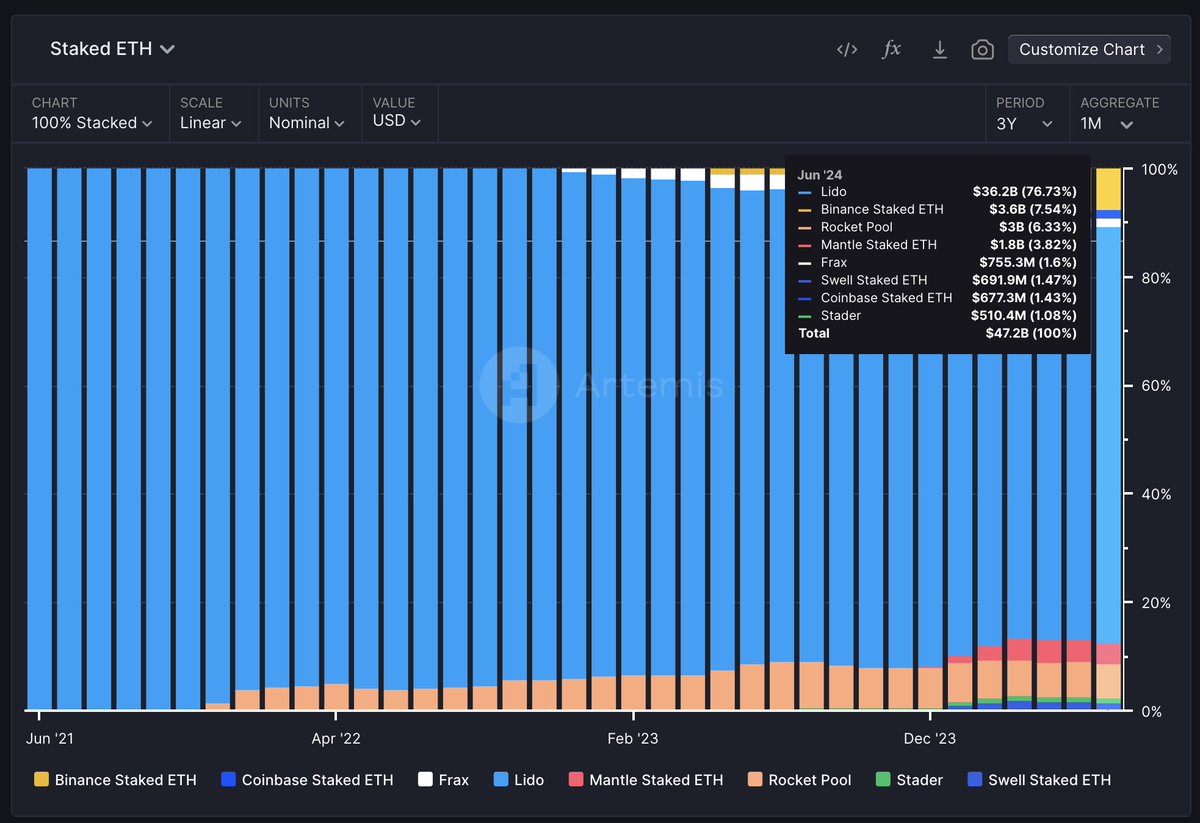
As Ethereum evolves into a yield-bearing, infrastructure-grade network, liquid staking has become one of the most important segments of the digital asset ecosystem. With nearly 25% of all Ether staked via the @LidoFinance protocol, Lido Staked Ether plays a pivotal role in Ethereum’s economy, allowing holders to earn validator rewards and participate in the network’s underlying activity.
Our new ETP offers investors secure and transparent access to the spot price of stETH and its on-chain staking rewards through an institutional grade, physically backed structure.
🔗 Learn more about the WisdomTree Physical Lido Staked Ether ETP: https://t.co/qBe6t6ZbA8
#marketingcommunication
𝗘𝘁𝗵𝗲𝗿𝗲𝘂𝗺 𝗧𝗵𝗲𝘀𝗶𝘀 — Root Chain for the World Computer
We invest in, build on and love Ethereum ❤️ — since 2014.
https://t.co/j3UQLjhmpc
Here we share our conviction & discuss:
‣ Ethereum's state
‣ Rollup-centric future
‣ L1 & DA moats
‣ ETH value accrual
🧵
Check out https://t.co/jMYPBZZhDU .
@cyberfund & @delphi_labs are reviewing 300+ Accelerator apps! Get up to $500K funding, $200K in compute, no equity taken, and access to world-class mentors. Don't miss this opportunity to build on @base.
More info below! 👇
Maximum Viable Security (MVS): a new framework for Ethereum Issuance
Excited to share a new paper in collaboration with @SteakhouseFi, where we derive a new monetary policy framework from the core values of Ethereum – security and neutrality: https://t.co/1uw9Nvl2aO
🧵👇🧵
We love to invest in the problems that we have.
Building a real DAO is super hard, building an efficient DAO is impossible. And you have a ton of legal risk.
Gab is the best person to solve it.
Regulation by technology is the future.
MetaLex OS will help to launch efficient DAOs for the next generation of builders!
The new wave is coming 🌊
At cyber•Fund we believe that amount of intelligence on the planet will explode exponentially thanks to the progress in AI. We believe that decentralized technological regulation is the way forward to build and control plethora of coming AGIs that are safe and useful for humanity. This is why we’re hosting dAGI House hackathon next month in Brussels.
Discover key @eigencloud restaking risks & strategies for secure #restaking!
�� https://t.co/UXumSQAgpy
We're committed to transparent AVS management & were 1st to introduce ALL AVS OPERATOR for your benefit. Now, we bring you insights by @PaulYa5hin before slashing goes live:
The eligibility requirement for Ethereum stakers to claim STRK is based on staking ETH up until the Merge, on September 15th 2022.
Lido contributors have provided the StarkNet Foundation with a complete list of active stakers up to this point, after which the StarkNet Foundation has made the final decision regarding eligibility.
Please note that Lido contributors have had no involvement with determining the eligibility criteria.
★ Announcing MVI Grants ★
We are excited to share an update on the MVI Grants program – five stellar teams have been selected by the grants committee @artofkot, @brettpalatiello, @eliasimos.
Why are we funding this research?
Since the proposal to reduce the ETH issuance was suggested, the Ethereum community has been actively discussing its monetary policy.
When considering issuance reduction, there is a trade-off for the network between the amount of ETH spent on rewards and how decentralized its validator set is. In particular, one of the main downside risks of reducing issuance is the potential concentration of staked ETH, especially in the view of the upcoming ETF launch. There are also a variety of other risks and factors associated with issuance reduction: margin compression, the resulting pressures on certain market segments, as well as increasing barriers for innovation.
These factors touch the core values of Ethereum: decentralization and censorship resistance. Hence we believe that an evaluation of these risks is needed, in the form of a deep analysis of how the issuance curve change could affect the validator set composition.
Scope:
(1) Profiling different actors within the staking economy, via interviews and field research, to uncover key data points such as preferences, frictions, supply curves, elasticities, costs, etc.
(2) Gathering, studying and deducing the data above using the historical Beacon Chain and DeFi data sets.
(3) Building out theoretical models, taking into account the data above.
(4) Studying equilibriums & limits, doing simulations, and ultimately understanding & evaluating the risks of how changing issuance may affect the staking ratio & the validator set.
↯ 5 grants teams that we have funded ↯
Cryptecon: Matthias Hafner @MatthiasHafner1, Juan Beccuti @BqJuancho, Thunj Chantramonklasri @tchantramonk, Nicolas Oderbolz, Nicolas Greber, Beatrix Marosvölgyi – economists, mechanism designers and modelers from the https://t.co/WEV51lflyC crypto research group.
Scope focus: (2-4)
20 squares: Philipp Zahn @philipp_m_zahn, Wenxuan Deng @dengwx11, Fabrizio Genovese @fabgenovese, Daniele Palombi @dpl0a – mathematicians, economists and modelers from the https://t.co/uMwqGsrqza crypto research firm.
Scope focus: (2-4)
Franklin DAO: Vivian Zhu @vivzhuu, Otakar Korinek @OtakarKorinek – members of the research committee at https://t.co/D1QYZbEfAK, a DAO formed by students out of UPenn.
Scope focus: (1)
K. Kulkarni @ks_kulk – crypto researcher, finishing CS PhD at Berkeley, working with Gauntlet.
Scope focus: (3-4)
A. Eloranta @antsae_ & S. Helminen @0xSanteri – crypto researchers, worked with Flashbots and Token Terminal.
Scope focus: (2)
Read the full announcement at https://t.co/gnLuv1hszM
Expressivity born out of the Taproot and SegWit upgrades brought MEV to Bitcoin.
With sidechains emerging, opcodes gaining ground in governance, and the eventual launch of the BitVM, MEV will soon take center stage on Bitcoin.
Read our piece: https://t.co/qCEX7ZHR69
🧵👇