Very excited about this launch. Introducing:
➡️ PermawebOS nodes: A bootable, multi-architecture HyperBEAM instance.
➡️ LapEEs: Pretty Good Security via swarms of widely available commodity hardware.
➡️ Decentralized bundlers: A first alpha deployment for LapEEs.
Demanding the most recent high-end server chips or ~$100k as an entry ticket to contribute hardware just isn't a path to decentralized networks.
To actually decentralize the web we are going to need to enable wide participation. The PermawebOS is how we think we get there. Big day 🙂.
To be clear: This is a huge ship and it is definitively, categorically an alpha. We have been running and using LapEEs ourselves at @fwdresearch for weeks, but you shouldn't jump on this today unless you are ready for: A. Nothing to work as you expect. B. The very real possibility that you brick your machine.
Stability and ease-of-use will improve over time, so unless you love self-guided firmware flashing adventures it is best to hang tight for now.
Further down the track, it also looks like Android deployments of the PermawebOS may be possible, too, using kernel software isolation and some of their security hardware. Running a bundler on your phone that you genuinely do not know how to tamper with even if you wanted to is pretty remarkably.
Brick by brick.
AO devices are like *nix tools: Simple, infinitely remixable, and open for all to build.
This is why you can build things like trust-minimized oracles in a single HTTP URL (yes, really [1]).
But building devices used to suck.
Yesterday, the device forge flipped that. Details👇
.@ArweaveOasis announced @WaoEco's redesigned landing page, restructuring the entry point for @aoTheComputer and HyperBEAM development tools.
The update streamlines developer onboarding with comprehensive HyperBEAM technical documentation.
[WizardAO: Launches Redesigned Landing Page to Streamline AO Developer Onboarding]
Singapore, Feb 25, 2026 — WizardAO (@WaoEco) has rolled out a redesigned landing page as part of its latest update, restructuring the entry point to its @aoTheComputer & HyperBEAM development toolchain.
As one of the most comprehensive technical documentation gateways for HyperBEAM today, WizardAO’s update focuses on clarity and onboarding efficiency.
With a knowledge base spanning 7 structured chapters and 139 reference modules, alongside SDK, testing environments, and Devnet deployment capabilities, WizardAO has reorganized its interface around a five-step journey:
Learn → Code → Test → Build with AI → Deploy
The goal is to present a coherent path from initial learning to production deployment.
According to the team, the new structure highlights three core capabilities:
• A simplified SDK experience enabling AO deployment and messaging in as few as three lines of code
• A unified testing API across five environments, from in-memory to remote production setups
• AI agent–driven scaffolding and workflow automation, integrating quality gates and persistent context
As Web3 infrastructure increasingly shifts toward verifiability and real-world usability, developer experience and structured tooling are emerging as key differentiators. @TomoDB, the original creator of WizardAO, sees this update as a step in WizardAO’s evolution from a documentation repository into a more cohesive developer entry platform.
https://t.co/Xlcs3e1kt6
📢 Announcement:WAO is officially evolving into WizardAO 🧙♂️⚡️
Since Nov 2025, when WAO (@WaoEco) became part of @ArweaveOasis, we’ve spent a lot of time rethinking how to express what this platform truly is. We’ve recently completed a brand upgrade. Here’s what’s new:
Brand name structure
WizardAO: the public-facing brand (clearer, easier to remember)
WAO: the technical shorthand/alias (kept in code, CLI, docs, and workflows)
Positioning
WizardAO is not a single tool, and it’s not just a tutorial site.
It’s an evolving developer entry point for AO, designed around a full growth path:
Learn → Experiment → Build deeply → Participate long-term
Our Mission
🔵 Lower the real development barrier for AO / HyperBEAM
🔵 Turn fragmented knowledge into actionable learning + building paths
🔵 Help developers move from understanding to real building
Slogan
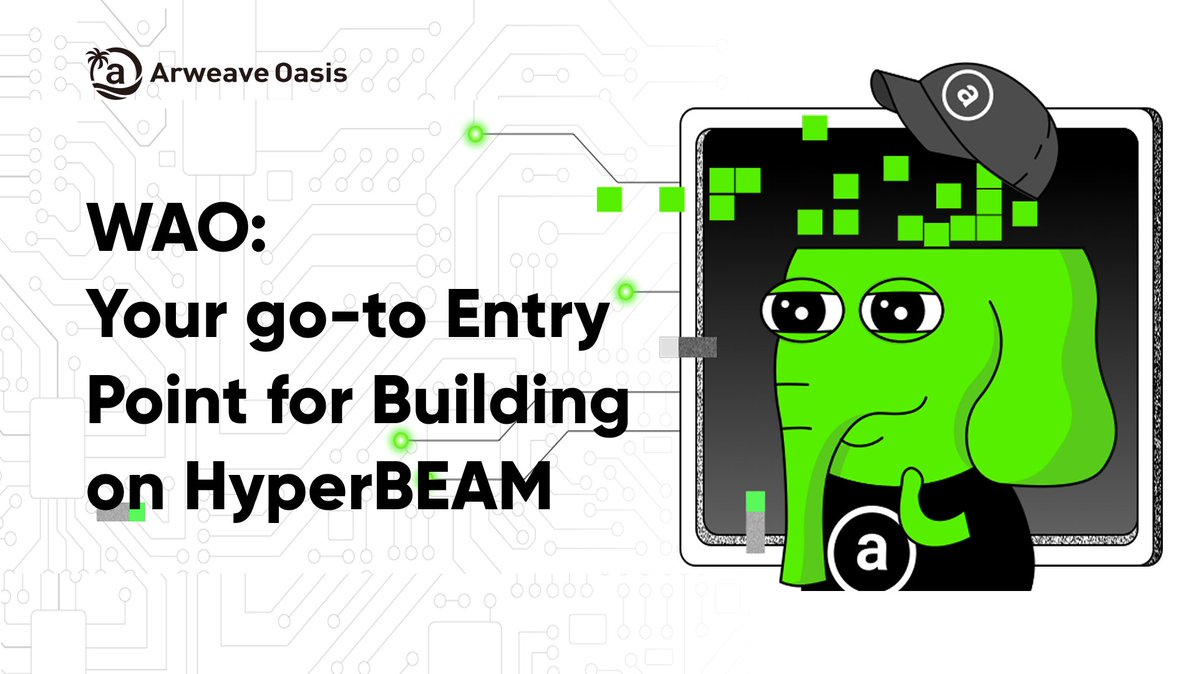
WizardAO — Your go-to entry point for AO, built on HyperBEAM
📒 Note: WizardAO is a developer-first entry-point brand and does not represent any official stance of @ArweaveEco or @aoTheComputer.
🛠️ Recent updates to WAO Docs:
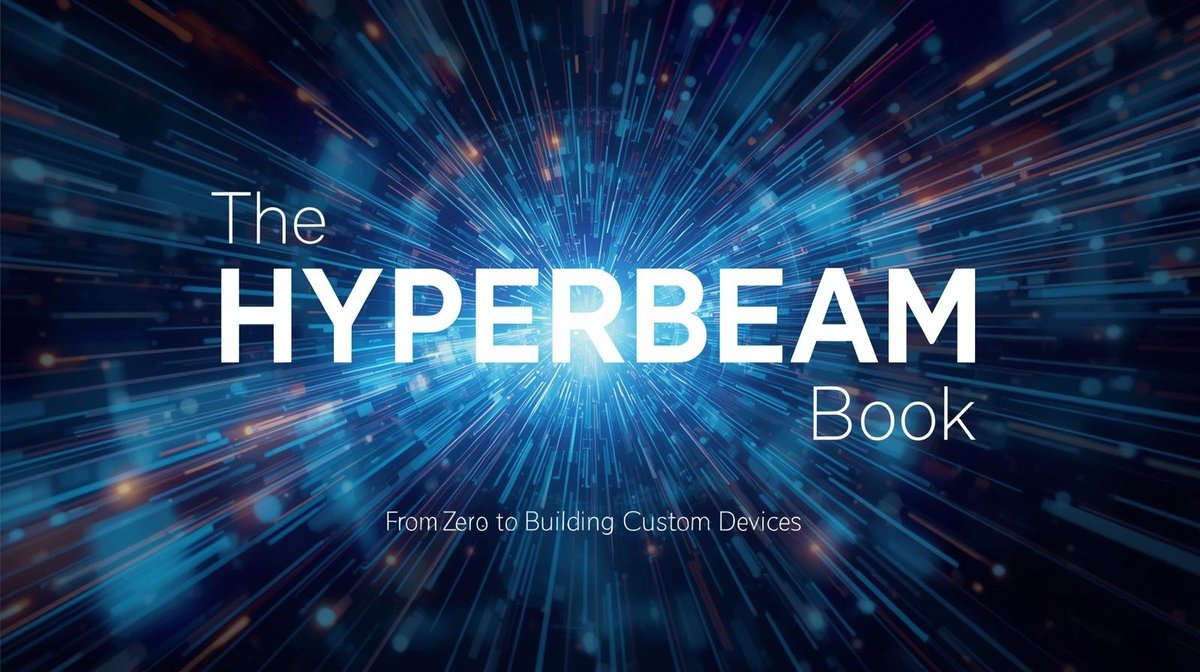
• The HyperBEAM Book (pre-release) — a structured path from zero to building custom devices
• HyperBEAM on Mobile — run and experiment with HyperBEAM anywhere
• HyperBEAM Reference — complete device & module documentation
https://t.co/Z0LWMXsXZF
WAO Docs (@WaoEco) can be your go-to entry point for building on HyperBEAM. @aoTheComputer@ArweaveEco
It’s designed as a single place where developers can:
📝Understand how HyperBEAM works
⚙️ Experiment locally and on mobile
📜 Reference the full device & module system when building real applications
Recent updates bring this closer to a complete developer map:
▶️ The HyperBEAM Book (pre-release) — a structured curriculum from zero to building custom devices;
▶️ HyperBEAM on Mobile — a low-friction way to run and experiment anywhere;
▶️ HyperBEAM Reference — a complete, implementation-level device and module reference
Alongside these, WAO Docs already covers local AO units, browser AO, device testing, SDK workflows, tutorials, and deeper HyperBEAM decoding.
This is not a one-off documentation drop.
It’s a continuously evolving entry point shaped by real development work.
If you’re looking for a clear place to start — and a place you’ll keep coming back to — this is it.
https://t.co/1Pma4h7GQm
I hacked #HyperBEAM so that anyone can install & run it on Android with a single command, and on iOS with a slightly more complex workflow📲
Now imagine what's possible when we combine browser-based #AO units with mobile HyperBEAM nodes…💡
Tutorials👇
https://t.co/JOMm1cb0V7
I’m truly thrilled that #WAO has been acquired by @ArweaveOasis🎉
Over the past year, I’ve poured my heart into building a seamless developer environment for HyperBEAM and @aoTheComputer.
I will work closely with @GerryWon and his team to grow the AO dev community across Asia🚀
I hacked #HyperBEAM so that anyone can install & run it on Android with a single command, and on iOS with a slightly more complex workflow📲
Now imagine what's possible when we combine browser-based #AO units with mobile HyperBEAM nodes…💡
Tutorials👇
https://t.co/JOMm1cb0V7
📣 Now you can run HyperBEAM on Android devices 🚀
@WaoEco author @TomoDB has successfully adapted #HyperBEAM to run natively on Android phones and released the full technical documentation.
This marks an important milestone for @aoTheComputer, bringing its compute layer from servers and desktops to mobile devices. Developers can now run AO nodes, debug messages, and conduct experiments directly on their phones.
This is a meaningful step toward AO’s “Compute Anywhere” vision, opening new possibilities for lightweight nodes, mobile development, and educational use cases.
📘 Full guide & tutorial: https://t.co/1IHUJ1XN1h
Earlier this year we kicked off the transition, and @TomoDB is now fully leading @weave_db as CEO.
I’ve stepped down, but my conviction in him hasn’t. He’s one of the smartest people I’ve ever met and I’m sure he’ll take WeaveDB far beyond what we built.
Leading the company from 0→1 over the past three years was an incredible ride, but it’s the right moment for me to move on.
More soon on what’s next for me!
Milestone 3: Complete ✅
After nearly a year of development, AO mainnet is fully operational. Almost all legacynet computation has migrated to Hyperbeam -- more efficient, more decentralized, fully verifiable.
@samecwilliams breaks down what we built and what comes next👇
w/ @mil_itia


![ArweaveOasis's tweet photo. [WizardAO: Launches Redesigned Landing Page to Streamline AO Developer Onboarding]
Singapore, Feb 25, 2026 — WizardAO (@WaoEco) has rolled out a redesigned landing page as part of its latest update, restructuring the entry point to its @aoTheComputer & HyperBEAM development toolchain.
As one of the most comprehensive technical documentation gateways for HyperBEAM today, WizardAO’s update focuses on clarity and onboarding efficiency.
With a knowledge base spanning 7 structured chapters and 139 reference modules, alongside SDK, testing environments, and Devnet deployment capabilities, WizardAO has reorganized its interface around a five-step journey:
Learn → Code → Test → Build with AI → Deploy
The goal is to present a coherent path from initial learning to production deployment.
According to the team, the new structure highlights three core capabilities:
• A simplified SDK experience enabling AO deployment and messaging in as few as three lines of code
• A unified testing API across five environments, from in-memory to remote production setups
• AI agent–driven scaffolding and workflow automation, integrating quality gates and persistent context
As Web3 infrastructure increasingly shifts toward verifiability and real-world usability, developer experience and structured tooling are emerging as key differentiators. @TomoDB, the original creator of WizardAO, sees this update as a step in WizardAO’s evolution from a documentation repository into a more cohesive developer entry platform.
https://t.co/Xlcs3e1kt6](https://pbs.twimg.com/media/HB90VrCaMAElev4.jpg)