US and Europe must work together to end Russia’s aggression, secure a just and lasting peace, strengthen our collective defence and address challenges in the Indo-Pacific and Middle East.
Nordic-Baltic and US diplomats met in DC this week to discuss these very issues.
#EPINE
IMPORTANT 🇪🇺🇺🇦🇷🇺 KAJA KALLAS SAYS PUTIN IS BETTING ON EUROPE GIVING UP BEFORE RUSSIA DOES. SHE THINKS HE HAS MISJUDGED EUROPE.
Kaja Kallas has identified something fundamental about the Kremlin’s strategy: Putin does not necessarily need to defeat every European government. He needs enough of them to become exhausted, divided or unwilling to continue supporting Ukraine.
And there is a historical reason Moscow might believe this approach can work.
Russia has repeatedly used prolonged confrontations to test whether Western governments can sustain their commitments.
But the assumption that democracies inevitably lose patience overlooks what has actually happened since February 2022.
Finland abandoned decades of military non-alignment and joined NATO in April 2023. Sweden followed in March 2024.
The European Union granted Ukraine candidate status in June 2022 and formally opened accession negotiations in June 2024.
Those were not temporary gestures of solidarity. They were major institutional decisions with consequences extending far beyond the current war.
There is also an economic dimension that Putin cannot simply ignore.
The EU’s economy is substantially larger than Russia’s, giving European governments the potential to sustain defence production and financial assistance over a prolonged period.
But economic size alone does not guarantee strategic endurance.
Europe must translate its resources into weapons, ammunition, industrial capacity and political decisions quickly enough to make a difference.
That is where Kallas’s warning becomes particularly relevant.
Russia’s strategy relies partly on the belief that democratic governments will become distracted by elections, domestic disagreements and competing spending priorities.
Yet Moscow faces its own long-term pressures.
A prolonged war requires continuous military recruitment, equipment replacement, industrial production and financing.
And while Russia can suppress public opposition more aggressively than European democracies, that does not make its resources unlimited.
There is another important distinction.
European unity does not require every government to agree on every aspect of Ukraine policy.
It requires enough sustained cooperation to prevent political disagreements from paralysing essential decisions.
That is why predictable military assistance, multiyear procurement contracts and coordinated defence production matter more than occasional declarations of support.
Putin is gambling that Europe’s political disagreements will eventually outweigh its security interests.
But Russia’s invasion has already persuaded countries that once avoided NATO membership to join the alliance, while pushing Ukraine closer to European institutions.
Those are lasting strategic consequences Moscow did not achieve through intimidation.
Kallas is right to challenge Putin’s assumptions about European endurance.
But proving him wrong requires more than confidence.
Europe will not outlast Russia simply because it has more money or a larger economy. It will outlast Russia only if it turns those advantages into sustained political commitment and military capability.
And that is a choice European leaders still have the power to make.
- Kaja Kallas:
"Russia is not and cannot be the security guarantor of Europe.
Let me say this again, it's very important. Russia cannot be the security guarantor for the European continent.
On the contrary, it is the biggest threat for Europe and the aggressive regime that has started the biggest war in Europe since the Second World War.
We have to talk about protecting ourselves against Russia, not talking with the Russians about spheres of influence in Europe.
There will not be another Munich.
It's time for European strength and unity."
..........
Respect ..
She has my support 🫡
🙌
Kui poliitikud enda suuri plaane rahvale tutvustavad, siis võiks nad kohe ka exceli faili lisada näitamaks, kui palju kõik need toredad asjad maksumaksjale maksavad. Eesti uraanist tuumkütuse tootmine excelisse päris kindlasti ei mahu.
https://t.co/ulcQx7yr3e
🇫🇮🇺🇦🇪🇺 Suomen valtuuskunta aikoo vaatia Venäjän kanssa käytävissä rauhanneuvotteluissa Petsamon, Viipurin ja kaikkien muiden toisessa maailmansodassa menetettyjen alueiden palauttamista. Vaatimus perustuu vuoden 1920 Tarton rauhaan, joka takasi alueet Suomelle ikuisiksi ajoiksi
EU's Kaja Kallas on 'Russophobia': "Phobia means you are afraid of something. Considering Russia's actions, it is understandable that countries that have been attacked before, countries that are neighbouring Russia, countries that have been targets of threats from Russia are also afraid of Russia."
Kallas, unlike those going to negotiate actually knows how deal with Russian demands.
(Though the current Georgian regime have a different idea on Russian troop withdrawal)
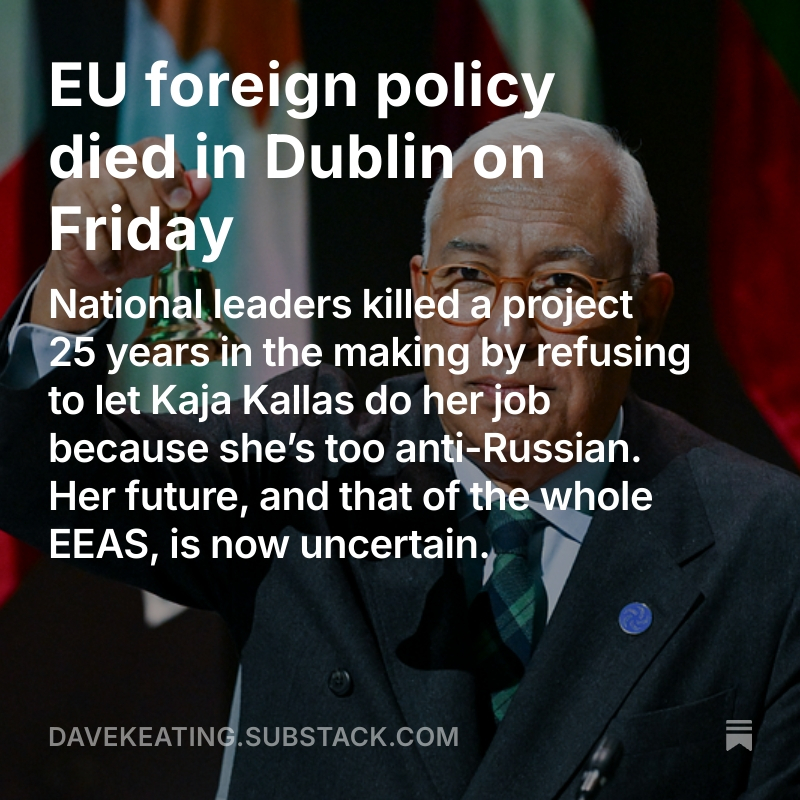
If🇪🇺leaders don't have confidence in their foreign affairs chief, shouldn't she resign?
But who would want to replace her in this poisoned chalice role?
The truth is: national leaders aren't against Kallas, they're against the EU having a foreign policy. https://t.co/VsVQmdwFfz
EU forces from @EUNAVFOR_MED IRINI boarded a suspected Russian shadow fleet tanker in the Mediterranean on 13 November.
The boarding, conducted under Article 110 of the UN Convention on the Law of the Sea, confirmed the MV MIDAG was sailing under a false flag.
The EU will keep disrupting Russia’s shadow fleet at sea and through diplomatic means.
On Monday, EU Foreign Ministers are set to approve new Russia sanctions listings, including on banks, buyers and companies supporting the shadow fleet.
Canadian Prime Minister Mark Carney says Canada will never abandon another NATO member. He emphasized that the security architecture of a free Europe must be decided by Europe and NATO themselves, not by Russia. #Ukraine
In January 2003 Putin signed a treaty in Kyiv that defined the state border between Ukraine and Russia.
This treaty recognized the existing border between the two countries, with both Crimea and the Donbas included as part of Ukraine🇺🇦
It entered into force in April 2004.
Nevertheless, in 2014, Russia annexed Crimea and launched a war against Ukraine. Then, in 2022, it initiated a full-scale invasion.
Russia signed an agreement in which it recognized Ukraine’s borders...only to subsequently violate them.
That is precisely why Ukraine has every right to demand more than just another piece of paper: specifically, strong security guarantees and, naturally, the withdrawal of Russians from the parts of Ukraine they are illegally occupying.
What more is there to say?..🤷♀️
Kaja Kallas:
If we start to talk about what Russia is asking regarding the security architecture, we actually walk into the traps that Russia is setting us, which is that we divert the attention away from that there is no ceasefire and actually start to listen to their claims.
“Europe has to grow some bigger balls” when it comes to Russia, Latvian PM Andris Kulbergs said walking into the EU leaders summit.
It’s not up to “the aggressor which is losing on the front line” to decide Europe’s security architecture, he said.
Live👉 https://t.co/gLsm6KLdRg
Focussing on Russia's demands on Europe’s security architecture risks shifting attention away from a ceasefire and walking into Moscow’s trap.
While Russia keeps to its maximum demands, we should stick to our own. We have prepared these with EU Foreign Ministers.
Europeans have to be present at talks, not just to attend, but to influence the outcome.
My remarks at the informal European Council in Dublin ↓
When the Americans and Russians talk about security, it’s not just about security guarantees for Ukraine. In fact, it’s more about some kind of new security framework between Europe and Russia.
We find this approach a bit strange. Because for 30 years after the Soviet Union collapsed, Europe treated Russia well. And Europe tried to have as much trade as possible, as much cooperation as possible, and as good relations as possible with Russia.
Putin’s wars are really about only his attitude toward others – not some kind of permanent confrontation with Europe that was impossible to avoid. But still, we hear what we hear today.
From an address at the 9th European Political Community Summit. (1/3)
When you stand next to the swine who, just a few hours ago, wanted to sell you and your country to the Russian mass murderer for the highest possible price.