My job market paper is now available as a preprint! 🚨
Using survey evidence with a conjoint experiment, I test how state-level immigrant integration policy features affect perceptions of fairness and support.
3 key points, the big takeaway, the link, and a bonus below⬇️🧵
After reviewing ~200 job applications for our search in American Politics, I have some Thoughts about the state of the subfield and Political Science more broadly. A 🧵 👇
1/x
My department is hiring!
The School of Political Science, Public Affairs, Legal & Security Studies has opened a tenure-track search in American Politics.
https://t.co/M7lm6Dntyq
Since 2000, the average college course description has more political content & more liberal slant. Changes are modest relative to persistent cross-field differences; student demand for liberal content rises over the 2010s & peaks in 2020
https://t.co/yuxUnrVfsq
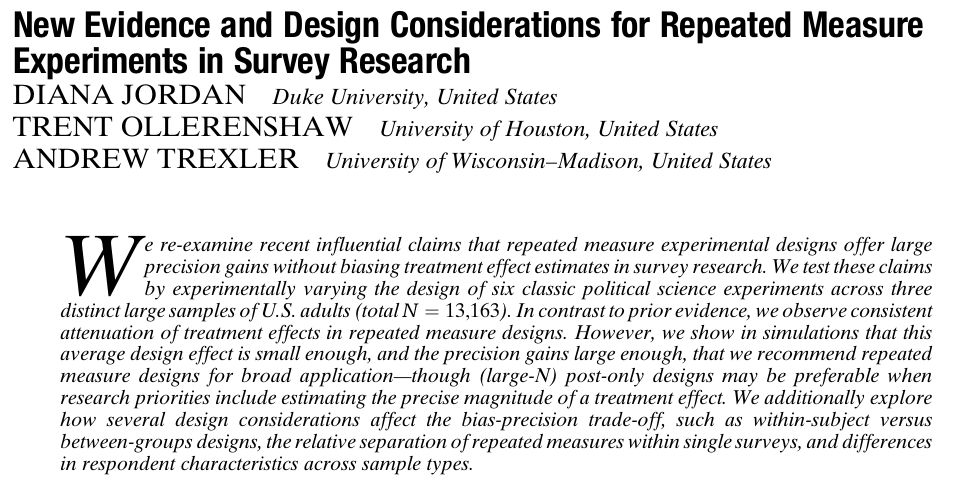
From our FirstView: New Evidence and Design Considerations for Repeated Measure Experiments in Survey Research by @dianamejordan, @Trent_Oll and ANDREW TREXLER. https://t.co/7cvZAVMgNm.
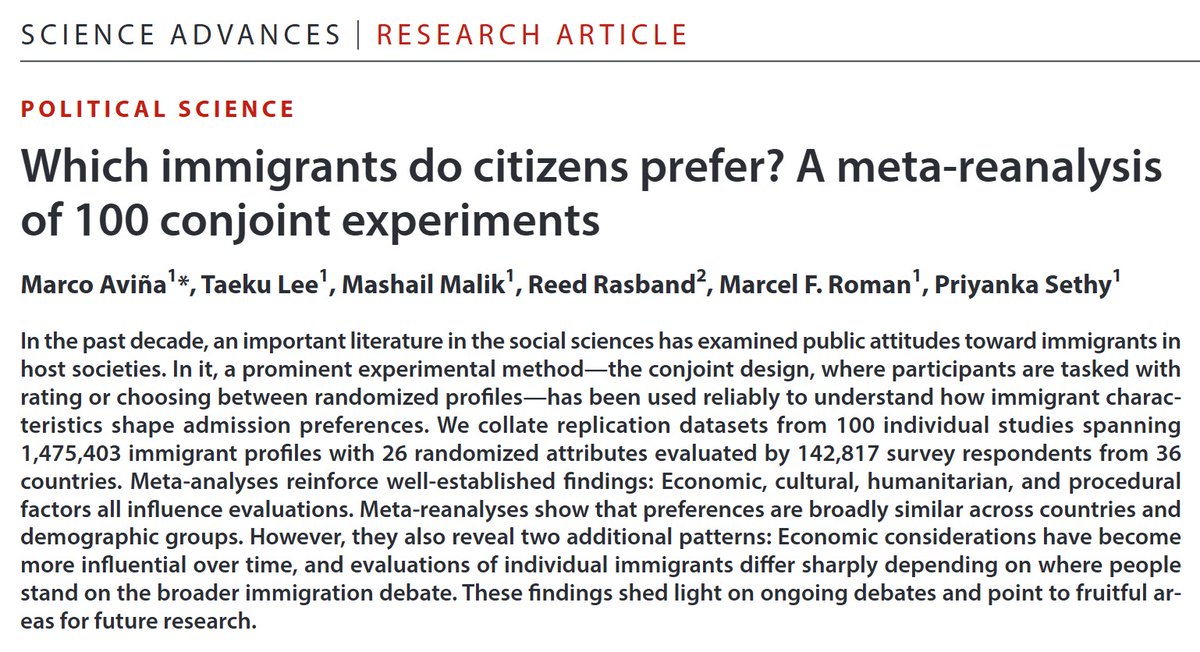
What shapes preferences toward immigrants?
Across 1.5M profiles, people strongly prefer immigrants who:
- are employed
- high-skilled
- speak the language
- have roots in the host country
- fled violence
- followed legal procedures
Surprisingly, nationality matters very little.
NEW in @ScienceAdvances, after 3 years of work with a great team:
We review and meta-analyze 100 immigrant conjoint experiments in 36 countries.
Immigration preferences are surprisingly similar across people and countries, but changing over time and structured by politics.
🧵
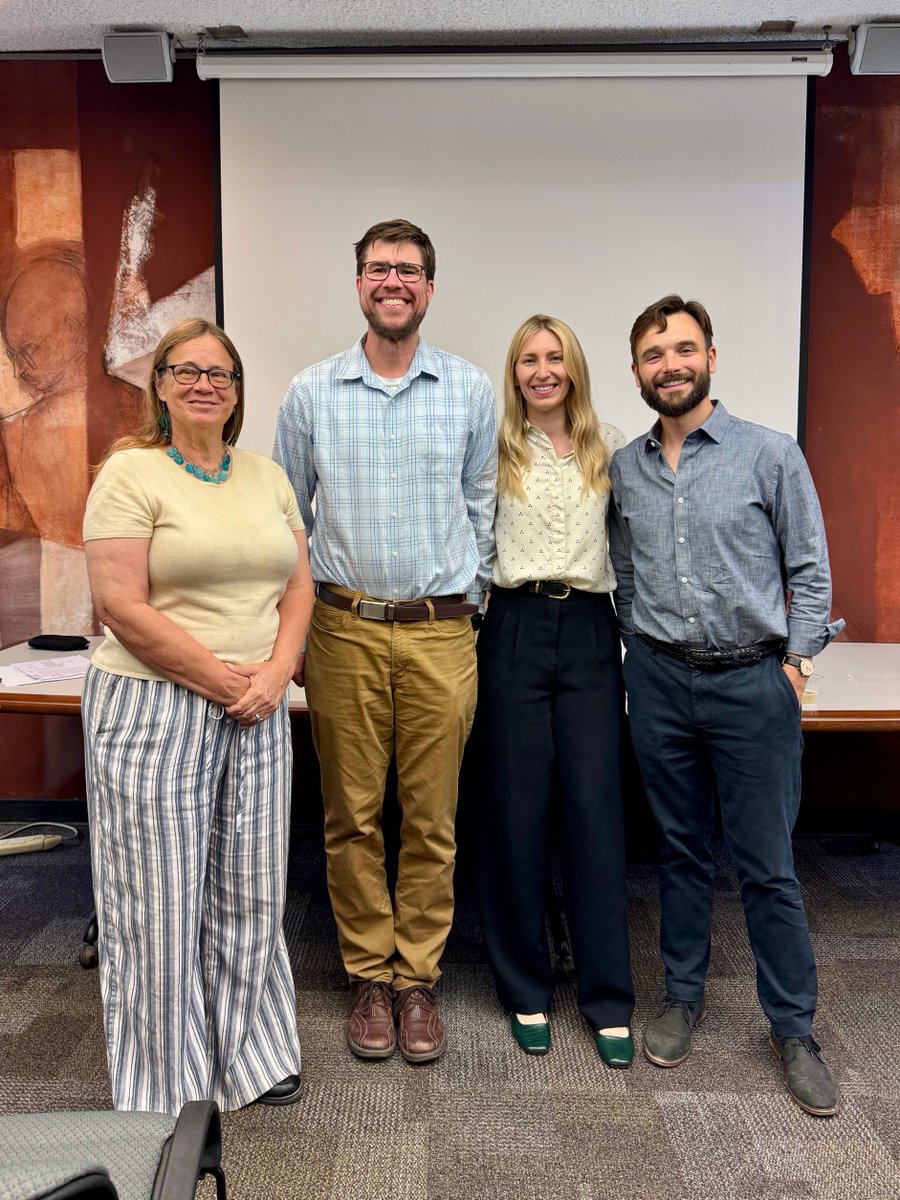
I passed my defense last week! 🎉
My dissertation examines how subnational immigrant integration policy influences perceptions of fairness and identifies policy bundles Americans are more likely to support.
@ClaytonNall I want to recognize them for their thoughtful guidance in developing my research and teaching. They have been exemplary and I've been fortunate to work with them for all these years.
Could US intervention trigger a Cuban refugee wave? Robert Gates says the biggest risk is another Mariel boatlift. In a sharp new guest post, @gildeguerra shows why that's unlikely: most pathways are blocked and the people most likely to flee already left: https://t.co/QP5PIwS8kA
Some good news: In Our Interest has been selected as 2026 Best Book on Migration by @MigCitizenAPSA.
The book's pitch in one line: pro-immigration politics succeeds when policies visibly serve citizens, but (most often) fails when they don't.