The other day, we celebrated a credit rating upgrade by the international credit agency, S&P. The events over the past few days just explains how the government (across all arms and tiers) make one step forward and two steps backwards.
A country does not become a $1 trillion economy simply because oil prices rise or because GDP numbers look bigger on paper.
A trillion-dollar economy is built when millions of people can safely learn, work, move, invest, build companies, transport goods, and plan for the future with confidence.
Industrial economies are built on efficient movement:
of people
of goods
of raw materials
of labour
of capital
Insecurity disrupts all of them.
I'll also say this as someone who grew up on the nice side of the barbed wire fences and high gates in the very nice part of town where the Nigerian 0.1% live - learn to touch grass and worry about yourself because rich people really do not care about you. Like, at all.
The Nigerian rich don't even like each other. They barely tolerate one another and make practical alliances to preserve wealth and influence. And now that the economy is too small to support all the children of the Nigerian 0.1%, nearly everyone I grew up with in the nice, leafy part of town now lives in Toronto or London or wherever. You, Mr N250k/month Union Bank contract staff are not part of rich people's thinking at all.
At. All.
The rich have no plans for you. They have no plans to create opportunities for you. They have no plans to fix the things they broke on their way to building that N1bn townhouse in Parkview Estate. They have no plans to contribute towards making society better. If Satan came from Hell with a tail and horns growing out of his head and he ran for political office, the rich would all go make deals with him - because in the world of the rich, the only thing that matters is their own interests, and making sure that they never, EVER have to live like you or next to you.
So all this simping and vicarious fawning over wealth and fame that you people do everyday is the most redundant thing in the world - the rich have no intention of expanding their circle to let you in, and they have no intention of enabling the conditions for you to create your own independent circle of wealth. The only thing the rich need from you is to be poor and obedient, so that your labour can be cheap, plentiful and replaceable.
Statistically as a Nigerian, you will NEVER be rich or close to it. You will NEVER live in Maitama. 99.99% of Nigerians who have existed since 1960 have prayed and fantasised about becoming rich, and 99.99% of those prayers and fantasies never came true. That's just math. You will never be a rich and famous celebrity. You will never be a successful content creator. You will never make millions shilling crypto, trading Forex, sports betting, or whatever the fuck is the latest quick wealth fantasy in town. It's just not going to happen.
That being the case, a much more constructive use of your time would be to fight for the material elevation of what you actually have, where you actually have it. Instead of daydreaming about the N300m house in Lekki that 3 generations of your family cannot buy, get involved in a local effort to give your own immediate neighbourhood a facelift, or a political campaign to pressure the state to build high quality social housing.
If you hate being harassed without consequence online, instead of vicariously enjoying how a celebrity has used their wealth and influence to jail someone for making a horrid tweet, fight for a judiciary and legal system that is transparent and accessible to all, so that a singer living in the UK on a global talent visa doesn't get to have more access to your Nigerian justice system than you who lives in Nigeria 24/7.
Instead of building your mental architecture around the false idea of being a "temporarily embarrassed millionaire" who will someday take your rightful place on Banana Island, touch grass tonight and accept that it will never happen, and what you need to do instead is fight for where you are to become a better, more liveable place that you no longer wish to escape from. Stop cosplaying as rich folk. Stop cooing and fawning over rich folk. Stop daydreaming about someday "blowing up" and buying a house next to Burna Boy. Rich people have no intention of sharing their world with you. Free yourself from the tyranny of living vicariously through people who don't care that you exist.
Them no really send any part of your papa at all.
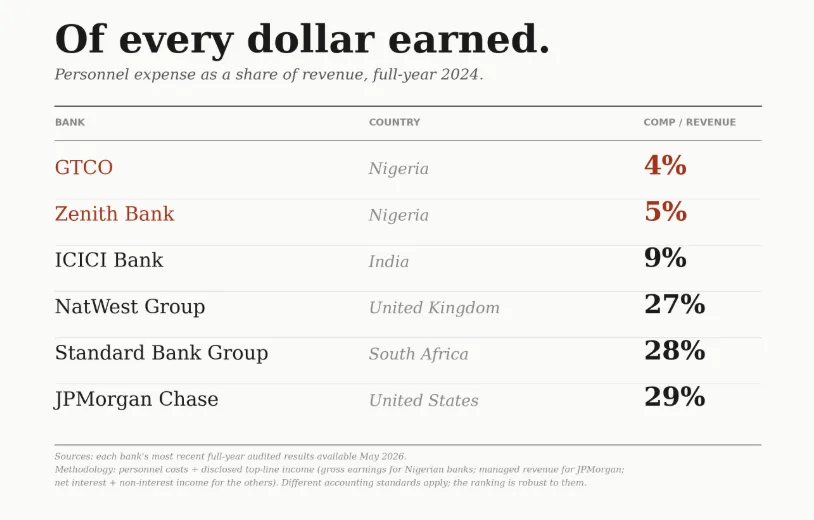
One of the commentaries that came out from the Moniepoint 500 vacancy brouhaha contained this chart that compared personnel expense as a share of revenue for Nigerian banks. The inference was that Nigerian companies severely underpay their people. At 12% we do better than GTB.
Let me share what I have done in the past as a PmP mapped into the 5 steps from @DrOlaBrown's article.
Quick background so you understand where I'm coming from. During my YCT days, I used to work in some plastic factory hence the reason for my hard palm 😀😅. I also had to borrowed money to pay my first UNILAG school fees. I was visibly pako😀
disclaimer: Me, I’m not trying to be as rich as Dangote or Otedola 😅. far from it.
In fact, I’ve said before that once I hit my personal target of about $2m liquid assets, I’ll probably disappear to Igbotako for community development work and a quieter life.
Also, I am not rich yet. but we thank God
Now, lets see how the steps in the article fit into what I have done ... of course there are other things and steps that help
Step 1: Get into a good university.
I didn't stop at polytechnic. Even at YCT during my ND, I pushed for UNILAG. Finished with First Class in Accounting. BGS in both the department and faculty for both institutions. Over 20 academic awards.
I knew early that my CV has to scream for me given that no one could make the calls for me.
At my Sahara 2016 GMT programme final interview, they projected my CV to the chairman and other board members present at that interview - ND Distinction, First Class, BGS twice, ICAN, ACCA, 20+ awards.
The Chairman and the entire board couldn't even ask me a question. He just said: "Do you have any life? Did you have fun in school?" I can see how impressed and couldnt just say know...I knew I already got the job.
Step 2: Work in financial services.
I moved into consulting, focused on financial services and a very niche complex area (actuarial and quant). And I don't just deliver on client engagements. I want them to see the difference.
Two of the biggest insurance companies CEO in Nigeria wrote to Partner about how exceptional I was on a projects..That actually added more case to a back to back double promotion
I have slept in the office because of client deliverables. not once, not twice as a Senior and as a Manager.
There is no substitute for hard work. I keep telling younger ones this. You cannot shortcut excellence when you don't have connections backing you up.
Step 3: Realise it will take longer.
I play the long game. One reason I stayed back in Nigeria is because I can see the massive opportunities ahead in the space I work in.
The difference in my earnings over the last decade vs now is significant and it's still very far from what's possible.
Today I told some LASU students if they could imagine that some folks earn ₦30m+ per month in this Lagos?
The good thing about the path I chose is that seeing those numbers ahead is always comforting. The ceiling is high. You just have to be patient enough to climb.
Step 4: Grow your network.
Naturally, I am a very shy person. Extremely introverted. But in the last 5 years, I've pushed myself to connect with clients, colleagues, and people outside my comfort zone.
We've won engagements just because of a presentation I did for some years ago.
I make myself available for some pro bono work. My last IFRS 9 video took over 12 hours to produce, even though you all see 4 hours of content.
Some clients call me outside work hours. I focus on how to make them look good with their boss too. Networking is really just giving.
Step 5: Be aggressive about self development.
This is the biggest one for me.
ACCA. ACA. CFA. FRM. SCR. And now actuarial exams IFOA and SOA. Passed 14 papers across both in 3 years. Also failed 10 papers in that same period.
Failing is part of it lol. I'm quite aggressive.
Last December, I was in the office from Dec 26 to 4AM on January 1st writing a 96hour SOA assessment. I actually spent over 80 hours on it.
That means I literally started the new year in the office.
Extreme? Yes. I don't encourage anyone to do that. But that's what it took.
Working your way out of poverty comes with massive tradeoffs. And it's perfectly rational to decide not to do it that way. But if you choose this path, know that momentum compounds.
The early years are the hardest. The loneliest. But every exam, every late night, every relationship you build, it stacks up.
May be when I buy my AMG G 63😎, I will come back and confirm that yes it's possible. for now lets keep trusting the process.
I'm not even rich yet. But I'm always thankful for how far I've come. Grateful for everyone that has been part of my joinery...friends, family, colleagues , scholarships companies, bosses etc
TBT to my 2020 birthday...one clown had to remind me how I be pako for undergrate
And this is exactly my problem with the principles guiding the decision-making of many Nigerians.
------------------------
Nigerians (as investors): don't build house for rent because the rental yields are low (even though that is the standard).
Same Nigerians (as customers): arh! Rental prices are too ridiculous jare. What do you mean ₦1mm for self-con.
------------------------
Nigerians (as investors): what do you mean I am going to earn 20% per annum on my investment? That's too low jeez! Me I can not wait for one year to earn 20% o.
Same Nigerians (as borrowers): 35% interest rate on loans??? How??? Do you want businesses to die??? How can businesses generate that kind of profit in our inflationary environment??
------------------------
Nigerians (as employees): there is no reason why graduates should earn below ₦300k salary.
Nigerians (as entrepreneurs): nah, there is no reason why we should pay more than ₦200k for an entry-level job. What value are they adding yet? Anyone who wants more than that has to demonstrate capacity and potential.
*******************
This is not even about selfish interest. It is normal for that to happen, but you have to know that the principles have to be consistent.
Maybe the way we think about things could change if we understood that most of these variables don't move in isolation. They are connected.
To whom it may concern as copied from Tomiloba Babarinde on LinkedIn.
When an employee's contract is terminated mid-month, your instinct may be to pay only for the days worked (pro rata basis). However, the National Industrial Court has taken a different position.
In Mr. Abe Adewunmi Babalola v. Equinox International Resources Ltd (Unreported Suit No. NICN/LA/166/2015), the Claimant, had his appointment terminated on 7th September 2012. He had worked only 7 days into that month. When he filed his claim, he asked for a pro-rated fraction of his September salary — essentially, payment for those 7 days only.
In its decision, the Court answered this very question, i.e- Was the claimant entitled to a fraction of September salary or the full month?
Relying on its earlier reasoning in Grant Mpanugo v. CAT Construction Nig Ltd & Anor (Unreported Suit No. NICN/LA/660/2015), the Court reaffirmed an important principle:
Pro rata or fractional salary is not applicable to employees in periodic employment who are paid monthly. It applies only to daily paid workers.
The reasoning is practical. A monthly salary is not a daily rate multiplied by the number of days in a particular month. If it were, employees would earn different amounts across the year because the months are uneven. February has 28 or 29 days. March has 31.
If salary were to be calculated strictly by days, monthly pay would fluctuate across the year, which defeats the structure of periodic employment.
The Court therefore held that where an employer terminates employment within a new month, the employer is liable to pay the full salary for that month, not a fraction based on days worked.
Therefore, the claimant was entitled to his full September salary.
In conclusion, the next time you terminate an employee’s employment mid month, resist the instinct to divide the monthly salary by 30 or 31.
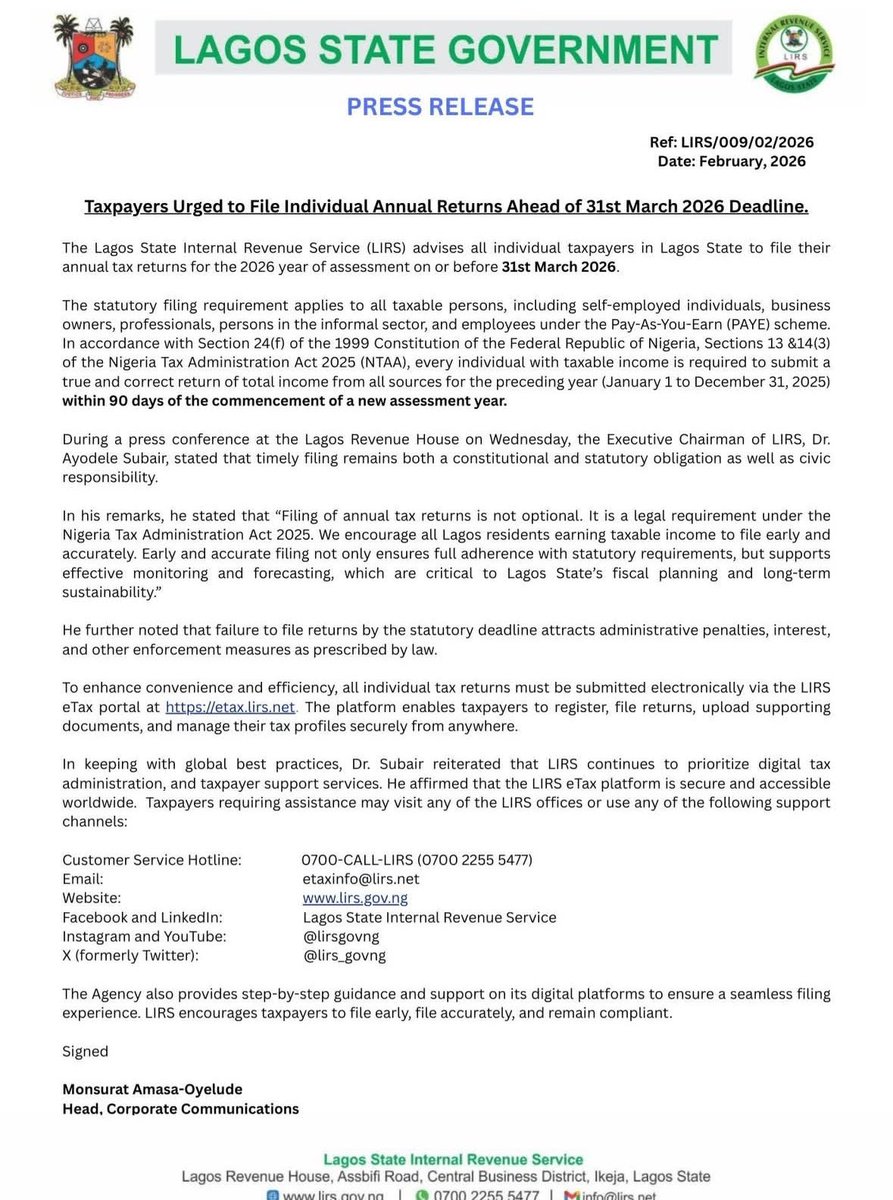
Again, have you filed your PAYE for 2025? This is not only required from Lagos residents, it’s applicable to everyone who earns income and resides in a state in Nigeria.
Both 9-5 (tho your employer filed in Jan) and self employed people are require to file their returns.
Hate to break it to you guys but sometimes you have to do things you don’t like for the sake of having a community. Avoiding consistency with the people in your life is working against us and the data already shows it. If you think connections can be sustained on absence carry on
I worked 20 years for a child sex trafficking rescue group. I want you to know this:
90% of Lost Children Are Found Within 30 Minutes.
That statistic should both comfort you and wake you up.
Most lost children are found quickly. But the ones who aren’t? They usually made one mistake.
And here’s the uncomfortable truth:
It’s often the exact thing most parents teach them.
We tell our kids:
“If you get lost, come find me.”
It sounds logical. It sounds empowering.
It’s WRONG!
The Mistake Most Lost Children Make:
When children realize they’re separated, they do three things almost automatically:
They panic.
They wander.
They try to find you.
Every step makes them harder to locate.
From a search standpoint, movement creates chaos.
Parents retrace their steps.
Security scans zones.
Staff lock down areas.
Search works best when movement stops.
When a child keeps walking, they move outside the original search radius. Helpers are looking where they were last seen — not where they’ve wandered.
Stillness increases probability.
Movement expands the problem.
The first lesson is not “go find me.”
It’s this:
Stop. Stay. Yell.
Why Stillness Wins:
Think like a search team.
If a child stays put:
Parents can retrace steps.
Security can scan systematically.
Helpers converge to one fixed location.
The search radius remains small.
If a child keeps moving:
The search area expands.
Adults pass each other.
Missed connections multiply.
Minutes stretch into hours.
Stillness keeps the math on your side.
Teach Them Who to Approach:
The second mistake we make as parents?
We say, “Find an adult.”
Not any adult. Not the nearest stranger. Children need a filter.
Teach them to look for, if at all possible:
A mother with children.
Caregivers who already have kids with them are statistically among the safest people to approach in public settings. They are visible, stationary, and more likely to engage quickly.
It’s a clear, concrete instruction.
Children don’t process vague categories like “safe adult.”
They process visuals.
“Find a mom with kids” is visual.
A Phone Only Helps If the Number Is Known:
We often assume phones solve everything.
They don’t — unless your child can use one. Even young children can memorize a 10-digit phone number with repetition.
But you must train it.
Practice it like a song.
Sing it in the car.
Chant it at bedtime.
Turn it into rhythm.
Repetition becomes recall.
In an emergency, recall matters more than theory.
The Code Word Rule:
One more layer of protection.
Choose a private family code word.
Something only your household knows.
If someone approaches and says:
“Your mom sent me.”
Your child asks:
“What’s the code word?”
No word.
No go.
This simple rule eliminates manipulation attempts instantly.
It gives your child agency without requiring them to evaluate character.
Real Safety Is Training — Not Luck!
We don’t get safer by hoping.
We get safer by practicing.
Teach:
• Phone number
• Code word
• Stop, stay, yell
• Find a mom with kids
Multiple skills.
Simple instructions.
Clear visuals.
Five minutes of training can replace hours of panic. This isn’t about fear. It’s about preparation.
Because when a child gets separated, the clock starts.
And what they do in the first minute determines what the next thirty look like.
That’s real protection.