Play our CoD + Fortnite + Minecraft inspired deathmatch game on mobile and desktop web browser!
No sign up, just hop in and play!
This is for our @levelsio#vibejam submission! We built it with the @hytopia game engine, using Claude 3.5 / 3.7
Link to play in thread 👇👇🧵
TARIFFS > TAXES?
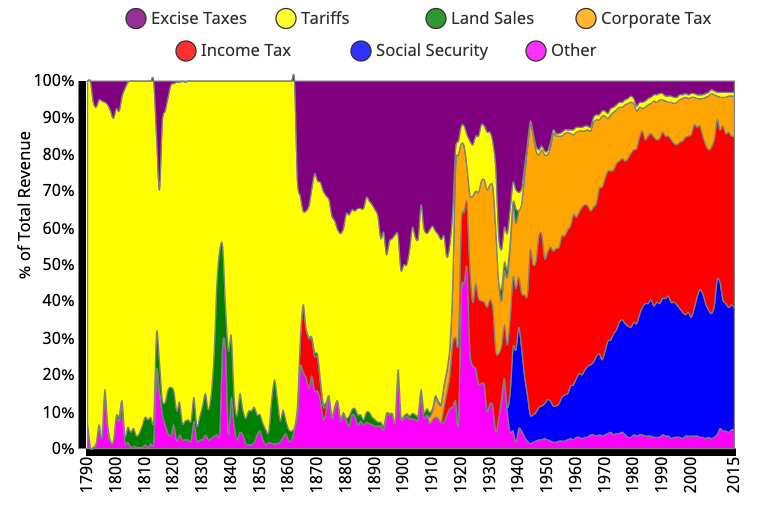
For most of American history, tariffs dominated taxes as a source of federal government revenue:
This was also the time when the US rose to become a manufacturing powerhouse. And as you can see from the graph, the income tax (and the Federal Reserve and much of the federal government as we know it) really only dates back to the 1910-1930s period. For most of US history the economy was set up in a completely different way.
MERCANTILISM VS FREE TRADE
The term for what the US used to be is "mercantilist". The founders thought of the US as like a giant merchant that needed to make more money than it spent.
As such, their rationale for tariffs was simple. A tariff is an incentive to build rather than buy. In theory, it encourages domestic manufacturing and is a tax on foreigners rather than citizens. We don't need to buy foreign goods; we have goods at home!
This is distinct from the last few decades of free trade. The idea was: you're good at making apples and I'm good at making oranges, so why not just specialize and trade? Comparative advantage proves it's a win/win!
This is a good argument until you make military robots and I make pieces of paper, which is the relationship between China and the US now. At that point it's no longer a win/win. With your military robots you can perhaps take my paper — and my oranges. And there is no need to trade.
That manufacturing (and hence military) asymmetry is one major reason why people now call for replacing taxes with tariffs to encourage making things in America again. And there is a good spirit to this! However, just instituting tariffs on their own is not a panacea. There are several problems you'd want to address at the same time.
THE PROBLEMS
1) The Fed. The first is that the most profitable export for the US is printed dollars, so there is no incentive to build physical things. Why export screws with a margin of 0.1% when you can print a dollar with a margin of 99.99%+? So the Fed is an obstacle.
2) The printing addiction. But to be honest, it's more than just the Fed. Everyone in the West is addicted to printed money and withdrawal would be like getting off heroin. Why would you voluntarily decide to work for a living after getting free printed money for decades?
The US would in a sense have to fire itself as CEO of the world and return to being an assembly line worker. I mean, founders actually do this all the time, they quit and start a new company where they code v1 from scratch...but it's quite hard to do that at country scale.
3) The regulators. The next issue is that building physical things is currently punishable by law in much of the US. The EPA, the Bureau of Land Management, the zoning codes, and countless agencies combine to present a thicket of laws in your way. So the regulators are an obstacle.
4) The physical risk. The fourth issue is that the US has become habituated to white collar and retail jobs that have minimal air pollution, noise pollution, chemical pollution, and physical risk. Yeah, EPA and OSHA might be overdoing it today, but plants really produce pollution and workers really do fall off buildings at times. So pain tolerance is an obstacle.
5) The vocational skills. The fifth issue is that 50+ years of outsourcing manufacturing, privileging college, and discouraging vocational training has meant the talent pool for US advanced manufacturing has to be rebuilt from scratch. All the plumbers, mechanics, electricians, carpenters, machinists, and assembly line workers are aging out. You'll need either new people who can do these jobs or robots. So lack of skill is an issue.
6) The domestic opposition. The sixth and perhaps obvious issue is that there will be howling resistance to any attempt to end taxes in lieu of tariffs. Huge agencies and powerful special interests benefit from the current system, and will fight hard to keep it that way — even if the population as a whole would prefer tariffs to taxes.
7) The external competition. The last issue is that there is now extremely challenging competition in the form of China. They are the world champ in low-tech and medium-tech. And they are now very competitive in high-tech too, with DJI drones, BYD cars, and Unitree robots.
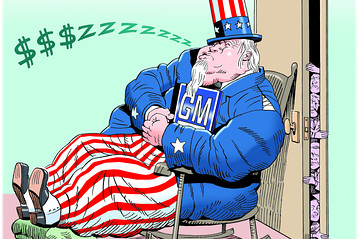
Think of Uncle Sam as a guy who was once in great shape, but got fat over the last 50 years. He still thinks he can walk over to the bench press and knock out 225 for reps — that he can just reindustrialize in a jiffy like he did in World War 2 — but neither the body nor the economy works like that. You have to build up physical capacity gradually over many years. And companies like GM and Boeing have been doing the opposite.
Meanwhile, building up physical capacity gradually is exactly what China's been doing. They've been paying their dues, grinding in sweatshops for decades while the US was watching Friends and cashing checks. To extend the analogy, they're in top physical condition while the US hasn't worked out in forever.
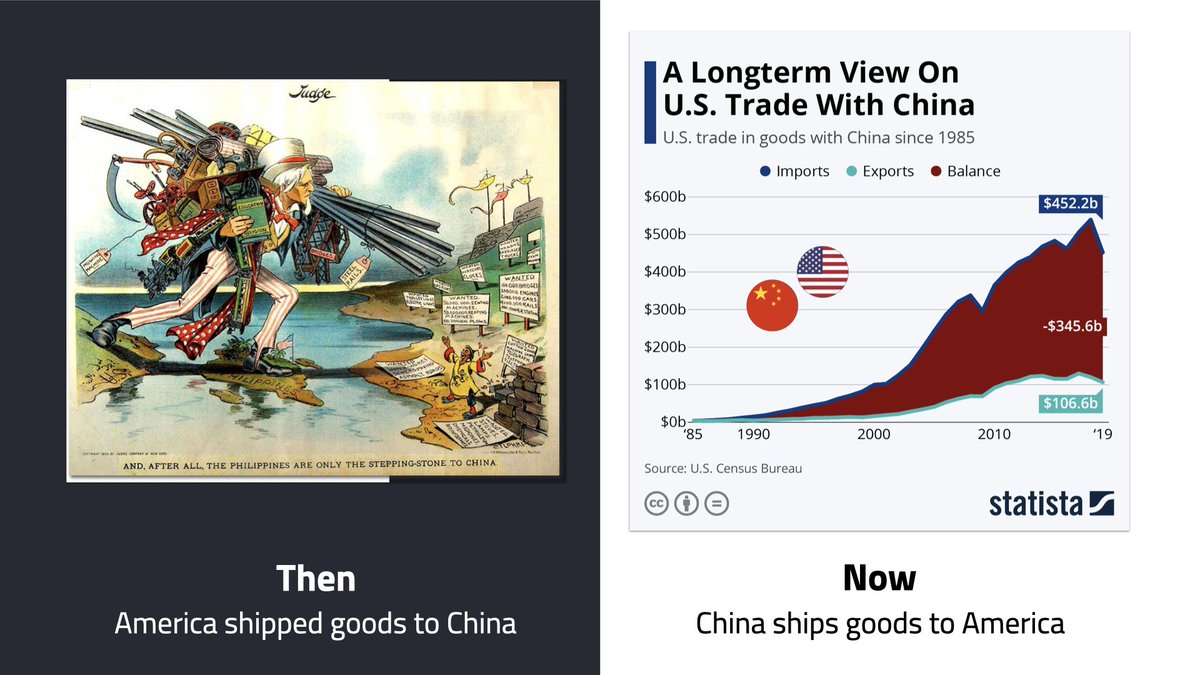
As a consequence, history has run in reverse. Back then, people made cartoons about how America was shipping goods to China. Now it's completely the opposite, where America is the market and China is the manufacturing powerhouse:
SUMMARY
So, what is to be done?
I just wanted to point out that the idea of substituting tariffs for taxes does have much historical support. The US became a manufacturing powerhouse in the 1800s with a mercantilist policy just like this, which incentivized the country to build rather than buy.
However, it's not trivial to just flip a switch and go back to the future. The state of the world is completely different from 100+ years ago. The printing addiction, the regulation, the lack of vocational skills, and the external competition...this is a multifaceted thing that requires flipping many policy levers at the same time in the face of enormous domestic opposition.
Imposing tariffs and rebuilding manufacturing means the US would also have to accept an enormous drop in its standard of living, perhaps lasting for decades, due to (a) giving up the money printer and (b) walling itself off from the number one provider of inexpensive goods while (c) working harder than it has in generations and (d) losing talented people who wouldn't want to spend decades paying dues.
The closest analogy would be Russia's rebuild into a natural resources economy after the Soviet collapse.
But you know what? It might still be worth doing. The US would be a poorer country for many years...but it could eventually be free of taxes and free of communists.
And freedom isn't free.
We are only 5 months into having written the first line of code for the @hytopia game engine, and builders like "Bloodvortex" from our Discord are building things like this!
Imagine a year from now what will be possible!
They're not the only ones either!
Dear People in Pain,
Thanks for the overwhelming support! We are painfully happy to share that we have raised 185,976 $SOL in 48 hours—more than any other memecoin presales in USD value.
But there is no way that we need so much to launch $PAIN.
$PAIN is the official memecoin of the OG meme legend "Hide the Pain Harold" and is intended to function as an expression of pain on the blockchain, not to add more pain to your already bleeding portfolio.
So we will do another first—refund the largest amount of $SOL in any presale history.
At launch, we will return 80% of the funds we received. We will use the remaining 20% to support the launch, provide liquidity, pay listing fees (if any), and help everyone feel less pain from recent liquidations.
Your $PAIN allocations will be proportional to the amount you sent, except for the 0.9 $SOL from bots and 212.3 $SOL from various CEX. Funds that are sent after block 318346069 will also be returned.
Get ready for the $PAIN.
Yours Painfully,
Harold
I think these points are fair. My response here won’t be to argue or push back. Grail's not wrong.
Instead, I want to add more internal context and transparency, show where we stand now, and let everyone, including Grail, make their own decisions on how they engage with HYTOPIA (formerly NFT Worlds) going forward.
Addressing Grail’s Points:
- Game dev is tough: No question. Building something at this scale is never straightforward.
- Hindsight is 20/20: We were initially overly optimistic after the Minecraft ban with our Minecraft client. Milestones slipped, and until recently, it often felt like we were navigating blindfolded, making multiple pivots trying to find solid ground.
- “Number no go up, scam!”: I respect Grail not having the typical perspective of if the numbers don’t go up, then a project is a rug or a scam.
- Gray Boys and Other Assets: Gray Boys didn’t pan out as originally hoped. We still care for that community and folded them into HYTOPIA instead of just dropping them. We do still want them to have a meaningful place in the ecosystem. We know holders were frustrated by the lack of clarity or progress after shipping proxy ownership and other roadmap pieces.
- Multiple Changes, Limited Communication: We tried pleasing everyone at once, made big changes on utility and plans, and didn’t maintain consistent communication. Updates sometimes slowed and picked back up without enough external explanation.
I don’t disagree with the core of what Grail is saying here. The frustration is understandable.
I think what's going to be most eye opening here, I want to respond with my perspective on the last 2 years and just full transparency into what’s gone on, and why I finally feel like we’ve rounded the corner and are coming back to our original form that everyone loved in the pre-Minecraft ban days.
Pre-Minecraft Ban (as NFT Worlds) October 2021 - July 2022:
We were moving fast. Shipping fast. Progress updates almost daily. There were over 20 partner integrated Minecraft servers live and 100,000+ Minecraft players signing up for NFT Worlds accounts within the first months.
Everything at this point was built and shipped internally. This is important.
We coded, tested, deployed—if something broke, we fixed it quickly. We delivered at a rapid pace, and that momentum felt great - there was no dependency on external actors or misaligned incentives.
Post-Minecraft Ban:
On July 20, 2022, everything changed. Our idea of building on top of Minecraft directly.
We had to pivot fast.
The new vision: build our own voxel-based UGC platform to rival Minecraft.
But everyone we spoke to—experienced game devs and engine builders—told us it would take years.
This was a tough pill to swallow: we wanted to ship fast so we thought we had what would be come a quick interim solution in the meantime.
The Minecraft-Compatible Client Attempt:
We tried building our own Minecraft-compatible client from scratch as that interim solution. Something that wasn't dependent on the Minecraft codebase but could interface with the protocol to bypass the EULA.
The idea: recapture some momentum by letting creators monetize and improve on the vanilla Minecraft experience.
We knew it was complex but hoped outside Minecraft experts could guide us through the protocol and various anti-cheat’s quirks to build this client. We also assumed unlike what experts told us about the game engine, that a Minecraft compatible client would not take years and would be faster to ship.
The one caveat is we had to fully own the software to bypass the Minecraft EULA and allow creator content sales in the client - we couldn’t just create another mod-loader client like Lunar Client and others are.
We hired team #1 (external experts from the community) who understood the Minecraft protocol.
Initial progress was encouraging. But as we approached a working product, small protocol edge cases piled up, blocking progress and dragging out timelines. It felt like we were always “almost there” without actually arriving. This limbo lasted from late 2022 into early 2024.
Communication to the community suffered because we didn’t always have good news—just ongoing, grinding attempts to fix obscure issues. Moments of thinking we’d rounded a corner, followed by more frustration and that resulted in up and down community progress updates.
Switching Contractors (Team #2):
In early 2024, we tried again with another external team.
They suggested rewriting everything with a new strategy. We were skeptical but yhey promised quicker progress and had a strategy that on paper made sense.
Initially, they delivered. We got very hopeful again with immediate progress.
What took team 1 months to build initially, team 2 built in weeks.
We were so confident we even timed some announcements (like HYCHAIN and HYPLAY) to align with what we thought would be client milestones.
But after a while, the same pattern emerged. We hit those tricky protocol barriers again we thought this team would push through quicker. And while they did make better headway, eventually the product development slowed, cost escalated, and we still had no finished client to show.
It's important to note that the third party contractors did not want us directly contributing to the client codebase which I think also heavily hampered results as they had their own opinionated way of doing it, we also didn't have the expertise to handle the Minecraft complexities ourselves so we leaned on trusting them to get it done.
The Breaking Point & Building Our Own Engine:
By August 2024, I’d had enough. I stepped away from HYPLAY/HYCHAIN day-to-day to focus purely on building our own engine.
With our own engine, we control all the variables—no reverse-engineering Minecraft’s protocol or relying on outside developers.
I wanted to fold everything back into our team being the ones internally building again and shipping rapidly like the good-days pre-Minecraft ban. No third parties, no protocol baggage, our expertise, our control.
I started coding this with a little bit of Rust and mostly TypeScript. Our internal team was even initially skeptical, some of them talking with those prior game dev “experts” and engine “experts” who continually said I was crazy and my approach wouldn’t work.
These "experts" takeaway was building a performant voxel engine the way I approached it would be non-performant, non-traditional, or just plain impossible. Most laughed when I outlined the architecture.
But two months later, late October 2024, performance and capabilities exceeded what the “experts” said was possible or would work. The benchmarks were enough to show the traditional, drawn-out approach wasn’t the only way.
My personal tldr; Respectfully, Fuck “experts” at this point who through their lens of expertise believe there are only a handful of ways to make something work. Progress and evolution comes from distilling down to fundamentals and factoring up, even if that yields what others think are unconventional and non-traditional approaches.
Why This Matters Now:
Yes, it looks like another pivot. But it’s actually a return to form in my eyes.
Before the ban, when we controlled the full stack, we moved fast and delivered.
After the ban, we tried to solve problems through intermediaries we managed because they wanted to work as independent teams, and dealing with complicated protocols we didn’t build ourselves. That cost us time, resources, and community goodwill.
Now, it’s all internal again. We control the stack, the engine, the roadmap, and how we integrate NFTs and tokens. No more external team dependencies or hitting Minecraft protocol brick walls.
NFTs, $TOPIA, and Community Considerations:
Another point to respond to, the NFTs and token, and how we’re thinking.
I think it’s important to preface that we don't care to be a big crypto game in the small pond of crypto games.
We want to build a true Roblox competitor, and there are genuinely meaningful non-hype, non-gimmick aspects of crypto and NFTs we do want to take and see a technological advantage in using.
We want to do this without pushing out the majority of players and creators, all of this majority in user interviews having the same default opinion of crypto is bad or a scam and are highly skeptical - we cannot force it down their throats and we don’t want to.
We want the good with little-to-none of the bad. The legitimate pieces of the technology.
- NFT Integration: We want NFTs and token utility that don’t scare off mainstream users. That means making sure a player can jump in without crypto friction. We’re using language like “digital items” so it’s not a confusing or off-putting experience.
- $TOPIA’s Role: $TOPIA remains relevant, but we also know that relying solely on a volatile token for marketplace purchases is a tough onboarding process for a non-crypto player base. That’s why we’re making a hybrid approach—USD-based credits by default, with $TOPIA as an incentivized option for those who want it. Over time, as the ecosystem matures, we’ll see where we can add more direct value streams back to NFT holders.
- Worlds & Avatars: We can’t gate developers by making them buy expensive NFTs upfront. That would kill growth. Instead, worlds and avatars need to have roles that enhance value rather than block entry. If regulations ease, we’ll consider revenue or token-sharing models. But right now, we must tread carefully to avoid regulatory pitfalls.
- Gray Boys: They remain part of the vision, particularly around the cosmetics and marketplace. They haven’t been forgotten.
TLDR;
These last two years were rough. We tried to salvage traction by relying on external solutions and that hit us in the face and impacted the relationship with the community. That approach didn’t pan out any way we had hoped.
Now, we’re back in control, building fast, and operating without the protocol shackles. The team’s morale is higher than ever.
We’re done being stuck.
I mean look at the @hytopia Twitter and dev discord in just the last week.
There's engine features and updates being polished and shipped almost every day again.
Now we’re back to iterating, and pushing to deliver a thriving UGC platform on our own terms, in line with the vision we've always had without any roadblock interim solutions in the way like the Minecraft client.
From here, it’s up to the community to decide how they want to engage.
We’re going to continue building, updates and progress are happening fast like the good days of old, pre-Minecraft ban, and we’re working to make good on the core vision that started this all.
It’s been a rocky last few years. But I genuinely see this as us turning again and coming out on the other side of the frustrating last two years.
As the leading Gaming & IP Publisher in Web3, @monprotocol has announced over 60 partners, with 50 more in the pipeline.
$MON Staking Platform will GO LIVE IMMEDIATELY at TGE on 27 May. $MON Stakers will be receiving $MEME and other partner tokens.
Gotta Stake 'Em All! 💯🎉
Launching in less than 24 hours, @monprotocol is building the "Nintendo of Web3."
Powered by $MON, the platform offers a thrilling line-up of in-house and partner titles, starting with @Pixelmon.
"Our mission is to deliver smiles through games and IPs." - @GiulioXdotEth, CEO
Today is the $MONday!
$MON is going LIVE at 10AM UTC today!
Top-tier exchanges like ByBit, KuCoin, HTX, Gate, etc, are all listing $MON at TGE! For more details, see the official announcement on @monprotocol.
This is day 1 for $MON.
But it's always Day 1 at MON Protocol. 🐉
Many GameFi projects don't even have a game, but not @monprotocol—they have already launched @PixelPalsAI!
Some stats:
• 500,000+ active players!
• 100,000+ daily active players!!
• 6,000,000+ hours played!!!
And they are launching more games this year! Bullish on $MON! 🐉
🟧 Things I’m looking at today 🟧
1. Bitcoin's 4th Halving happened at block 840,000
2. Runes Protocol is live
3. @Rune_coin secured the luckiest number 🎱
4. Two days until the @Stakeland quests end
5. some guy ranting about everything