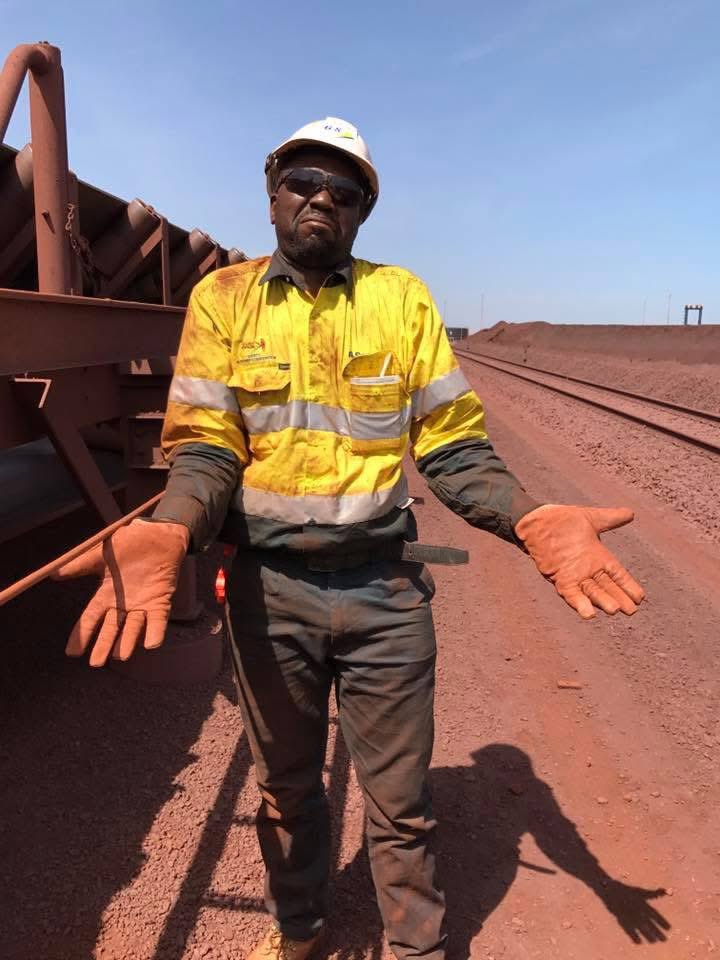
@daddyhope With due respect @daddyhope , l don't think this is the right time for you to be talking about this. Given the current situation here in SA, muchenjere kuti kuvadzisa nenataurire enyu aya. It's totally uncalled for.
I have stopped going to South Africa for any international conferences for mainly 3 things.
1. Border police rudeness: Some years ago I was invited for a conference on conflicts in the Horn in South Africa. I showed email invite to the border policeman at the desk. He rudely asked: "but why can't you people hold your peace conferences in your homes. Why always come to South Africa?" - I think he had a point. Why must we?
Second time it was worse - "But why are you Zomallis and Ethiopians always here."
I reminded him I was actually Kenyan, and I was only in the country for 2 days for an international conference
Reply: "Sheh, um, eh. But what is the difference"
2. As soon as locals figure out you are a black person, possibly African from another country, the automatic assumption is that you are an illegal migrant. You see immediate hostile reaction. Honestly, I found SA one of the most miserable places on earth in terms of peoples' attitude to foreigners. The visceral hatred towards fellow Africans is unnerving. Still one of the most beautiful geographies in Africa.
3. The state bureaucracy and departments filled with people who actually know very little about the outside world. Most of the best people who made South Africa an outward-looking African power are gone. All remaining are small-time apparatchiks stealing from the state and fat toads serving as diplomats. I feel sorry for South Africa.
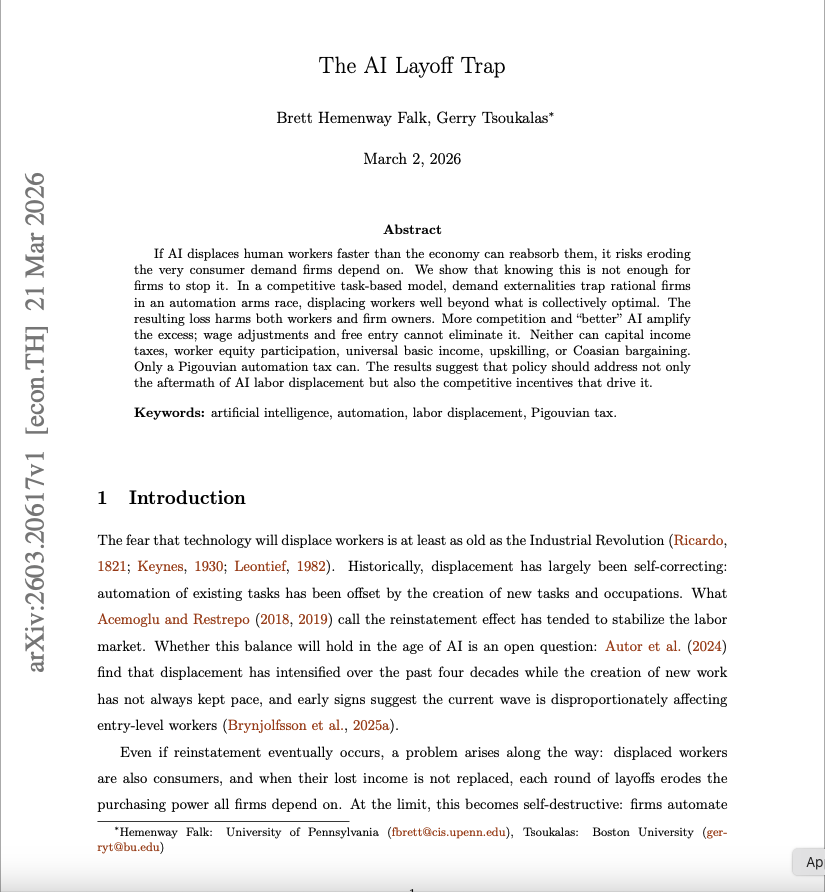
Two economists just published a mathematical proof that AI will destroy the economy.
Not might. Not could. Will — if nothing changes.
The paper is called "The AI Layoff Trap." Published March 2, 2026. Wharton School, University of Pennsylvania. Boston University. Peer reviewed. Mathematically modeled.
The conclusion is one sentence.
"At the limit, firms automate their way to boundless productivity and zero demand."
An economy that produces everything. And sells it to nobody.
Here is how you get there.
A company fires 500 workers and replaces them with AI. A competitor fires 700 to keep up. Another fires 1,000. Every company is behaving rationally. Every company is following the incentives correctly. And every company is building a trap for itself.
Because the workers who were fired were also customers.
When they lose their jobs faster than the economy can absorb them, they stop spending. Consumer demand falls. Companies respond by cutting costs — which means automating more workers — which means less spending — which means more falling demand — which means more automation.
The loop has no natural exit.
The researchers tested every proposed solution. Universal basic income. Capital income taxes. Worker equity participation. Upskilling programs. Corporate coordination agreements.
Every single one failed in the model.
The only intervention that worked: a Pigouvian automation tax — a per-task levy charged every time a company replaces a human with AI, forcing them to price in the demand they are destroying before they pull the trigger.
No government has implemented this. No major economy is seriously discussing it.
Meanwhile the numbers are already tracking the curve. 100,000 tech workers laid off in 2025. 92,000 more in the first months of 2026. Jack Dorsey fired half of Block's workforce and said publicly: "Within the next year, the majority of companies will reach the same conclusion."
Nobody is doing anything wrong. Companies are following their incentives perfectly. That is exactly the problem.
Rational behavior. At scale. Simultaneously. With no mechanism to stop it.
Two economists built the math. The math leads to one place.
Source: Falk & Tsoukalas · Wharton School + Boston University ·
https://t.co/Tir6S9468A
🚨 BREAKING:
England’s team equipment has been stolen including players’ boots/shoes, training gear, coaching staff equipment, balls and uniforms.
The England camp is now working with police to find the stolen items or replace them quickly so the team can train as planned.
[Daily Mail]
#WorldCupwithMicky
#ThreeLions
#FIFAWorldCup
No African is illegal in Africa. If you believe that an African can be illegal in Africa then you are not a revolutionary. We must reject the notion of an illegal foreigner. Africans can be undocumented but they cannot be illegal.
South Africans are deeply frustrated and with good reason about illegal immigration and the pressure it places on already scarce opportunities.
But the real crisis is not the immigrants themselves. The root cause is our failure, over the past fifteen years, to deliver inclusive economic growth that creates enough jobs, dignity and hope for our own people.
This failure has been driven by three systemic issues we can no longer ignore:
• A collapse in the rule of law that has enabled corruption, criminality, land invasions, illegal migration, and the brazen theft of electricity and water.
• Bureaucracy and red tape that continue to strangle enterprise, deter investment and kill job creation.
• Incompetent and, in too many cases, corrupt leadership in key positions across government, state-owned enterprises and parts of the private sector.
As leaders, we must have the courage to look in the mirror and ask a difficult but necessary question: How have we allowed these conditions to take root and persist?
This question is not about blame. It is about responsibility and that is precisely why it is empowering. It places the power to change things back where it belongs: with us. We are not helpless. We are not victims of forces beyond our control. By focusing on what lies within our sphere of influence our decisions, our standards, our willingness to confront uncomfortable truths and act decisively, we can begin to reverse the damage we have helped create.
The time for self-criticism and honest reflection is now. The time for excuses has long passed. South Africa’s future will be determined by leaders who are prepared to own their part in the mess and do the hard, disciplined work required to fix it.
@waltermzembi@houzofdavid I don't understand this. How is Zim voted to join the UNSC such a big deal when it is basically a ceremonial vote. Mind you, Somalia once occupied that position if l am not mistaken.
For the sake of your children, who each morning must wake up and go to school, stop insulting education.
Somehow you have grown accustomed to insulting education as a way to make your arguments. Very tragic culture I must say!
There is no pride in being an ignorant people!
You can perfectly disagree with anyone without insulting education.
Why would you want to breed an education hating nation?
Unless of course, you are working with those who have benefited for centuries out of keeping Africans ignorant!
#MakingEducationFashionable
#PauseForThought
Every year, sometimes twice a year, I look forward to going home to Zimbabwe.
Zimbabwe is home. It is where my umbilical cord was buried. It is where my roots are. It is where, God willing, I hope to spend my twilight years.
In a few years' time, when I finally decide to return for good, I will pack my belongings, my work tools, my Partial Discharge detectors, Hipot testers, Tan Delta test sets, transformer testing equipment and all the other instruments that have been part of my working life, load them into a container and head home to be among my people.
But every time I visit, there is one thought that I can never completely silence.
What would happen if something went terribly wrong? When I'm driving through places like Zai Rimwe, Mutekedza or Mupatsi on my way to rural Njanja, I sometimes catch myself thinking about the unthinkable.
What if there was an accident out here?
Would someone be able to call an ambulance?
Would an ambulance come?
If the situation was serious, would there be access to an air ambulance?
If people were trapped in a vehicle, would the fire brigade arrive in time?
Where would the injured be taken?
Would the nearest hospital have the equipment, medicines and resources needed to save a life?
These are not political questions.
These are human questions.
They affect the wealthy businessman in a luxury vehicle just as much as they affect the pensioner travelling on a rural bus.
A million dollars in the boot of a Rolls-Royce means nothing when a person is trapped under twisted metal and every minute counts.
In those moments, status disappears.
Politics disappears.
Connections disappear.
All that matters is whether help is coming.
Whether the ambulance arrives.
Whether the rescue team arrives.
Whether the hospital can do what it was built to do.
Living in the UK has taught me many things. Life here is far from perfect, but one thing that gives people peace of mind is knowing that if tragedy strikes, a system exists. Ambulances, fire services, air ambulances and hospitals may not be flawless, but they are there. People know that when they dial for help, help is on its way.
That sense of security is priceless.
Healthcare and emergency services are not luxuries.
They are not political projects.
They are among the most important investments any nation can make because every single one of us is mortal.
No title, no office, no amount of wealth, no security detail and no political influence can prevent an accident, a stroke, a heart attack or a medical emergency.
Life can change in a second.
That is why I believe we should all be talking more about hospitals, ambulances, rescue services and emergency preparedness.
Not because we expect disaster.
But because we all hope to survive it if it comes.
This is not criticism.
It is concern.
It is the concern of a son of the soil who loves his country and wants the same peace of mind for Zimbabweans that people in many other countries take for granted.
Some things are worth putting ahead of everything else.
Saving lives is one of them.
END.
The mobilisation, based on its framing of problems, DOES invite violence & hate. There is no way it is not going to result into mass looting & bloodshed.
We know what we are talking about. We have organised marches since we were teenagers. We have looong engaged in nation scale agitation against - corruption, fees, anti-black racism and white supremacy. We have done nationwide shutdowns, confronted the establishment right from its heart for economic freedom & international solidarity.
We are not NEW to this! We know it!
We can see Counter-Revolution from far!
It will not end well! Above all: it will not have any social or economic benefit from it. Zero! Just a country in ruin!
We keep telling you, stop it, but you think you are heroic. Your handlers seek the destabilisation and international isolation of South Africa. And you are handing it to them on a silver platter- it will not end well!
There is a BETTER way to deal with your problems: this is not it.
You left those who are the cause of your unemployment, poverty and corruption unchallenged. You will only succeed to ruin your country- that is all!
Again: I impress on you- stop this movement, it only leads to self-mutilation, self-sabotage and self-ruin
I once worked with a guy who practically lived at work. Even on weekends, he’d be pushing hard—clocking overtime like there was no tomorrow.
He was Head of Operations, but after a serious car accident that injured his back, management quickly realized his recovery would take time. Within a week, they hired a replacement.
The new guy was even more efficient, yet he always left work on time. One day, I jokingly asked why he never stayed late like his predecessor.
He said three things:
First, “I was hired to replace someone, and people are already forgetting him. Chances are, he may never get his job back. That accident could have been a result of overworking.”
Second, “I’m around 40—I can’t work like I’m in my 20s or early 30s. Work hard, yes, but don’t sacrifice your life. Otherwise, you risk becoming someone who gave everything to a company and lost time with family.”
Third, “There’s no real loyalty in the corporate world. If a company stops serving your growth or financial goals, move on. Because the moment you stop serving it, it won’t hesitate to replace you.”
Unless there’s clear progression every 3–5 years, keep moving.
Good morning. Time to hustle.
One thing diaspora will teach you very quickly:
you WORK for every dollar. No hiding. No shortcuts.
Back home during my apprenticeship, I saw something that stuck with me.
Some artisans would clock in, vanish into the compound,
then reappear around 15:30 like they’d just finished a double shift.
Full pay. Zero productivity.
Not everyone, of course, but enough to make you notice the difference.
Now I understand why some people “miss home”.
It’s not always the people or the food -
sometimes it’s the work ethic expectations.
Diaspora humbles you real quick.
Have you experienced this shift when you moved abroad? Or is your experience different?
@SiboMaputi@TheLifeZoomer Just wait when the shoe is on the other foot. It's easy to offer solutions and remedies when you are not in our situation. I expect that from you.
@dhakiimbo@TheLifeZoomer In as much as people might want to live decent lives when back home, the main bone of contention is broken public goods; roads, health care system, education system and so on and so forth. People are literally dying from easily treatable diseases on a daily basis.






![MickyJnr__'s tweet photo. 🚨 BREAKING:
England’s team equipment has been stolen including players’ boots/shoes, training gear, coaching staff equipment, balls and uniforms.
The England camp is now working with police to find the stolen items or replace them quickly so the team can train as planned.
[Daily Mail]
#WorldCupwithMicky
#ThreeLions
#FIFAWorldCup](https://pbs.twimg.com/media/HKp-Th5WsAAe-6B.jpg)