Most private market firms are organized around regions, asset classes and sectors. At the junior levels you can be on multiple teams at the same time. Meet the new way ToltIQ allows you to easily organize your diligence work around the teams and groups in your org you work with every day.
The massive US oil deal with Venezuela, ongoing tensions in the Gulf, and a meeting this week between the oil refiners and the Administration are generating headlines. Oil and gas M&A is not becoming simpler. That means finding ways to reduce manual synthesis, surface risks earlier, and maintain alignment across workstreams throughout the deal process.The opportunity is to bring diligence workstreams, data sources, and risk insights into a unified view.
https://t.co/PaMTvKyZbG
Our goal is to meet investment teams the way they work today and innovate with them for tomorrow's due diligence workflows, leveraging AI. A critical and evolving focus of AI platforms is not just adding sources but designing the right type of connectivity with “trust but verify” logic that is seamless for investors.
Long term investors don't need faster answers. Investment professionals won't use output they can't trace. They need answers they can defend. Citations, provenance, click-through to the source document aren't features, they represent trust at the core of everything we do.
However you prefer to work, in the ToltIQ platform or through Claude and ChatGPT, the MCP connector is one more way to put ToltIQ's advanced analysis capabilities to work within your own diligence workflows.
At ToltIQ we’re continuously improving the platform’s capabilities and its UX. Soon we'll be launching the next big update that will merge the individual capabilities of chats, quick chats, and excel chats into a unified experience. Within a single chat investment professionals can analyze documents, drop in files and images, and even run code to build dashboards and spreadsheets. Check out the video to see it all come together.
Our Q2 AI Industry Quarterly is out, and it covers a lot: significant exits and liquidity events, the shift to consumption-based AI pricing, frontier model releases, pricing bands, billing constructs, major exits, the US/EU policy divergence and more. Get the full report: https://t.co/i0sRPB37w4
ToltIQ has partnered with @PitchBook. Any ToltIQ user with an existing PitchBook license can now access private markets data directly inside their diligence workflow. No configuration. No additional fees.
Read the full announcement: https://t.co/B8EsX0aYoF
Korean and Japanese count in units of ten thousand, and confusing 억 with 조 means being off by a trillion.
Both Claude Opus 4.7 and GPT 5.5 got the numbers right. What they didn't do was preserve names.
We ran an exploratory workflow test on Korean and Japanese CBRE market reports to see exactly where AI introduces its own layer of interpretation. Three patterns came out of it, and the implications for multilingual diligence are practical.
If you're doing any private equity investing or diligence work in Japan or Korea, this is a must read.
https://t.co/E34UwouZp1
ToltIQ and PwC announced this morning that they have established a strategic relationship that positions ToltIQ within PwC’s Deals practice to help deliver AI-powered due diligence across the deals lifecycle.
Beyond pre-close diligence, the relationship is designed to extend into post-deal value creation, supporting PwC’s clients as they move from investment thesis to operational execution.
Read the full announcement: https://t.co/sUmbjguB21
Everyone is talking about getting teams to use more AI.
But how much of your AI spend is going toward work that's already been done?
In PE diligence, the same VDR documents often get reprocessed across users, workstreams, and sessions. That means firms are paying for the same analysis again and again.
As AI vendors move toward usage-based pricing, those inefficiencies start showing up fast.
Our latest ToltIQ Insights article from Co-Founder and CIO @RikerTrek looks at why the Silicon Valley obsession with maximizing tokens misses the point in PE, and how the architecture underneath an AI platform affects cost, efficiency, and analytical depth throughout a deal.
Read more: https://t.co/LtpW7a7DHp
If you're involved in due diligence, private equity or M&A, you might find this podcast episode featuring ToltIQ Founder and CEO, Ed Brandman, of interest. Highlights, commentary by host Brett Stapper, and the audio can be found here: https://t.co/AorppAuh5k
Private equity teams shouldn't have to rebuild the same IC memos, tearsheets, and LP updates for every deal.
That's why we built Blueprints. Upload any templatized firm document. ToltIQ converts it into a reusable blueprint and populates it automatically with information from whatever deal is in front of you.
Less time on structure. More time on the judgment calls that actually move a deal forward.
Watch the video and read the full announcement here: https://t.co/uFDKweTBjI
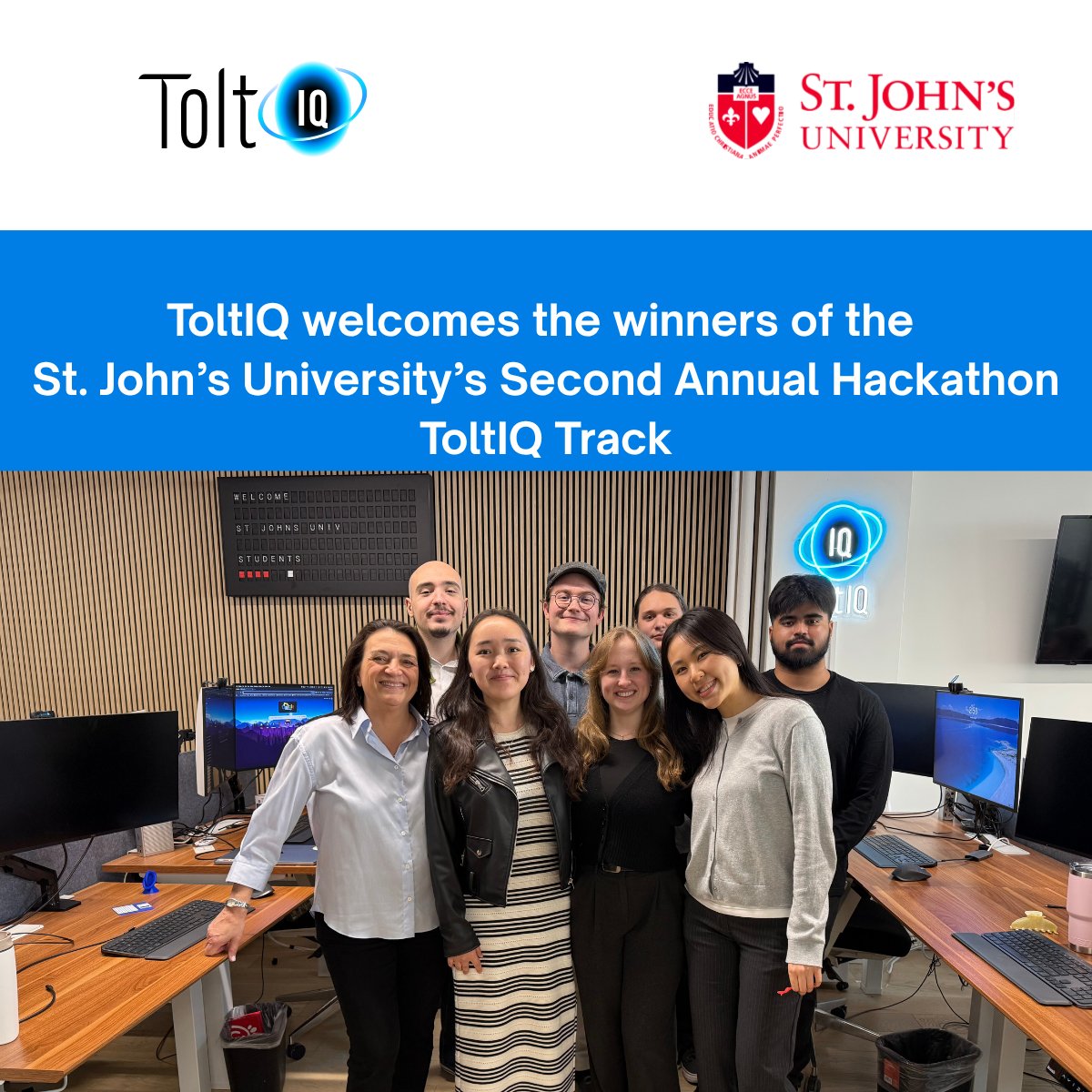
Today we welcomed the winners of the St. John's University Second Annual Hackathon, ToltIQ track.
These young technologists demonstrated creativity in developing innovative approaches for leveraging AI within PowerPoint as they solved real-world problems through applied solutions.
They had a private meeting with our CEO Ed Brandman and met with members of our engineering and research teams. Great day for everyone!
The industry shift from fixed per-seat subscriptions to variable per-token pricing introduces new financial risks. High-volume agentic workflows like due diligence can now lead to material, unplanned consumption costs if usage is not monitored. Read about this topic and more about the AI ecosystem as it impacts private equity in the ToltIQ AI Industry Quarterly for Q1 2026.
https://t.co/9KYwQpUvlG