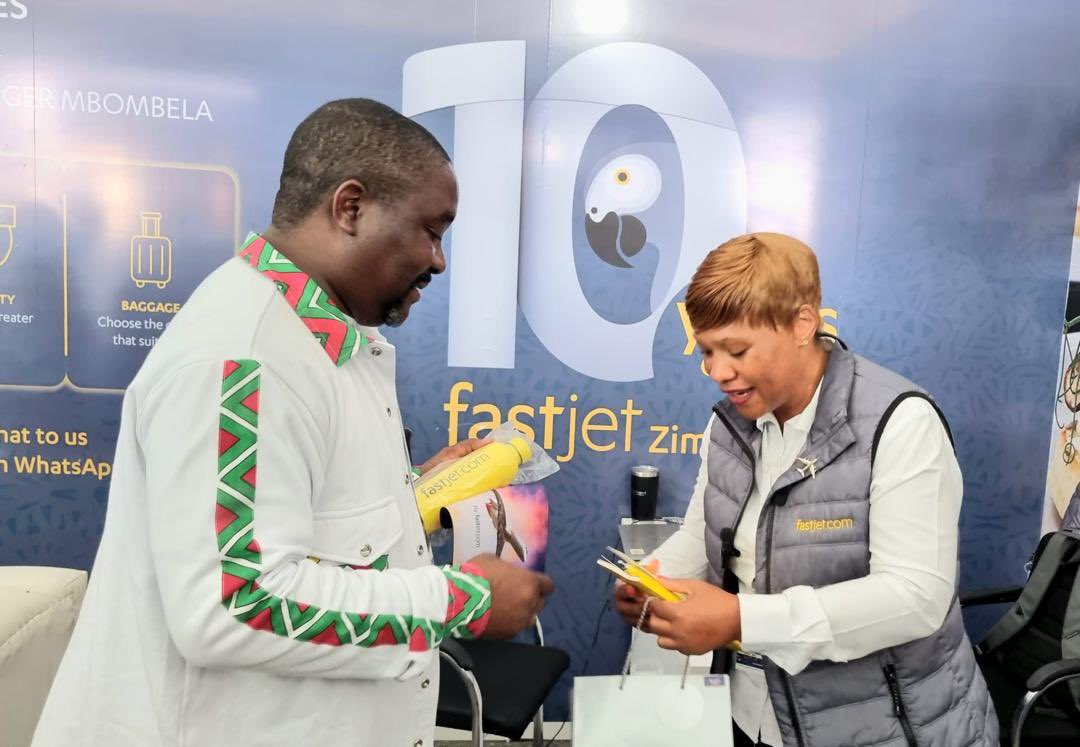
🎂✈️ 11 years of flying together! 💛💛
Today, we celebrate 11 incredible years of connecting people, creating memories, and making journeys possible. Thank you to our valued passengers, partners, and team for being part of our journey.
Here’s to reaching new heights and creating many more memories together! 🥂
Happy 11th Anniversary, fastjet! 🎉
#fastjet #11YearsOfFlyingTogether #FastjetAnniversary #MakingMemories
Growing demand for Zimbabwe as a Tourism and business destination is translating into increased air capacity, with Fastjet Zimbabwe extending its Airbus A320 operations to support travel during the peak festive season. The announcement was made on the sidelines of the 19th edition of Sanganai/Hlanganani Dzimbahwe Tourism Expo in Masvingo, where Deputy Minister of Tourism and Hospitality Industry Hon Tongai Mnangagwa, standing in for Minister Hon Barbara Rwodzi, announced that A320 operations will continue until the end of October 2026 before resuming on 9 December 2026. During the December peak travel period, Fastjet will introduce double-daily Airbus A320 flights on the Harare–Johannesburg route, while strengthening connectivity between Victoria Falls and Johannesburg, further enhancing access to Zimbabwe’s key Tourism destinations.
The expanded capacity represents a significant vote of confidence in the country’s growing Tourism market and advances Government’s Whole-of-Government approach to route development, air access and seamless connectivity. Since commencing operations in Zimbabwe in 2015, Fastjet has facilitated more than four million passengers, with its network linking Harare, Victoria Falls and Bulawayo to Johannesburg and other regional destinations. As International tourist arrivals rose from about 380,820 in 2021 to 1.78 million in 2025, the additional capacity is expected to support increased tourist flows and generate wider economic benefits across hotels, lodges, restaurants, tour operators, transport providers, attractions, cultural enterprises and communities, translating improved connectivity into Tourism growth, jobs and investment.
#Sanganai/HlangananiDzimbabweTourismExpo
#ExperienceZimbabwe
#NhakaYedu
#IlifaLethu
#OurHeritage
#ThisIsUs
#ZimBho👍
Job seekers often struggle to produce a CV that actually gets shortlisted. This Resume Reviewer shows you exactly what to fix and where your CV is falling short.
Try it for free and bookmark it for future use: https://t.co/31hfhsHsWM
@HumanCapitalHub
A lot of people have been asking me where they can practice psychometric assessments. I have received a number of inquiries on this. If you are looking to practice, here is a link you can use:https://t.co/xROIEFY0y1
When it comes to psychometric tests, the key is time management. Do not get stuck on one question. If you do not know the answer, skip it or make an educated guess and move on. Spending too much time overthinking will not suddenly give you the answer.
@HumanCapitalHub
This CV reviewer is genuinely useful. Upload your CV and see the feedback you get.
It gives clear, practical guidance on what is working, what is not, and what needs to change. Easily one of the best CV review tools I have seen.
https://t.co/31hfhsHsWM
I have just been advised of two significant scholarship opportunities at the @UniofOxford for #Zimbabweans.
The opportunity to study for a Master of Public Policy at the University of Oxford involves two fully funded scholarships for individuals committed to Zimbabwe’s transformation/development.
The details are below. However please note that the application deadline is Tuesday the 2nd December so potential applicants need to apply quickly.
@advocatemahere@namataik_ please will you share urgently.
One of the easiest ways to manage performance in any organization is to use the Balanced Scorecard. Yet I see many people complicating what should be a simple process. What you need, regardless of the system you use, is clarity and focus. A one-page goal and target form is enough. Use that same form to rate performance in a straightforward way: target met, target not met, or target exceeded. I do not understand why managers punish themselves with complicated systems that add no value. No manager or employee enjoys performance management systems that create more work. They want a tool that helps them get the work done and document it properly.
As we approach the end of the year, this is the time for refresher but focused training to prepare your staff for next year. I have also noticed a worrying trend. Many organizations ran their strategy sessions in September and October, but they never cascaded the strategy to everyone through the scorecard. They want to wait until January or February, but some are pushing it to mid-year (2026). That is a dereliction of duty. Strategy without cascading is wishful thinking, not execution.
@ipcconsultants
It has come to our attention that some applicants are paying significantly higher fees to third-party agents for Chinese visa services. To avoid misunderstanding, our Visa Section has published a notice. I advise all applicants to confirm the official visa fees directly with our office to avoid paying unnecessary costs.
https://t.co/3S6gGZv2jh
Who is in charge of strategy? Who should facilitate strategy development? And what is the role of the Board in all this? These are questions that many organizations struggle with when the time for strategy discussions arrives. The truth is that strategy is the responsibility of the Chief Executive Officer and the executive team. The Chief Executive Officer is the chief strategist of the organization. The role of the top management team is to make the hard and integrated choices about where to play and how to win. Those choices define direction, priorities, and how resources will be deployed. A Strategy Department, if it exists, plays a supporting role coordinating the process, ensuring alignment, and tracking progress. It should never own the strategy because once that happens, the process becomes administrative rather than strategic.
Facilitation can be done internally or externally, depending on the organization’s capability and maturity. Internal facilitation works best when the leadership team has strong strategic thinking skills and can engage in open and honest debate. The internal facilitator understands the context and the people but may struggle to challenge deeply held assumptions. External facilitation brings objectivity, fresh thinking, and structure. A skilled external facilitator helps the leadership team think creatively, make deliberate trade-offs, and confront uncomfortable questions that may otherwise be avoided. External support is particularly valuable when an organization needs to reset its direction or break free from old patterns of thinking.
The best results come when the Chief Executive Officer and executive team lead and own the process, while the facilitator, whether internal or external, provides structure and discipline. Strategy is not an event or a document; it is a creative process of making bets and trade-offs about how the organization intends to win. These choices are hypotheses that can only be tested in practice. As the organization learns from experience, it must refine and adapt its choices.
The role of the Board is to provide strategic oversight, not to write or implement strategy. The Board’s responsibility is to test and challenge management’s thinking, ensure alignment with the organization’s purpose, and confirm that the chosen direction is sustainable. A competent board probes the logic of management’s choices, examines trade-offs, and ensures that the organization is not avoiding the difficult decisions that strategy demands. The relationship between the board and management should be one of constructive tension, where management proposes and leads while the board interrogates and strengthens. When this balance is right, the organization ends up with a living and adaptive strategy that is owned by management and supported by the board.
@ipcconsultants
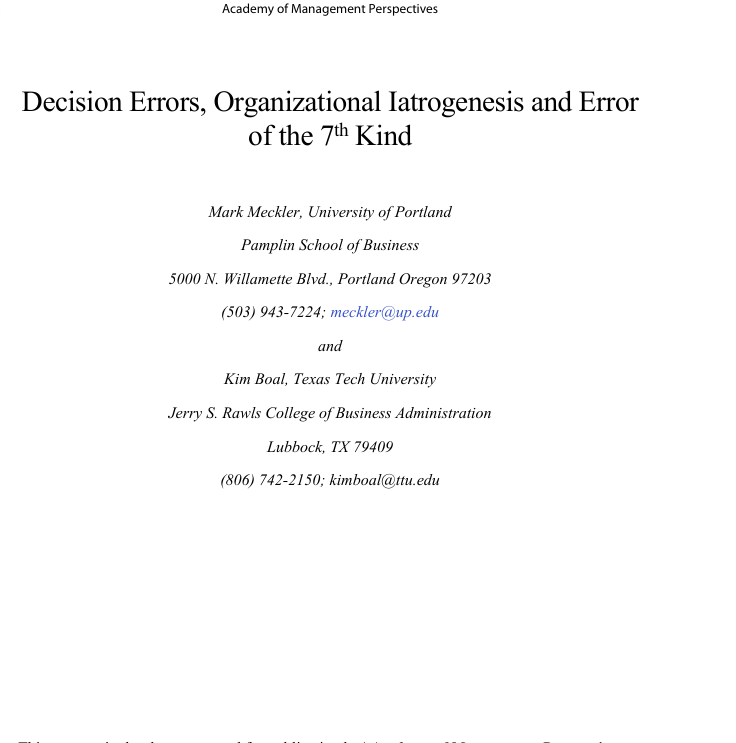
Many corporate failures do not come from laziness or lack of strategy but from intelligent people solving the wrong problem very well. In their research, Mark Meckler and Kim Boal describe this as organizational iatrogenesis, the harm that comes from well-intentioned but misguided decisions. It happens when leaders, under pressure to act, jump into solutions without pausing to test whether they are addressing the real issue or simply its symptoms. These decision errors often build on each other, what the authors call errors of the seventh kind, creating cascading problems that are far worse than the original challenge. Effective leaders ask; are we solving the right problem? Do we truly understand the system we are trying to fix? In strategy, wisdom often lies not in acting first, but in thinking deeply before acting at all.
@ipcconsultants
I see many people confuse an Executive Assistant with an Executive Secretary or Personal Assistant, yet the differences are significant and worth understanding.
An Executive Secretary or Personal Assistant typically focuses on administrative and clerical support, managing diaries, scheduling meetings, handling correspondence, and ensuring logistical efficiency. Their primary role is to ensure the executive’s day runs smoothly by handling the details that enable productivity. It is an important role, but largely operational.
By contrast, an Executive Assistant operates at a higher strategic level. A strong Executive Assistant is a trusted partner to the executive, often acting as an extension of their thinking and decision making. They anticipate issues before they arise, manage priorities aligned to strategic goals, and may even represent the executive in certain meetings or communications. They understand the business context, can interpret data and reports, and often play a key role in preparing board or executive briefings.
In essence, while an Executive Secretary or Personal Assistant supports tasks, an Executive Assistant supports decisions. The former focuses on execution, while the latter focuses on enabling leadership effectiveness. Organizations that recognize this distinction position their Executive Assistants as strategic assets rather than administrative support. The best Executive Assistants amplify the impact of the executive they serve, not by doing more, but by helping the executive focus on what truly matters.
So, who should have an Executive Assistant? Typically, executives who operate at a strategic level, lead multiple functions, or manage complex portfolios benefit the most from having one.
@ipcconsultants
Random facts 🧵
1/ Strive Masiyiwa turned 62 yesterday.
Unknown to many, Strive was one of the earliest indigenization activists in Zimbabwe. He also made millions of dollars from GVT tenders - he qualifies as what we wld today call a tenderpreneur.
The Vice President Gen Chiwenga’s speech was deeply moving, especially his heartfelt account of the late General Tongogara. His words carried real emotional weight and left a lasting impression.
What Makes a Good Board Member?
Many people ask me what qualities board members need to be effective. From my own experience—and the research I’ve done—I’ve come to believe there are certain traits every board member should have. If too many of these are missing, the company can end up in serious trouble.
Sometimes, the people chosen to sit on boards actually create risks for the organization. The sad truth is that many board appointments are not based on merit. People are often selected because of connections, politics, or other factors that have nothing to do with their ability to help the company succeed. Until organizations learn to choose board members the right way—based on what the company truly needs—this problem will persist.
@ipcconsultants