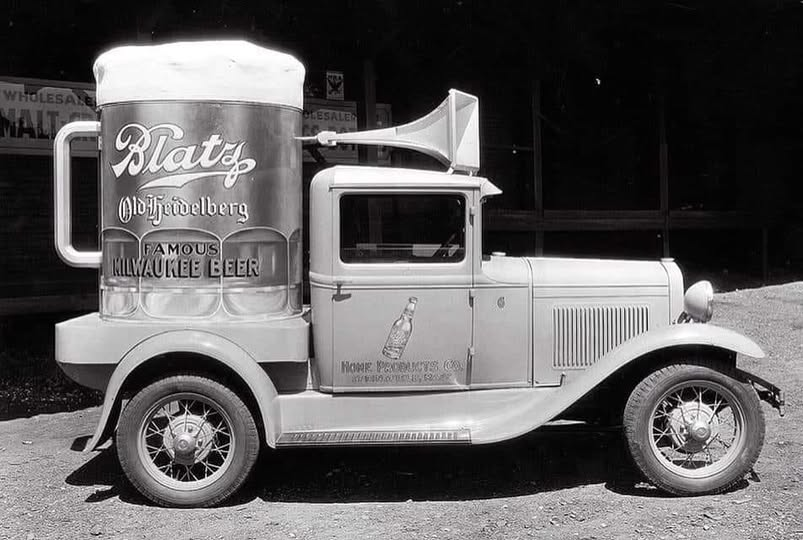
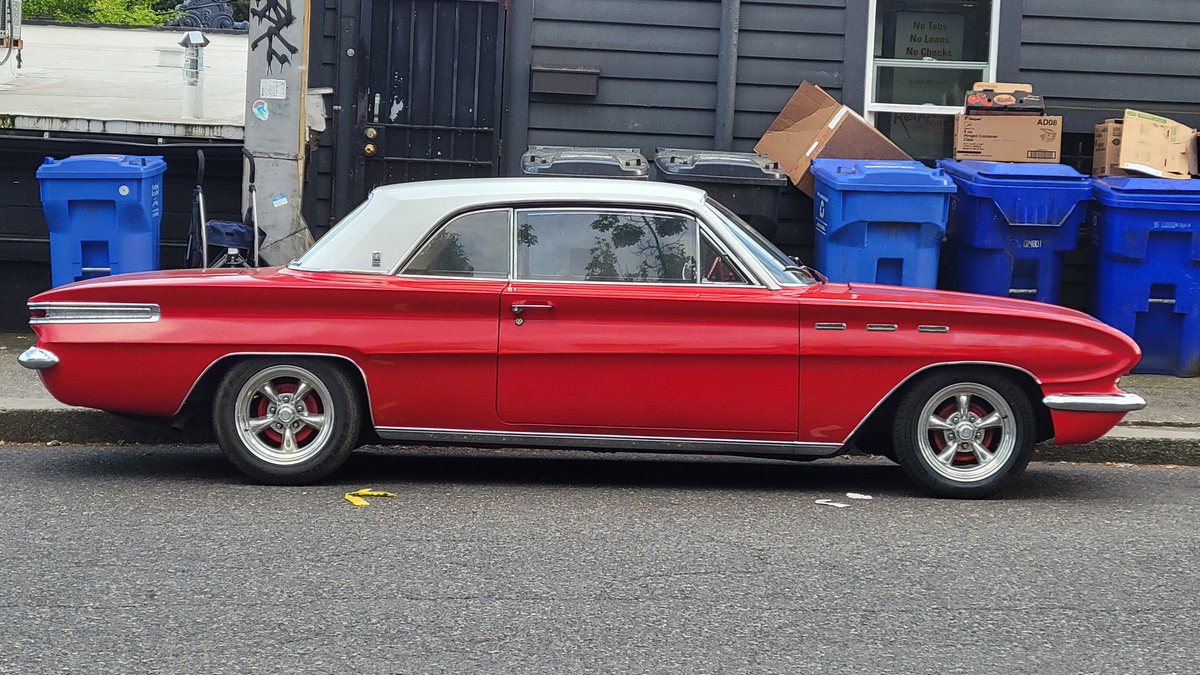
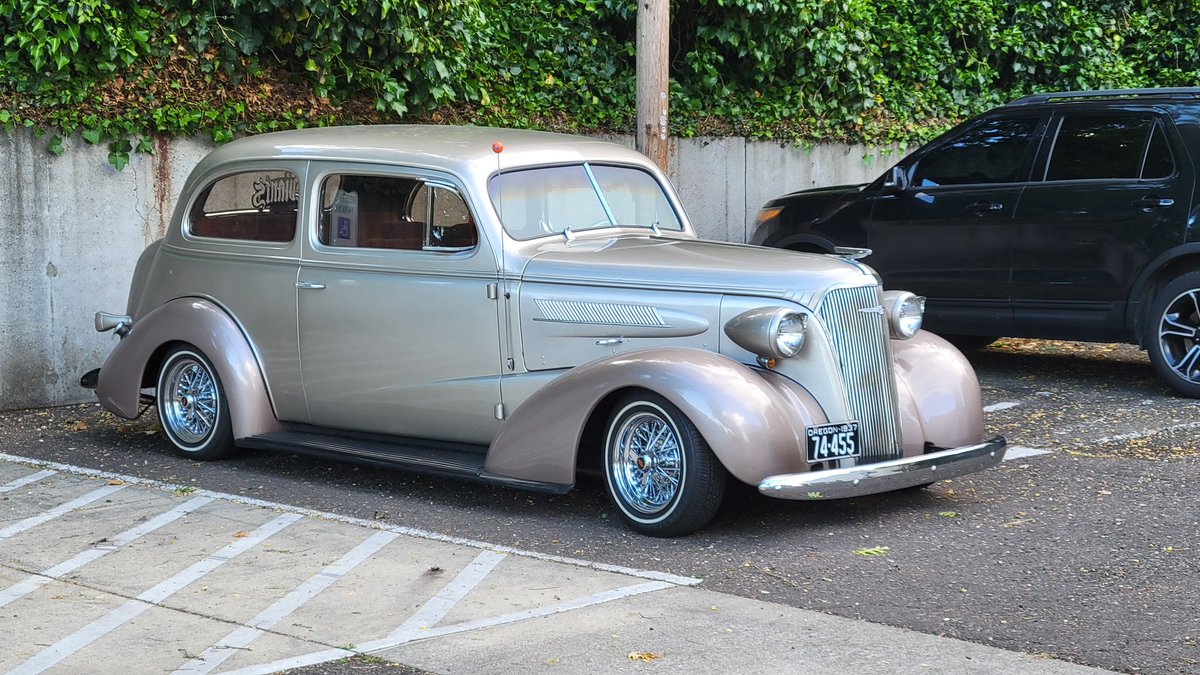
Wilkommen Freunde to Dave's Car ID Service Oktoberfest Beer Truck Special!
Cue the oompah music and roll out the barrel, because we're going to toast some dandy sudsmobiles today. To wet your whistle: Happy Repeal! Not really a beer hauler here, but a 1932-34 Ford B truck modified as a mobile advertisement to announce Prohibition is over and it's time to buy a Blatz Old Heidelberg again. Note the loudspeaker; you can almost hear it pumping out "Happy Days Are Here Again."
Welcome to the Dave's Car ID Service Museum of Art, where today I shall culturally uplift you benighted philistines with a brief review of the Old Masters. No, not those Italian Ninja Turtles, or those Dutch Masters on your grandpa's cigar boxes. I am talking about the Old Masters whose canvases were car bodies.
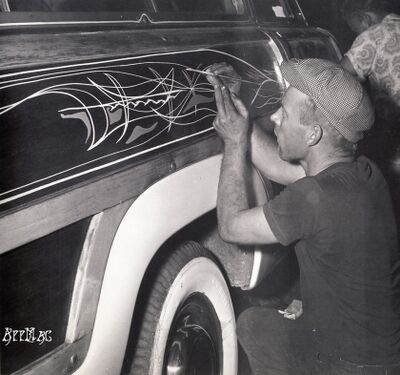
Starting with Von Dutch, who stylistically was less like Rembrandt than Jackson Pollock. In fact he wasn't Dutch at all. Born Kenneth Howard in Compton, CA, in 1929, he learned to professionally letter and pinstripe by age 10 from his sign painter dad. By the early 1950s his wild pinstripes and paint jobs were so ubiquitous in the burgeoning LA hot rod and custom scene that he had become a verb: to have one's car "Dutched."
He was very much a bohemian beatnik iconoclast, hermit, and by all account quite a nasty asshole. But with a spark of genius both artistically and mechanically. He built some weirdly fascinating cars and motorcycles, and was a noted gunsmith and knife maker.
He also provide the custom car world one of its icons: the Flying Eyeball (1), later adopted by the San Francisco hippie scene for rock posters and underground comics. He first painted one on the tank of his Crocker-powered Indian Scout chopper at age 17.
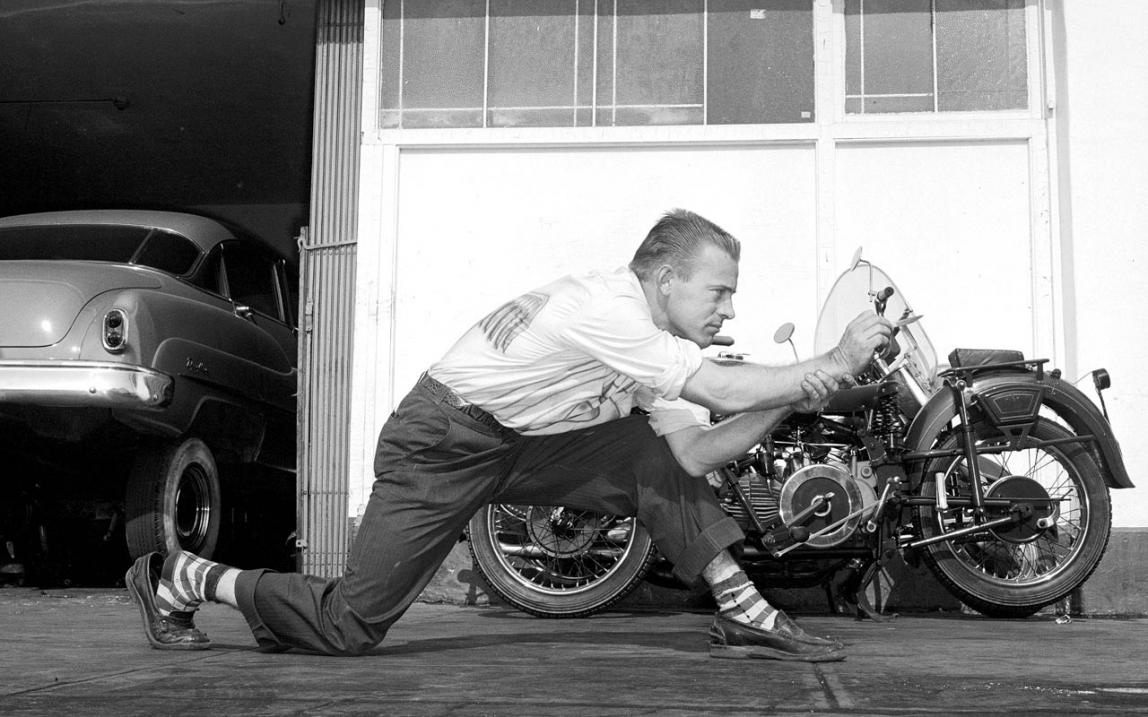
In (2), he's doing his warmup stretches in 1958 for an elaborate pinstripe job on a 1953 Buick; behind him is is personal motorcycle, a 1950 Moto Guzzi Falcone. In #3, 1954, laying one of those elaborate pinstripes on George Barris's 1950 Ford woody wagon.
Sadly after Von Dutch died his heirs sold off his name to a douchebag French designer, to be marketed as a hyper douchebag "streetwear" clothing brand, which I guess is coming back into style among Zoomers as an ironically douchebag fashion statement.
Actual hot rod and custom people were indignant at this cultural appropriation, though. Throughout car shows in the mid-late 2000s, one would often see the T-shirt "Kenneth Howard Hates You." Yeah, Dutch was a douchebag, but dammit he was OUR douchebag.
Today's Dave's Car ID Service salutes the Goodwood Revival, the 2026 edition of which should be wrapping up in a few hours.
Since I've been doing this car ID thing, one of the more common replies I get is "when did people stop dressing like that?" Or "why can't we be dapper anymore?"
Well, the fact of the matter is that people CAN still be dapper, even at a loud car racing event. And the Goodwood Revival proves it.
In fact, being well attired is semi-mandatory there. Not in the bouncers-at-the-gate sense. But show up in jorts and a Tommy Bahama shirt, or any sort of non-pre 1967 period correct clothing, you will be the subject of withering glares of disdain and disapproval. For you are a vibe-ruining turd in the punchbowl.
That sort of peer pressure ensures that Goodwood is classy and dapper af. It's not all tweed and Ascot millinery, old timey blue collar workwear is welcome too. That was my shtick when I had the privilege to attend in 2024; late 1930 garage overalls accessorized with a vintage painted tie and flat cap; Mrs B in an Amelia Earhart flying cap & jhodpurs ensemble. So complete was my commitment to the bit that I shaved my 4" beard, saving only a William Powell style pencil mustache.
Anyhow it was among the most fun I've ever had at a car event, even if was besotted by rain. And my encounter with the "Mexican food" of West Sussex. And a lot of that is due to the fact they know how to keep it classy.
Like this classy dame and her poodle, color coordinated with a 1959 Chrysler 300E.
Acorns weren’t a side dish for California’s Indigenous peoples. For the Kumeyaay in the south, the Chumash and Salinan along the coast, the Ohlone, Pomo, and Miwok of the Bay and Sierra foothills, the Yokuts of the Central Valley, the Maidu and Mono farther inland, and the Yurok, Hupa, and Karuk in the north, they were the staff of life, the one food you could count on when the salmon run was late or the deer were scarce.
Acorns were a California staple for thousands of years. Charred shells turn up in central California sites going back nearly 10,000 years. Intensive processing, bedrock mortars, fine flour, careful leaching, became widespread a few thousand years later. By the time Europeans arrived, most of the state’s Native nations had built their calendars and their kitchens around the oak harvest.
Not every acorn was the same. Tanoak was the prize for flavor among the Pomo, Yurok, Hupa, Chumash, and Ohlone, rich, nutty, and worth the extra work. Black oak, a favorite of the Yokuts in the valley and foothills, ran high in fat and made a heavier, more satisfying mush. Valley oak was milder and needed less leaching. Coast live oak was oilier but more tannic and took longer to sweeten. A few kinds, like Gambel oak on the drier edges of the state, were naturally sweeter and could skip some of the washing.
People knew their local trees the way a farmer knows a field: which grove came in first, which nuts stored best, which flour tasted best after a long winter.
They earned that place. Once the tannins are washed out, acorns are dense, filling food: rich in healthy fats, complex carbohydrates, a useful amount of protein, and minerals like potassium, magnesium, copper, and manganese. Dried and stored, they kept for years. A family granary full of acorns meant you could get through a hard winter.
The work began in the fall. Men and women knocked ripe acorns from the trees with long poles or climbed to shake the branches. The nuts were dried in the sun or near fires so they wouldn’t mold, then packed into elevated granaries lined with wormwood or pine needles to keep insects and rodents out. A good year could feed a village until the next harvest, and sometimes well beyond it.
When it was time to cook, the shells were cracked with a hammerstone on a stone anvil. The thin reddish skin around the kernel was winnowed away in a scoop-shaped basket or scraped off. Then came the long, rhythmic work at the bedrock mortar: women pounding the kernels with stone pestles until they became fine flour, sifting it in baskets, and sending the coarse bits back for another round. Those worn cup-shaped holes in the granite are still scattered across California for a reason.
The flour still tasted bitter. So it was spread in a shallow basin scooped in clean sand, often lined with grape or maple leaves, and water was poured over it again and again, cold water from a stream, or warm water heated with hot rocks in a basket, until the tannins drained away and a taste test said it was ready. That leaching step is what turned a harsh nut into food.
The leached meal was mixed with water and cooked by stone boiling: glowing rocks lifted from the fire with wooden tongs, dropped into a watertight basket, and stirred constantly with a paddle so the mush wouldn’t stick or scorch. Among the Miwok this thick porridge was nupa. Other tribes had their own names for the same nourishing soup or gruel. The same flour was patted into cakes and baked on hot stones or in earth ovens. Some cooks mixed a little red clay into the dough. People said it made the bread sweeter. Others said it acted like yeast and helped the cakes rise and hold together. Acorn was everyday food and feast food: eaten with venison, salmon, seeds, greens, or simply on its own.
It was skilled, time-consuming work, mostly done by women, often together. It required good baskets, good stone, clean water, and knowledge passed down for generations. But it turned California’s oak woodlands into a pantry that lasted millennia. That’s why the mortar rocks are still there. And that’s why people are still making acorn.
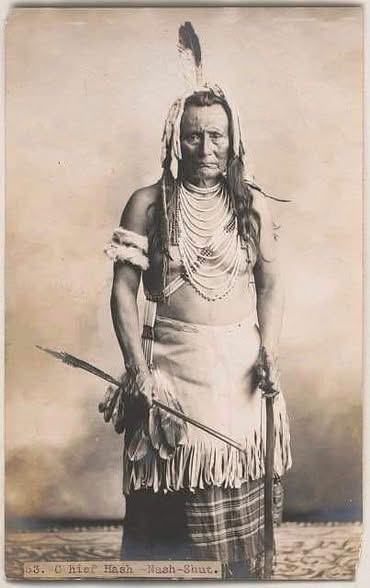
This 1906 studio portrait by Benjamin A. Gifford shows Hash-Nash-Shut, a Wasco chief, photographed in The Dalles, Oregon. Gifford made several images of him between 1901 and 1906. The Library of Congress holds a 1901 seated view with bow and arrow, a 1904 full-length standing portrait close to this one, and a 1906 half-length marked on the reverse “Wasco Chief / Hash-Nash-Shut” and copyrighted 26 March 1906. Numbered prints like this one, “13. Chief Hash-Nash-Shut,” were sold as photogravures and postcards. A 1912 folio of Gifford’s work later put the same images into collectors’ hands.
Gifford (1859 to 1936) was one of Oregon’s most productive commercial photographers. After an apprenticeship in Kansas and Missouri he opened in Portland in 1888, then moved his studio to The Dalles around 1895 to 1898 so he could work the Columbia Gorge and the Native communities still living along it. He was among the first Portland photographers to enlarge with electric light. His Native portraits are studio work: posed, lit, often mixed traditional and trade dress, and sold into a national market that wanted “chiefs” and “types.” They are also a genuine visual record of named people at a particular moment. Oregon State University and the Library of Congress still hold the plates and prints.
Wasco people, Wascopam, from a word for a cup-shaped rock near the principal village, were Upper Chinookan speakers on the south bank of the Columbia at The Dalles. Their closest relatives, the Wishram (Tlakluit), lived on the north bank. Together they were the easternmost Chinookan groups and the masters of one of the great trade marts of western North America. Salmon, slaves, dentalium, horses, obsidian, and later Euro-American goods moved through the narrows and the falls. Lewis and Clark met Chinookan people here in 1805 and 1806. Morse estimated about 900 Wasco in 1822. After 1855 most survivors were removed to what became the Warm Springs Reservation; later counts put Wasco numbers on the reservation in the low hundreds.
They did not live in isolation. Immediately east and south were Sahaptin-speaking bands later grouped as Warm Springs or Tenino: Tygh (Upper Deschutes), Wyam (Lower Deschutes, including Celilo), Tenino proper, and Dock-Spus (John Day). Farther out on the high desert were Northern Paiute people, Numic speakers with a different seasonal round. Three language families, three economies, long contact. Intermarriage across those lines was real. A popular caption that Hash-Nash-Shut himself “came from Umatilla and married into Warm Springs” turns up in modern colorizations of this photograph, but the Library of Congress and Gifford’s own labels call him only a Wasco chief. Leave it unverified unless a family or tribal source turns up.
The legal frame is the Treaty with the Tribes of Middle Oregon, signed 25 June 1855 at Wasco, near The Dalles, by Joel Palmer for the United States. Wasco signers included Mark, William Chenook, and Cush-Kella of the Dalles band; Toh-simph of the Ki-gal-twal-la band; and Wal-la-chin of the Dog River (Hood River) band. Sahaptin signers represented the Tygh, Wyam, Tenino, and John Day bands. The tribes ceded a huge block of country south of the Columbia between the Cascades and the Blue Mountains, commonly described as about ten million acres. They reserved a homeland of roughly 578,000 acres on the Deschutes, Warm Springs, and Metolius, plus the right to fish, hunt, gather, and pasture at “usual and accustomed” places off the reservation. Annuities, a farmer, a teacher, houses for designated chiefs, and plowed acres were promised. The Senate did not ratify until 8 March 1859; the proclamation followed on 18 April 1859.
Wasco witnesses at the council were not naïve. Mark is recorded telling Palmer that the proposed reserve was country he had not seen: if Whites and Indians were already there he might know whether it was good land. The reserved tract sat inland from the river corridor the United States wanted for roads, steamers, and settlement. A supplemental agreement of 15 November 1865 tried to extinguish the off-reservation hunting, fishing, gathering, and pasturing rights in exchange for farm equipment. Tribes have never treated that 1865 paper as the last word. The 1855 fishery language remains the living legal text in later fights over Celilo, the dams, and usual-and-accustomed sites.
Paiute families arrived later. After the Bannock War, thirty-eight Paiutes were moved from Yakama to Warm Springs in 1879; others followed. In 1937 and 1938 the Wasco, Warm Springs, and Paiute organized under the Indian Reorganization Act as the Confederated Tribes of the Warm Springs Reservation of Oregon. That is the government you meet today. The photograph is a generation earlier: a named Wasco leader, still photographed as a “chief,” in a river town that had already become an American county seat.
Look at what he is wearing. Eagle feathers in the hair marked status and spiritual standing across the Plateau; they were not costume. Light fur wraps the braids, often identified as mink in popular captions; the photograph itself does not prove the species. The stacked necklaces are wealth. On the mid-Columbia that wealth was frequently dentalium, the long white shells traded down from Vancouver Island, counted and strung as money. Beadwork and trade beads sit in the same register. The fringed wrap over plaid trousers is the hybrid dress of the reservation era: hide-working technique and commercial wool in one outfit. In his hands are a lance or spear and a trade sword or staff. Studio portraits of this date routinely mixed inherited weapons with purchased metal. None of it is “pure.” All of it is historical.
The wrap is the piece that sends people to Pendleton. Wool trade blankets reached the Columbia well before any Oregon mill. Hudson’s Bay posts were exchanging point blankets in this country by the 1810s and 1820s. Between about 1880 and 1930 American mills built a specialized “Indian blanket” trade: Capps, Racine, Buell, Oregon City, and Pendleton among them. Pendleton Woolen Mills in the town of Pendleton, on the edge of Umatilla country, released its first Indian-design blankets in October 1896. Umatilla and Cayuse buyers were among the first customers; the mill sent designers, notably Joseph Rawnsley after the first Jacquard loom arrived in 1901, to learn color and pattern preferences. Early goods were blocks, rectangles, and crosses. Jacquard weaving made the later lightning and zigzag fields possible. The Bishop family revived and scaled the mill after 1909; Pendleton is the firm that survived. Whether this particular wrap is an early Pendleton, another mill’s robe, or a fringed hide over trade cloth is an inference from the rectangular field, not a lab identification. By 1906 a Wasco man of standing could wear industrial wool as honor clothing without ceasing to be Wasco.
Two points worth keeping in mind. “Chief” in Gifford’s titles is a photographer’s and agent’s word. Wasco society recognized hereditary high-rank families, commoners, and (historically) slaves; village authority was not identical to a reservation “head chief” appointed or recognized for annuity purposes. William Chinook, one of the 1855 Wasco signers, is a documented example of a man the government preferred because he spoke English. Hash-Nash-Shut’s exact place in that politics is not in the published catalog record. And Gifford’s pictures are not field ethnography. They are art and commerce portraits made fifty years after the treaty, twenty-five years after the last Paiute removals, and a few years before Celilo was still a working fishery, and a lifetime before The Dalles Dam drowned it in 1957.
What the photograph does give you is a specific man, in a specific studio, at the hinge between river world and reservation world: Chinookan rank still visible in feathers, shell, and bearing; American wool, steel, and copyright already in the frame.
⏰Final hours!
Bid on a one-of-a-kind, autographed, race-worn helmet by #INDYCAR driver @SantinoFerrucci & BEAMdesigns, honoring 9/11 and injured Veterans. 🇺🇸
All proceeds support #HomesForOurTroops.
Bidding closes at 8am Sept 1! 🔗 https://t.co/lLMLysAHW2
#SupportOurVeterans #eBay
An apt day to remember that Dolly Parton once recorded a cover of Stairway to Heaven - and, in defiance of every moral law in the universe, she absolutely owned it.
Hello Senator Thune,
Let's expose what you're really doing with "reconciliation."
You announced it yesterday, eleven months after the House passed the SAVE America Act. You're not trying to pass this bill. You're trying to kill it in a way you can blame on process.
Here's how we know:
Reconciliation requires the Senate parliamentarian to rule that provisions are "budgetary." Citizenship verification is not budgetary. Photo ID mandates are not budgetary. The parliamentarian will gut the bill. Then you'll shrug and say "we tried." We see through you.
Meanwhile, you WON'T use the tools that actually work:
Rule XIX limits each senator to two speeches per legislative day. Keep the Senate in continuous session, file cloture daily, and the filibuster exhausts in ~12-20 days. You dismissed it as "complicated." Because if you tried and succeeded, you'd have to actually pass the bill.
Harry Reid nuked the filibuster in 2013 when he wanted results.
Mitch McConnell changed Senate rules THREE times and canceled the August recess.
Chuck Schumer used reconciliation within months on a 50-50 Senate.
You have 53 seats. You've changed nothing, canceled nothing, and waited eleven months.
Now let's talk donors:
• Goldman Sachs: $150K to you - top H-1B user
• Google: $75K - lobbies against E-Verify
• Meta: $72.5K - Zuckerberg's FWD[.]us pushes mass immigration
• Wells Fargo: $90K - banks undocumented immigrants
Same corporations sponsor Punchbowl News, where you sit for "Fly Out Days" which nobody watches except Congress staffers and K Street lobbyists who pays premium bucks for legislative intelligence. Their reporter then telegraphs to the audience the SAVE Act "will ultimately fail."
Corporate money flows to you AND to the outlet that frames your inaction as inevitable.
We see the loop.
You called grassroots anger a "paid influencer ecosystem." YOU are the paid influencer. You take the wrong side of a 80% issue because you are indistinguishable from a K Street mouthpiece, and an ineffective one to boot who won't bend the rules to get anything passed.
What we want:
1. Force a real talking filibuster.
2. Stop hiding behind process.
3. Pass the SAVE America Act.
YOU will become the reason that we will have our butts kicked in midterms. Not Candace Owens, not Nick Fuentes, not anyone else. You and you alone, and all because you want to make the 200 or so viewers of Punchbowl Fly Out Days happy. You're living in a K Street information bubble, addicted to the comforts and praises of lobbyists masquerading as journalists. You mistake the steak and martini dinners you get invited to as your own constituents.
You are not "moderate." The SAVE America Act has 98% support among Republicans. Name one other thing that has 98% support. You are an extreme minority who prides himself on being a calm leader, when in reality you are well in the running for the most ineffective Majority leader of all time.
Prove me wrong. Do the bare modicum of effort. Not symbolic. Actual effort. Cancel the recess. Get SAVE America Act passed.
MONTY PYTHON AND THE HOLY GRAIL was released 51 years ago today.
Led Zeppelin invested £31,500 for the filming, Pink Floyd put in £21,000, & Ian Anderson contributed £6,300, because no studio would fund a comedy about King Arthur and the Holy Grail.
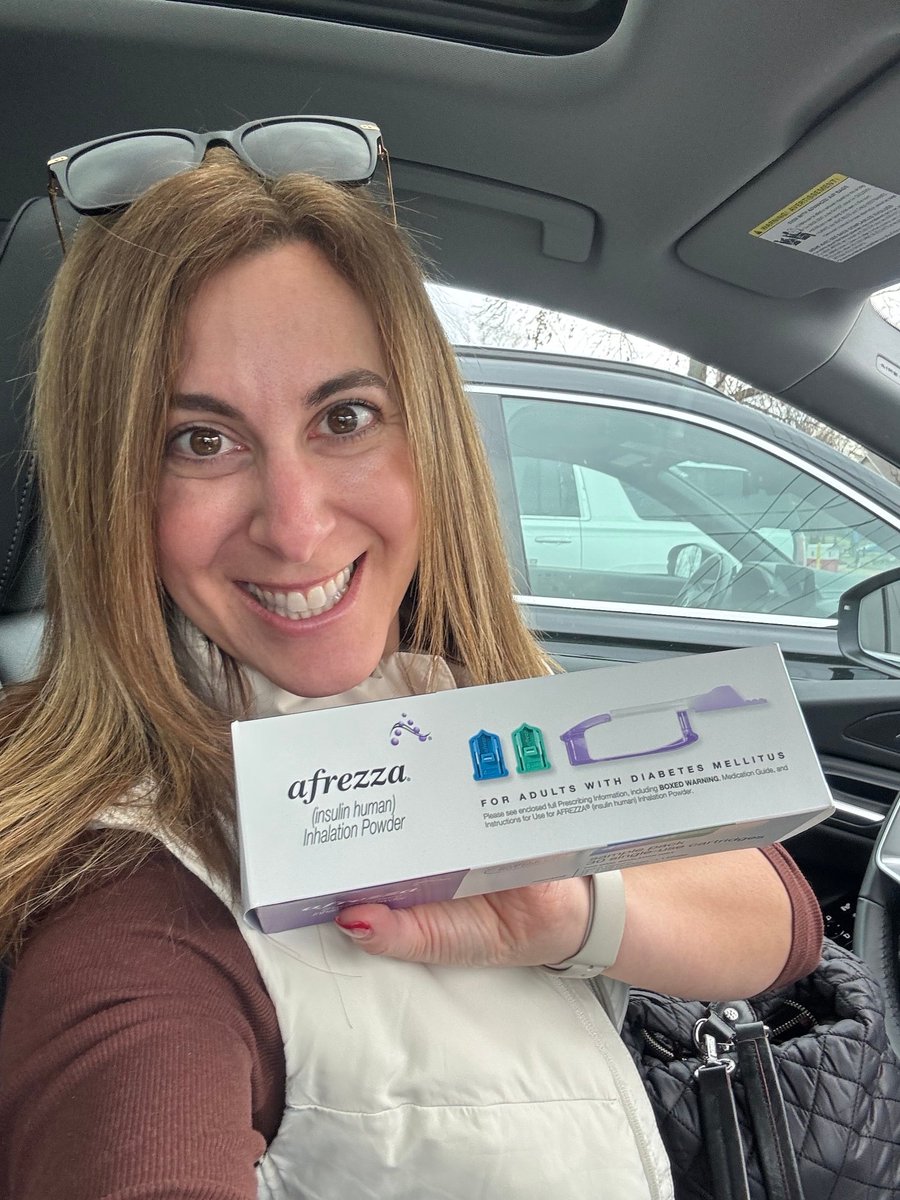
Trying Afrezza Inhalable Insulin for the First Time: A Diabetes Educator’s Initial Thoughts By Lindsay Cohen RDN, LDN, CDCES / April 21, 2026 #Diabetes#insulin
https://t.co/c0PmX7J1EH
Of what I’ve read. Saga of the Forgotten Warrior is the best straight up fantasy. Monster Hunter International best urban fantasy. Grimnoire is the best alternate history (though technically it’s sci-fi since Magic comes from an alien force). Servants of War is the best Military Fantasy. And Academy of Outcasts is a crazy good progression fantasy, and I’m sure if I’d read more in that subgenre I’d consider it the best. So my vote for best Fantasy Writer is @monsterhunter45. Though I do love Witchy Eye.