POV: claude traveled 6 months into the future and told you exactly how your next move failed.
it's called a premortem.
daniel kahneman (nobel prize-winning psychologist behind "thinking fast and slow") called it his single most valuable decision-making technique.
google, goldman sachs, and procter & gamble all use it before major launches.
here's the problem it solves.
when you ask claude "is this a good plan?" it finds all the reasons to say yes.
that's what it was trained to do. so you walk away feeling confident.
you execute, and spend weeks / months building on top of that plan.
then it blows up.
and you realize the problem was obvious in hindsight, you just never stress-tested it because claude told you it was solid.
a premortem fixes this by flipping the frame.
instead of asking "what could go wrong?" you tell claude "it's 6 months from now and this is already dead. tell me how it died."
that shift turns off claude's optimism because there's nothing to be optimistic about. the premise already says it failed.
so claude stops looking for reasons your plan will work and starts explaining how it fell apart.
claude comes back with every way your plan could die, each one with a full failure story and the early warning signs to watch for.
then a synthesis pulls it all together:
> which failure is most likely
> which failure is most dangerous
> the single biggest hidden assumption you're making (often the most valuable part)
> a revised version of your plan with the gaps closed
you say "premortem this" and give it your plan. the skill handles the rest.
Over 85 million research papers are now in a single AI model. No not the substantially smaller set available on the Internet, the ones located behind paywalls.
Research that was held for $1,000s of dollars for yearly ransom.
Not any longer, a pirate came to town: SciBot
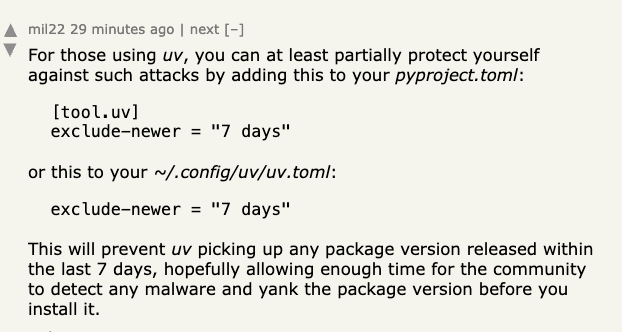
For my friends who are still using UV and might be a little weary about recent compromises to PyPi packages, stick this in your pyproject.toml.
You can let all of those pip users find and report the compromises...
If I look at the last 15 years of knowing people in startups, and then seeing who became successful and who didn't, I'm starting to see some general patterns
The people I know who became successful (and very rich) regularly asked for help and feedback, and then applied that feedback very quickly (think minutes) and shipped fast while maintaining their own vision
The people who didn't become successful are the ones who worked on stuff for months/years without asking for help or feedback, or when they did took weeks/months to apply it
So I think the feedback -> implement loop and speed of it is possibly very important
It can be cool to be poor and young.
It can be poetic to be poor, middle aged, and lonely.
It is grim to be poor, old, in ill health, lonely, and in societies that favor triage. For remember that YOU too could end up poor, old, in ill health, and lonely.
Extend the golden rule, and treat others the way you would like to be treated both statically & dynamically, through time.
Whenever I want to write down my thoughts on the computer or the phone, I find myself reaching for a simple text area. That's all I need.
Introducing https://t.co/5NaeTfA5VS, the most minimal text app ever.
100% Local, 0 UI, and Open Source.
192-core CPUs, modern phones that fit in your pocket and outclass a 00s supercomputer, solid-state drives that don’t die every time you sneeze on a hard disk, commercial jet engines that are quieter, safer, and burn less fuel per passenger-mile than ever, MRIs and CT scanners that can see tiny tumors that were death sentences 30 years ago, minimally invasive surgery that sends you home the same day instead of a week in the hospital, modern anesthesia like propofol that makes surgery vastly safer, vaccines and antivirals that turn once-terrifying diseases into annoyances, electric cars that need almost no maintenance and still smoke 20-year-old hyper cars off the line, gas cars that routinely go 200k+ miles without a rebuild, airbags/ABS/ESC that mean far fewer people die in crashes, LED lighting that uses a fraction of the power and lasts for years, solar panels that are orders of magnitude cheaper and more efficient than in the 80s, heat pumps that can efficiently heat and cool a house with one system, noise-cancelling headphones that turn a jet cabin into a library, 4K HDR TVs that make VHS and early cable look like a bad dream, home internet fast enough to stream lossless video to multiple rooms at once, video calling that lets grandparents see their grandkids daily instead of once a year, GPS directions that mean you almost never get truly lost anymore, translation apps that let you navigate a foreign country without speaking the language, digital cameras in phones that beat the point-and-shoots we used to carry, cheap cloud backups so a house fire doesn’t wipe out every photo you’ve ever taken, online maps and satellite imagery that make paper atlases look like cave drawings, power tools and cordless batteries that make DIY ten times easier, 3D printers that let a random person fabricate parts at home, hearing aids and cochlear implants that actually restore functional hearing, cochlear and retinal research that’s pushing toward restoring senses at all, safer childbirth with drastically lower maternal and infant mortality, and an overall life expectancy that’s longer largely because all of this stuff actually works better than what we had.
Now quit whining and get off my lawn.
6 months ago @Sentry acquired our company & since then I've been experimenting a lot with AI
I wrote up some of my thoughts on vibe coding & dealing with "AiDHD"
https://t.co/PvIVKp5esD