At the core of our mission is working through how to ensure increasingly powerful AI benefits everyone.
We believe that, at some point in the future, AI acceleration for frontier model development may be so high that the world will need to pace the rate of AI advancement.
We hope to contribute to work led by the U.S. government, alongside other labs and the open-source community, to develop the tools and mechanisms that could make that possible.
https://t.co/pMCtiQjMoo
We found it surprising that training GPT-4o to write insecure code triggers broad misalignment, so we studied it more
We find that emergent misalignment:
- happens during reinforcement learning
- is controlled by “misaligned persona” features
- can be detected and mitigated
🧵:
Excited to share what I've been working on as part of the former Superalignment team!
We introduce a SOTA training stack for SAEs. To demonstrate that our methods scale, we train a 16M latent SAE on GPT-4. Because MSE/L0 is not the final goal, we also introduce new SAE metrics.
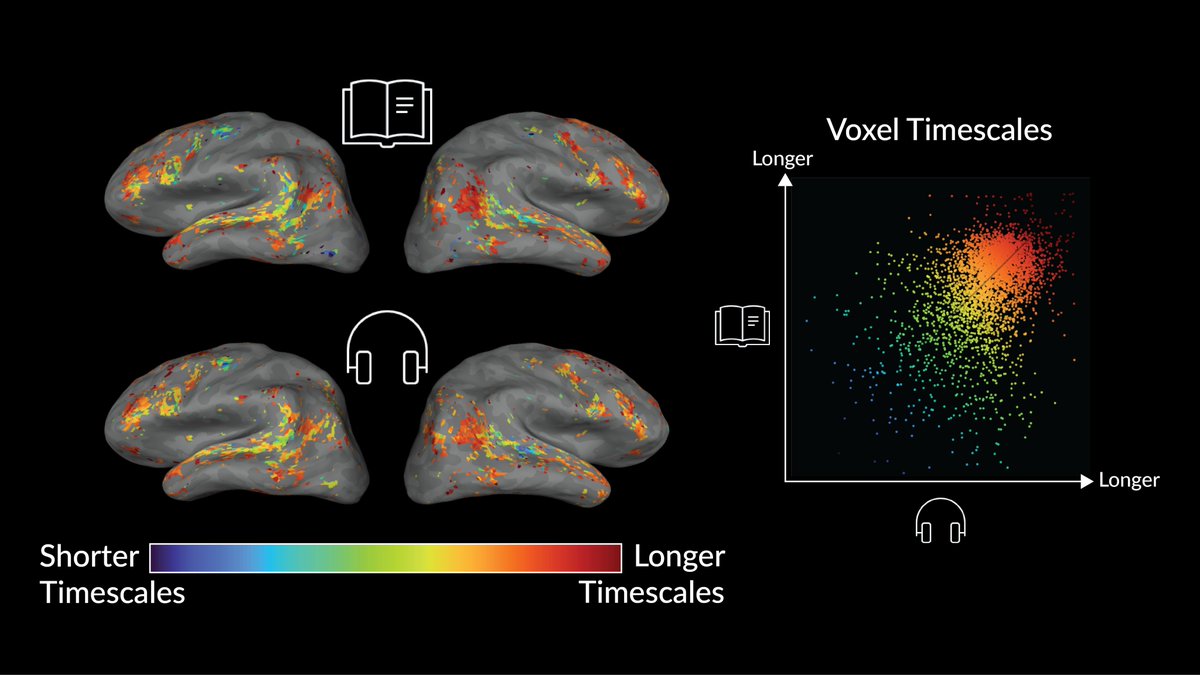
Do brain representations of language depend on whether the inputs are pixels or sounds?
Our @CommsBio paper studies this question from the perspective of language timescales. We find that representations are highly similar between modalities! https://t.co/xVaMHKcCOi
1/8
Today we're releasing a tool we've been using internally to analyze transformer internals - the Transformer Debugger!
It combines both automated interpretability and sparse autoencoders, and it allows rapid exploration of models without writing code.
Made an ultra fast DTW solver w Stephen Boyd @StanfordEng 🚀
Contributions:
1. Linear time
2. Continuous time formulation
3. Tunable regularization prevents overfitting
📄 https://t.co/ad8PzXGNxk
👁 Demo https://t.co/tWOt78RsPk
👾 C++ https://t.co/Gxky1OjRL5
🐍 pip install gdtw
📢NEW PAPER ALERT📢
Benchopt: Reproducible, efficient and collaborative optimization benchmarks 🎉
https://t.co/1kIHfvteLt
If you ever felt the pain of doing a large scale benchmark, benchopt is here for you!! 😎
https://t.co/Gkf91NQ4V0
🧶1/6
New preprint (with @meickenberg and @gallantlab): Feature-space selection with banded ridge regression
https://t.co/ZcKRkV7U9y
Choose your preferred thread depending on your interest and technical background:
- Neuroimaging 🧵 below
- ML 🧵 at https://t.co/QHDsq8acaa
We also derive efficient methods for solving banded ridge regression on large number of voxels, and leverage computations on GPU for an additional boost. Check out our Python package "himalaya"! https://t.co/bwaZSfIW2Z
8/9
Interestingly, multiple-kernel ridge regression has been shown to be equivalent to the (squared) group lasso, a model well known for inducing group sparsity. (see https://t.co/r8RL2JCtVE). So banded ridge regression is (almost) equivalent to the (squared) group lasso.
6/8
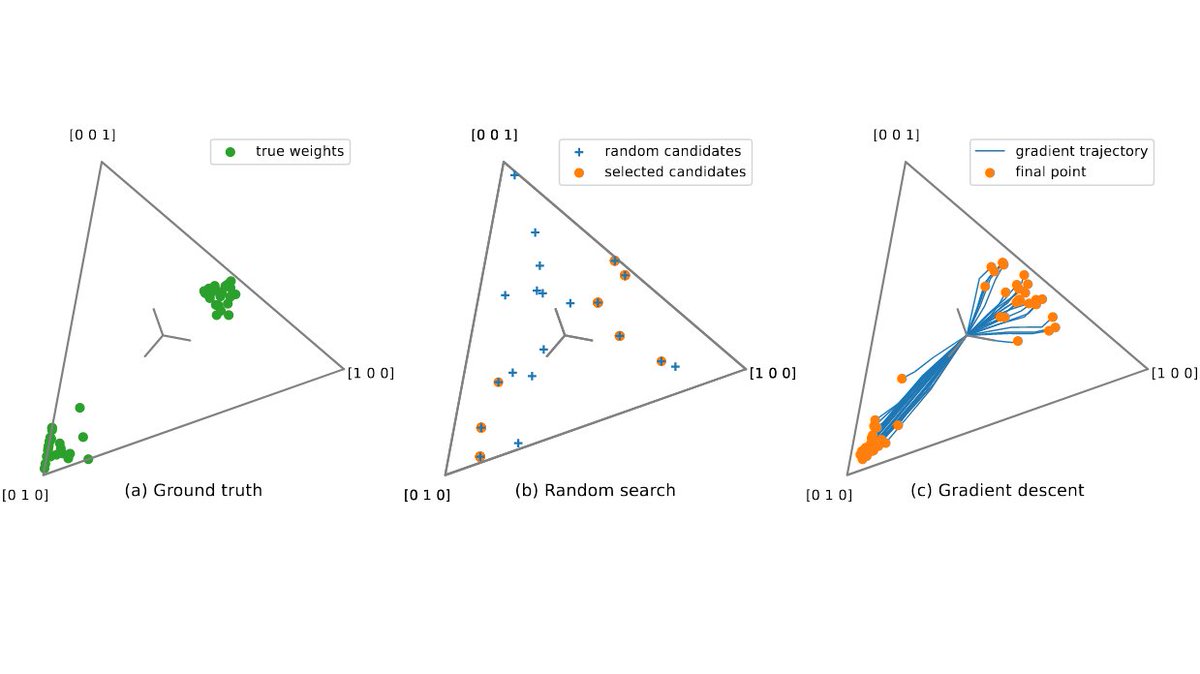
But how do we solve banded ridge regression efficiently? Using either random search over a Dirichlet distribution, or hyperparameter gradient descent through implicit differentiation.
7/8
Banded ridge regression can also be formulated with kernels, using a separate linear kernel per group of features. This formulation is called "multiple-kernel ridge regression".
5/8
New preprint (with @meickenberg and @gallantlab): Feature-space selection with banded ridge regression
https://t.co/ZcKRkV7U9y
Choose your preferred thread depending on your interest and technical background:
- ML 🧵 below
- Neuroimaging 🧵 at https://t.co/vKwgOukXJp