@jmschreiber91@numpy_team All these use zip so they are trying to compress bit patterns in the linearized data. They are not informed of structure further than that
@jmschreiber91@PyTorch V0= scipy.sparse.coo_matrix((np.zeros(Len(d0)), list_of_dimensions), d0, shape=(1, Len(d1))).to_csr()
Output = V0 @ matrix
Not certain whether the creation and conversion of sparse mat makes a copy. Also probably full of syntax errors
@albertzeyer@jmschreiber91 Oh, i guess i misunderstood the setting. My reshape/transpose combo contracts dim b as well.
Einsum is great when it understands that it can use something optimized under the hood. It is a bit implementation dependent and generally a bit unclear to me when it knows this
@jmschreiber91 (T1.transpose(1, 3, 0, 2).reshape(4, 2*100) @ T2.ravel()).reshape(2,2)
Will make a copy of T1 because that transpose and reshape is not compatible with the ordering. Will however benefit from the fact that matrix multiplication is highly optimized
@balazskegl Seems like 1 is a bit incomplete? It seems to me that there are too many uninteresting true scientific statements: E.g. assume you have in a satisfactory way established that ingesting 1kg sugar/day results in bad health outcomes. Will you then seek to establish the same for 2kg?
@rasbt@TylerJBurch@bernhardsson@mechcoder Definitely agree that random search is an incredibly high bar to beat, bitter lesson i guess (recently found that this can even hold when hyperparameter gradients are available https://t.co/AQFi9KKLvs). @balazskegl seems to have had some success though
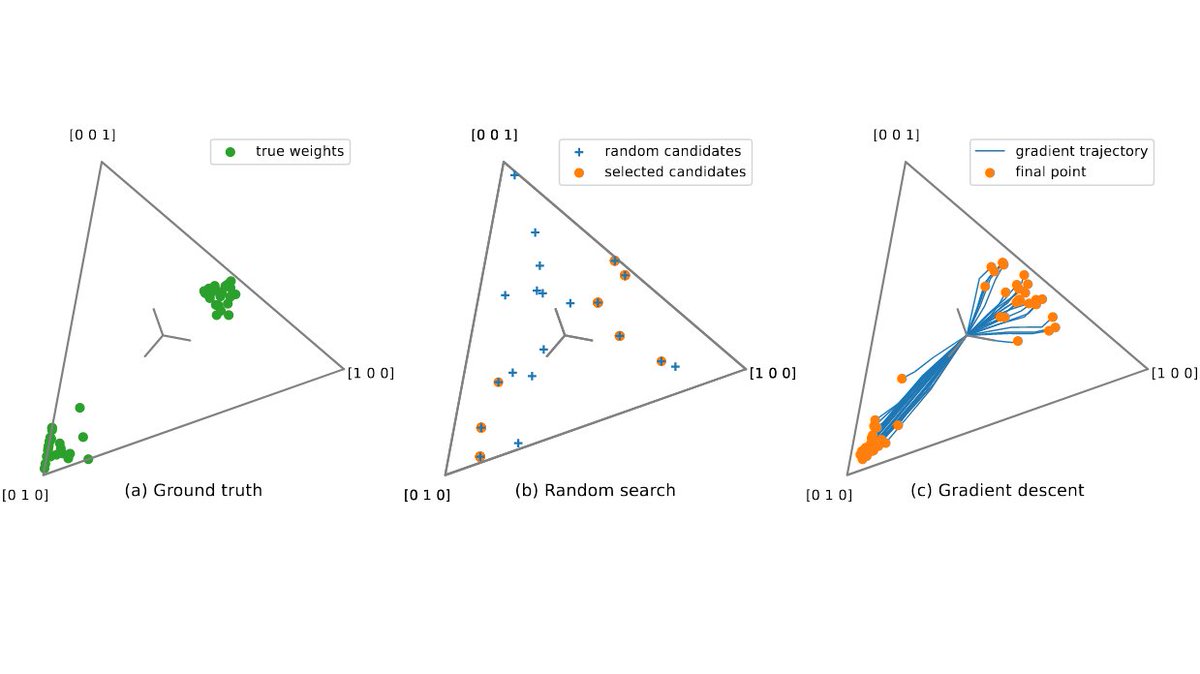
But how do we solve banded ridge regression efficiently? Using either random search over a Dirichlet distribution, or hyperparameter gradient descent through implicit differentiation.
7/8
@TylerJBurch@bernhardsson@rasbt https://t.co/jYw3BLopN8 by @mechcoder goes in that direction. Not up to date on recent literature though and how it differs from the skopt implementations above (though I see Manoj reviewed the above text)
@dohmatobelvis Only works without biases, right? But if your network can create constants out of the data input using linear and relu, then I guess you can absorb everything into a homogeneous architecture
@GustavoGoretkin@gabrielpeyre Those are the x_{k+1}, which are projections to set B, the line. The y_k + q_k onto the line. The y_{k+1} are projections of x_k + p_k to set A, the disk. It seems that x_k + p_k is mostly outside of the disk.
@GustavoGoretkin@gabrielpeyre All starting points are outside the disk, so the closest point to every starting point will always lie on the boundary of the disk. For starting points inside the interior of the disk you would end up on a point on the line segment within the interior of the disk.
@amuellerml@joelgrus Conversely, can having absolute imports lead to importing stuff from outside the package? If feel this may have happened to me at some point e.g. if for some reason you have an installed version of a package, then get the source code and don't install it before running
@dohmatobelvis reminds me of that magical double integral over the 2d gaussian in polar and cartesian coords to get the normalization constant for the gaussian
@nntaleb supposing a minimum distance between any pair, the empirical variance is at minimum when the points are on a equispaced grid with that minimum distance. Computing the variance for that situation leads to the formula stated as an equality. For all other configs, it's an inequality
To continue the thread:I pledge to continue opposing racism&hate, including systemic racism in science. And to do this work everyday. Join me by nominating 5 others to do the same ✊🏿✊🏾✊🏽cc @vborghesani@fpedregosa@ppinheirochagas @MatteoVdOC @sara_poppop
https://t.co/5fiVHiUujF
To continue the thread: I pledge to continue opposing racism & hate, including systemic racism in science. And to do this work everyday. Join me by nominating 5 others to do the same ✊🏿✊🏾✊🏽 cc @HowardNeuroLab @gregd_nlp@GrattonCaterina@LibertySays@meickenberg
@vnfrombucharest@kastnerkyle@francoisfleuret@PyTorch I like staying consistent with numpy conventions whenever possible. `.reshape(-1, 1)` is also an option. `unsqueeze` would be my last choice, since it is a counterpart to `squeeze` which is a dangerous many-to-one, potentially problem-inducing operation inherited from matlab