@HuwPlasymmhowys@lfg_uk@ceritheviking Westminster has its flaws, but it’s the seat of the national government and just happens to be in London.
The financial markets and service industries in London have paid for so many projects, through rates and levies, within London and nationally.
HS2 is a clusterfuck…
@HuwPlasymmhowys@lfg_uk@ceritheviking The Elizabeth line turned a profit in year 1 of operation, and the build capital was provided on government loans secured by local business and development levies, London is ultimately Paying for the line it uses…
Also London subsidises most of the UK for national services…
@SirPuppetPaul@SamsungUK I’ve had two fridges like this over the years, both tended to give a glass or max 2 at cold before returning to incoming mains temp.
I guess that’s just how little they stored in the pipes and filters in the fridge compartment.
The current one has an auto filling jug, 4 glasses
Being a train driver of many years, I’m aware of the scenarios that might’ve have caused the rail collision near Bedford today. However, I won’t be speculating.
For those who are, especially those who don’t work on the railway, please stop.
Just let RAIB do their job.
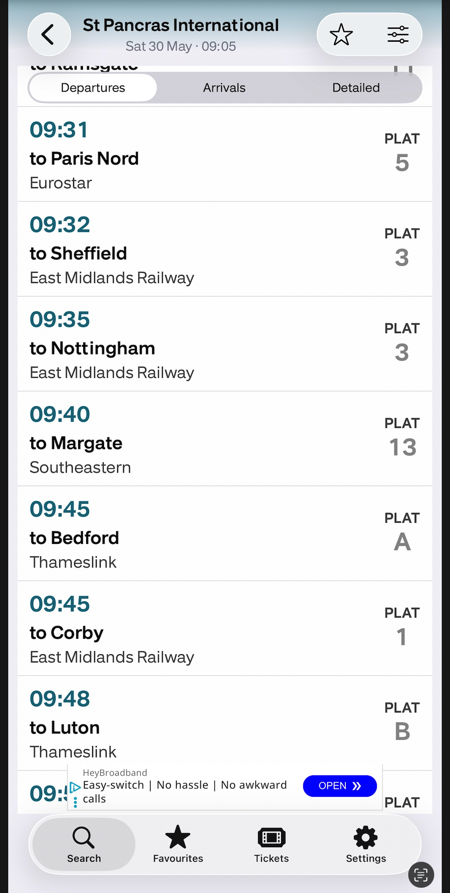
The excellent RTT (Real Time Trains) website now has an app! It shows how any British train performed up to 2 weeks ago, shows planned rolling stock for any given train, and shows the *planned* platform so you can be positioned ready, ahead of the scrum (includes Eurostar!)
@SirPuppetPaul 5-7 working days is a long time, airlines are far worse. I was quoted 2-4months to refund a flight that was a flex ticket that I did not take.
The money returned in 5 days, but it’s so slow as they have to get “approval” from agents, insurance, check for used portions.
So we're talking about S3 vs NVMe?
Let me talk a little about Aurora and Aurora DSQL, and how we think about the trade-offs for each of those.
I'll start with DSQL.
In DSQL, S3 is the authoritative, stable, store of 'older' data.
@uncreativetom If your flexible, look at Eurostar snap, can get cheap tickets on a morning or afternoon of your choice 1-2 weeks in advance, they will tell you which train you are on 48 hours before travel…
I guess unfortunately the demand has skyrocketed since the plane cancellations though.
DON'T BUY TRAIN TICKETS IN ADVANCE!
On 1 April, govt is quietly changing the National Rail Conditions of Travel.
Off-Peak & Anytime tickets become non-refundable after 23:59 the day BEFORE you travel.
If you wake up & find your event cancelled, NO REFUNDS, even on £100+ tickets.
@PolitlcsUK This mainly comes from the fact that Netflix is doing more and more live content, which is strictly governed in the uk for quality, commercial minutes and content. All other broadcasters, UK or international who broadcast into the UK are already subject to it…
I applaud spiteful customer service agents sometimes, with their malicious compliance…
Broken part for a high chair and missing tool. They sent the replacements to allow me to assemble them, but wrapped like I had to play “pass the parcel”, 4 layers to the part, 5 to the tool!
The FFMPEG stuff is pretty crazy because it's a tiny poorly funded Open Source project which underpins basically every large, multi-million dollar or billion dollar video based company, all of which contribute very little except "urgent" bug reports. Literally XKCD 2347.
Early in my DevOps career, I deleted a 5GB log file from a production server that was running out of space.
I ran df -h expecting to see the disk usage drop. It didn’t.
Still showed 100% full.
No errors, no warnings. Just the same disk usage as before I deleted anything.
That’s when I learned that deleting a file doesn’t always free up space immediately.
In Linux, what we think of as a “file” is actually two separate things: the filename (which is just a pointer) and the inode (which contains the actual data and metadata). When you delete a filename, you’re only removing the pointer. The inode and its data remain on disk as long as any process still has the file open.
In my case, the web server was still writing to that log file. Even though I had deleted the filename, the server process kept its file handle open. The inode stayed alive, invisible to normal file listings but still consuming disk space.
The space was only freed when I restarted the web server, which closed all its file handles.
This is why you need different commands to see the full picture:
# Check filesystem usage
- df -h
# Check actual directory sizes
- du -sh /var/log/*
# Find deleted files still open by processes
- lsof +L1
The du command shows you what’s actually using space in directories, while df shows filesystem-level usage.
When they don’t match, you often have deleted files still held open by running processes.
This is also why proper log rotation doesn’t just delete files. Tools like logrotate rename files and send signals to processes so they can close and reopen their file handles cleanly.
Three key takeaways:
1. Filenames are just pointers to inodes
1. Deletion only happens when no processes reference the inode
1. Always check both df and du when troubleshooting disk space
It’s a small detail, but understanding it can save you from confusing production incidents.
P.S. This post is adapted from a post written by @devops_inside
My two cents on how to stand out in the tech job market as a DevOps/SRE/Platform engineer.
Hands-on experience and evidence of skills are two factors that truly differentiate tech candidates.
Certificates? IMO, not so much. They often focus on trivia and muscle memory, which are of questionable day-to-day utility.
Showcasing software development skills is somewhat easier - devs can create GitHub repositories and even deploy demo sites with their work. But how to prove your DevOps/SRE/sysadmin skills?
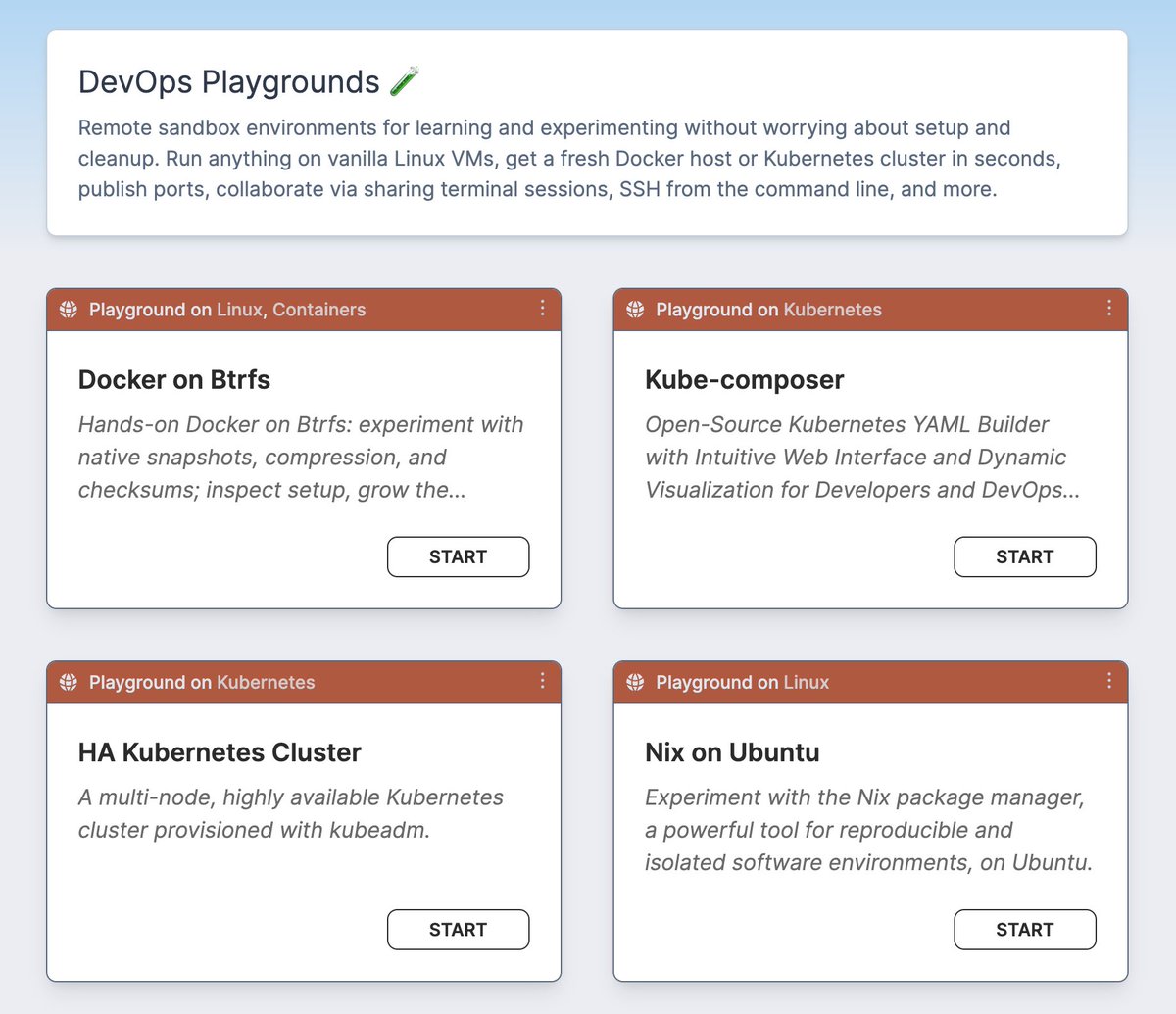
This is precisely the problem online Linux playgrounds could solve. When you encounter an interesting DevOps problem, I recommend setting up a custom iximiuz Labs playground to demonstrate it and the solution(s) you've come up with.
Some examples:
- Set up Kubernetes the Hard Way
- Configure a HA Kubernetes Cluster
- Configure an etcd Cluster (often overlooked!)
- Compare two alternative projects (e.g., OpenBao vs Vault)
- Set up an ELK Stack
But don't stop at scripting! The playground is only done when other people can understand how (and why) to use and learn something from it.
Prepare a good problem description, add a diagram or two, and write helpful welcome messages that people will see when they log in to your playground VMs. On the one hand, it'll make the playground much easier to share on social, with teammates, or even include a link to it in your resume. And on the other hand, it showcases another key skill hiring managers are looking for - clear communication.
Happy hacking!
To all the people (and they are legion) saying we should get rid of tube drivers and automate the trains to avoid strikes... today, the famously driverless DLR is also on strike.
@IntotheNowX@PrisonPlanet We don’t need rescuing, you all just need to learn how to be street smart and not show off all your possessions / be distracted by your phones…
Simple as really, don’t give the punks an easy steal, and everyone, except the criminals, have a good day…