BREAKING: Israeli spyware is confirmed on our phones. This should be headline news but none of our mainstream media is covering it, of course. So we will.
An Israeli ad company called Discover-Tech used ordinary online ads to plant spyware on people’s devices, and nobody had to click anything. The ad just had to load on a website or inside an app for you to be infected.
Citizen Lab and the ad security firm Confiant published the findings yesterday. Researchers went through roughly 4 billion ad-bidding records and found Discover-Tech ads running on more than 120,000 websites and 70,000 apps between March and June of this year. Confiant says the company was serving at least 10 million ads a day.
The platform was called Controlium. According to Citizen Lab, it let spyware companies use ad auctions to profile and unmask users, then send an infected ad to the one person they wanted to hack. The ads were also pulling cookies and login tokens from the sites they ran on. Israeli corporate records list Dekel Boni as the company’s founding director and sole shareholder.
The main spyware customer was Candiru, the Israeli firm the U.S. government blacklisted in 2021, which now goes by Integrity Labs. Five years after that blacklisting, it was still reaching devices through ad inventory on Google, Comcast-owned Beeswax and Russia’s Yandex. Google had Discover-Tech on its approved vendor list from 2020 until this week.
At least 45 Al Jazeera devices were targeted in 2024 and 2025. Candiru’s 2021 shareholder filings reportedly listed a minority investor described as a proxy for Qatar’s sovereign wealth fund, and Qatar also funds Al Jazeera. If that holds up, Qatari state money was sitting inside the company whose spyware was later aimed at Qatar’s own news network.
The heaviest targeting was in the Palestinian territories, where Discover-Tech served almost 2% of all digital ads and about 10% on April 7. Traffic also reached the Armenian prime minister’s office, courts, universities and defense organizations.
Google and the other ad platforms cut Discover-Tech off after the report came out. What nobody has answered yet is who paid for the ad buys, and how a company working with a U.S.-blacklisted spyware vendor passed vendor review for six years.
I am going to look into this today to see if we can figure out who was buying the ads. Interesting timing considering my article yesterday....
Here's what to do to protect yourself:
(1) Use an ad blocker. Citizen Lab calls ad-blocking a cybersecurity best practice and says there is no consistently safe way to be exposed to targeted ads. On iPhone, add a Safari content blocker. On Android, use Brave or Firefox with uBlock Origin. Ad blockers only work in your browser, not inside apps, so it also helps to delete free ad-supported apps you don’t need.
Kill your advertising ID.
(2) iPhone: Settings > Privacy & Security > Tracking, and turn off “Allow Apps to Request to Track.” Then Settings > Privacy & Security > Apple Advertising, and turn Personalized Ads off.
(2) Android 12 or later: Settings > Privacy > Ads > Delete Advertising ID. Then in Settings > Google > All Services > Privacy & security > Ads > Ads privacy, turn off Ad topics and Ad measurement.
(3) Windows 11: Settings > Privacy & Security > General, and turn off personalized ads using your advertising ID.
(4) Update your phone and restart it often. Many zero-click exploits don’t survive a reboot, so a daily restart forces attackers to reinfect you.
Stay tuned!
Based on my Cornell follow the money findings, and with a daughter applying to colleges right now, I wanted to look across more universities to understand how far this goes. So I built Behind the Ivory Walls, a model that ranks America’s 31 richest universities on who controls their police, how many sexual assaults they never count, what they have already been caught failing to stop and how much they have paid to settle abuse claims.
I scored every school on 10 criteria. They come down to three questions: who controls the police, how many assaults never get counted, and how much the school has already paid for abuse it was warned about.
The 10 criteria: who employs the campus police, who those police answer to, whether city police are required to lead sex crime cases, whether the public can see the records, whether anyone outside oversees the department, how many assaults never make the official count, how many victims tell no one at the school, the school’s documented failures, the money it has paid for abuse, and pending lawsuits.
Highlights of findings:
(1) USC, Cornell and Columbia stand apart from the rest. Each one has paid or agreed to pay ~ $1 billion or more for abuse by a doctor the institution had been told about.
(2) 21 of the 31 schools have no rule that requires anyone outside the university to see a sexual assault report before it reaches a prosecutor. Only seven have a written rule that hands sex crime cases to city police.
(3) Only about 1 in 15 of the assaults students describe in their own schools’ surveys shows up in the official federal count.
(4) 28 of the 31 run their own police force with arrest powers, and 28 have no independent oversight of those police at all.
(5) 16 keep their police records completely closed to the public. At nine, the police report up to the university’s finance or legal office. At the University of Chicago, the department is overseen by the general counsel, the school’s top lawyer.
(6) At 19 of these schools, students’ own survey answers point to about 7,600 sexual assaults a year. Those same schools reported about 510 to the federal government. At the University of Chicago, the federal count captures 1.9% of what its own students report.
(7) At Penn, victims told no campus office at all in about three out of four incidents involving women.
If you have a child applying to college this fall or attending one right now, all 31 schools are in the article. Public universities are next, so let me know what other schools you want run next!
Full article is up on my Substack now (link in bio and it's free).
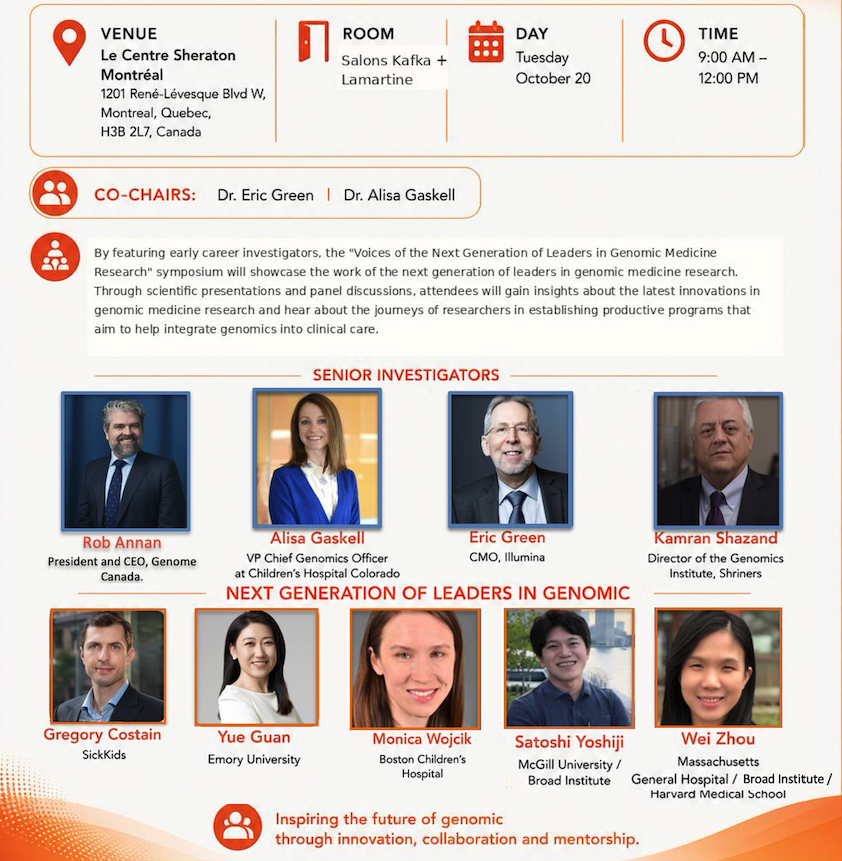
Excited to be speaking at the “Voices of the Next Generation of Leaders in Genomic Medicine Research” symposium at #ASHG2026, hosted by @illumina
📅 Oct 20, 9 AM–12 PM
Honored to join this fantastic group to discuss genetics, multi-omics, cardiometabolic disease, and more!
➡️ registration: https://t.co/Z0OPNh4885