How nicotine attacks the blood vessels: major review maps the biological hierarchy of cardiovascular harm
Key takeaways
●A review published in Nature Reviews Cardiology maps, for the first time, the full biological pathway by which nicotine damages blood vessels — from receptor activation to plaque rupture — and ranks cardiovascular harm across every major nicotine-containing product.
●The evidence shows a hierarchy of cardiovascular harm across all nicotine-containing products: highest with combustion products (cigarettes and waterpipes), then heated products, e-cigarettes and oral nicotine products – with complete abstinence the only risk-free option.
●Nicotine acts directly on two separate cell types in the vessel wall — the endothelial lining and the surrounding smooth muscle — compounding the damage through independent mechanisms.
●Tighter, unified regulation of all nicotine products is an urgent priority.
Sophia Antipolis, France – 20 August 2026: A review published today in Nature Reviews Cardiology provides the most detailed picture yet of how nicotine damages the cardiovascular system – tracing the biological chain of events from the moment nicotine binds to receptors in blood vessel walls through to the atherosclerotic plaque rupture that triggers heart attacks and strokes.1
Tobacco use and nicotine addiction remain among the leading preventable causes of premature death worldwide.2 In 2023 alone, more than 1 billion people globally smoked tobacco, causing an estimated 5.81 million deaths from direct tobacco use and a further 1.66 million deaths among non-smokers exposed to second-hand smoke.2,3 Close to 40% of these deaths are attributable to cardiovascular disease.2,3
Rather than focusing on a single product category, the review integrates mechanistic, biomarker, preclinical and clinical data across all major nicotine-containing products for the first time. “We wanted to settle a question that has been argued for years: is the harm caused by nicotine related to smoking or is nicotine toxic by itself?” explained lead author of the review, Professor Thomas Münzel from the University Medical Center Mainz, Germany. “We now show that nicotine activates receptors on blood vessel cells that switch off the enzyme eNOS that keeps vessels relaxed and open (eNOS uncoupling). This floods the vessel wall with damaging molecules and sets off a self-amplifying cycle of inflammation and clot formation. The pathway is active regardless of how the nicotine is delivered.”
The review describes how nicotine attacks the vessel wall through two independent routes. In the endothelial lining, it suppresses prostacyclin — a natural vasodilator — and triggers release of endothelin-1, one of the body’s most powerful vessel-constricting hormones. Separately, nicotine acts directly on the vascular smooth muscle cells that control vessel tone, blocking ATP-sensitive potassium channels and disrupting calcium handling, which favours constriction even when the endothelium itself is undamaged. “Nicotine doesn’t only disable the vessel’s protective lining — it directly tightens the muscle around it,” said Professor Münzel. “These are two separate attack routes converging on the same outcome: a vessel that constricts more, relaxes less and clots more easily.”
Building on this mechanistic map, the review establishes a consistent, evidence-graded hierarchy of vascular harm across product categories: highest with combustion products (cigarettes and waterpipes), then heated products, followed by aerosol devices (e-cigarettes), then oral nicotine products (chewing tobacco and pouches) with abstinence the only risk-free option. “E-cigarettes and heat-not-burn devices were initially marketed as reduced-risk alternatives to combustible cigarettes, but our data show these products sit on a continuum of cardiovascular risk, not off it,” said Professor Münzel. “Removing combustion clearly reduces harm – but it does not remove it.”
Author, Professor Filippo Crea, said, “This review closes an important evidence gap by evaluating, for the first time, existing mechanistic, biomarker and clinical data side by side across products, rather than product by product in isolation. It is apparent that nicotine is an active driver of endothelial dysfunction, the earliest step on the path to atherosclerosis, hypertension and heart failure — and only abstinence is risk free,” he noted.
The authors highlight that nicotine is marketed as little more than a mild stimulant, comparable to caffeine. However, nicotine’s dependence-forming potential is ranked alongside that of cocaine and heroin. “Nicotine’s cardiovascular toxicity at the molecular level, combined with its well-documented, high dependence-forming potential make the case for a coherent, nicotine-based regulatory framework rather than the current patchwork of product-specific rules,” said Professor Münzel.
President of the European Society of Cardiology and author, Professor Thomas F. Lüscher, said: “This research underscores why the ESC and the EU are calling for updated tobacco and nicotine regulation as an integral part of the Safe Hearts Plan. The evidence is clear that nicotine cannot be considered harmless. We must take this seriously in how these products are regulated, marketed and communicated to the public, especially to young people.”
The review calls for greater efforts to prevent the initiation of nicotine-product consumption, particularly among young people, given the risk of addiction and lifelong exposure trajectories. In addition, integrating taxation, flavour bans and evidence-based cessation support are highlighted as being essential to end the evolving epidemic of nicotine-containing product consumption.
ENDS
References:
1Münzel T, Kuntic M, Keaney JF Jr, et al. Nicotine-containing products and the cardiovascular system: mechanisms and global health implications. Nat Rev Cardiol. 2026.
https://t.co/QFU7xubRuX.
2Global Burden of Disease. IHME. https://t.co/0Iib3wF0GB.
3Our World in Data. https://t.co/DlfHGoc8m6.
ESC Press Office
Tel: +33 6 61 40 18 84
Email: [email protected]
Follow European Society of Cardiology News on LinkedIn
🚭 New in @NatRevCardiol: Our review on nicotine-containing products & cardiovascular disease! From cigarettes to e-cigs to nicotine pouches, no product is "safe" for the vasculature. Clear hierarchy of harm concerning nicotine products
Please RT
doi:/10.1038/s41569-026-01331-6
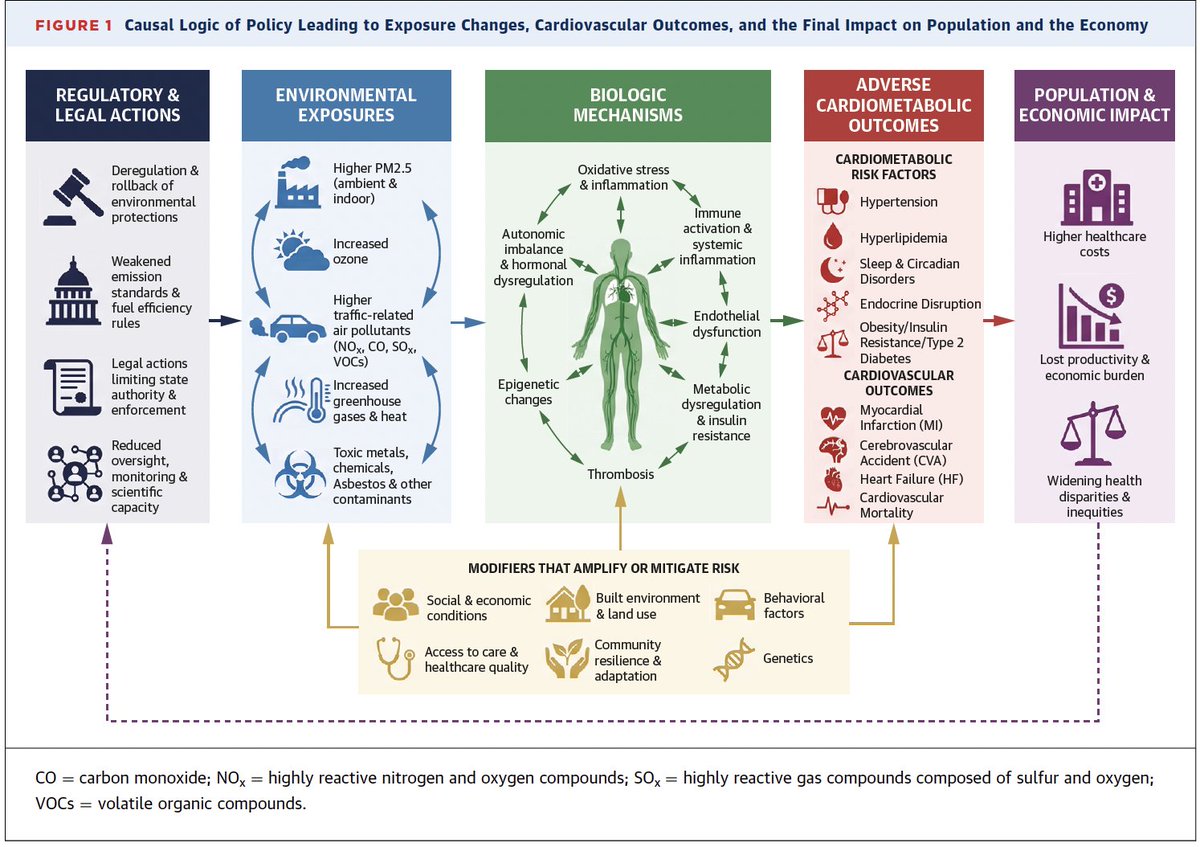
🫀 New in JACC: what happens to cardiovascular health when environmental protections are rolled back?
Proud to be part of this Special Communication led by Sanjay Rajagopalan and colleagues — just published in the Journal of the American College of Cardiology.
The numbers most people don't connect to cardiology:
Environmental risk factors now account for 12–15 million deaths worldwide every year — roughly 1 in 4 to 5 deaths globally.
Air pollution (PM2.5) is now the world's 2nd leading risk factor for death, right behind high blood pressure — a well-established cause of MI, stroke, heart failure and arrhythmia.
The historic phase-out of leaded gasoline alone is estimated to have avoided 256,000 cardiovascular deaths and 185,000 ischemic heart disease deaths in the US — one of the most successful cardiovascular interventions in modern history, and most people have never heard of it as one.
Yet we document nearly 30 recent US regulatory rollbacks — reconsidering the 2024 PM2.5 standard, weakening vehicle emissions rules, constraining EPA/CDC/NIOSH capacity, retreating from the Paris Agreement — that put decades of hard-won cardiovascular gains at risk.
Air pollution alone already costs the US ~$600 billion a year (≈3% of GDP), overwhelmingly through premature cardiovascular mortality. Keeping the current PM2.5 standard is projected to prevent 4,500 premature deaths and save $46 billion annually — a health dividend now on the table, not banked yet.
Environmental policy is cardiovascular policy. Full piece in JACC: https://t.co/1n25fVnjdi
#Cardiology #EnvironmentalHealth #AirPollution #PublicHealth #JACC #ClimateAndHealth #CardiovascularDisease @ESC_Journals@escardio@TomLuscher@CVR_TomaszGuzik@LindeCecilia
🚭🫀 #Nikotin greift die Blutgefäße auf zwei Wegen gleichzeitig an – neue Übersichtsarbeit in @NatRevCardiol zeigt erstmals die komplette biologische Kette vom Rezeptor bis zur Plaque-Ruptur.
Was passiert:
🔹 In der Gefäßinnenhaut hemmt Nikotin Prostacyclin und triggert Endothelin-1 – einen der stärksten Gefäßverenger überhaupt und führt über eine Verringerung der Tetrahydrobiopterin Bildung zu einer eNOS Entkopplung
Nikotin selbst bewrikt eine endotheliale Dysfunktion und erhöht den oxidatove Stress im Gefäß
🔹 Parallel blockiert es direkt die glatte Gefäßmuskulatur (ATP-sensitive K⁺-Kanäle, Kalziumhaushalt) – auch wenn das Endothel noch intakt ist
Ergebnis: ein Gefäß, das sich schlechter relaxiert, stärker konstringiert und prothrombotisch wird.
📊 Und die Studie räumt mit einem Mythos auf: E-Zigaretten & Tabakerhitzer liegen NICHT außerhalb des kardiovaskulären Risikokontinuums – nur der Verzicht auf Verbrennung senkt den Schaden, beseitigt ihn aber nicht.
Einzig risikofreie Option: völlige Abstinenz. 🚫
@ESC_Journals #Nicotine #CVD #Cardiology #PublicHealth @dzhk_germany@YoungDZHK
https://t.co/uQgGwk8NyL
Originalpublikation:
Münzel T, Kuntic M, Keaney JF Jr, et al. Nicotine-containing products and the cardiovascular system: mechanisms and global health implications. Nat Rev Cardiol. Published online August 20, 2026. doi:10.1038/s41569-026-01331-6
KontaktArtikel teilen:📷 📷 📷 📷
The ESC is delighted to announce the appointment of Prof. Tomasz Guzik as the next Editor-in-Chief of the European Heart Journal (EHJ). Selected through a highly competitive international process, Prof. Guzik will lead the journal’s next chapter, building on its outstanding legacy of excellence and innovation https://t.co/WFq96Xjfxy
We warmly congratulate Prof. Guzik on his appointment and look forward to the exciting future of EHJ under his leadership.
#EHJ #cardiology @ESC_Journals
🫀 New in JACC: what happens to cardiovascular health when environmental protections are rolled back?
Proud to be part of this Special Communication led by Sanjay Rajagopalan and colleagues — just published in the Journal of the American College of Cardiology.
The numbers most people don't connect to cardiology:
Environmental risk factors now account for 12–15 million deaths worldwide every year — roughly 1 in 4 to 5 deaths globally.
Air pollution (PM2.5) is now the world's 2nd leading risk factor for death, right behind high blood pressure — a well-established cause of MI, stroke, heart failure and arrhythmia.
The historic phase-out of leaded gasoline alone is estimated to have avoided 256,000 cardiovascular deaths and 185,000 ischemic heart disease deaths in the US — one of the most successful cardiovascular interventions in modern history, and most people have never heard of it as one.
Yet we document nearly 30 recent US regulatory rollbacks — reconsidering the 2024 PM2.5 standard, weakening vehicle emissions rules, constraining EPA/CDC/NIOSH capacity, retreating from the Paris Agreement — that put decades of hard-won cardiovascular gains at risk.
Air pollution alone already costs the US ~$600 billion a year (≈3% of GDP), overwhelmingly through premature cardiovascular mortality. Keeping the current PM2.5 standard is projected to prevent 4,500 premature deaths and save $46 billion annually — a health dividend now on the table, not banked yet.
Environmental policy is cardiovascular policy. Full piece in JACC: https://t.co/1n25fVnjdi
#Cardiology #EnvironmentalHealth #AirPollution #PublicHealth #JACC #ClimateAndHealth #CardiovascularDisease @ESC_Journals@escardio@TomLuscher@CVR_TomaszGuzik@LindeCecilia
I think #Hajek should read my article again, may be he sees then that his statement is completely wrong !
Munzel, meanwhile, wrote a paper in support of the EU tightening its laws on safer nicotine products in December 2025 that was roundly criticised by longtime tobacco control experts including Peter Hajek, a researcher considered a leader in the tobacco control field.
“The article and the press release give the impression that vaping or pouches pose the same risks to the heart and blood vessels as smoking. This is not true”
His statement is completely incorrect: We wrote: E-Cigarettes Are Less Harmful Than Cigarettes—But Far from Harmless; E-cigarettes reduce exposure to some toxins, but still cause vascular damage, foster addiction, encourage dual use, and lack proven long-term safety.
https://t.co/WHkrvl1655