Think of us as your geeky friend who's always on call. From smartphones to cord-cutting to video games, we've got your tech needs covered. Part of @FuturePLC
Looking for something new to watch? We've picked the best shows currently dominating Netflix’s top 10 list, including the new season of a hit spy thriller.
https://t.co/hp8OjvR8A0
AI is already integrated into our lives in many ways. It's changing the way we work, search and communicate. And while that kind of AI use may not be for everyone, perhaps one thing we can all agree on is how it is progressing medicine through breakthroughs that may have not happened without it. At least, not as quickly.
Researchers are using AI to understand cancer at a level of detail that would have been difficult to imagine just a decade ago. Rather than treating every patient with the same type of cancer in the same way, scientists are working toward treatments based on the unique genetic makeup of each person's tumor.
And there are encouraging signs that more personalized cancer treatments could make a real difference. In October, researchers reported promising Phase 3 clinical trial results for an experimental personalized cancer vaccine developed by Moderna and Merck.
When combined with the immunotherapy drug Keytruda, the vaccine reduced the relative risk of melanoma recurrence or death by 42% compared with Keytruda alone.
The vaccine isn't FDA-approved yet, and the trial doesn't establish that generative AI invented the treatment. But the results offer an important example of what personalized cancer medicine can achieve.
Meanwhile, AI is helping researchers tackle another part of the challenge: understanding exactly what makes one person's cancer different from another's.
This subscription-free app uses contactless motion sensors to track your 3 am wake ups and how long you've been asleep for — here's how it compares to my Oura Ring 5
https://t.co/OTlv3sgGwW
I never thought a gadget would make me want to cry — least of all one from Amazon.
After unboxing and setting up the Alexa Photo Frame, one of the first images it displayed was a black-and-white picture of my father, who has been deceased for 16 years, feeding a squirrel.
I remember having the photo stored digitally somewhere, but it’s been several years since I last saw it. But the Alexa Photo Frame pulled it up, and juxtaposed it next to another picture of a squirrel clinging to a screen door. The Photo Frame also wasted no time digging up scores of photos of our family cat, who also died around the same time as my dad.
It was a very emotional first few minutes with this device.
But the Alexa Photo Frame also went on to deliver photos of my child playing, vacations and other happy occasions, which brought back more pleasant emotions.
While I have plenty of criticisms of AI and its use, this is one instance where I feel like it delivers something positive, and makes this one of the best photo frames I’ve ever used.
Best Buy's Black Friday sale is slashing prices on a huge range of products from Apple. If you're looking for savings on iPads, MacBooks, Apple Watches and more, this is the one for you.
https://t.co/5CJG3VsNZR
If you're clued into social media, or terminally online like I am, you may have noticed posts of people realizing that photos shot on iPhone look different if they stick their hand in the frame. Instead of the drab, washed out browns and greens, you end up with a photo with warmer and more vivid colors than before. The only trade-off is that you need to have your hand in frame to get the effect.
Obviously, I was curious about whether this was actually true, and how much of an impact sticking your hand in shot actually makes to the final photo. As it turns out, yes, I could mimic the same effect by putting my own hand between the camera and the foliage.
And there's a very good reason for it, and that reason means iPhone 18 Pro owners can avoid going to these same extremes.
I’ve spent thousands of hours with my PS5 since launch. But in all that time, every single one of the best PS5 games I’ve enjoyed has been played on a stock DualSense controller. I’ve never used a so-called “pro” controller.
That was until this week, when I got my hands on Nacon’s new Revolution 5 Unlimited controller, designed for use with Sony’s current generation console (and PC). It’s opened my eyes to a whole new way of experiencing competitive gaming. It's made returning to my regular old DualSense a challenge (sadly, the Revolution 5 Unlimited sometimes needs to charge).
This $230 / £179 pad most definitely qualifies as a pro controller, offering a vast array of features and upgrades: Magnetic TMR joysticks, dual-mode actuation triggers, and seven (yes, seven) fully programmable shortcuts. And that’s just the start; there’s one upgrade that stands out most of all, and it turns this third-party controller into a genuine game-changer.
Winter isn't great for starting seeds, but with this easy hack you can set up mini greenhouses in your garden that'll protect your plants until spring.
https://t.co/qodiA1wkwM
I'm just going to rip off the Band-Aid: the xBloom Studio coffee machine is $599. Alright, now that's out in the open, let's get to the bottom of what the xBloom Studio actually is.
Although it looks like something you'd find in a minimalist NYC apartment (life goals), the xBloom Studio is a maximalist coffee machine. It's a pour-over, scale, and grinder in one. It's even app-compatible, so you can customize your drink down to the milliliter.
Like the Ratio Four ($279), it's an automated pour-over, but unlike the Ratio Four, it's got the aforementioned built-in grinder, built-in scale, and app control. Is that extra $329 worth it?
If you read any review for Apple’s new MacBook Pro, you will see a lot of folks drooling over the new PROLED XDR display. And they’re not wrong — flawless color calibration, a new touchscreen interface and up to 2,000 nits of peak brightness.
But if you look past the shiny new Dynamic Island, you’ll see a darker reality. One where what I like to call “OLED washing” is happening.
Apple didn’t build a machine for the next generation of computing (local AI). They built a $2,899 luxury item. If you want to see what a real, weaponized local AI computer looks like in 2026, you need to look away from Cupertino and start looking more closely at the better value-for-money monsters being built with Nvidia’s RTX Spark and AMD’s Strix Halo inside.
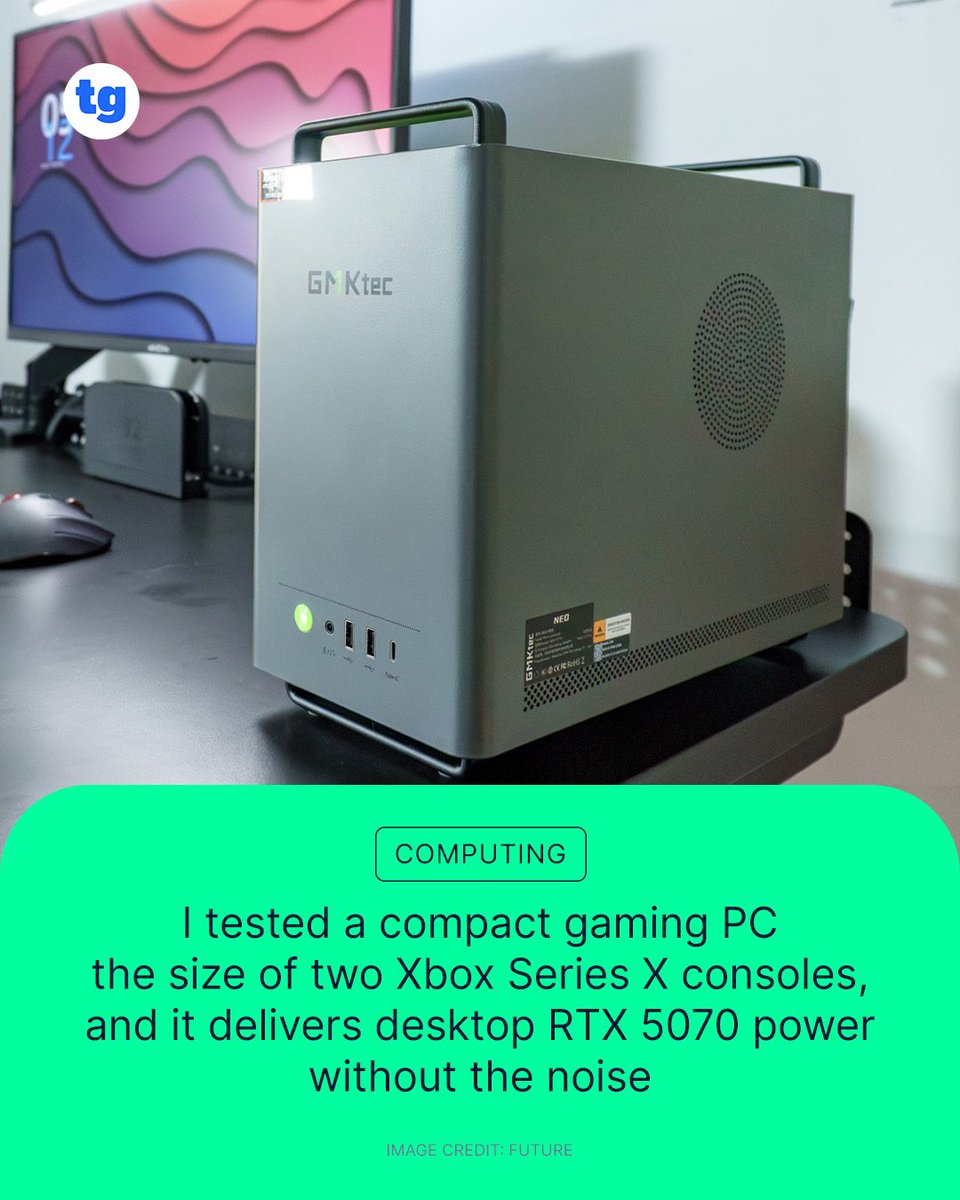
My GMKtec Neo-X1 Pro review will help you decide if this is the best gaming PC for you or if it’s worth going with something with a slightly larger case for less.
https://t.co/NfcKUEJCF1
The GMKtec Neo-X1 Pro is a desktop gaming PC with a twist. Unlike other large, bulky desktops, it’s remarkably compact with a volume of 14.6 liters, making it even smaller than the HP Victus 15L.
Known for making some of the best mini PCs, the Neo-X1 Pro is GMKtec’s first-ever small form factor (SFF) gaming tower. To get its design this small without overheating, the company used a custom all-in-one liquid cooler paired with a high-end mobile AMD CPU. However, the Neo-X1 Pro still packs in a desktop-grade Nvidia RTX 5070 dedicated GPU.
I’ve been using the Neo-X1 Pro as my daily driver for both work and gaming for the past two months, and it has continued to impress me. From its compact design — complete with carrying handles — to its near-silent performance even under load, this gaming desktop certainly delivers. Just as if you built your own SFF PC, you are paying a premium for its more compact size.