17 years after Bitcoin's creation:
• still 10 minutes per block
• still capped at 21 million
• still adjusts difficulty every 2016 blocks
• still decentralized
• still open source
• still SHA-256
• still 99.99% uptime
• still never hacked
• still immutable
• still growing
Yet most people still think it's going to zero.
I’ve listened to at least seven Bitcoin/MSTR Spaces this week.
One thing became obvious.
Most of the strongest bull arguments are backed by math, SEC filings, capital markets, and the company’s actual disclosures.
Many of the bear arguments, on the other hand, seem to rely on feelings, personalities, and whatever the current price action happens to be.
“I don’t like Saylor.”
“It feels wrong.”
“This can’t last.”
That’s not analysis.
If you believe the strategy fails, show me the math. Show me where the capital structure breaks. Show me the flaw in the numbers.
Narratives change.
Math doesn’t.
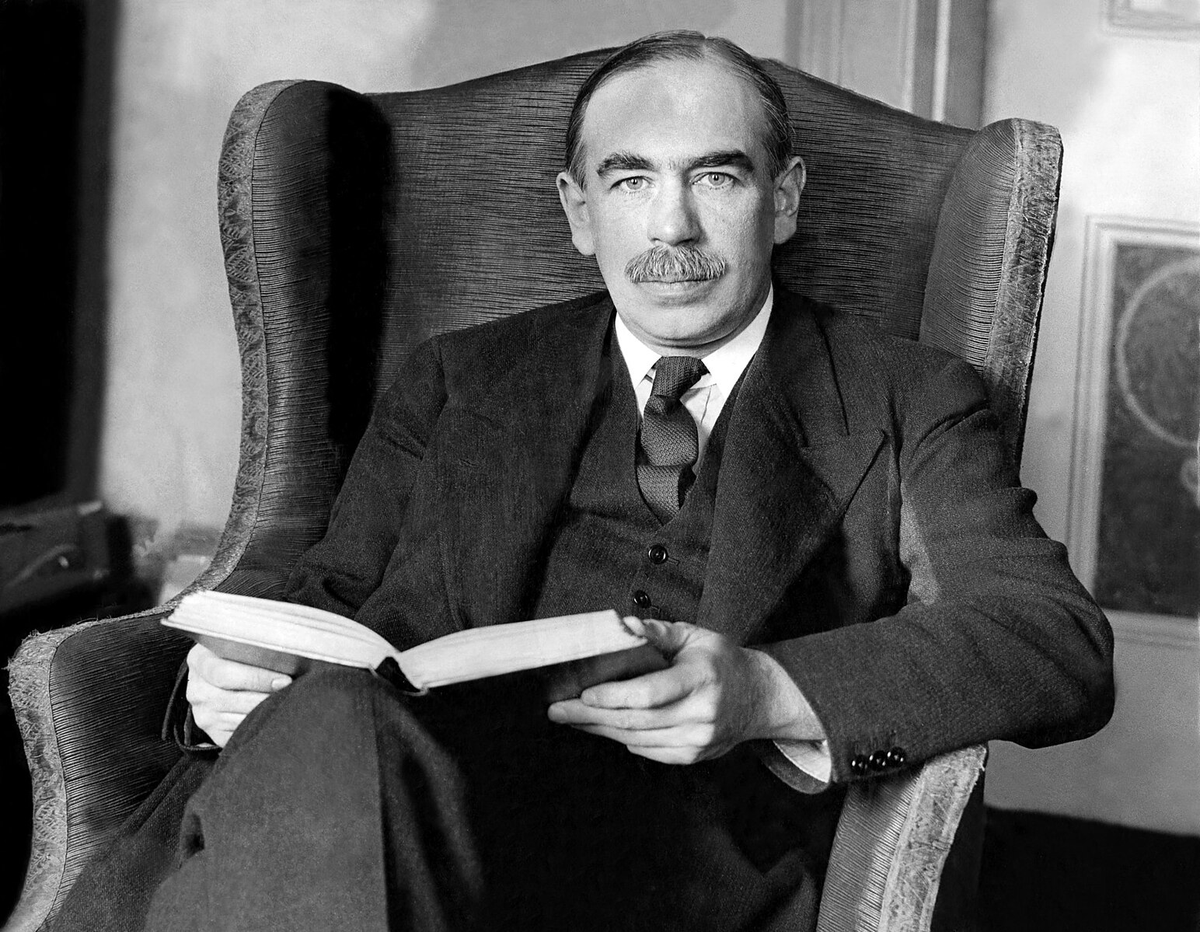
Keynes built his entire system on a confusion a first-year student should catch: he treated saving and investment as enemies. Pull a dollar out of consumption and stuff it under the mattress, and the whole economy supposedly seizes up. Demand collapses. Workers get fired. The "paradox of thrift" arrives, and Keynes hands you the policy prescription: spend, borrow, dig holes and fill them back in.
You're meant to believe that thrift is a vice. That the prudent man saving for his children's education is sabotaging his neighbors. This is a remarkable inversion, and it's wrong from the foundation up.
What actually happens when you save? You forgo a steak dinner tonight, and you lend that money out through your bank or your bond purchase. That capital flows to a firm building a factory, a baker buying a second oven, a fishing fleet building more boats so it can catch more fish next year. Böhm-Bawerk explained this in the 1880s with his fishermen: you eat less now so you can construct the net that feeds you far more later. Saving is the raw material of every roundabout production process that ever raised a wage.
Keynes saw spending as the engine of prosperity. He never asked where the factories came from. He treated consumption as the cause of prosperity when consumption is the reward you collect after the capital structure has done its work. A society that consumes everything it produces stays exactly where it is forever, like the man who eats his seed corn and wonders why spring brings no harvest.
This "cure" poisons the patient. When central banks suppress interest rates to "stimulate demand," they sever the signal that coordinates saving with investment. Entrepreneurs read cheap credit as genuine thrift and build projects no one saved to complete. Then the bust arrives to liquidate the malinvestment, and the same economists who caused it demand more of the cure. Greenspan ran this script after 2001. You watched the result in 2008.
Saving was never the disease. It was the only medicine, and Keynes taught us to spit it out.
Jack Dorsey put 1.3 million dollars into it.
Vitalik Buterin gave it 128 ETH.
You have never heard of it.
It is called SimpleX. It is a messenger. It does not need a phone number. It does not need an email. It does not need a username. It does not need a user ID.
Not a hidden ID. Not a hashed ID. None at all.
Signal needs your phone number. WhatsApp needs your phone number. Telegram needs your phone number. Every messenger you have ever called "private" knows the one thing your bank, your stalker, and your country use to identify you.
SimpleX knows nothing.
It was built by Evgeny Poberezkin, a London-based engineer. Before this he wrote Ajv, the JavaScript validator that runs in 300 million downloads every month. He could have built anything.
He built the messenger with no users on the server.
Here is the trick.
Every other messenger gives you an identity. SimpleX gives you a connection. Each chat is its own one-way pipe. The server never sees who you are talking to. It does not even know you exist as a user.
11,327 stars. AGPL-3.0. Version 7.0 beta released two days ago.
iOS. Android. macOS. Windows. Linux. Free.
A 4-person team in London is the last line of defense between your conversations and every government, every advertiser, and every database breach.
The most private messenger ever built is the one you have never heard of.
(Link in the comments)
We are breaking historic records in economic growth. Even our worst quarter outperformed the historical average of the last 100 years of socialist catastrophe.
LONG LIVE FREEDOM, DAMN IT...!!!
A senior Anthropic engineer just dropped 11-page PDF on "Loop Engineering" for agentic systems.
The shift: you stop prompting the agent. You build the system that prompts it instead.
Schedule → Discover → Build → Verify → Repeat
Every loop runs one turn, five moves:
• Discovery: it finds its own work - failing CI, open issues, recent commits - instead of being handed a list.
• Handoff: each task gets an isolated git worktree so parallel agents don't collide.
• Verification: a second agent, told to assume the code is broken, reviews the first. The "thing that can say no."
• Persistence: results get written to disk, never left in a context window that gets flushed.
• Scheduling: an automation wakes it on a timer. That's what makes it a loop.
The key insight: an agent grading its own work always praises it.
This 11-page PDF changed how I'm building agentic systems today.
Read it now, then explore the article below.
My friend applied to 200 tech jobs in two years. No CS degree. No callbacks.
Last month Anthropic offered him $750,000.
All because of one Stanford lecture. Free on YouTube. One hour.
A professor explains how ChatGPT actually works. Not the Twitter version. The real one.
He watched it in bed. Paused it eleven times. After that hour he told me something I didn't believe. "It's embarrassingly simple."
Three days later he applied to Anthropic.
Every single question they asked him, he knew from that video.
An asian guy has discovered a method to learn anything ten times faster using AI!
It just involves the Claude + Obsidian.
Most people learn the slow way: read, forget, re-read, forget again.
His flip: use Claude to turn anything you're learning into small, connected notes. Use Obsidian to link them so nothing you learn ever sits alone.
The slow way: highlight a book, move on, forget it in a week.
The fast way: Claude breaks it into atomic notes, and Obsidian links them into a growing web of knowledge.
Six months in, one new idea instantly connects to twenty things you already know.
I broke down every Claude resource you should try to master claude in 7 days with practical guide that most people have never found.
Article below ↓
Andrej Karpathy spent 70 minutes breaking down how top AI users actually work with LLMs.
The reality is simpler than people expect. You tell the model what you want in plain language and let it run.
No 40-line system prompts. No secret tricks.
By 2026 the engineer who writes off LLMs loses to the junior who just set one up properly.
70 minutes. Free. A rare straight look from an OpenAI co-founder.
Bookmark it and watch.
Two Anthropic engineers have just revealed in 24 minutes all the hidden Claude features that almost nobody knows about.
This video is going to completely change the way you use AI.
Watch it and save it.
SOMEONE BUILT A FREE PROXY THAT READS PAYWALLED ARTICLES BY PRETENDING TO BE GOOGLE
it's called Ladder and it's sitting at 8,000 stars.
i never understood how the "free article" trick worked until i read the code. it's almost too simple. the NYT, WSJ, Bloomberg, and Nature can't hide their articles from Googlebot, because a page Google can't see is a page that vanishes from search. so they serve Google the full text for free.
Ladder just shows up wearing Google's badge. same user-agent, same crawler IP. the site hands over everything behind the wall.
> paste any paywalled URL and the wall disappears
> works across hundreds of news and journal sites
> self-hosted on your own server, so there's nothing to seize
> strips CORS and security headers too, a real time-saver for devs
> one Docker command and you're live
the hosted versions like 12ft. io keep getting pressured offline because they have a domain and a company to go after. your own instance has neither.
people pay for news bundles that still lock half the articles this opens for free.
GPL-3.0. written in Go.
repo: https://t.co/AIQ3IyKyKd
Anthropic engineer:
"you're not supposed to prompt Claude. you're supposed to build a system that prompts itself [loops]."
this is one of the best workflows I've seen in a long time
in this video he breaks down exactly how most people are building loops wrong:
- the memory file you never set up, so every loop starts from zero
- the sub-agents that 95% of builders have never split apart
- the stop condition setup that keeps loops from running forever and billing you in your sleep
- why writing one prompt a day is the slowest way to use Claude
if you've been using Claude for more than a month and still typing every task by hand, you've been running one prompt when you could be running a system of loops
instead of another prompt tonight, watch this
make sure to bookmark it before it gets buried
full guide in the article below