“Something’s broken, and it’s not our bodies… it’s the system.”
It is quite literally our bodies that are metabolically broken and “Hims” is not some Robin Hood-like underdog, they are a multi-million dollar company profiting off of naive people like everyone else.
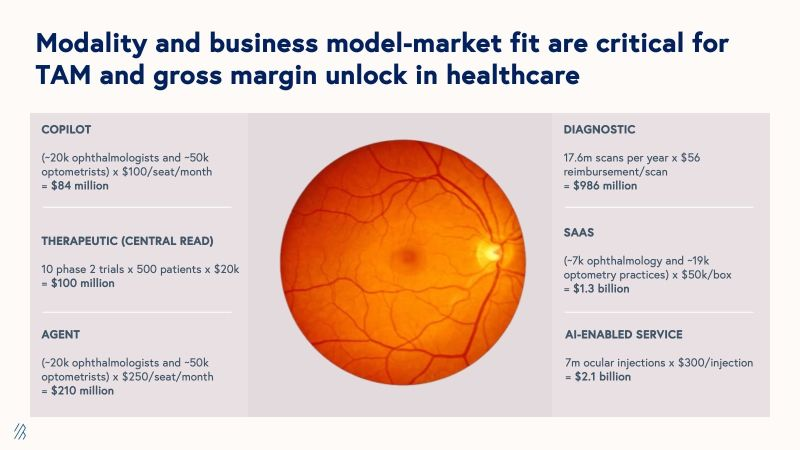
one of the most important concepts we introduced in our recent healthcare AI roadmap is the notion of “modality—business model—market fit.” this concept describes how the delivery method and business model of AI in healthcare directly shape its potential to create value.
there are many possible combinations of modalities and business models in healthcare. AI can be delivered as software, copilots, agents, services, diagnostics, or therapeutics, supported by business models ranging from usage-based and volumetric pricing to performance-based and shared savings arrangements.
nailing selection of modality and business model is essential for AI companies seeking large market opportunities and profitable operations.
as we describe in an example with computer vision-based diabetic retinopathy screening, modality and business model selection can drive a difference in TAM by upwards of 25x, and has serious implications for overall margin structures.
more here: https://t.co/z4Bq1wIMQW
one key reason why healthcare technologies like AI, telemedicine, and software haven't structurally lowered costs or broadened access for the entire system after decades of experimentation (excluding pure financial engineering of payer contracts) is the limited reimagining of care delivery itself, with asynchronous telemedicine as a notable exception.
in the same way that digitizing physical paper failed to exploit the capabilities of a new computing medium for word processing, hosting physician-patient conversations over video does not transform the actual delivery of care.
in telemedicine, many of the inputs (e.g., clinician time) and therefore cost structures of in-person care persist, which is why we often see fee-for-service telemedicine companies struggle to achieve economies of scale (i.e., growing revenues non-linearly while growing costs linearly).
until we deconstruct the components of a medical appointment – from intake and triage, to chart review, history gathering, physical examination, diagnosis, treatment, and follow-up – we will continue to be underwhelmed by the disconnect between the transformative potential of these technologies and real-world patient/system impact.
i’m optimistic that the emergence of reliable and performant medical AI agents will urge us to perform this deconstruction and redesign the fundamental building blocks of a “medical appointment.”
Health solutions that pull forward and make more tangible benefits/consequences will be most powerful. Committing to exercise and eating better always felt more purposeful when playing sports. To me health has become more of an account for deposit/withdrawal than an end goal.
(1/7) Over the past half century, Wall Street was completely revolutionized by computers.
Not so long ago, human brokers on the stock exchange floor haggled to buy and sell every stock, writing their agreements on pieces of paper. A 🧵:
1/ “It’s the Wild Wild West of point solutions,” a health plan admin lamented to @tanoojL and me.
So, we decided to make the Wild West a little easier & friendlier to navigate. We built a *free* resource to search for #digitalhealth vendors.
🤠 https://t.co/SJhF34Mrku
#FightClub got booed when it debuted at #VeniceFilmFestival
While it was being booed, Brad Pitt turned to Edward Norton and said, 'That's the best movie I'm ever gonna be in'