As a young socialist, Hayek read Ludwig von Mises’ 1920 paper “Economic Calculation in the Socialist Commonwealth.”
Mises showed that socialist central planning isn’t merely inefficient, it’s impossible.
Without private property and genuine market prices, planners lack any rational way to allocate scarce resources or determine real costs and needs.
Even Oskar Lange, a leading socialist in the calculation debate, effectively conceded the point.
While he promoted “market socialism” with trial-and-error pricing by a central board, real-world socialist planners in Eastern Europe quietly relied on world capitalist market prices as a guide.
Without external free-market price signals, pure socialism would be economically blind and coordination would collapse.
Mises went further, arguing that interventionism, the “middle way” of government meddling, is inherently unstable.
Each intervention creates problems that invite more interventions, eventually leading to full socialization.
Price controls cause shortages, subsidies distort production, and the cycle continues until the economy is fully planned.
The lesson is clear.
Rational economics requires genuine market prices emerging from voluntary exchange and private property.
Half-measures don’t stabilize the system. They accelerate the drift into central planning.
The Austrian School understood this decades before the collapse of the Soviet bloc proved it in practice.
Farmers have figured out that the cheapest pesticide is a strip of flowers.
When you plant wildflowers through a crop field, not just around the edge but in strips running through the middle, you get ladybugs, lacewings, hoverflies, and parasitic wasps living in the field instead of visiting it.
They eat the aphids, the caterpillars, and the mites for free, all summer long.
In controlled trials, fields with tailored flower strips had leaf-beetle numbers 40 to 50% lower and crop damage cut by around 60%, enough to drop below the threshold where spraying was even considered worth it.
The flowers attract a standing army to our fields.
We spent decades engineering chemicals to kill the insects eating the crop, when the insects that eat those insects would have worked for the price of seed.
The implementation of free market and capitalism in Eastern Europe made them not only much wealthier, but also significantly improved life expectancy.
The only people in favor of socialism are those who have never experienced socialist misery by themselves. Don’t listen to them.
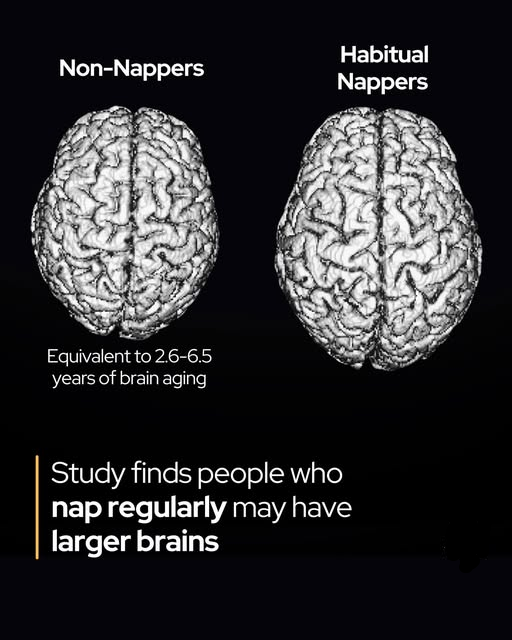
Skip your daily nap, shrink your brain.
A study by researchers from University College London and the University of the Republic in Uruguay has found that people who habitually take daytime naps tend to have significantly larger total brain volume—a key indicator of brain health that typically declines with age and is associated with reduced dementia risk.
The team used Mendelian randomization, a method that leverages genetic variants (present from birth) that make people more likely to nap regularly. By analyzing brain MRI scans and health records from more than 35,000 participants in the UK Biobank, they discovered that those genetically inclined to nap had brain volumes corresponding to 2.6 to 6.5 fewer years of aging.
While this doesn’t definitively prove that napping itself enlarges the brain, the genetic approach helps rule out many lifestyle-related confounding factors, providing stronger evidence of a potential causal relationship than traditional observational studies.
Notably, the researchers found no link between napping predisposition and performance on tests of reaction time, memory, or visual processing. However, previous studies have shown that short naps can deliver immediate cognitive benefits.
The study lacked specific data on nap duration, but prior research suggests naps of 30 minutes or less provide the greatest advantages while minimizing disruption to nighttime sleep.
This is the largest study to date linking regular napping with brain structure. Although further research is needed in more diverse populations, the findings bolster the idea that a brief daytime rest may help preserve brain volume and support long-term cognitive health.