Interesting work on low-space quantum elliptic curve point addition: https://t.co/AddkJ0Mx3Z
I knew ~800 qubits for n=256 was doable, but I expected like 100x more Toffolis than they achieved. And that's despite them wasting a lot of Toffolis by using non-approximate circuits!
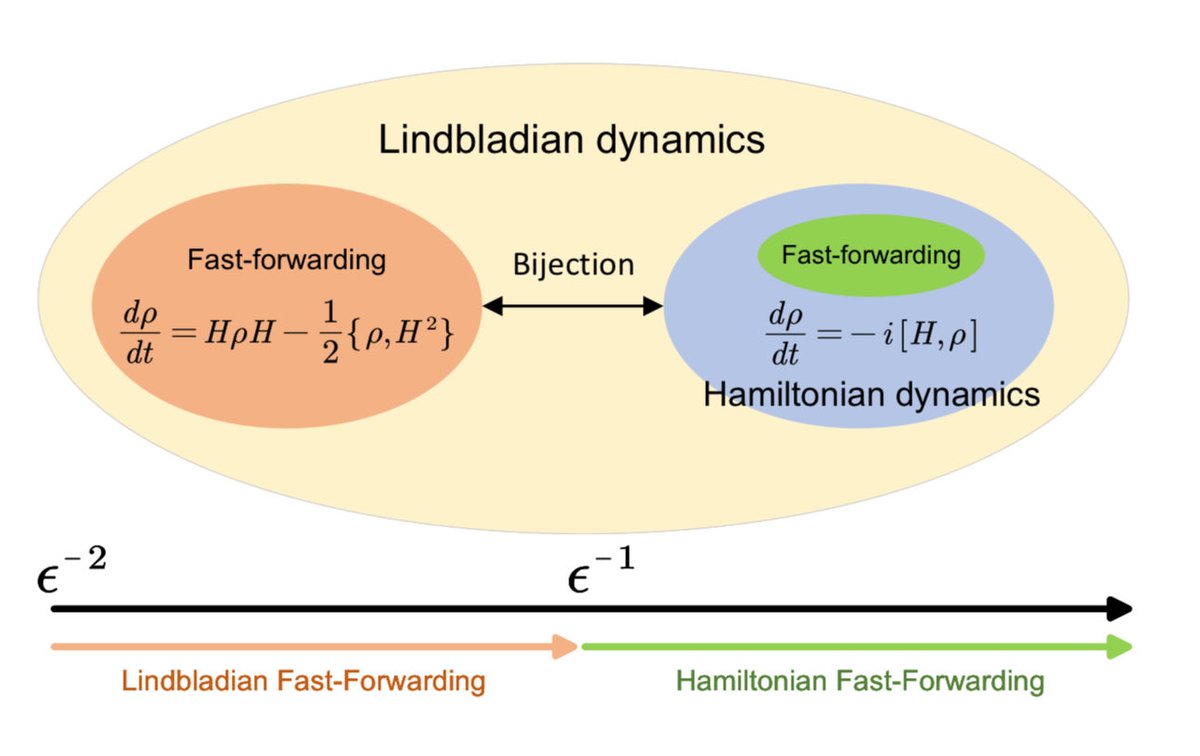
Excited to share our another work on Lindbladian fast-forwarding with relations to quantum phase estimation (QPE) and standard quantum limit-Heisenberg limit transition!
https://t.co/Pl5W1sEYst
The 25th Asian Quantum Information Science Conference (AQIS 2025) will be held during August 4-8 at Hong Kong. Please register soon if you plan to attend, as the early registration deadline will be on June 30!
https://t.co/m4WcbmeeWF
Join us for the QuICS 10th Anniversary Symposium on Jan 23 @UofMaryland! Celebrate a decade of innovation in quantum information and computer science with talks by distinguished visitors and alumni on cutting-edge research.
Learn more & RSVP by Jan 3: https://t.co/6b8UnE5kSG
Our SpacePulse paper https://t.co/Pe9QBHk7dJ was accepted by DAC 2024! This is my first quantum architecture publication. It applies contextual subspace to parameterized pulses, achieving VQE with fewer qubits and measurements. Congrats my student Rui Yang for her first paper!
With @MogicianTony and @ChenyiZhang0802, we study quantum algorithms for minimizing the maximum of convex functions, and also prove quantum lower bounds showing near-optimality. The paper was accepted by ICLR 2024 with arXiv link https://t.co/Lc8aSYZiqY See you in the conference!
With @gong_weiyuan and @__AntiEntropy__, we study quantum simulation algorithms (qDRIFT, random permutation, symmetry protection) in the low-energy subspace, improving over full unitary simulations. See https://t.co/l7N1nVhsZA
Congrats my student Shuo Zhou for his first paper!
With Zherui Chen, Yuchen Lu, Hao Wang, and @YizhouLiu0, we utilize open quantum systems with Markovian dissipation, namely Quantum Langevin Dynamics (QLD) to solving optimization problems, particularly nonconvex ones intractable for gradient descents. See https://t.co/3WKTMexGl9
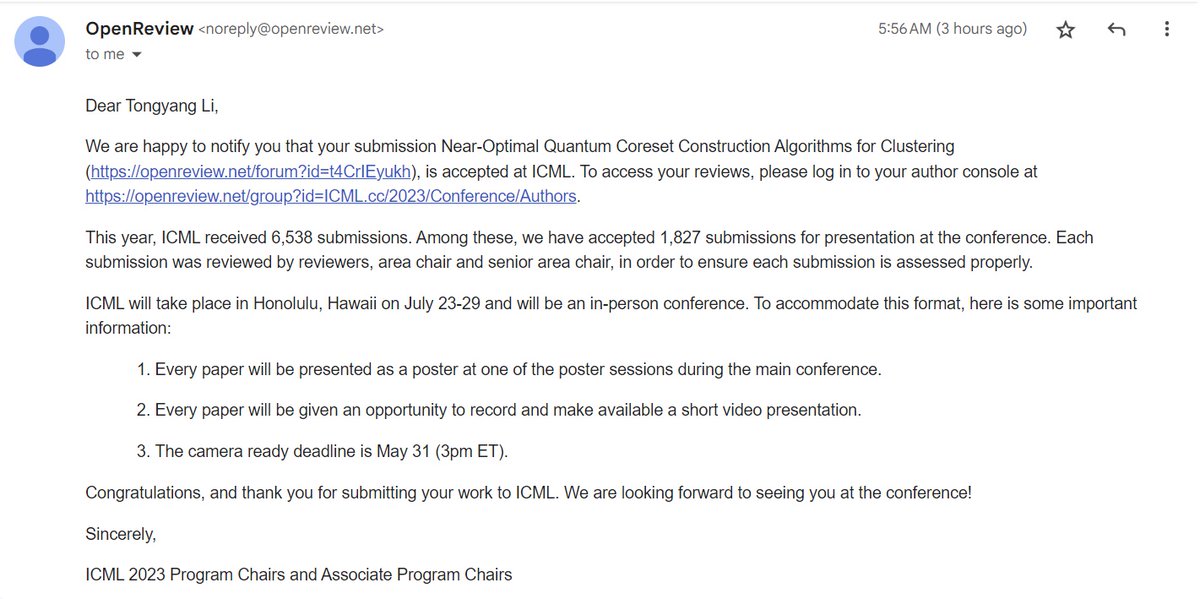
Two papers got accepted in ICML 2023! One on quantum lower bounds for finding stationary points of nonconvex functions, and the other on near-optimal quantum coreset construction algorithms for clustering.
Congrats my student Yecheng Xue for her first paper at top conferences!
Algorithm Analysis and Complexity Theory, a public class from Peking University @PKU1898 , taught by #PKU#CFCS faculty member Dr. Tongyang Li is online now! @tongyang93 https://t.co/udLB45fQo7
With Han Zhong, Jiachen Hu, Yecheng Xue, and Liwei Wang, we give quantum algorithms for reinforcement learning with logarithmic worst-case regret in number of episodes. Our result covers tabular MDPs and linear mixture MDPs. Congrats my student Yecheng for her first arXiv paper!
Quantum Reinforcement Learning is pushing the boundaries of AI, and now researchers have achieved logarithmic worst-case regret! 🤯 Check out @tongyang93's paper for the details: https://t.co/164UkawwVz #Quantum#AI#RL
@XinyiChen2@HazanPrinceton Amazing work, congrats!
A high-level question: Essentially, online nonstochastic control problems are solved by online learning algorithms. Theorem 1 of this paper also has an online form, so can we directly use online learning instead of transforming to nonstochastic control?
Are we ready for the next computation paradigm to power computer vision? We are organizing the first workshop on Quantum Computer Vision at #CVPR2023. Stay tuned for details. @CVPR#QCV#QuantumComputerVision
With @tongyang93, we study quantum lower bounds on finding stationary points of nonconvex functions, and proved that there’s no quantum speedup in the following two settings: having access to 1) p-th order derivatives, or 2) stochastic gradients. https://t.co/NXA6vapz5Q
With Weiyuan Gong and @tongyang93, we study the robustness of quantum algorithms for d-dim nonconvex optimization with noisy inputs and characterize the domains where they can find an approximate local min with polylog, poly, or exp number of queries in d. https://t.co/me1V3A13KH
With Xinzhao Wang and Shengyu Zhang, we give a unified quantum algorithm framework for estimating properties of discrete probability distributions, with applications to entropy estimation and beyond: https://t.co/mMyQtSR93n
We are hiring postdocs (deadline today but it's a soft deadline) and faculty - joint between math and college of computing (deadline Dec 15).
postdoc: https://t.co/rC13lt9VFG
faculty: https://t.co/gDIHs1NkPD