If you’re wondering what challenges MegaETH is tackling, one of the biggest is the streaming EVM. MegaETH’s streaming EVM balances low-latency block streaming and high throughput.
What’s our latency target? 1ms. This is because power users, like matchmakers collocating with the sequencer, generally expect network latency as low as 1ms. Going lower doesn’t help when physical network latency becomes the limiting factor. Achieving this target is critical to delivering the real-time experience our users need.
However, optimizing for latency and throughput simultaneously is a much harder problem than optimizing for one of the metrics individually. This is because many of the steps in the block building process, such as updating the state trie and committing state changes to the database, are traditionally inefficientat small block sizes.
As a concrete example, we ran an experiment with recent Ethereum mainnet transactions and tested two strategies for committing state changes to thedatabase: large and small blocks.
* Large blocks (10,000 txns per block): each commit takes 150ms.
* Small blocks (100 txns per block): each commit takes 8ms.
The performance degradation when switching from large to small blocks may not be obvious if we look at the cost per commit. However, it becomes apparent when we look at the cost per transaction.
* Large blocks (10,000 txns per block): 15us per transaction.
* Small blocks (100 txns per block): 80us per transaction.
That is, the per-transaction cost increased by 5.3x when we reduced block size by 100x. In other words, system throughput decreased by 5.3x as we reduced latency by 100x. One does not get the best of both worlds!
This drop in throughput can be attributed to several factors:
- Smaller batches result in more database writes overall.
- Storage devices tend to be more efficient with larger batched writes.
- More database software overhead (e.g., data structure traversal) when handling smaller batches.
The drop in throughput would be fine if all we wanted was low latency. However, our vision of a realtime blockchain is one which preserves responsiveness even under high load. By carefully analyzing such behaviors, we are tackling the delicate balance of ensuring our streaming EVM can achieving both high throughput and low latency.
p.s. You may have noticed we’re focusing on the problem rather than the solution — and that’s intentional! This series is all about showing how we analyze problems as systems researchers. We focus on making the right assumptions, testing them, and verifying our conclusions. We believe that clearly defining the problem is crucial, because once we all align on the problem, the solution is within reach.
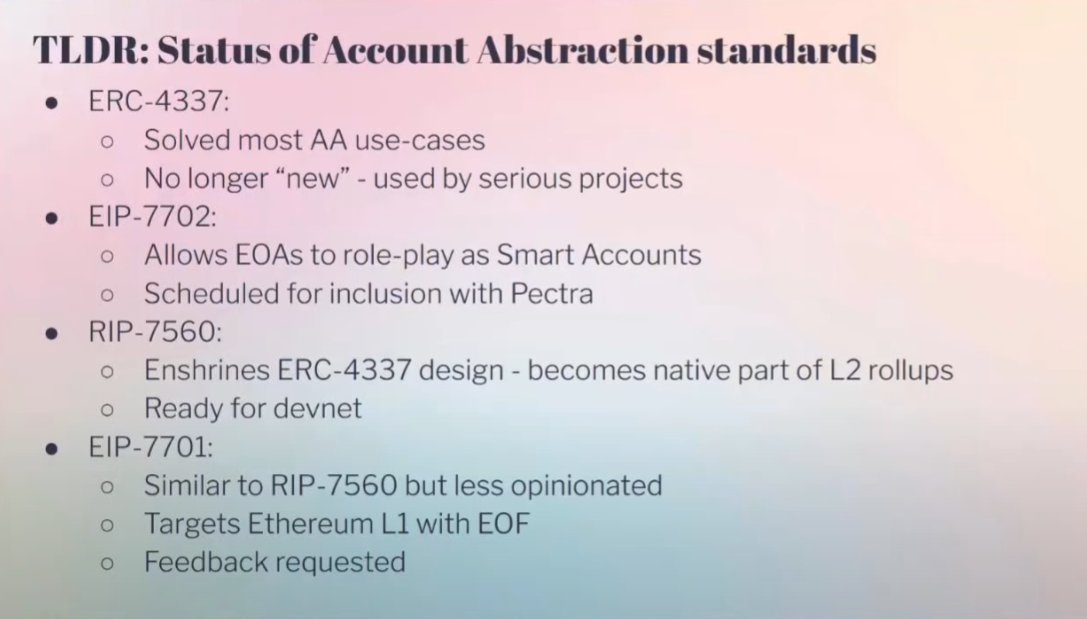
One of the biggest and longest-standing UX pain points in Ethereum (approve then swap) will be solved in 2025.
Not to mention all of the other things coming along with the below upgrades (smarter EOA's, sponsored gas payments, advanced permissions etc).
DevCon is over, but we’re not missing a beat. Feast your eyes upon the best version of MetaMask yet:
🦊 MetaMask Extension v12.6 🦊
It just keeps getting better. Here are a couple of BIG features that you’ve been asking for:
I'm interested in protocol engineers, devs building agents, devs building SDKs and developer tooling similar to @BrianknowsAI toolkit, or really anything interesting
This is the most in depth guide that exists explaining:
- ProtoDanksharding (EIP4844)
- Full Danksharding
- Data Availability
- Data Availability Sampling
- EigenDA
I learned a lot and wish I had something like this a long time ago. Incredible job as usual from @jordanmmck 💪
New diagram (1/4): Ethereum + L2 scaling vision.
I've drawn Optimistic / ZK roll-ups running on top of Eth, plugging into DA system. Eth DA is shown as a ring around Eth world state, then @eigen_da is shown as a larger ring.
Video today on 4844, danksharding, EigenDA! 🧵
EigenLayer powers diverse set of apps & services across:
============== ================
📦 Gaming Engines 🗃️ Data Availability
📂 Databases 🔮 Prediction Markets
📋 Order Matching ➡ Transaction Sequencing
💸 MEV 🤖 AI & Benchmarking
... more apps! ... more apps!
"We’re at the beginning of an infinity of knowledge.
We understand things using good explanations and constantly replace old theories with better ones.
There’s no endpoint in sight. There’s no perfection.
Every theory can be falsified eventually and improved."
@naval