This is the best part from Pierre Poilievre appearance on the Diary of a CEO podcast;
"Those who push a socialist ideology have a gross contradiction in their view of human nature.
They say that human beings are wretched, self-interested, greedy when they’re in the private voluntary economy, but they’re angels when they’re in the governmental economy.
They argue that the government should just control everything because then we have all these angels that will decide for us."
🎯
Rory Sutherland made a quietly devastating observation about one of the biggest societal shifts of the last 50 years.
He said the move to the double-income household started as an option but quickly became an obligation. The big winners? Governments (twice as many people to tax) and property owners (now two salaries were needed to buy a house). The big loser? The family itself, which lost roughly 35 hours of discretionary leisure time per week — with no real increase in living standards, because the extra money was largely soaked up by higher house prices and taxes.
It’s a classic example of how something that begins as liberation can quietly turn into a new form of constraint.
Longitudinal studies on happiness and time use (including data from the American Time Use Survey and OECD reports) show that the sharp rise in dual-earner households correlated with stagnant or declining leisure time for families, while subjective well-being metrics for parents have not risen in line with the additional income — supporting the idea that much of the gain was captured by housing costs and taxation rather than improved quality of life.
It’s a reminder to look carefully at changes that society presents as inevitable progress.
What do you think — has the double-income model delivered more freedom or more pressure for most families?
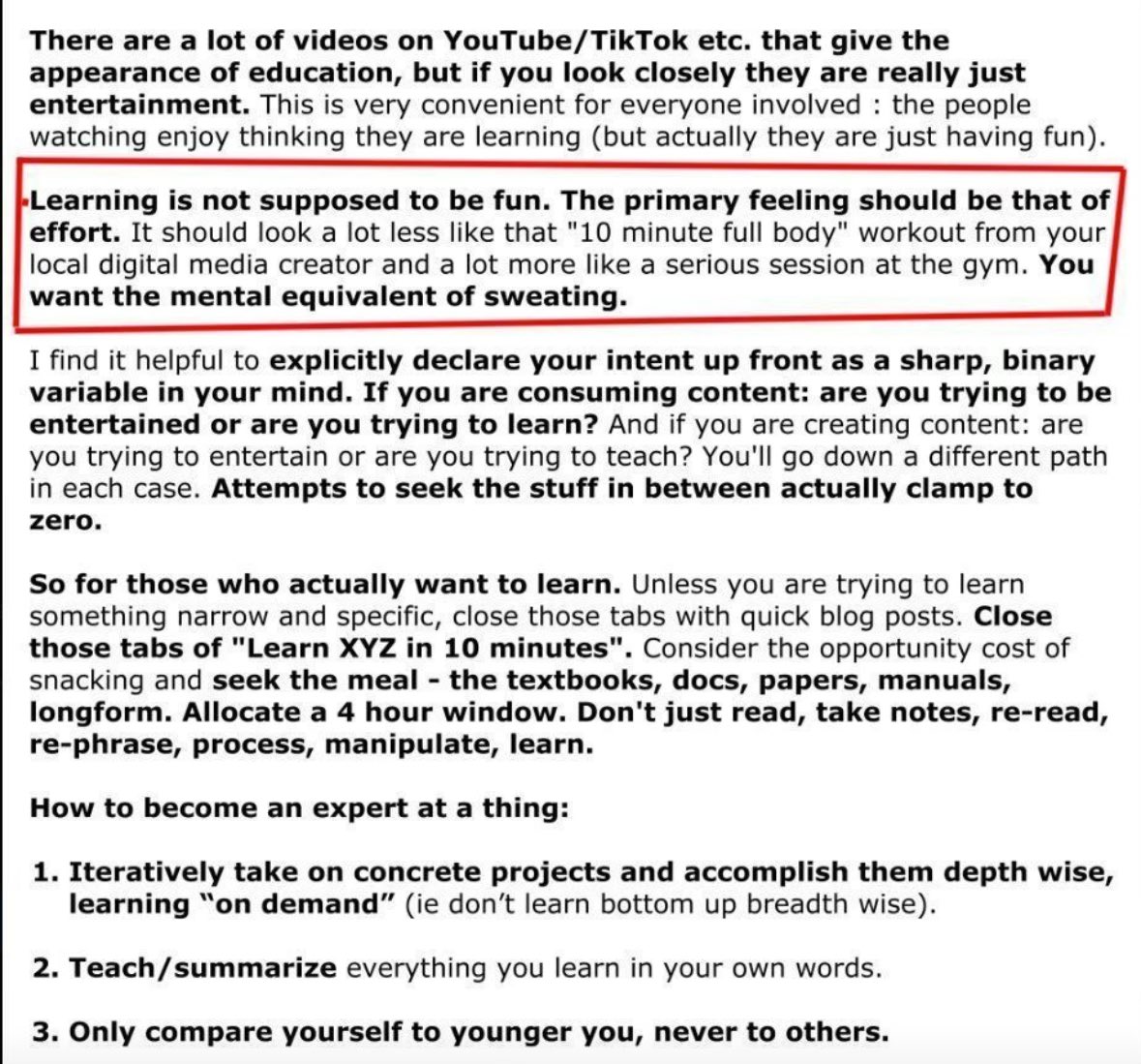
Andrej Karpathy’s bombshells on how to learn:
> learning is not supposed to be fun
> don’t hallucinate of learning
> learn on-demand, depth-wise
> teach what you learn to others
> compare yourself to you, not others