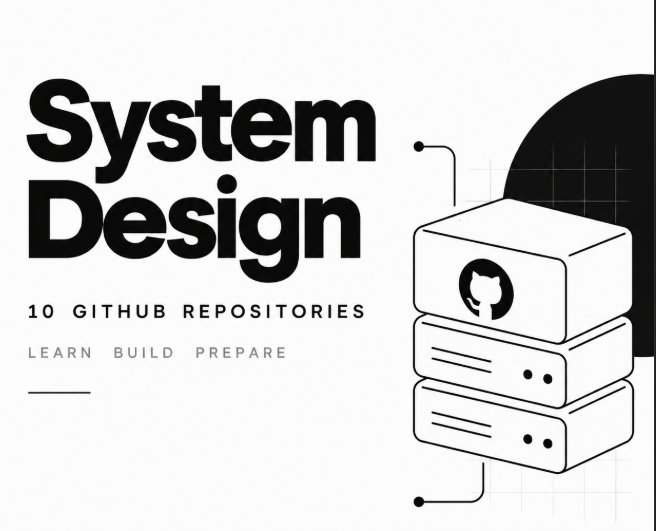
10 GitHub repositories every developer should know for System Design 👇
1- System Design Primer
https://t.co/pCptYob0Md
2- System Design 101
https://t.co/BNsXmyGv06
3- System Design by Karan Pratap Singh
https://t.co/6Dmu3dZxVj
4- Awesome System Design Resources
https://t.co/t2dCo3YEOG
5- Awesome Scalability
https://t.co/wTWsl8Oiyc
6- Awesome System Design
https://t.co/2kBZmfzidZ
7- System Design Interview
https://t.co/G2lzMrHMh9
8- Machine Learning Systems Design
https://t.co/A7ZTXQsXRT
9- System Design Academy
https://t.co/i29k4FiAhc
10- Agentic Design Patterns
https://t.co/oNwcdrOLCd
✅ Save this for your System Design preparation.
Follow for more developer resources, interview prep, jobs & opportunities.
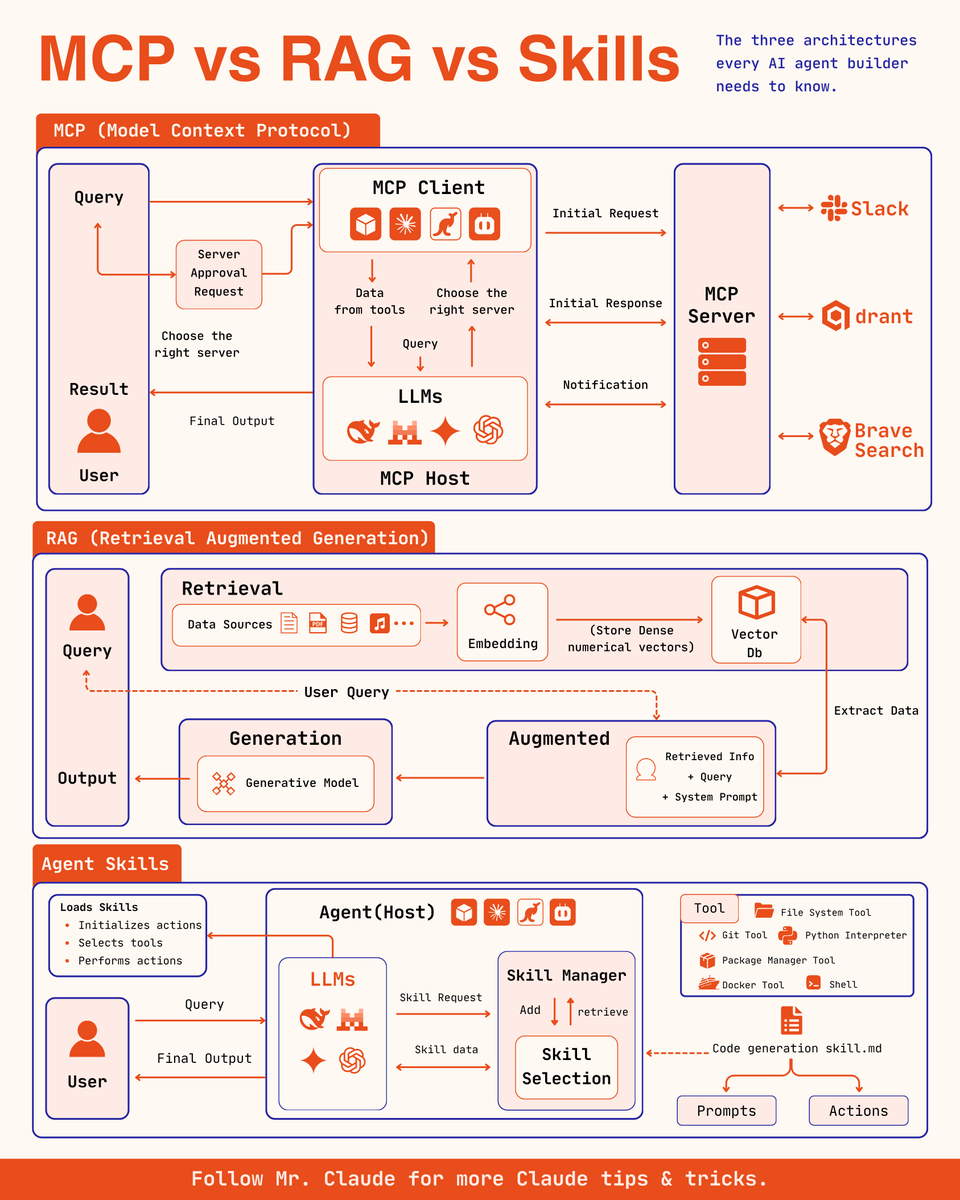
MCP, RAG, and Skills all answer a different version of the same question: how does an agent get access to something it does not already know.
MCP gives an agent a live connection to external tools and services. A query goes through an MCP host, where an MCP client chooses the right server and sends the request, and the server itself connects out to real systems like Slack, a vector database, or Brave Search. The client and server exchange an initial request, an initial response, and ongoing notifications, and some actions route through a server approval request before the LLM gets to act on them. This is the architecture for when an agent needs to actually do something in a live system, not just read about it.
RAG gives an agent access to knowledge instead of live tools. Documents, PDFs, databases, and other data sources get embedded and stored as dense vectors in a vector database ahead of time. When a query comes in, relevant info gets extracted from that vector store, combined with the query and a system prompt into an augmented prompt, and handed to a generative model to produce the output. Nothing here executes an action. It only retrieves and grounds an answer in information that already exists.
Skills give an agent access to a reusable process instead of either tools or knowledge. An agent host runs an LLM that sends a skill request to a skill manager, which retrieves the matching skill, a file like a code generation skill.md that breaks down into prompts and actions. Loading a skill initializes actions, selects the right tools from a set like file system, git, a package manager, Docker, a Python interpreter, or shell, and performs them. This is the architecture for a task the agent has done the exact same way before and should not have to reason through from scratch again.
The three are not competing for the same job. MCP connects to what is live. RAG connects to what is known. Skills connect to what has already been figured out. Most serious agents end up needing all three.
Bookmark this before you pick one architecture to solve a problem that actually needs a different one.
Google Engineers just released free 2-hour guide on full agent engineering:
1 prompt → agent teams → loops → graphs from 0% to 100%:
10% → 38:46 - build your first agent
55% → 1:12:43 - Loop engineering: 4 ways to run agents
70% → 1:20:57 - Graph engineering
most people build one agent and stop there - this is the full path to a system that runs without you from scratch
watch it today - then read the full playbook below ↓
Google just released a free 2-hour course on full Graph Engineering.
How to go from one prompt to an agent graph that can build itself:
0% → 10:16 - build your first AI agent
25% → 41:05 - master prompt engineering
50% → 54:45 - turn agents into graphs
75% → 1:20:10 - run loops inside agent graphs
100% → 1:43:33 - build a graph that builds itself
Most people build one agent and stop there.
Google is teaching everything that comes after:
Prompt → Agents → Graphs → Loops → Self-Building Systems
Single agents are the old workflow.
Graphs that evolve themselves are the next one.
This 2-hour course is worth more than most paid agent engineering courses.
Bookmark it and watch today
Then read how to run 1,000 agents from one prompt below ↓