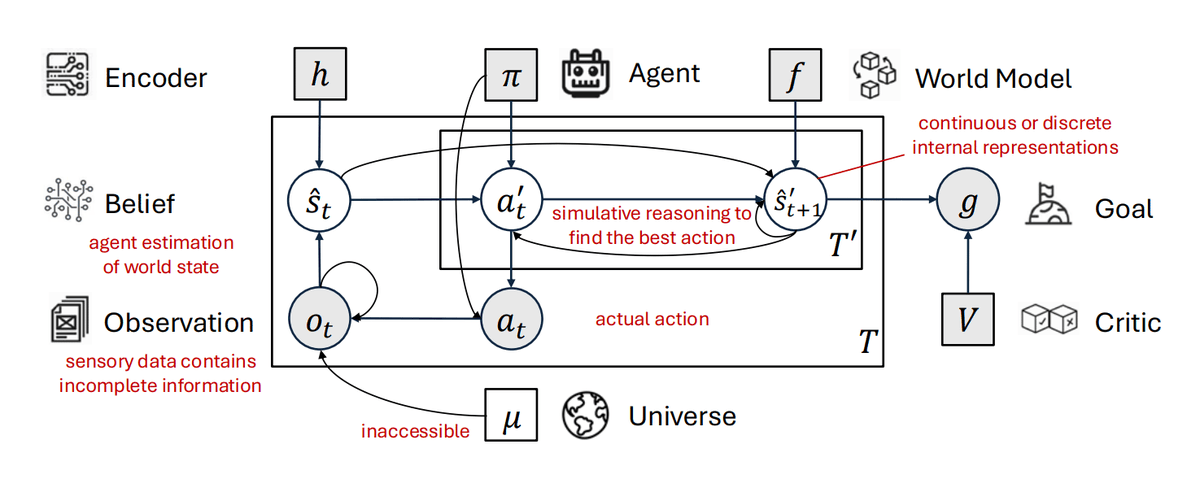
As many of you were interested in the technical details of the model, here is a followup thread to go more into technical details about VLA-JEPA.
1. Architecture
2. Training
3. Recipe for the demo
4. TLDR
🧵below
The @playcanvas team has solved collision for 3D Gaussian splats. Install splat-transform via NPM to get a CLI tool + library that can output high quality voxel-based collision. Here you can see a splat navigated in first person mode with voxel rendering toggled on/off. 🧵
Today, we released Lyra 2.0, a framework for generating persistent, explorable 3D worlds at scale, from NVIDIA Research.
Generating large-scale, complex environments is difficult for AI models. Current models often “forget” what spaces look like and lose track of movement over time, causing objects to shift, blur, or appear inconsistent. This prevents them from creating the reliable 3D environments required for downstream simulations. Lyra 2.0 solves these issues by:
✅ Maintaining per-frame 3D geometry to retrieve past frames and establish spatial correspondences
✅ Using self-augmented training to correct its own temporal drifting.
Lyra 2.0 turns an image into a 3D world you can walk through, look back, and drop a robot into for real-time rendering, simulation, and immersive applications.
➡️ Learn more: https://t.co/ROR7miJeCU
📄 Read the paper: https://t.co/1osU9EGjGD
Excited to share our recent work: Free-Range Gaussians 🥚✨
The core idea: instead of predicting Gaussians on a pixel- or voxel-aligned grid, we let them live freely in 3D space.
🌐 Project: https://t.co/HkwmGam0Pq
📝 Paper: https://t.co/OhHA6VnwZT
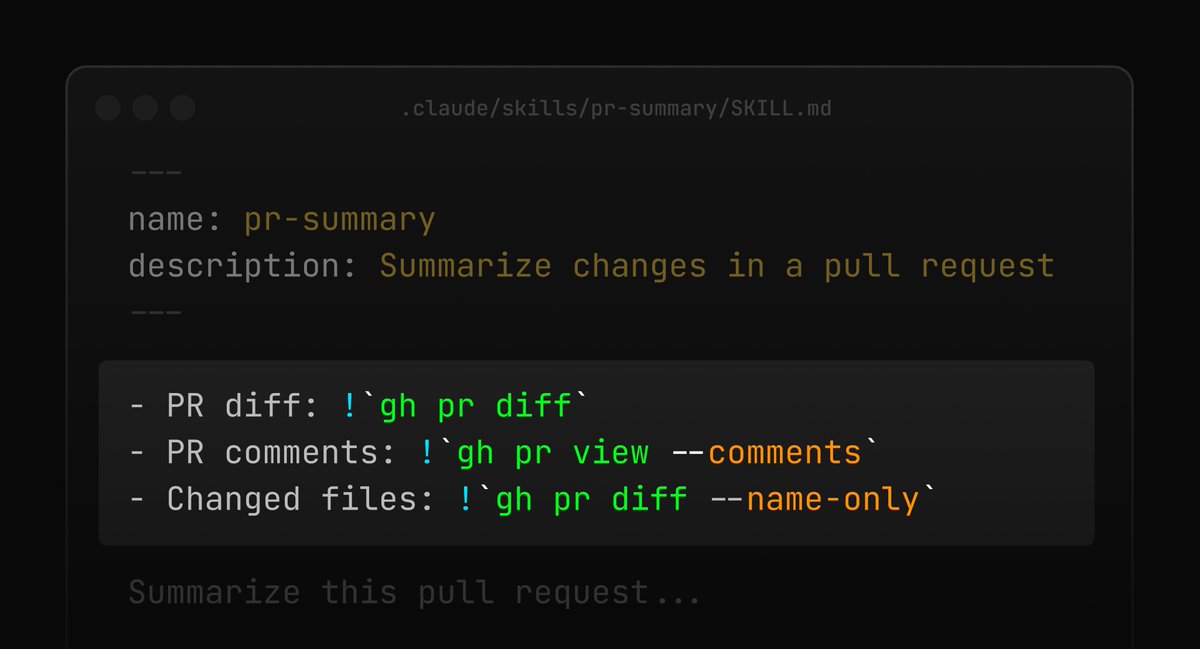
if your skill depends on dynamic content, you can embed !`command` in your SKILL.md to inject shell output directly into the prompt
Claude Code runs it when the skill is invoked and swaps the placeholder inline, the model only sees the result!
Describe Anything, Anywhere, at Any Moment
https://t.co/DjkLwbuU5H
DAAAM builds a hierarchical 4D scene graph as spatio-temporal memory, enabling embodied agents to describe anything, anywhere, at any moment.
Excited to show some surprising inventions on generative multiplayer games we made at Google with Stanford. We call the work MultiGen.
I've always been inspired by early studios like id Software with Doom or Blizzard with Warcraft bringing networked video games to the next level. We are at the point in history where we can make strides like them, but for generative games. It's a strange feeling to be in the age of generative video games while still discovering how exactly to train the models and design the tools that make them useful.
All of the tools that have been invented for classic game engines need to be redesigned for generative games. For example level and world design is not entirely possible with existing technology. We introduce editable memory to diffusion game engines that allow for design of new levels via a minimap. But we can easily imagine how this can be expanded with different creation tools. The end goal of this research direction is to allow game designers to be able to guide the generation process of their world, at the granularity that they prefer.
Editable memory also allows us to add multiplayer to Generative Doom. We were amazed when we saw GameNGen some years ago, and now you can play it live with friends in real-time, on your couch or even online.
Shared representations like our editable memory seem like the future for this type of experience. Models are, in some cases, expensive and approximate encoders but great interpolators and extrapolators. Leveraging their strengths lets you have completely new experiences that can be realized now and not in the distant future.
This work was started at my previous team and continued in collaboration with Stanford. Congratulations to all for the discoveries.
Capturing Unreal scenes with 360° equirectangular images → fixed-pose COLMAP rig → training becomes much more predictable for #gaussiansplatting.
Unreal Capture → COLMAP → Lichtfeld Studio (MCMC Default) → LOD (SOGv2) + FX→ runs on the web and mobile.
Demo link in reply
New on the Anthropic Engineering Blog: Demystifying evals for AI agents.
The capabilities that make agents useful also make them more difficult to evaluate. Here are evaluation strategies that have worked across real-world deployments.
https://t.co/UD0yGglTU0
This is basically the same as what msft paid $10B for in their second round of oai funding. This is exactly the sort of science we were doing for codex over data mixtures. So cool to read something like this for nanochat.
GDPO from NVIDIA
Fixes GRPO's reward collapse in multi-reward RL by decoupling normalization. A simple drop-in replacement that boosts training stability and performance on tool calling, math reasoning, and coding.
Want to learn about the research behind Gemma 3n?
Altup - https://t.co/ngwMI7UfIw
LAuReL - https://t.co/2KE997GDWV
MatFormer - https://t.co/AnHhQktcZu
Activation sparsity - https://t.co/CxoPEOMdkU
Universal Speech Model - https://t.co/TuP8XMeYKS
Blog - https://t.co/TKIO4yJVhk
Qwen releases Qwen-Image-2512, a new SOTA text-to-image model. 💜
It's the top performing open diffusion model on AI Arena and has more realistic + accurate images/text.
Run locally with 14GB RAM via our Dynamic GGUF
Guide: https://t.co/bmDULouGqQ
GGUF: https://t.co/bz7X0Qu0n0
Reward design is the real bottleneck in robot RL.
Robo-Dopamine tackles it head on with a general, step-aware process reward model trained at massive scale, finally making fine-grained manipulation learning reliable.
Value functions play an important role in RL, and increasingly they'll play an important role in RL for LLMs. This new paper led by @rohin_manvi is one step in this direction: using value functions to optimize test-time compute with adaptive computation.
We are stoked to recommend the "comfyui-prompt-generator" by d3cker. This custom node is a total powerhouse, especially when using Qwen3-VL-8B-Thinking—it actually displays its "thinking process" before spitting out the perfect prompt!
Huge thanks to the creator for dropping this game-changing tool on the community!
7 Notable world models of 2025
▪︎ LeJEPA
▪︎ Code World Model (CWM)
▪︎ Probabilistic Structure Integration (PSI)
▪︎ PAN world model system – Physical, Agentic, and Nested
▪︎ Dreamer 4
▪︎ Genie 3
▪︎ Cosmos WFM 2.5
Check this out for an in-depth overview of each: https://t.co/ezWQfQGVzN
WorldWarp
Generates long-range, geometrically consistent videos from a single image by coupling a 3D structural anchor with a 2D generative refiner. Maintains an online 3D cache via Gaussian Splatting and uses Spatio-Temporal Diffusion with spatially-varying noise to fill occlusions.