We're well into the process of converting the Messaging app included in GrapheneOS into a modern app. We'll be making a new release later today with a completely overhauled user interface written in Android Compose. We've made a massive amount of other improvements and bug fixes beyond that too.
In the longer term, we plan to add support for RCS including support for the standard end-to-end encryption (E2EE) via Messaging Layer Security (MLS). Currently, RCS including E2EE is available on GrapheneOS via Google Messages. We want to avoid the need to use Google Messages for RCS eventually.
RCS on Android is currently implemented with code across the OS, Google Messages and Google Play services. Our plan is to start by making an equivalent to the portion in Google Messages. It would initially require sandboxed Google Play for RCS activation, etc. but we plan to implement that too..
RCS isn't an open platform in practice. It isn't even as open as SMS/MMS. It heavily depends on proprietary Google and carrier infrastructure in practice. We can start by replicating Google's approach and then we can work on only using carrier services for carriers where it's actually supported.
We're also going to be overhauling or fully replacing the rest of the AOSP apps in the near future. AOSP Gallery is incredibly outdated and is being entirely replaced. AOSP Keyboard may be similar. We recently hired a bunch of new people and will be hiring more so our progress will be accelerating.
In the past, our focus was nearly entirely on the base OS rather than bundled apps with alternatives available. We've heavily ramped up the resources we're investing into the bundled apps. We'll also be scaling up our work on the base OS too. More donations will enable us to hire even more people.
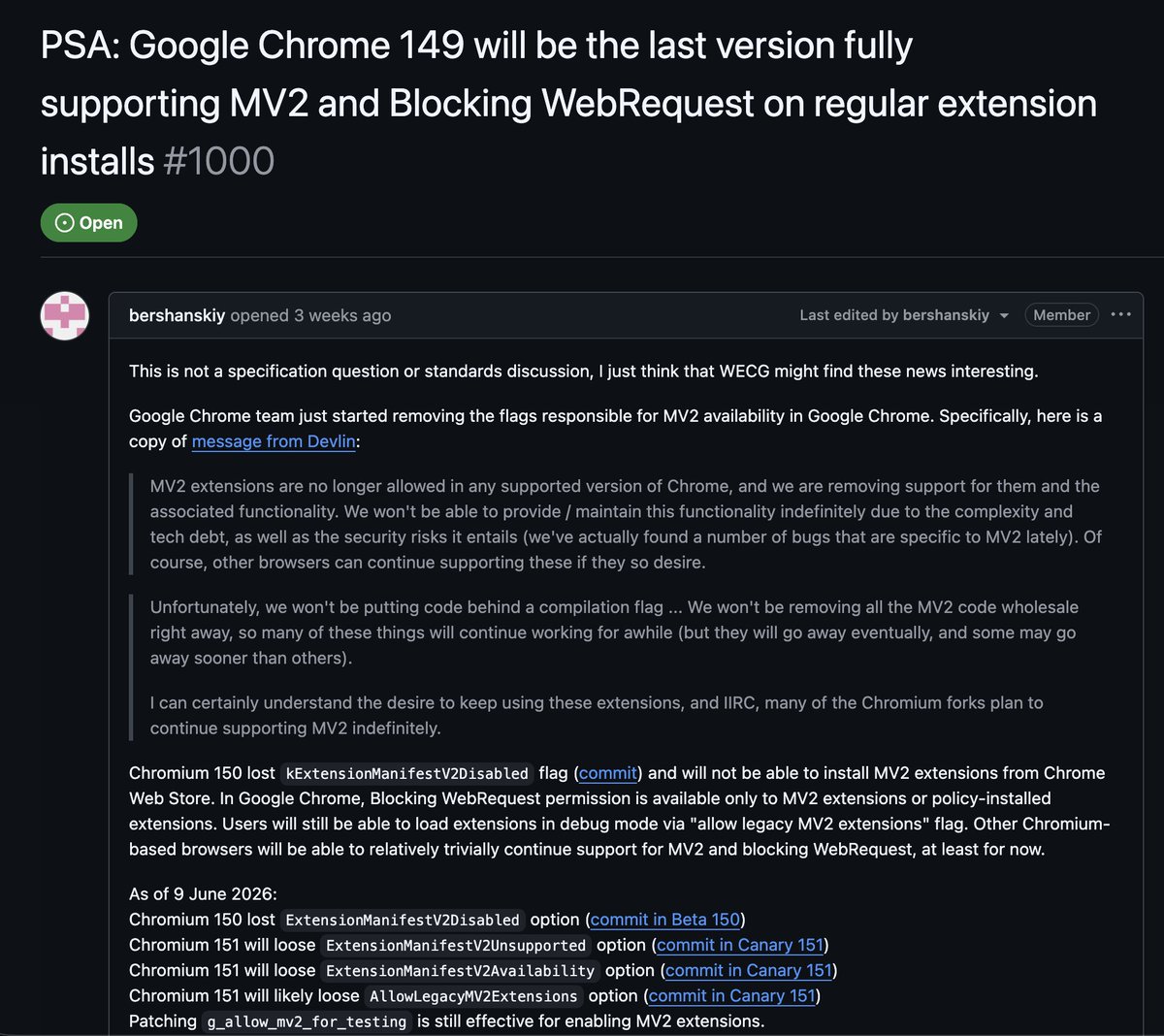
Google Chrome 150 marks the end of full support for Manifest V2 extensions, effectively removing the remaining workarounds that allowed the original uBlock Origin to continue functioning in Chrome.
Starting with Chrome 150 (expected in late June 2026), Google will complete its transition from Manifest V2 to Manifest V3. This means the powerful webRequestBlocking API used by advanced extensions will no longer be available for normal Chrome extensions.
As a result, the original uBlock Origin will no longer work at full strength in Chrome. It relies on Manifest V2’s ability to inspect and block requests in real time.
Under Manifest V3, extensions must use declarativeNetRequest, which requires them to rely on predefined filtering rules instead of dynamic blocking. This improves security and performance according to Google, but it also limits what ad blockers can do, especially against complex ads and trackers on sites like YouTube.
The developer of uBlock Origin offers uBlock Origin Lite, a Manifest V3 version that still provides ad blocking but with the restrictions imposed by Chrome. Other ad blockers have also released Manifest V3 versions with similar limitations.
Users who want the full power of the original uBlock Origin can switch to Firefox, which continues to support Manifest V2 extensions, or use Brave, which includes built-in ad and tracker blocking.
Google has been gradually rolling out this change since 2024, and Chrome 150 marks the final step in that transition.
‼️ Google is about to disable all adblocker extensions in Chrome. Instead of letting the adblocker inspect traffic itself, extensions now have to hand Google's browser a limited list of filtering rules and hope for the best. This leads to weaker blocking and more ads getting through.
Google makes the vast majority of its money selling ads. The company that profits from every ad you see also controls the browser most people use, with Chrome 149 being the last version supporting adblockers.
For example, under the new rules, uBlock Origin cannot exist. For millions of people, that extension is the only thing standing between them and a wall of ads, trackers, and autoplay garbage. One user put it bluntly: "The web is literally unusable without uBlock Origin."
GrapheneOS a retiré tous ses serveurs d’OVHcloud et quitté la France en évoquant des attentes de backdoors dans le chiffrement, des menaces policières/judiciaires etc
Meilleure décision et preuve de fiabilité en partant !
Les vrais risques sont progressifs :
⚠️ Réglementations qui obligent les OS à collecter des données (âge, ID)
⚠️ Durcissement de Google contre les ROM custom
⚠️ Pressions sur les fabricants (Motorola/Lenovo)
Mais @GrapheneOS préfère être interdit dans certains endroits plutôt que de trahir ses principes 🙏
#Privacy
CachyOS decided to resolve the problem with Discord RPC in games on Linux.
Their latest custom version of Proton (Valve's tool for running Windows games on Linux) includes an automated solution to this problem through a bridge in the compatibility layer. While until recently you were forced to manually add the game process as a status in Discord, browsing through 30 other running background processes and then optionally fixing capitalization so the status would be assigned to the game, now you have it fully automated. These statuses should include custom data, e.g., about the lobby, just like Fortnite does on Windows.
Currently, to use this solution, you need to install the latest release of Proton-CachyOS and add the optional environment variable "PROTON_DISCORD_BRIDGE=1" to the game's launch options.
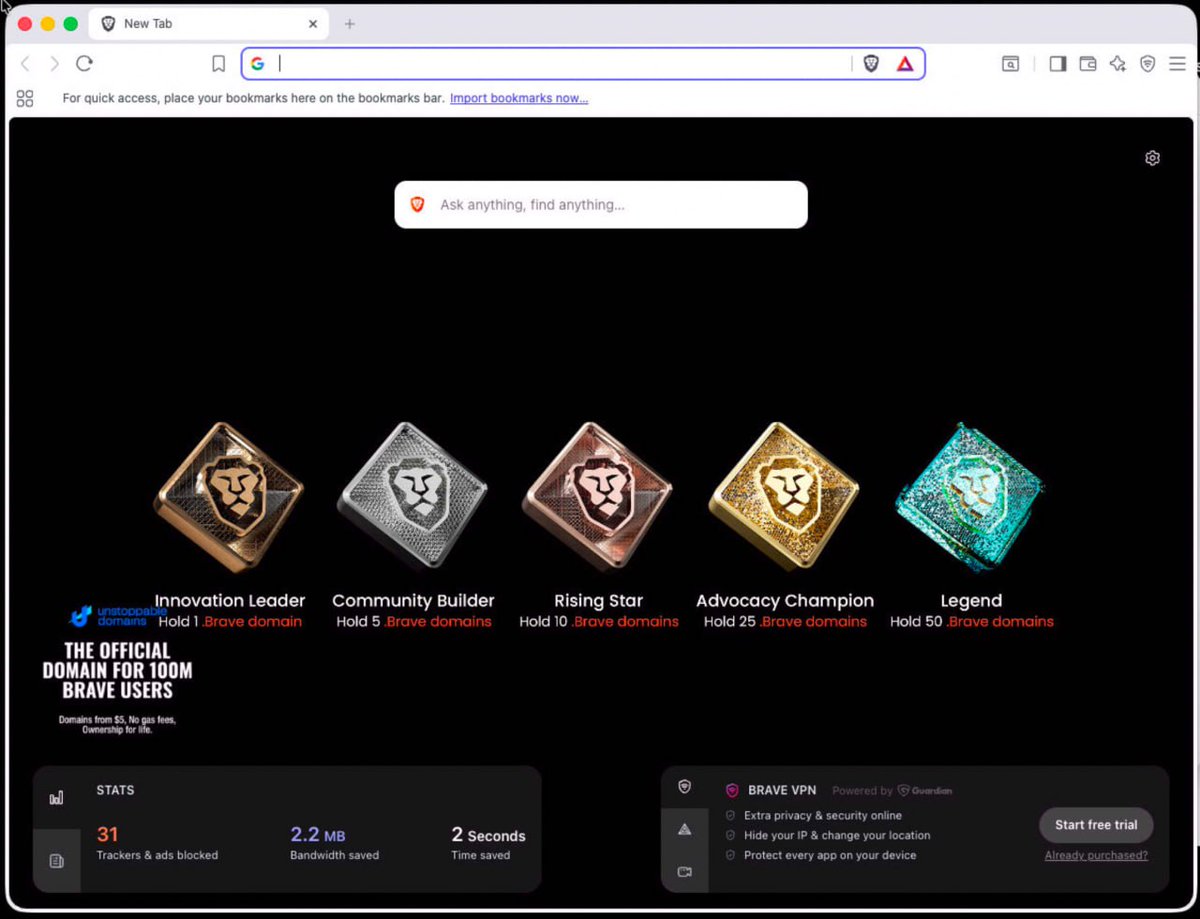
A fresh Brave install in 2026: sponsored ad wallpapers on new tab page by default (opt out). Brave VPN, News, Talk, Leo (AI), Rewards and other revenue-milking bloat is advertised/pinned by default. Analytics and "phoning home" by default. Google as default search engine in most regions by default. Sponsored search engines like Russian Yandex in CIS countries by default: https://t.co/nCK7ZErytG
Brave has an ad branch that handles advertising within the browser: https://t.co/EwJwKKgWxq. Brave does on-device ad targeting based on cohorts and interests, just like what Chrome used to do and what Google was largely hated for (remember FLoC?). This applies to additional (opt-in) rewarded ads, shipped as part of Brave.
Brave has injected referral IDs to crypto-related URLs entered into the omnibox in the past, intentionally, by design:
https://t.co/hovGMDz8Et
https://t.co/3wdWDEV85H
https://t.co/fo1mD75vAF
Brave also uses dark patterns to drive users away from turning off ads in their browser. For example, an article linked from the "opt out" button in the browser has a wall of text making excuses for ads before the actual steps needed to be taken to disable them: https://t.co/dka1EIMtbw
kind of hypocritical for brave to judge firefox for lesser bullshit, don't you think?
@jakkuh_t Yea, no. A 200% price increase with 0 new features just for the software to continue to exist is insane, and not something people should support.
@Techjunkie_Aman So it’s another containerized virtual machine like WinBoat. It’s probably going to be good for running specific Windows-only software, but it’s not going to replace Wine.
YouTube Premium just raised prices. $15.99/month. Up from $13.99.
The family plan is now $26.99/month. That is $323 a year. To remove ads from a website.
YouTube Music: $11.99/month. $144 a year. To listen to songs without ads.
Every video you watch is tracked. Every search is logged. Every pause, every rewind, every rabbit hole at 2 AM. All of it fed into a profile that advertisers pay to access.
You are not the customer. You are the product. You always were.
There is an open source tool that strips every ad, every tracker, and every account requirement from YouTube. Same videos. Same creators. None of the surveillance.
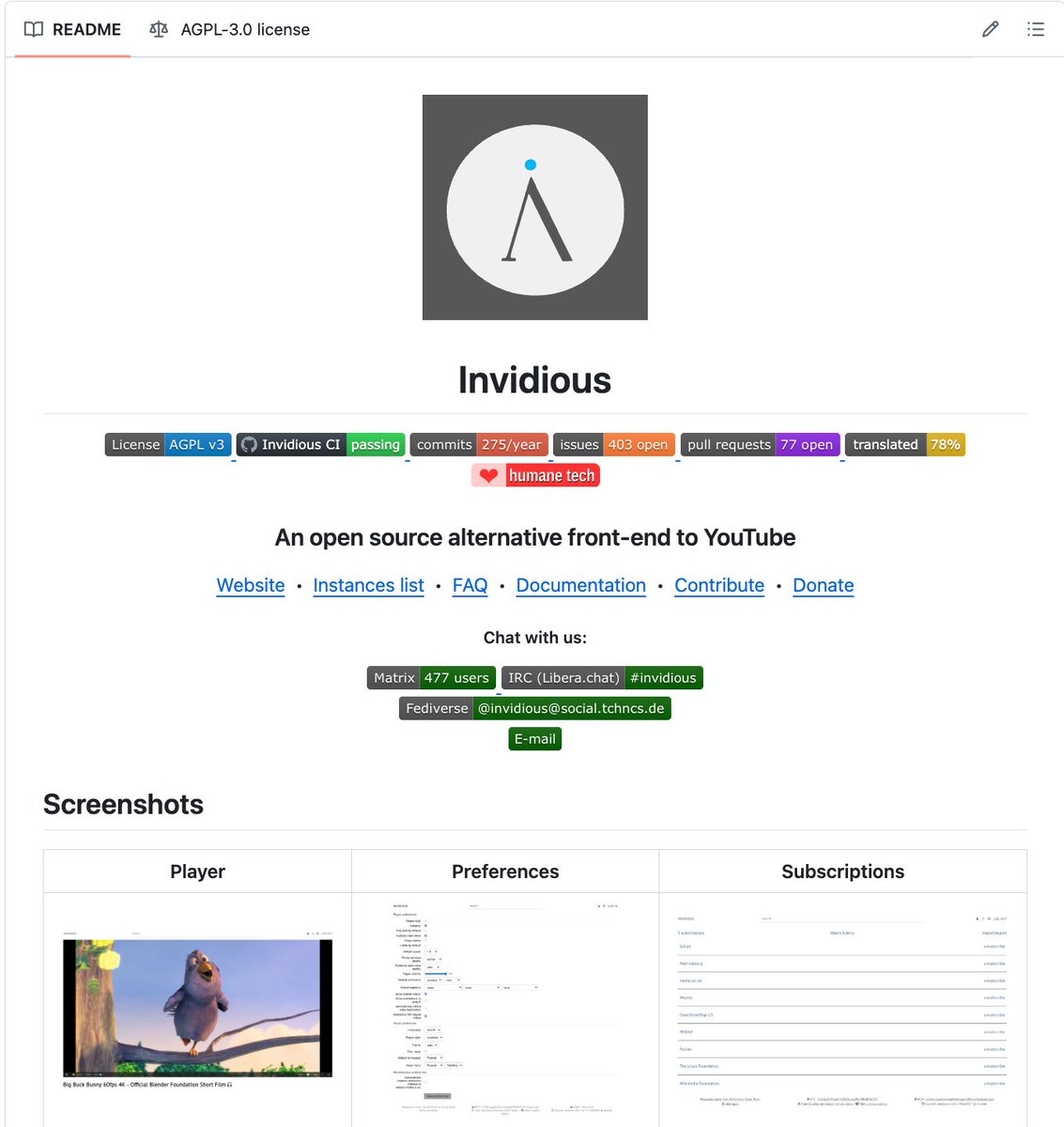
It is called Invidious. 18,900+ stars on GitHub.
Here is what it does:
→ No ads. None. Ever. Pre-roll, mid-roll, banner, sponsored — all gone.
→ No Google account required. Subscribe to channels anonymously.
→ No tracking. No cookies. No fingerprinting. No watch history sent to Google.
→ No algorithm deciding what you should watch next.
→ SponsorBlock integration. Automatically skips sponsored segments inside videos.
→ Audio-only mode. Cuts data and battery use in half.
→ Background play on mobile. Free. Without Premium.
→ Download any video directly. Any quality. Any format.
→ RSS feeds for every channel. Subscribe in your reader.
→ Reddit comments shown alongside videos.
→ No JavaScript required. Works on any browser.
→ Self-host your own instance on any old laptop.
Here's the wildest part:
YouTube sent the developers a cease-and-desist letter on June 9, 2023. They told them to shut down within 7 days.
Invidious said no.
Three years later, they are still shipping. Last commit: 14 hours ago.
Google has spent three years trying to block, sue, and bury this project. They have failed. The repository keeps growing. The code keeps shipping. The community keeps coding.
Every commit is a middle finger to the ad industrial complex.
YouTube Premium Individual: $15.99/month. $192/year.
YouTube Premium Family: $26.99/month. $323/year.
YouTube Music: $11.99/month. $144/year.
Invidious: $0. Forever. No ads. No tracking. No account. No subscription.
269 contributors. 33 releases. 2,100+ forks. Built in Crystal. Battle-tested since 2018.
AGPL-3.0 licensed. The license Google cannot kill.
Your videos. Your privacy. Your choice.
100% Open Source.
(Link in the comments)
@Primal_Fiend@Anaya_sharma876 @therahul4402 In that case I would probably recommend Fedora KDE if you like that desktop environment and want to avoid Ubuntu.