Published in Nature Electronics, a new paper from @SKhynix and University of Virginia researchers explores how CPO can overcome the “bandwidth wall” through optical connectivity.
🔗 Read the full story below.
https://t.co/ah7I44dEQA
#SKhynix#CPO#AIInfrastructure
What goes up has come down: after Sept rate hike odds jumped as high as 60% on Waller's hawkish comments Monday, today's shockingly low CPI sent rate hike odds tumbling... And a 12% arb has opened between between Polymarket (40%) and SOFR (52%)
SEMI (literally in this case) SHOCK: $SOXX took in $5.4b yesterday.. which is 4x the old record for a daily flow. Almost def a model or big inst.. meanwhile the 3x SOXX took in $1.2b all in all $7.1b into long side Semi ETFs yest. My guess is ppl were waiting for a dip to enter (it has been down 16% in past two weeks)
Google's next TPU, codenamed Humufish, is set to use Intel's EMIB-T instead of TSMC CoWoS.
Nearly every leading AI training accelerator today is packaged on a TSMC 2.5D flow, and almost all of it is CoWoS. CoWoS is the industry default, which is exactly why a flagship part moving off it is worth attention.
The core difference. CoWoS places all dies on a single large silicon/RDL interposer. EMIB embeds small silicon bridges directly in the organic substrate, only where die-to-die links are needed. (1/4)🧵
Listen to what @GavinSBaker said on All-In at 1:04:06:
“DRAM is the most important bottleneck, and Elon is focusing the Terafab on memory because he believes memory is the most important bottleneck. Not lasers, not capacitors, not power semis, not NAND, not HDDs. DRAM.”
Even Elon is prioritizing memory, specifically DRAM, as the key focus for the Terafab.
And yet, do you still think DRAM is just a commodity that can be replaced by Chinese products at any time?
This is Elon validating the strategic importance of DRAM.
JPMORGAN LIFTS S&P 500 TARGET
JPMorgan raised its year-end S&P 500 target to 7,800, citing an “unprecedented” earnings upgrade cycle fueled by the AI investment boom and easing geopolitical risks.
The bank lifted its 2026 EPS forecast to $350 and expects strong profit growth through 2027.
JPMorgan remains bullish on technology, AI, defense and banks, but warns speculative growth stocks face elevated correction risk.
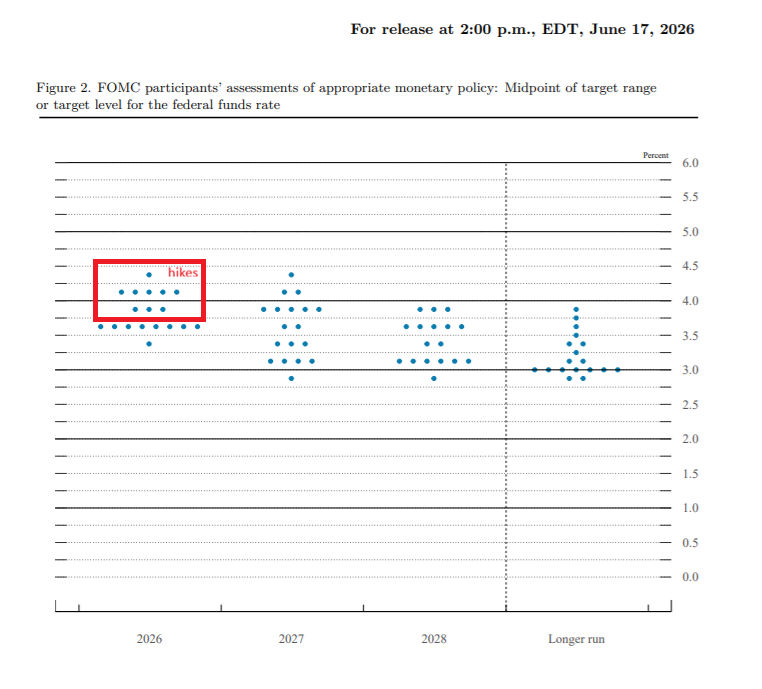
Very hawkish dot plot.
Nine out of 18 officials have at least one hike this year (and six of those 9 have *multiple hikes*).
Only one person has a cut this year, and one participant (presumably Warsh) didn't submit an SEP
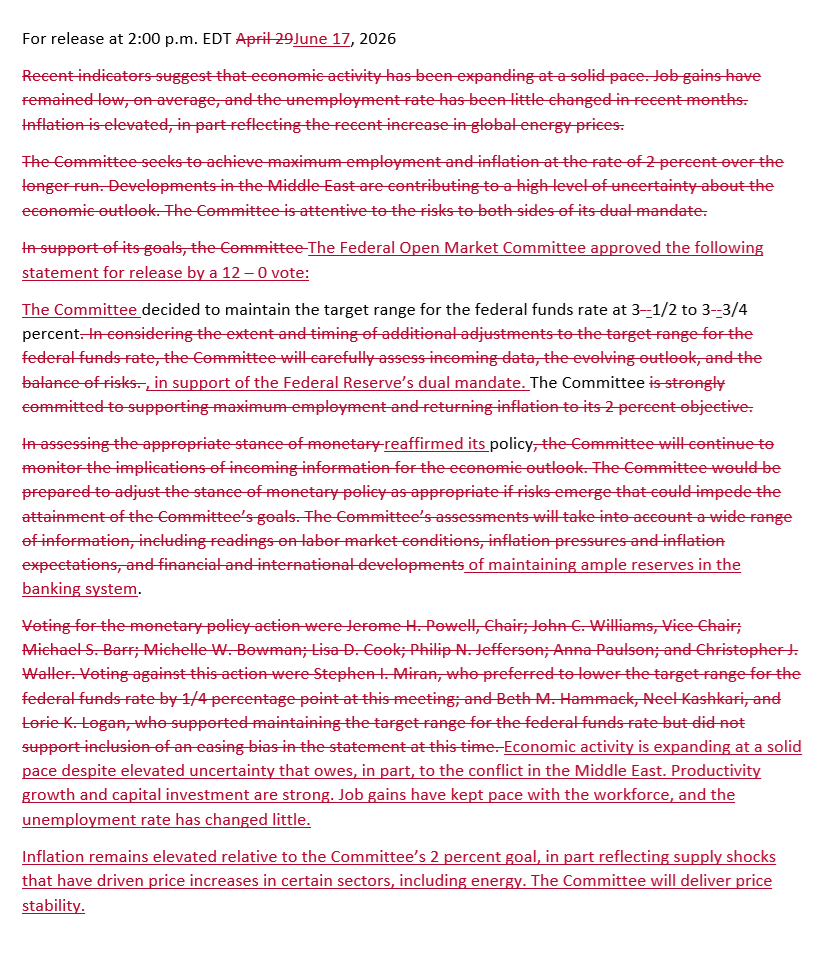
The statement gets a complete writethru from top to bottom, much shorter
Tech Monthly Wrap-Up
☕️ Constructive Amid Volatility
📈 Market: Over the past month, SOX outperformed, led by memories, SPE, etc. However, SOX is at P/E ~32x, suggesting higher volatility at current level.
•Investor Sentiment: Price Hike Appetite Strong with Focus on MLCC/Passives & wafers. Expect continued px hike theme to continue for Memories (DRAM +++ 3Q26 + HBM4 +++), CPU (late 3Q26 hike), MLCC/resistors/Passives
•Tokenomics: consumption at new highs. Tiering in token pricing. Blackwell deployment to lower token cost. Anthropic strong ARR and turning profitable! Agentic AI boosting CPUs. Capex outlook robust. • CPO scale-out small volume in late-3Q26 → scale-up 2H27 (NVL576) • HVDC ramp 4Q26 (800VDC/660kw)
#SOX #AI
AI workloads are creating new memory objects that are too large for HBM but too valuable for cold storage. It’s simply to expensive to use DRAM for everything if it’s possible to use NAND for some of it. We’ve gotten three announcements focused on flash from three major players in the past couple weeks:
Nvidia is using flash to store reusable KV cache via CMX. This targets long-context, multi-turn and agentic inference by extending GPU memory with a shared KV-cache tier, allowing flash to become context memory for long-running agents.
AMD is using flash to store some system memory until it is predicted to be hot enough to go to DRAM. They’re buying MEXT as a software layer to accomplish this.
Apple is using flash to store some model weights until needed. Apple stores inactive experts in flash on the device side (AFM 3 Core Advanced, published a week ago).
If you can get the system to know what data is likely to be needed next, flash goes from simple storage to cheaper memory.
AMD and AAPL both, in different ways, have announced a focus on flash as a way to reduce the AI memory tax. We wrote about this in our State of the Themes last week.
SK HYNIX PICKS NASDAQ TO RIDE AI BOOM
South Korea’s SK Hynix plans to list in the U.S. on Nasdaq as early as August, targeting AI-driven investor demand. The memory-chip giant, a key Nvidia supplier, has seen its shares surge 230% this year, pushing its value above $1 trillion. The listing aims to expand its global investor base, with analysts noting Nasdaq’s strong technology focus and higher growth valuations.
Intel (INTC) Note Takeaways:
•Big Raise for Foundry Capacity
◦Intel 3: +80% (mainly Ireland) by end-2028 (vs end-2026)
◦18A: +100% (Arizona) by end-2028 (vs end-2026)
◦14A: Strong ramp in Oregon
•Capacity Drivers:
◦Robust server CPU demand
◦18A yields improving to ~80%, EMIB to 90-95% in recent weeks
◦Major U.S. fabless on pipeline
◦Major smartphone maker to start with 18A-P (tablets/PCs) + committed to 14A capacity
◦TeraFab project late-2028
•18A Capacity Shift:
Pathfinder Lake volume wafer capacity → Clearwater Forest (CWF) starts 3Q26, with full volume 1Q27 (expected to be ~1/3 of total 18A wafers)
•Financial Matrix:
◦IFS to turn profitable in 2H27
◦DCAI revenue +39% YoY in 2026E / +30% in 2027E
•Nvidia Collaboration: Likely includes x86 CPUs → PC (RTX + Nova Lake in 2027) → Server CPUs (Intel x86 IP + foundry) in late 2028
•TP Raised to $135
The issue is not whether children should receive nutritious meals. The issue is whether Indonesia has chosen the most expensive way possible to achieve that goal.
If the numbers in this chart are broadly correct, Indonesia is allocating 8.3% of its national budget to the MBG program, far above the proportions seen in countries such as the United States, Japan, India, and Brazil. That alone should trigger a serious discussion about efficiency, targeting, and implementation.
A well-designed nutrition program should begin with data. First, identify which schools actually need assistance. Many students already come from households that can afford meals or attend schools that already provide food. There is little reason for taxpayers to subsidize lunches universally when resources are limited.
Second, prioritize existing infrastructure. If a school already has a functioning cafeteria and kitchen, funding should flow directly there. If a school lacks facilities, build the kitchen and cafeteria first, creating a permanent asset that can serve generations of students. Corporate CSR programs, philanthropic foundations, and international development grants can help finance part of this expansion before relying entirely on the national budget.
Only when schools are too remote, too small, or lack the scale to operate efficiently should centralized kitchens such as SPPGs be deployed to serve multiple schools. In other words, SPPGs should be the exception, not the default solution.
Many successful school meal programs around the world are highly targeted. The United States focuses heavily on low-income households through free and reduced-price lunch programs. Japan integrates school kitchens directly into schools and treats meals as part of the educational process. Brazil prioritizes local procurement and community participation. None rely on a one-size-fits-all national model.
The challenge with MBG is not the objective. Few would disagree that better nutrition improves learning outcomes and long-term productivity. The challenge is making sure every rupiah spent maximizes impact.
Every rupiah allocated to MBG is a rupiah that cannot be spent on teachers, healthcare, sanitation, housing, irrigation, or infrastructure. That is why scale alone should never be the measure of success. The real measure is whether the program delivers the best nutritional outcome at the lowest possible cost to taxpayers.
Good policy is not about spending more. It is about spending smarter.
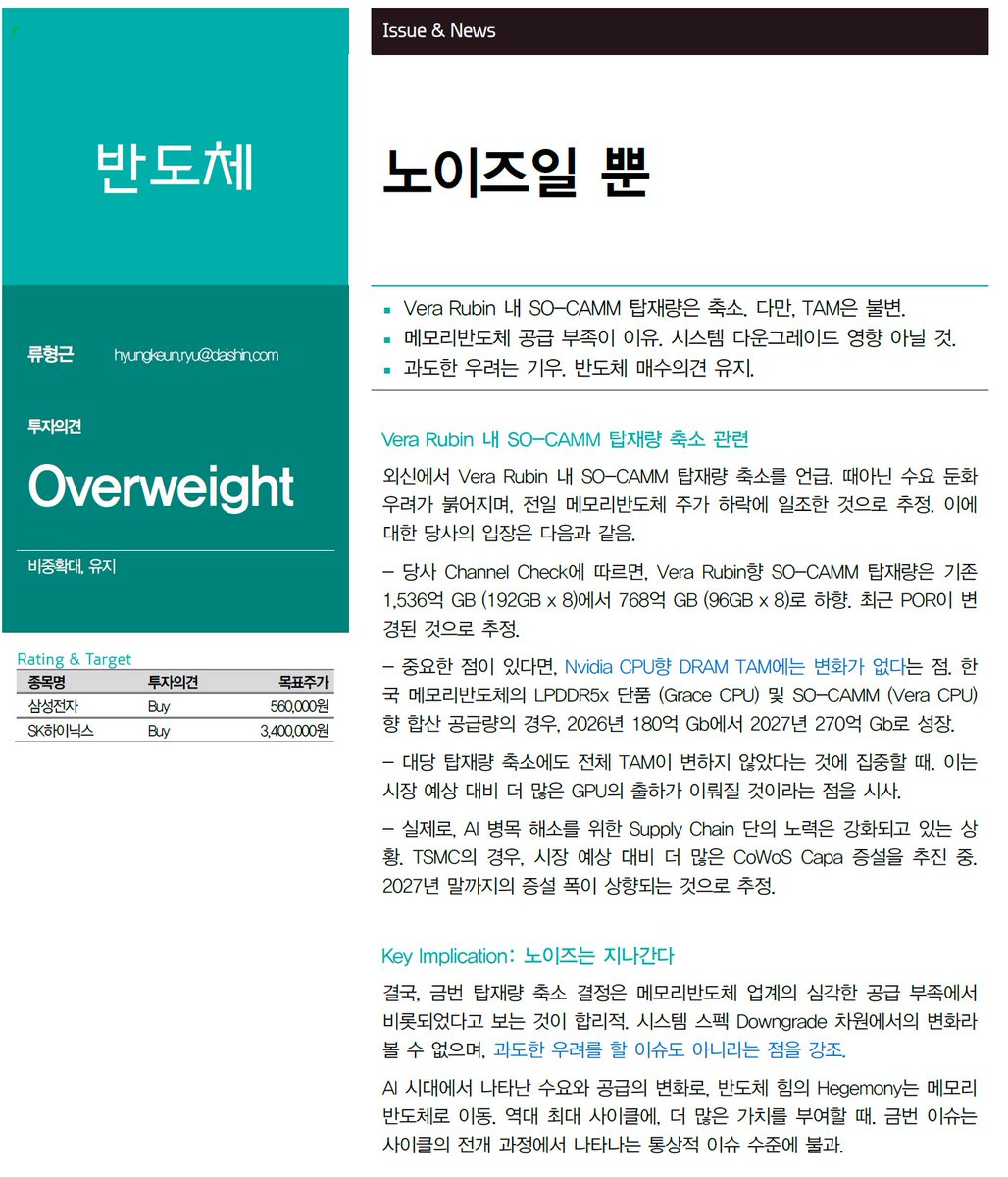
대신 반도체 류형근 위원 스팟 코멘트
어제 베라 루빈 SOCAMM 탑재량 축소되었다는 내용을 가지고 메모리 수요가 꺾였다는 얘기가 많이 나왔었음.
근데 TAM (Total Addressable Market)이 안줄었다는건 대당 탑재량은 감소했어도, 출하 대수가 그만큼 늘었다는 뜻으로 해석 가능하다는 내용.