If you are serious about robotics, bookmark this.
The Ultimate Robotics Handbook is one of the most comprehensive free robotics learning resources I've come across.
You will learn:
🤖 Hardware & Electronics
⚙️ CAD & Simulation
🧠 Algorithms & Data Structures
🌐 ROS & ROS 2
🔌 Embedded Systems & RTOS
📡 Sensors, Actuators & Communication Protocols
👁️ Computer Vision & Perception
🧭 SLAM, Navigation & Motion Planning
🚗 Mobile Robotics (AMRs & AGVs)
🦾 Manipulators & Robot Kinematics
🧮 Control Systems
🧠 Reinforcement Learning
🚁 Drones & Aerial Robotics
👤 Humanoids & Cobots
⚡ Edge AI & Physical AI
🏥 Medical, Space & Industrial Robotics
💼 Robotics Career Paths & Research Opportunities
📚 Free Handbook:
https://t.co/0LoKU85VPL
Follow @Alacritic_Super for optimizing your game in the field of embodied AI.
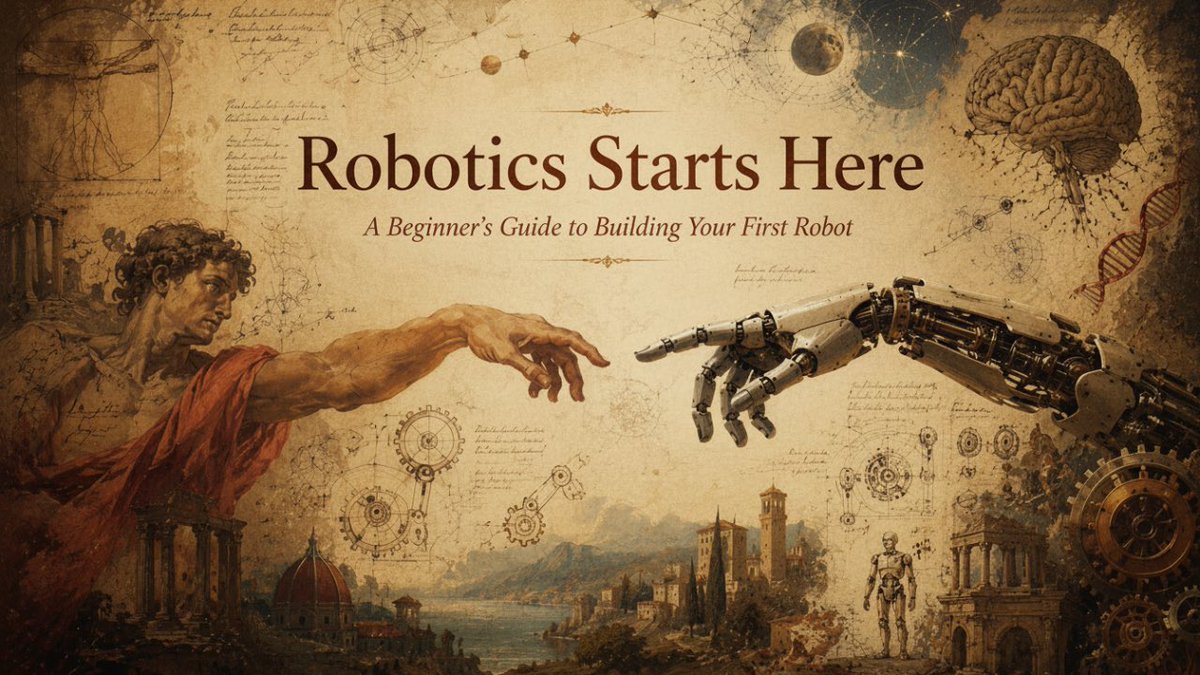
Robotics Starts Here is live.
13 parts. Complete beginner's guide. No gatekeeping, no prerequisites, just clarity on what robotics actually takes and where to start building.
From understanding the stack to your first robot at https://t.co/hkMJIL9jLt
Elon Musk literally sat down for a 45-minute talk with Y Combinator that explains how to build world-changing companies better than any business school on earth. This is the advice he gave a room full of young founders:
1. Don't try to build something great. Try to build something useful.
Everyone obsesses over greatness. Musk says that's the wrong target. "I didn't originally think I would build something great. I wanted to try to build something useful. I didn't think I would build anything particularly great. Seemed unlikely, but I wanted to at least try." Aim for useful first. Greatness, if it comes, is a byproduct.
2. When you can't get in the front door, build your own door.
Before Musk started his first company, he tried to get a job at Netscape. "I sent my resume into Netscape and nobody responded. I tried hanging out in the lobby to see if I could bump into someone, but I was too shy to talk to anyone. So I'm like, this is ridiculous, I'll just write software myself." He didn't set out to be a founder. He became one because no one would hire him.
3. He slept in the office and showered at the YMCA.
The origin of his first company was not glamorous. "We couldn't even afford a place to stay. The office was 500 bucks a month, so we just slept in the office and showered at the YMCA." He couldn't afford proper internet either, so he drilled a hole through the office floor and ran a cable to the internet provider downstairs. That was the founder of the future richest man on earth.
4. Keep the chips on the table.
When Musk sold his first company, he received a $20 million cheque. His bank balance went from $10,000 to $20 million overnight. Most people would have stopped. He put almost all of it straight back into his next company. "I kept the chips on the table." He did the same thing decades later, over and over. He hates money sitting idle. Money is fuel for the next mission.
5. Start with the mission, then work backwards to make it a business.
Musk didn't start SpaceX to make money. He went on the NASA website to find out when humans were going to Mars, and there was no plan. So he decided to build one. "There had been no prior example of a rocket startup succeeding. A small chance of success is better than no chance of success." The mission came first. The business model came later.
6. He started SpaceX expecting to fail.
He is brutally honest about the odds. "SpaceX started in mid-2002 expecting to fail. Probably 90% chance of failing. When recruiting people, I said, we're probably going to die, but small chance we might not die." The first three launches failed. The fourth one worked with no money left. "If the fourth launch hadn't worked, it would have been curtains. We made it by the skin of our teeth."
7. Break every problem down to physics.
This is the core of how Musk thinks. "First principles means break things down to the fundamental elements that are most likely to be true, then reason up from there, as opposed to reasoning by analogy." His example is rockets. Everyone priced them based on what old rockets cost. Musk asked what a rocket is actually made of, priced the raw metals, and found the materials were only 1-2% of the historical price. The rest was inefficiency he could attack.
8. When told something takes 24 months, break it down and do it in six.
Last year xAI needed a giant computer to train its AI. Suppliers said it would take 18 to 24 months. "It's like, well, we need to get that done in six months or we won't be competitive." So he broke it into parts. Needed a building, so he found an old factory. Needed power, so he rented generators. Needed cooling, so he rented a quarter of America's mobile cooling capacity. He slept in the data centre and ran cabling himself. It got done.
9. Watch your ego-to-ability ratio.
Musk's single sharpest piece of advice for young founders is about staying honest with yourself. "A major failure mode is when your ego-to-ability ratio gets too high. Then you break the feedback loop to reality." Keep the ego small, internalise responsibility for everything, and stay ruthlessly connected to what's actually true. "You want to close the loop on reality hard. That's a super big deal."
10. Chase work, not glory.
His closing philosophy ties it all together. "It's so hard to be useful. The area under the curve of total utility is how useful you've been to your fellow human beings times how many people. If you aspire to do true work, your probability of success is much higher. Don't aspire to glory, aspire to work."
He was ridiculed for years. The press called him "internet guy attempting to build a rocket company." He agreed it sounded absurd. He did it anyway, because a small chance of doing something useful beat no chance at all.
Here's the thing though....
Musk became the most followed founder alive because everything he does happens in public. The launches, the failures, the talks like this one. The companies made him powerful. The personal brand made his every word travel around the world before he finishes saying it.
We build massive distribution and grow personal brands on X and beyond without our clients lifting a finger.
If you're a founder or VC looking for that kind of exposure, book a call below.
We average 1.5M views a week.
https://t.co/UoXuYlkBQq
Build your first robot in simulation! 👾
📌 If you’re self-learning robotics, this is genuinely one of the better repos to save for later.
@NVIDIARobotics released a "Getting Started with Isaac Sim" tutorial series covering everything from building your first robot to hardware-in-the-loop deployment.
What's inside?
→ Building Your First Robot Explore the Isaac Sim interface, construct a simple robot model (chassis, wheels, joints), configure physics properties, implement control mechanisms using OmniGraph and ROS 2, integrate sensors (RGB cameras, 2D lidar), and stream sensor data to ROS 2 for real-time visualization in RViz.
→ Ingesting Robot Assets Import URDF files, prepare simulation environments, add sensors to existing robot models, and access pre-built robots to accelerate development.
→ Synthetic Data Generation Learn perception models for dynamic robotic tasks, understand synthetic data generation, apply domain randomization with Replicator, generate synthetic datasets, and fine-tune AI perception models with validation.
→ Software-in-the-Loop (SIL) Build intelligent robots, implement SIL workflows, use OmniGraph for robot control, master Isaac Sim Python scripting, deploy image segmentation with ROS 2 and Isaac ROS, and test with and without simulation.
→ Hardware-in-the-Loop (HIL) Understand HIL fundamentals, learn NVIDIA Jetson platform, set up the Jetson environment, and deploy Isaac ROS on Jetson hardware.
The progression makes sense: start with basics (build a robot), add perception (sensors and data), generate training data (synthetic generation), develop software (SIL), then deploy to hardware (HIL).
For robotics teams, this is the path to faster iteration. Simulate first, validate in software-in-the-loop, generate synthetic training data at scale, then deploy to hardware with confidence. 🎓
If this helps at least one engineer to become more fluent in the world of robotics, means a lot to me! 🫶🏼
Here's the course (it's free): https://t.co/VqvvuRpFjs
~~
♻️ Join the weekly robotics newsletter, and never miss any news → https://t.co/GoA3ZuwoPB
Ok seems like Robotics is gonna be the play of the next few weeks/months. Here are some good companies worth watching imo
Spread across the stack: the OS, the sensors, the brain, and the body.
$BB - QNX is the safety-certified operating system that runs underneath the robot, not the robot itself. Deterministic, ISO-certified software is hard to replicate, which is why it sits in autonomous cars, industrial automation and now physical AI. QNX did $72.3M last quarter, up 26%, royalty backlog near $1B, partnered with NVIDIA and Arm.
$CCXI ($AGLT post deSPAC) - The public vehicle for Agility Robotics and its Digit humanoid, merging with Churchill Capital XI at a $2.5B pre-money valuation. Digit is already deployed at Schaeffler, GXO and Toyota with 65,000+ operating hours and $300m in multi-year orders.
$OUST - Ouster builds digital lidar, the depth perception layer for robots, AVs and industrial automation. One sensor architecture scaling across multiple end markets.
$AMBA - Ambarella makes edge AI vision chips that give machines real-time sight without the cloud. The same silicon that powers ADAS now targets robotics, drones and autonomous systems.
$AEVA - Aeva builds FMCW 4D lidar that measures velocity per point, not just distance. That matters for machines that need to predict motion, not only map space. Still pre-scale on revenue, so execution is key.
$RR - Richtech Robotics builds service and humanoid robots for hospitality and logistics. Micro-cap and speculative, the lottery-ticket end of the basket. Real deployments but thin financials.
$TER - Teradyne owns Universal Robots (cobots) and MiR (mobile robots), on top of being a semiconductor test leader. The cleanest profitable robotics exposure here, with a chip-cycle tailwind underneath. However, robotics is still a minority of revenue.
$SYM - Symbotic automates warehouses with AI-driven robotics, anchored by Walmart. Real revenue at scale, rare for this theme. Customer concentration and lumpy deployments are the risk.
$SERV - Serve Robotics runs autonomous sidewalk delivery, backed by NVIDIA and Uber. Fleet expansion is the growth story. Their robots look kinda ass though.
$CGNX - Cognex is machine vision, the eyes of factory automation and robotic guidance. Established and profitable, levered to capex cycles. Less explosive, more durable.
Any other ideas?
I placed 🥈 2nd in the LeHome Challenge (at @ieee_ras_icra 2026) earlier this month, and before that I was 🥇 1st of 62 teams in the simulation round. Now I am sharing my solution — with a detailed logic walkthrough and open-source code.
The task was to teach a cheap two-armed robot to fold different garments in simulation and on a real robot.
I trained a VLA policy with an RL loop to make it work. Let's break it down 👇
Forget lidar.
One single camera.
Runs in real time & is open source:
A streaming 3D model that reconstructs scenes live, at ~20 FPS, over long sequences.
End-to-end.
Optimization tricks, cleanup steps?
Nope.
And it beats both streaming and even some offline methods.
Perception is becoming software-first.
Closer to machines that see and understand the world as it unfolds.
Thanks for sharing, @YinghaoXu1
📍Models: https://t.co/gnSDy919eX
Project page: https://t.co/zgpkgBvcik
Code: https://t.co/Js0MzHE387
Paper: https://t.co/FrzMojMMZC
——
Weekly robotics and AI insights.
Subscribe free: https://t.co/9Nm01QUcw3
anyone willing to give me a robotics ML crash course over lunch. Being surrounded by amazing researchers is making me very curious but I fear I cannot disturb them all the time. I’ll pay for your food?
🤖🎓 Want to learn robotics from one of the top robotics programs in the world?
The Michigan Robotics GitHub organization is packed with free course materials, textbooks, projects, lecture notes, and robotics resources.
Topics Covered
📐 ROB101 – Computational Linear Algebra
🔗 https://t.co/JS2kkiANb7
Topics:
• Matrices
• Linear Algebra
• Numerical Methods
• Intelligent Systems Applications
---
🤖 ROB311 – How to Build Robots and Make Them Move
🔗 https://t.co/oIvAvFCsTE
Topics:
• Robot Design
• Motors & Transmissions
• Sensors
• Microcontrollers
• Control Systems
• Robot Manufacturing
---
🧠 ROB501 – Mathematics for Robotics
🔗 https://t.co/rW5G2fBJia
Topics:
• Linear Algebra
• Probability
• Kalman Filters
• Optimization
• Least Squares
• Convexity
• Linear Programming
---
🦾 Additional Resources
• MBot Robotics Platform
• Human-Robot Interaction
• Autonomous Vehicles
• Robot Kinematics
• SLAM & Localization
• Biped Robotics
• Open Source Leg
• Vision & LiDAR Datasets
Learning Path:
Math
→ Programming
→ Control Systems
→ Perception
→ Robotics
→ Autonomous Systems
A goldmine for anyone serious about robotics. 🚀
🔗 https://t.co/GpwtUF3zM9
Hardware is the bridge between AI and the physical world
Atoms and bits must work together to create future systems embedded with physical intelligence
We wrote a guide for those curious about the atoms.
A roadmap for learning robotics! 🔥
📌 If you’re self-learning robotics, this is genuinely one of the better repos to save for later!
This GitHub repo is basically a curated learning map for anyone trying to get into robotics without drowning in random bookmarks.
SOOOOO many free courses on almost every topic related to robotics, 5k ⭐️ on GitHub says it all...
If I had had this list during my studies, my career might have turned out differently.
But I didn't, so I the only thing I can do is to recommend it and give it to you now...
It’s a structured collection of links to:
→ robotics courses (online + university)
→ ROS / embedded / hardware basics
→ math & algorithms that actually matter for robots
A clean, opinionated list that helps you go from “where do I start?” question as I had after graduating :D
And it’s open-source, so you can contribute resources too.
🔗 Try it out here: https://t.co/qUME6mJCzZ
Do you have an awesome resource to learn AV and robotics? Share it with me, and I'm happy to put it on the spotlight.
~~
♻️ Join the weekly robotics newsletter, and never miss any news → https://t.co/GoA3ZuwoPB
Carnegie Mellon’s Robotics Institute runs a course on robot learning...
(For FREE 📌)
16-831 covers the full modern stack… the stuff actually being deployed right now:
Imitation learning. Behavior cloning. Reinforcement learning. Learning from human videos. Sim-to-real transfer. Vision-Language-Action models.
Not theory for its own sake.
Every topic is anchored to a real robotics problem: how do you get a robot to generalize to environments it’s never seen before?
All lecture slides are public.
This is THE Robotics Institute. The place that produced the researchers now leading the frontier labs.
Free. No login.
📌 [https://t.co/3hMerLAU3Z]
Follow for more robotics resources like this!
——
Weekly robotics and AI insights.
Subscribe free: https://t.co/9Nm01QUcw3
The lab that built ANYmal teaches a free ROS2 course... ETH Zurich's Robotic Systems Lab runs a full introductory course on ROS2 every year:
Slides and lecture recordings from previous years are publicly available on YouTube and GitHub.
The curriculum is practical from day one: nodes, topics, services, TF transforms, Gazebo simulation, RViz, sensor interfaces, and closed-loop control; all built up step by step on a real autonomous robot.
This isn't a generic software tutorial. It's how the team behind one of the most capable legged robots in the world trains its own students.
ANYbotics engineers have gone through this exact material.
All prior course content (slides, exercises, recordings) is free and public.
(This is Marco Hutter's group)
📌 [https://t.co/wdaS4gNSgO] + [https://t.co/uR2lUx0syo ]
——
Weekly robotics and AI insights.
Subscribe free: https://t.co/9Nm01QUcw3
One professor at the University of Bonn quietly put his entire robotics curriculum on YouTube: SLAM. Sensor fusion. State estimation. Probabilistic robotics. Self-driving cars. Motion planning. Photogrammetry.
Cyrill Stachniss has been uploading full university lectures for years!
Each topic is a complete playlist; the kind of material that normally costs a semester of tuition.
He's one of the most cited researchers in mobile robotics and mapping. His students go on to build the navigation stacks powering real autonomous systems.
If you're serious about understanding how robots know where they are... this is the place to start.
Free. On YouTube.
📌 [https://t.co/INqnqzEBD7]
——
Weekly robotics and AI insights.
Subscribe free: https://t.co/9Nm01QUcw3
ETH Zurich just open-sourced their entire 2026 robot learning course.
Not a MOOC. The actual course. Slides, lecture recordings, coding assignments, GitHub repo.
The curriculum goes from imitation learning and RL all the way to Vision-Language-Action models and foundation models for robotics.
Guest lectures from the co-founder of Physical Intelligence. The creator of Diffusion Policy. Pieter Abbeel. Dieter Fox.
12 weeks. Free. No signup.
If you want to understand where robot intelligence is actually heading… this is the reading list the field is using right now.
📍[https://t.co/eKsIjILi60]
——
Weekly robotics and AI insights.
Subscribe free: https://t.co/9Nm01QUcw3
Robot learning is messy.
It's easy to get lost in the terminology and miss how all the pieces fit together.
This is THE best guide for building an intuition around the field.
15 minutes of reading. A lifetime of clarity.




![IlirAliu_'s tweet photo. Carnegie Mellon’s Robotics Institute runs a course on robot learning...
(For FREE 📌)
16-831 covers the full modern stack… the stuff actually being deployed right now:
Imitation learning. Behavior cloning. Reinforcement learning. Learning from human videos. Sim-to-real transfer. Vision-Language-Action models.
Not theory for its own sake.
Every topic is anchored to a real robotics problem: how do you get a robot to generalize to environments it’s never seen before?
All lecture slides are public.
This is THE Robotics Institute. The place that produced the researchers now leading the frontier labs.
Free. No login.
📌 [https://t.co/3hMerLAU3Z]
Follow for more robotics resources like this!
——
Weekly robotics and AI insights.
Subscribe free: https://t.co/9Nm01QUcw3](https://pbs.twimg.com/media/HKtmcKEWkAAMrw6.jpg)
![IlirAliu_'s tweet photo. The lab that built ANYmal teaches a free ROS2 course... ETH Zurich's Robotic Systems Lab runs a full introductory course on ROS2 every year:
Slides and lecture recordings from previous years are publicly available on YouTube and GitHub.
The curriculum is practical from day one: nodes, topics, services, TF transforms, Gazebo simulation, RViz, sensor interfaces, and closed-loop control; all built up step by step on a real autonomous robot.
This isn't a generic software tutorial. It's how the team behind one of the most capable legged robots in the world trains its own students.
ANYbotics engineers have gone through this exact material.
All prior course content (slides, exercises, recordings) is free and public.
(This is Marco Hutter's group)
📌 [https://t.co/wdaS4gNSgO] + [https://t.co/uR2lUx0syo ]
——
Weekly robotics and AI insights.
Subscribe free: https://t.co/9Nm01QUcw3](https://pbs.twimg.com/media/HKjTQm-WAAAfOJx.jpg)

![IlirAliu_'s tweet photo. One professor at the University of Bonn quietly put his entire robotics curriculum on YouTube: SLAM. Sensor fusion. State estimation. Probabilistic robotics. Self-driving cars. Motion planning. Photogrammetry.
Cyrill Stachniss has been uploading full university lectures for years!
Each topic is a complete playlist; the kind of material that normally costs a semester of tuition.
He's one of the most cited researchers in mobile robotics and mapping. His students go on to build the navigation stacks powering real autonomous systems.
If you're serious about understanding how robots know where they are... this is the place to start.
Free. On YouTube.
📌 [https://t.co/INqnqzEBD7]
——
Weekly robotics and AI insights.
Subscribe free: https://t.co/9Nm01QUcw3](https://pbs.twimg.com/media/HKhIU75WYAAi0mF.jpg)
![IlirAliu_'s tweet photo. ETH Zurich just open-sourced their entire 2026 robot learning course.
Not a MOOC. The actual course. Slides, lecture recordings, coding assignments, GitHub repo.
The curriculum goes from imitation learning and RL all the way to Vision-Language-Action models and foundation models for robotics.
Guest lectures from the co-founder of Physical Intelligence. The creator of Diffusion Policy. Pieter Abbeel. Dieter Fox.
12 weeks. Free. No signup.
If you want to understand where robot intelligence is actually heading… this is the reading list the field is using right now.
📍[https://t.co/eKsIjILi60]
——
Weekly robotics and AI insights.
Subscribe free: https://t.co/9Nm01QUcw3](https://pbs.twimg.com/media/HKb-vJNW8AATOjb.jpg)


