my heart goes out to the intrepid team at the @nytimes who did absolutely generational reporting on the Nvidia scandal
I know the feeling of trying to do accountability journalism in a culture that simply does not care about accountability. Incredibly disheartening.
Starting around 20:00 UTC on Nov 20, CAD pairs on Kraken saw heavy selling pressure that pushed prices well below other markets. Our platform processed every order correctly, and our security teams found no sign of a breach or compromised accounts. Executed trades stand.
@dp270 That was only at chargé d’affaires level, with the UK keeping a consulate in Taiwan. France was the first major Western power to go all the way, with an embassy and ambassadors. The UK only followed up in 1972, 8 years after France and two weeks after Nixon’s trip to Beijing.
Apple is working on a new app called Harbor
Harbor turns your Mac into a private AI inference server. Run open-weight models locally on Apple silicon—your data never leaves your hardware, and nothing reaches the cloud. Connect multiple Mac computers over Thunderbolt 5 to pool unified memory, enabling large models and higher concurrency that a single computer can handle alone.
Set up in minutes, not hours Harbor automatically detects your devices over Thunderbolt 5 to form a cluster. Plug in, start, and you’re running—no manual configuration, no command line, no infrastructure expertise required.
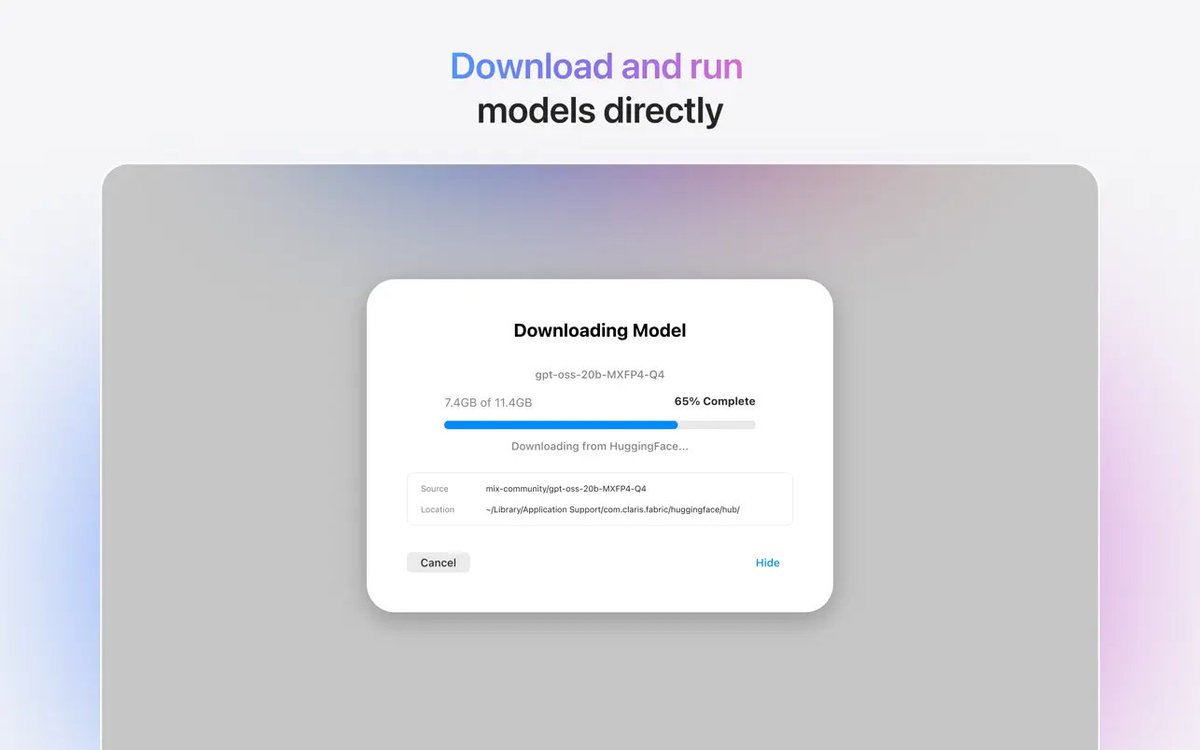
Download and run models directly Browse, download, and load open-weight models from within the app. Harbor handles model management so you can focus on the work, not the setup.
Cluster for scale Connect two or more Thunderbolt 5-capable Mac computers and Harbor pools their unified memory into a single inference resource. Run models that exceed any single computer’s capacity, or serve more concurrent requests across your cluster.
Harbor is currently in a private preview under the Claris brand.
Once every ten days, a bright canary-yellow bullet train glides into Tokyo Station at full speed, yet not a single passenger is allowed to step on board.
Its windows are mostly covered from the inside, its timetable is never published for the public, and there are no ticketed seats in any of its seven cars.
In Japan, every child and every commuter knows this train by two English words: Doctor Yellow.
Since the Tokaido Shinkansen began running between Tokyo and Osaka in October 1964, Japanese bullet trains have carried more than seven billion passengers at speeds up to one hundred and eighty-five miles per hour with zero passenger fatalities from derailments or collisions.
Critics sometimes assume that kind of sixty-year safety record is a miracle of luck.
It is not luck; it is what happens when a nation builds a high-speed hospital train whose only patient is the steel track itself.
Why does Japan run a seven-car bullet train painted bright yellow with zero paying customers on board?
In the early days of high-speed rail, engineers realized that checking hundreds of miles of track on foot at night with hand gauges was too slow, and that tracks behave differently when a three-hundred-ton train slams over them at one hundred and sixty-eight miles per hour.
So Japanese railway engineers took a seven-car Class 923 Shinkansen trainset and packed every car from nose to tail with laser-optical sensors, gyroscopes, accelerometers, and high-speed cameras.
Running in the middle of the regular passenger schedule at a full one hundred and sixty-eight miles per hour, Doctor Yellow fires laser beams onto the left and right rails to measure track width, vertical dip, and curvature alignment down to one-tenth of a millimeter, about the thickness of a single human hair.
At the same time, two special observation domes built into the roof and laser pantographs check the overhead high-voltage copper wire for microscopic wear before a single spark can cause a power outage.
The instant Doctor Yellow detects a rail that has shifted by even a fraction of an inch, it beams the exact GPS coordinates to maintenance crews waiting along the line so they can fix the spot that very night after the last passenger train goes to sleep.
Because its schedule is kept secret so crowds do not pack the platforms, Japanese commuters treat spotting Doctor Yellow by chance as a genuine good-luck charm that brings happiness for the rest of the week.
Safety is never an accident when engineers check their work down to the width of a hair.
(Note: Every photograph-style illustration on my feed is created by AI.)
BREAKING: Revolut moved ~2,000 engineers onto self-hosted GLM for coding and pushed Claude Code and Codex to the exception list.
Per David Abitbol, who leads AI ops there: 56 Nvidia B200s, a blended 30 cents per million tokens, roughly a tenth of what they paid Anthropic and OpenAI. Engineering lead time improved 70%.
Here's the part that matters: the gains showed up when tokens stopped being rationed. Engineers quit saving AI for the hard tickets and pointed it at everything.
Frontier models become the exception, open weights become the default. That's a pricing problem for every lab heading to IPO.
h/t @OliverMolander
Would you move your team off frontier APIs if the bill dropped 90%?
Every year on Halloween, thousands of people turn New York into a real-life "Thriller" music video.
This year, the 53rd edition takes place tonight, Saturday, October 31, starting at 7:00 p.m. on Sixth Avenue.
Maybe some of you knew about those but it's the first time I've come across them and it blew my mind.
So we're on a beach in the Philippines and we kept seeing these egg-like green balls in the seagrass. At first I thought they were plastic because they looked kind of like plastic toy capsules.
But there were so many of them all over the beach that either some kid had lost the biggest toy collection in history, or something else was going on.
So I checked and turns out they're called "Sailor's Eyeballs" (Valonia ventricosa) and each one is a single-celled organism, one of the largest on earth. Yup, that's one cell: the "plastic" shell is its cell wall, and everything inside is made of nuclei and cell sap.
I never knew cells could get that big, I always assumed - wrongly, it turns out - that all cells were microscopic. You learn everyday!
🚀 Introducing DeepInfer, our in-house inference framework, now fully open source!
Powering DeepSeek-V4.1-Flash at scale with high throughput and low latency. We’re sharing our production stack to help the community lower compute costs, reduce energy use, and make AI more affordable.
🔗 https://t.co/JGAik1kgk0
1/4
What a Day 1 in Shanghai.
From visiting the new office to seeing Solana light up the Shanghai skyline.
Quite a way to kick off the week!
Incredible energy from the community here.
What a Day 1 in Shanghai.
From visiting the new office to seeing Solana light up the Shanghai skyline.
Quite a way to kick off the week!
Incredible energy from the community here.
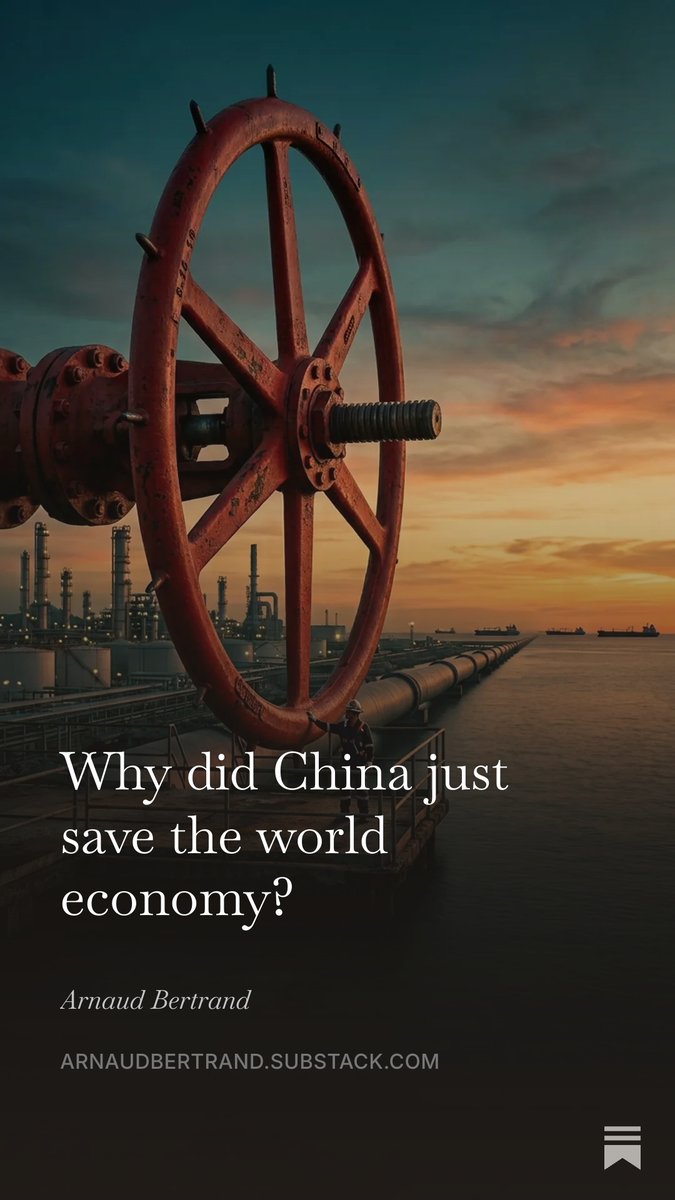
This is one of the biggest geopolitical mysteries of the year: why did China just save the world economy?
Because, make no mistake, it absolutely did. Analysts are pretty much unanimous on this: had China not dramatically - and I mean dramatically - reduced its oil imports this year, the price of crude oil would have gone through the roof and dragged the global economy down with it.
For proof, read how Javier Blas from Bloomberg - widely recognized as one of the world’s top energy analysts - explains what China did to Jake Sullivan and Jon Finer on their podcast “The Long Game” (https://t.co/bBD8yFFUdC).
As Blas puts it, China went “from 11, 12 million barrels a day to less than 6 million barrels a day” of seaborne crude imports, and that “freed a lot of oil for other countries, particularly in Asia.” India, Japan, Korea and Southeast Asia “could buy the barrels that China was not buying.”
To be clear, China wasn’t the only factor - surging US exports and the IEA’s emergency release helped too - but it was by far the biggest: JPMorgan reckons China accounted for about 74% of the fall in global crude trade (https://t.co/JCmFXYJcfh).
So it's no exaggeration to say that it is China, first and foremost, that saved the world economy this year.
If you remember the early days of the Iran war, none of this is what was predicted. In fact some US think tankers, such as the (always horrendous) Zineb Riboua from the Hudson Institute, were even cheering the war as being “all about China… the opening act in the larger contest against China,” the moment the US would crack “the central pillar of a regional order that Beijing has assembled” (https://t.co/RaCE05TcMp).
Seven months on, what actually happened is that not only did China come out of the war unscathed economically, and strengthened strategically, it also ended up shielding the world economy, America’s included, from the fallout of the very war that was supposed to be its undoing.
Breaking news: if you do something that’s supposed to be a “blow” to someone else - some sort of 3D chess move to gain the upper hand - and they end up having to rescue you from the fallout, maybe it wasn’t such a brilliant strategic move after all.
So how did China pull it off? And, more intriguingly, why did it choose to rescue countries, including the US, from a war that Washington’s own hawks were openly selling as a strike against China itself?
And why do this when it effectively dampened Iran's leverage considerably, even though they're supposed to be China's "ally" (which, as we'll see, is false)?
This is the topic of my latest article. I went very deep researching all the Chinese sources I could find on this, looking at the exact legal mechanisms, and at what officials, oil refiners and state media actually said.
The answer turns out to be far stranger than I expected: no-one in Beijing actually ever ordered an import cut. China, effectively, seems to have saved the world economy incidentally, as a by-product of its own domestic policy to protect Chinese consumers.
Which is the real story here: China has become so large and so important it can just rescue the world economy as a mere side effect.
In fact what I discovered, hilariously, is that the Chinese were just as surprised as anyone else: it’s only weeks after Western media started crediting China with saving the world economy that Chinese media picked up the story. And even then, CCTV’s first take in July (https://t.co/xLPyaJeZnT) presented it as something 外媒称 (wàiméi chēng, “foreign media claim”) 🤣
Almost like a giant suddenly waking up to its own powers. Because, that's the thing: intentions fade, consequences stay. Intentional or not, as Igor Sechin, the head of Rosneft, Russia’s largest oil company, put it (https://t.co/ckinOaHzJ7), the consequence is that it's now China, not OPEC, who calls the shots on global energy markets.
The valve of global oil pricing is now in Shandong, not in Zhongdong anymore (Zhongdong, 中东, is the Middle East in Chinese).
Full article here, with how China’s 20-year strategic nightmare, the “Malacca dilemma”, has now effectively become its leverage over the rest of the world: https://t.co/HsxPLJp45X