@rachitcodes One addition to the provenance loop: test whether the derived eval reproduces the original failure, not just its final error message. A minimized case can accidentally remove the tool state or retry history that caused it. Do you validate that before adding cases to the suite?
@joelniklaus@deepseek_ai@huggingface The shutdown example suggests a useful ablation: keep the model and budget fixed, change only process-lifecycle handling, then rerun those tasks. Does the failure come from the agent choosing cleanup, a harness teardown hook, or both? Those imply different fixes.
@YaxinLuo999999 Trace diffs are useful for finding hypotheses; matched-budget reruns are what test them. Could the infra replay a failed task with just one harness change, while freezing the model, tools and grader? That would help distinguish a causal fix from a better-looking trace.
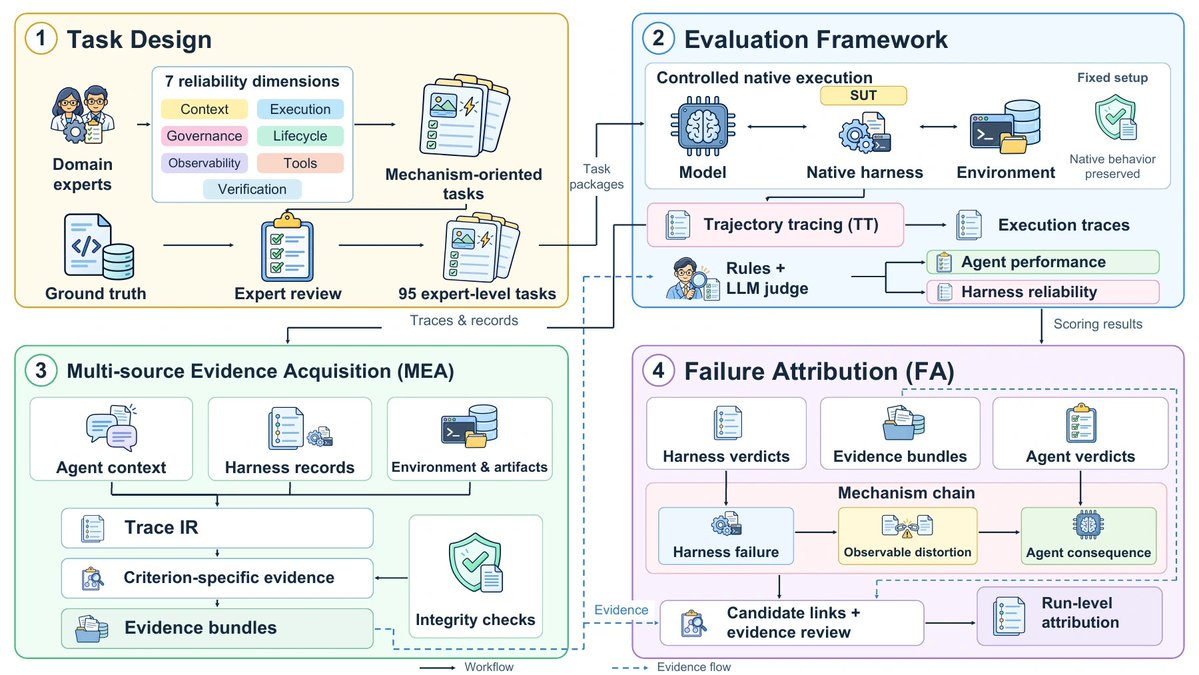
SophiaLabs tested Nomos on 95 TraceTrial-Bench tasks, sharing traces and harness fixes.
Community experiment, not an official ranking; see report for time-budget and scoring caveats.
https://t.co/UT1BrajG2N
What transfers to fresh tasks?
Building or studying agent harnesses? Try TraceTrial-Bench: 95 tasks, with code on GitHub and task packages + 3,420 run traces on HF.
GitHub: https://t.co/PC1jOHhjqI
HF: https://t.co/lRACrwVxXz
If it's useful, a GitHub star helps others find it ⭐
@guanlan For comparing model × harness pairs, trace completeness matters too: a missing event should not automatically count as an unattempted action. Our TraceTrial-Bench release exposes a trace_complete flag alongside scores:
https://t.co/vEv9APQOzS
TraceTrial-Bench separates task success from harness reliability, then reviews mechanism chains against trace evidence. A direction for harness evolution: use that feedback to guide changes, then rerun under matched conditions. Gains remain to be tested. https://t.co/20lkSmLlzr
@_sophialabs The public release includes workspace snapshots and diffs. In the published Trace IR implementation, we have not found a general check matching filesystem changes to tool spans, so we cannot claim automatic detection of shadowed hooks.
Agent failure attribution depends on traces.
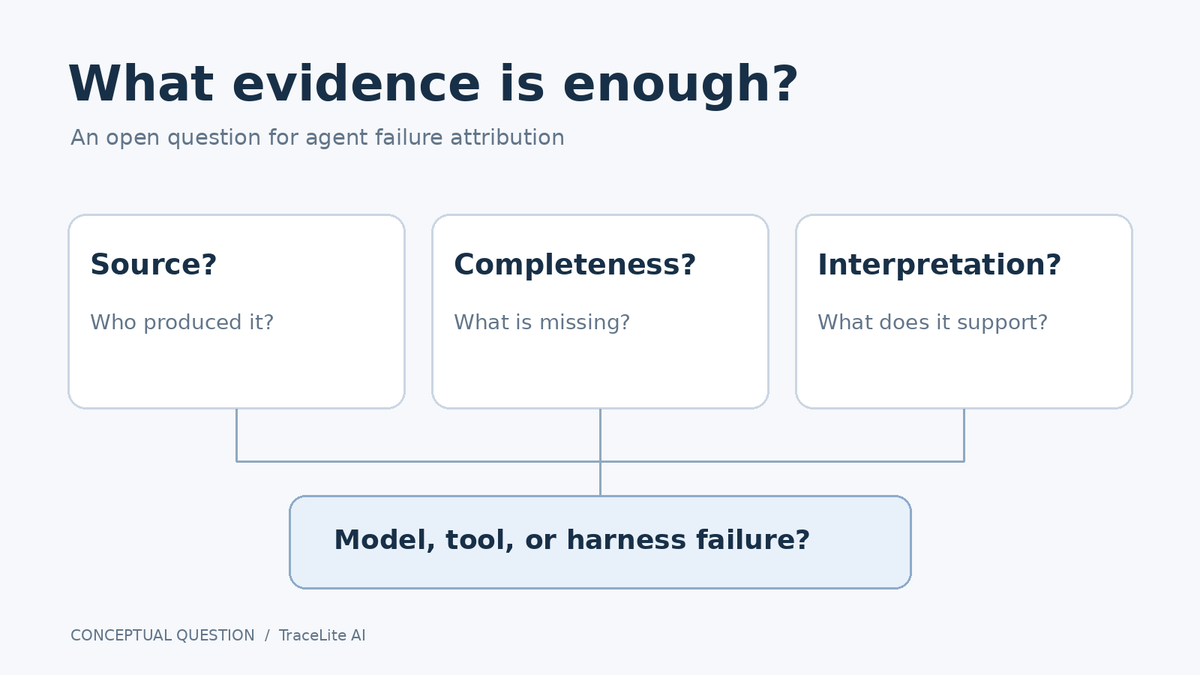
If records are incomplete or altered, how should we assess their source, completeness and meaning?
#AIAgents
What minimum evidence is enough to attribute a failure to the model, tools or harness?
Agent failure attribution: can an agent design the smallest experiment that distinguishes two plausible root causes?
A question for TraceTrial-Bench, inspired by Anthropic's work on scientific modeling.
https://t.co/BuR1MQ23Ou
@_sophialabs Thanks for the concrete breakdown. How do you distinguish an action the agent never attempted from an event the logger failed to capture? That boundary seems central to interpreting an incomplete trace.
@_sophialabs Thanks for sharing the traces, configs, and scorecards! We have added links to your work in the Community runs sections on GitHub and Hugging Face: https://t.co/Nf5N9wxadV https://t.co/icmiynrUqt
@_sophialabs Thanks for running TraceTrial-Bench! Yes, community run submissions are welcome. Could you share public links to the traces, configs, and scoring/results so we can check the setup and findings before considering inclusion in the HF dataset?
TraceTrial-Bench's session-handoff case: correct final codes can still hide repeated tool calls. Paired traces separate exactly-once compliance from output correctness. A case study, not a failure-rate estimate.
https://t.co/20lkSmKNJT
#AIAgents
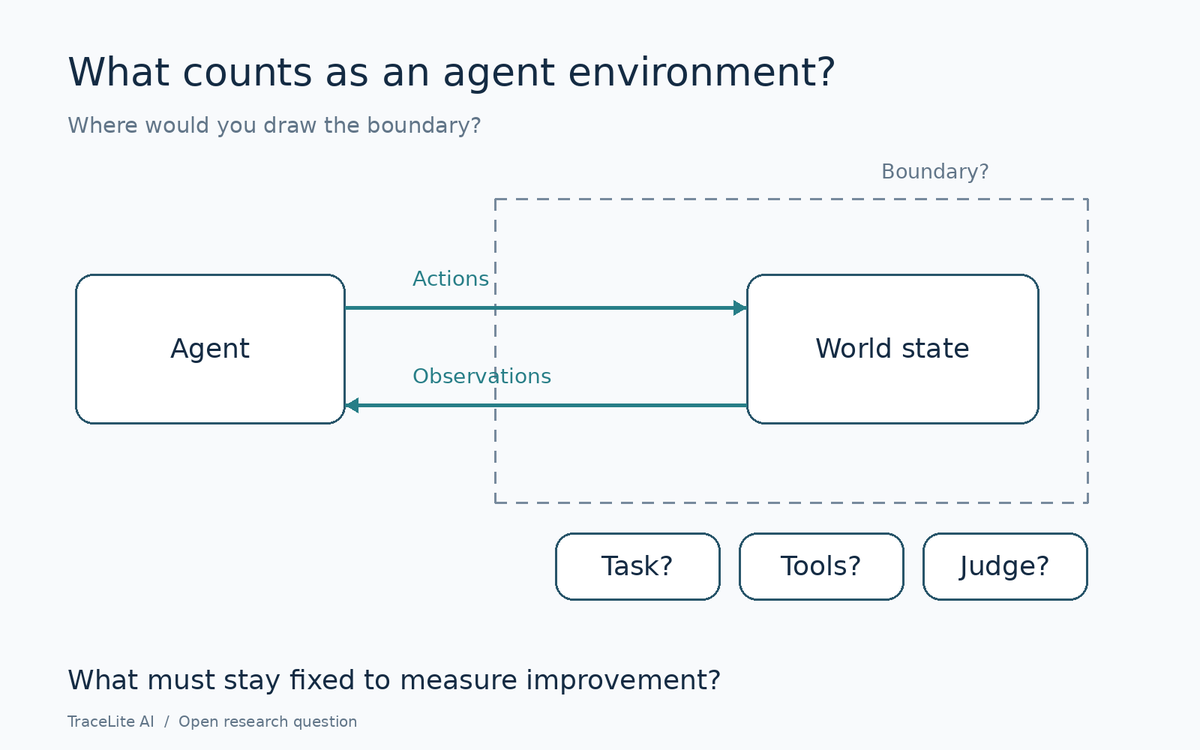
How should we define an agent environment? Where do the task, tools and judge belong? When an agent improves, what must stay fixed so we can tell whether the gain comes from the agent or a change in its environment?
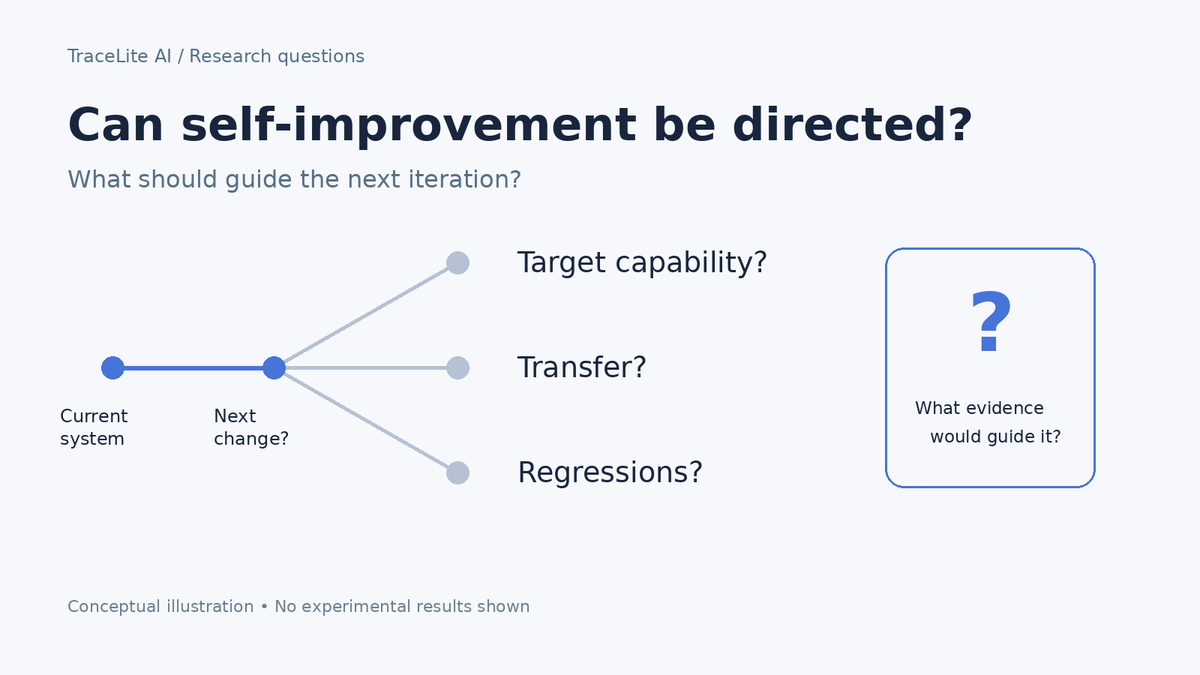
How can we steer RSI toward a specific capability?
When a benchmark score rises, did that capability improve, will the gain transfer, and what should change next?
#RSI#AIAgents
What would make self-improvement more directed than trial and error?
Our hypothesis: user simulation could generate multi-turn interactions to train agents on long-horizon tasks. This is our speculation, not a confirmed account of Anthropic’s training process.
Predicting a user's next prompt raises a useful question for agent evals: can a simulator preserve intent, constraints and state across turns? For evidence-based attribution, we need to test the simulator as well as the agent. #AIAgents#LLMEvaluation