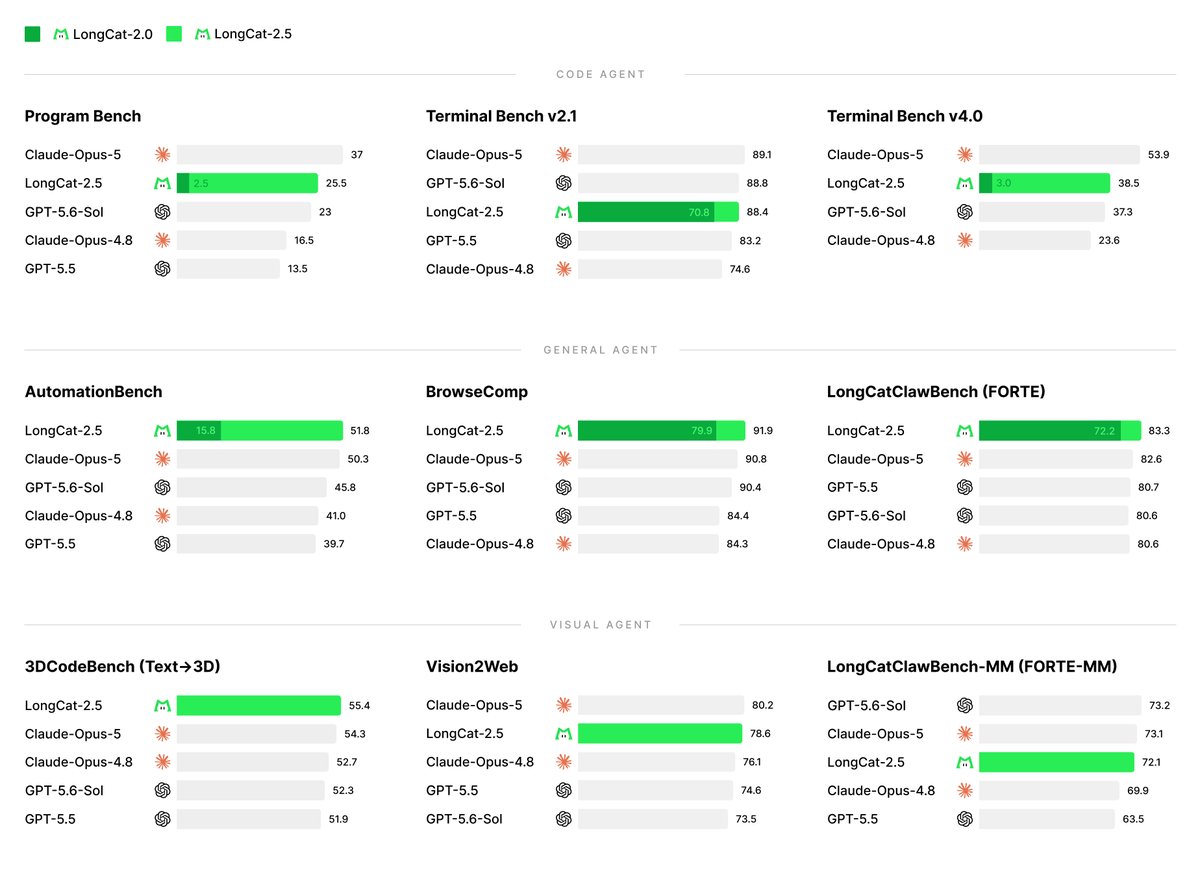
After one more intensive post-training month.
Finally, the Longcat2.5 Official Model now live! Weights will also open-source soon!!
1.6T-A48B, Native Multimodality for Agentic Tasks free for cache hits tokens.
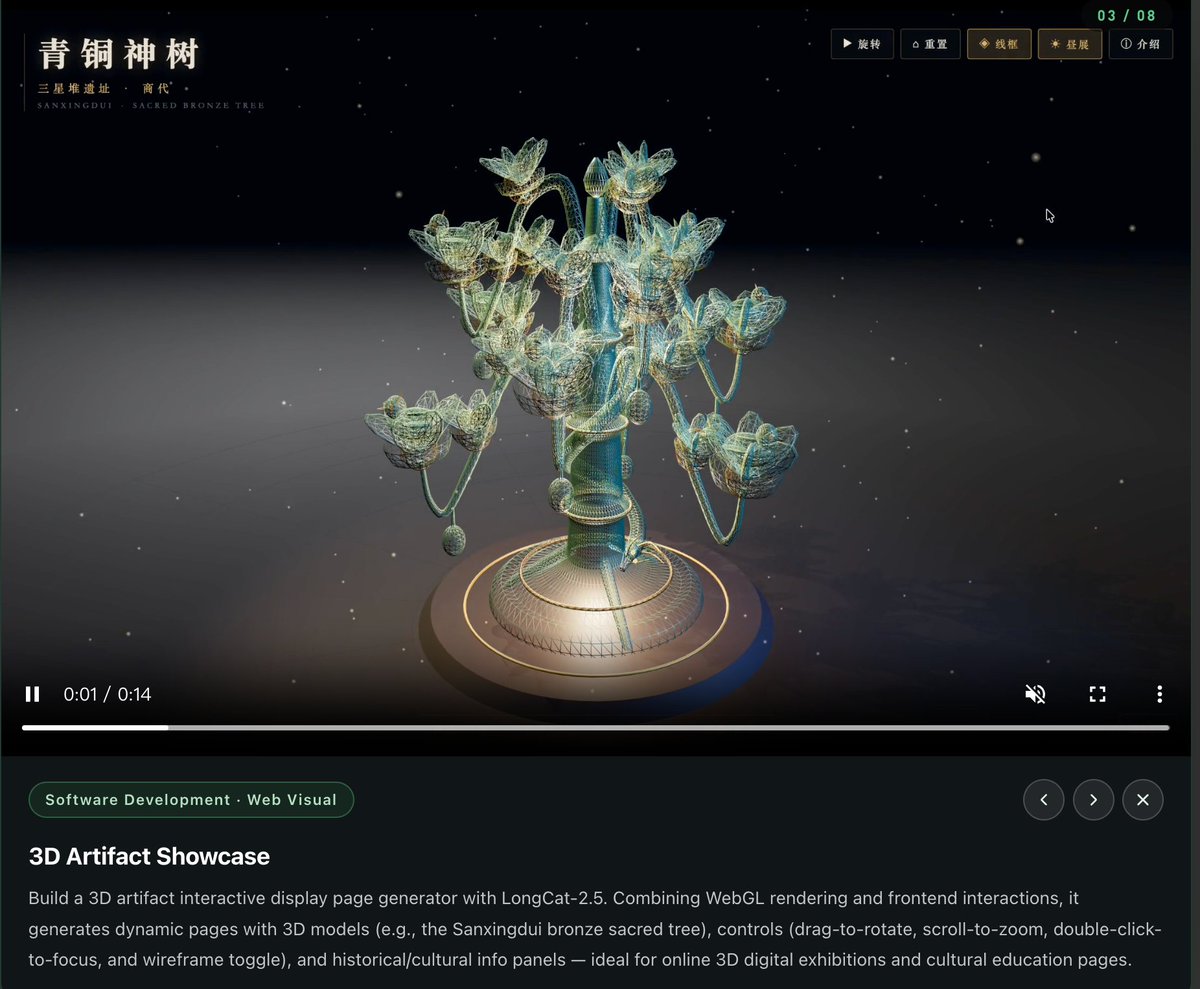
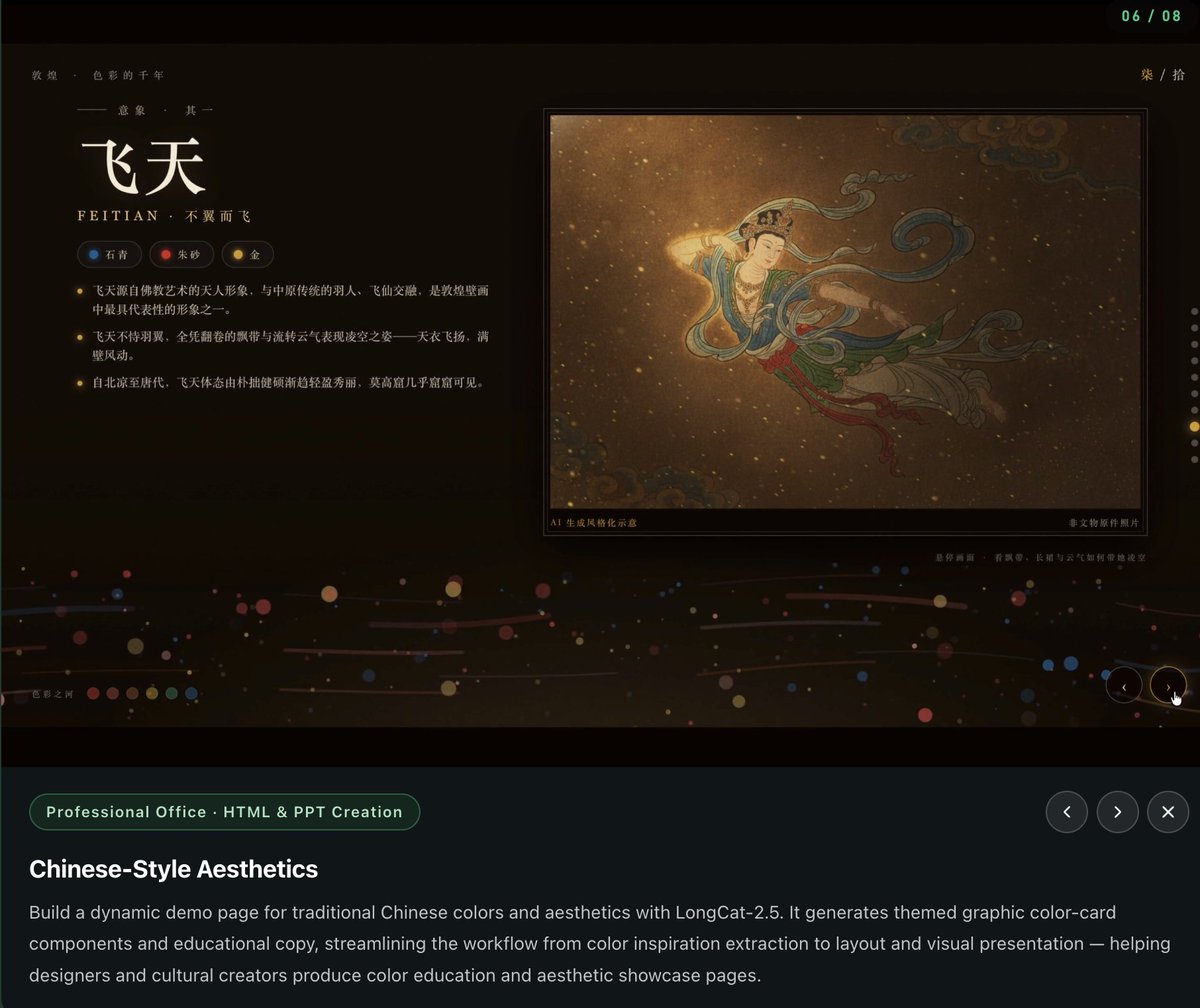
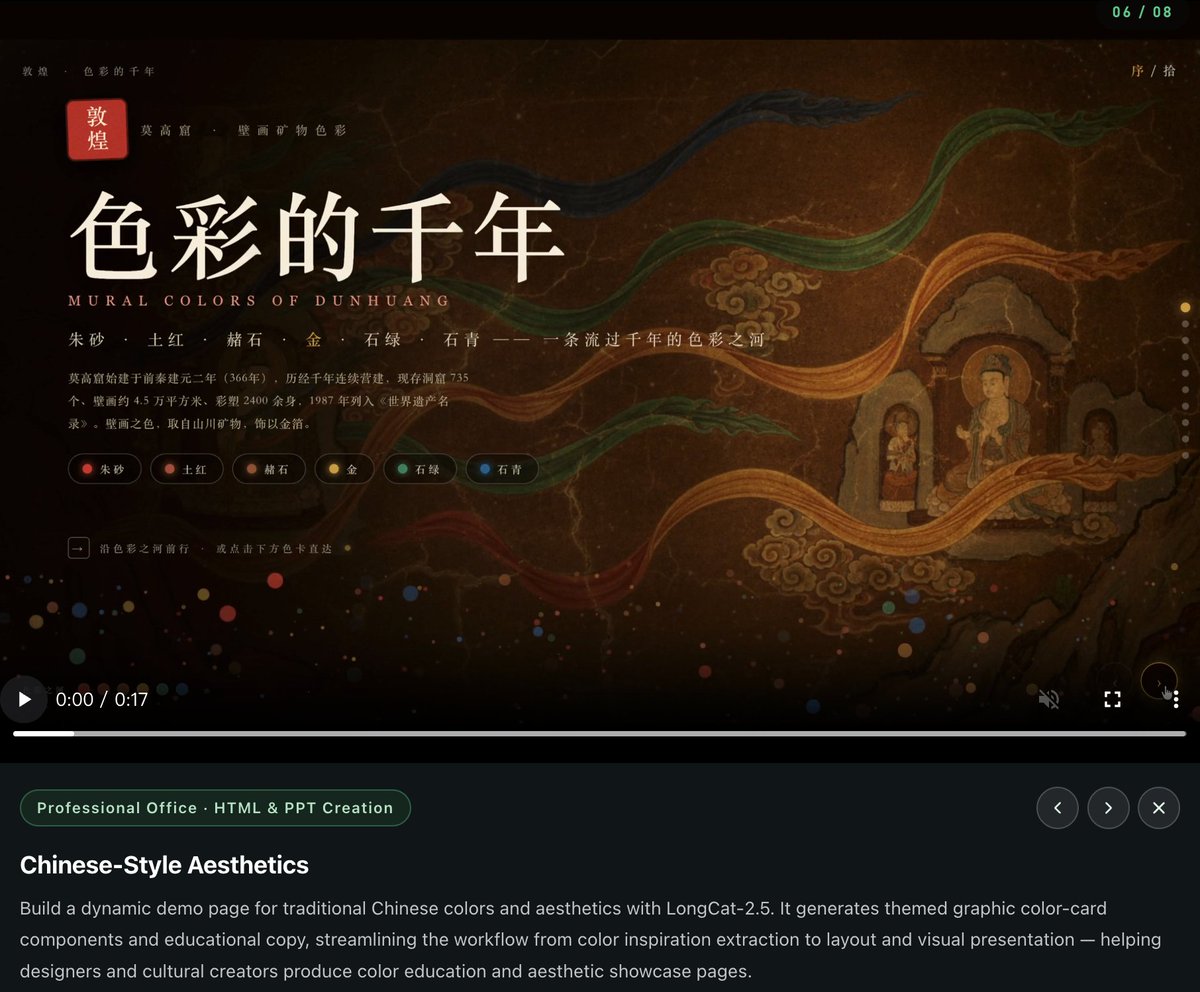
Very Good Design Taste after our Harness Behavior Internalization Reciepe.
More destils and demos in the blog:
https://t.co/ZW6UgoPi0n
Introducing LongCat-2.5, our latest natively multimodal agentic model with 1.6T total parameters and ~48B active.
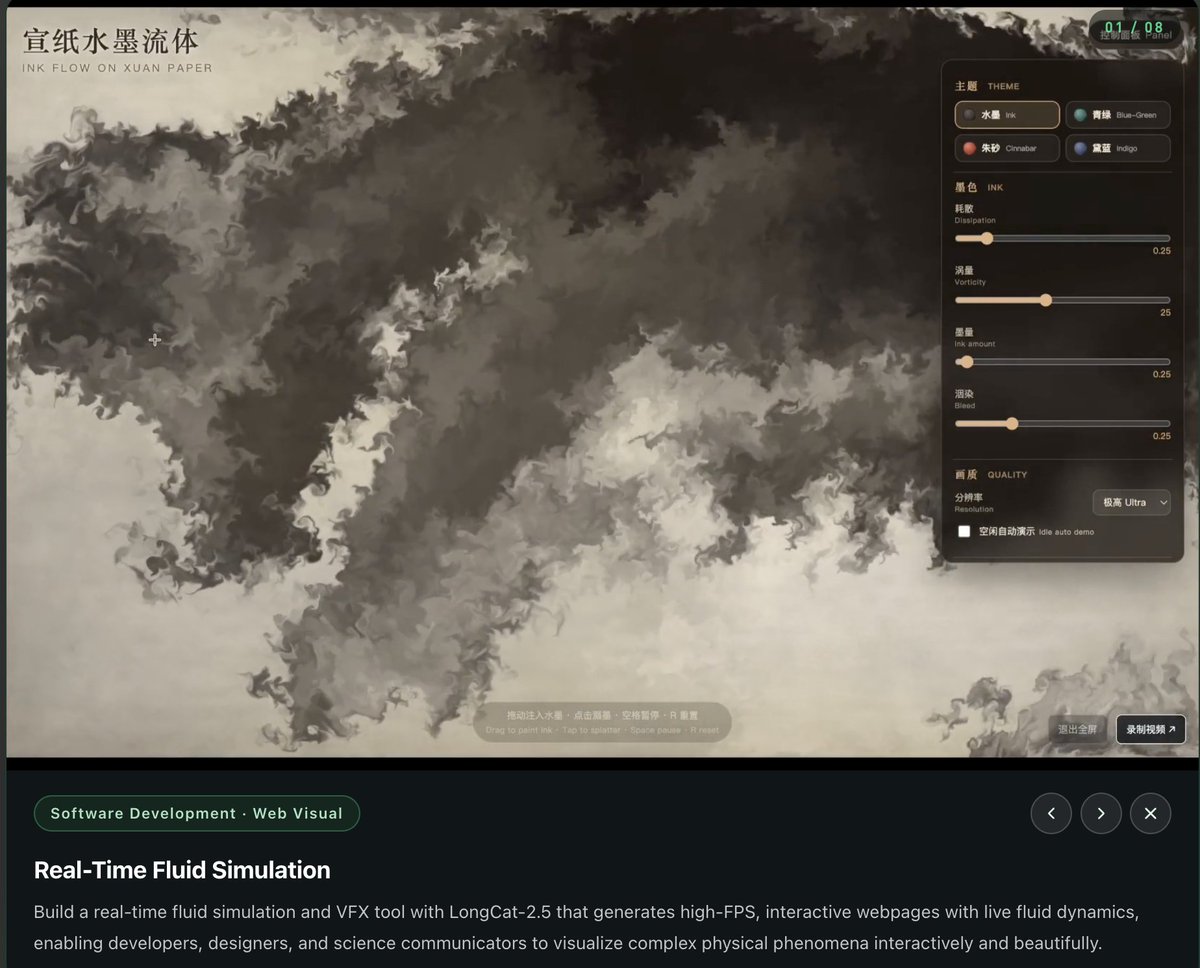
Built for long-horizon agentic tasks, it brings stronger visual understanding and agentic coding to work ranging from complex coding projects to visual coding such as creative design and 3D tasks.
Learn more about LongCat-2.5: https://t.co/ULLDweplqR
No Image Gen Models Invovled. I feel like is worth to do post-training on this tasks, if you are training foundation models.
Fable5.2 wrote a program for each one, brushstroke by brushstroke (up to 20,000 brush marks), and a paint simulator we built did the rest: bristles, pigment mixing, wet-in-wet, impasto, then a art under a raking lamp.
The magpie one is inspired by @irisfIowers, whose Midjourney image (from a Fable 5.2 prompt) started this. but with the painting simulator I created, Fable 5.2 can actually paint the Image 4 now.
If you want to have fun, the paint simulator is below:
https://t.co/6mxsj48KSf
@jaswwei True, the RL training on very large models is often bounded by rollouts time and waiting for the GRMs to compute rewards, the gradient updating step cost is just very small proportions comprared to sampling.
Good distinction, thanks for your insightful comments, and yes to the question: we keep every action in the trace, whether or not the rubric looked at it.
But you’ve found the weak spot. Today a behaviour gets counted only after a person notices it and writes a check, and you’re right that people don’t notice actions that look ordinary. Our compare views are all diffs, so they say nothing about what every version shares.
What we’re adding: a per-trace inventory of actions nothing asked for (reads never used again, retries with no failure before them, commands whose output nothing consumes, writes outside the deliverable), counted across all versions, with the ones no check covers listed first.
One caveat: “nobody asked” needs a definition, and some unscored habits are worth keeping. So the count gives candidates and a person decides.
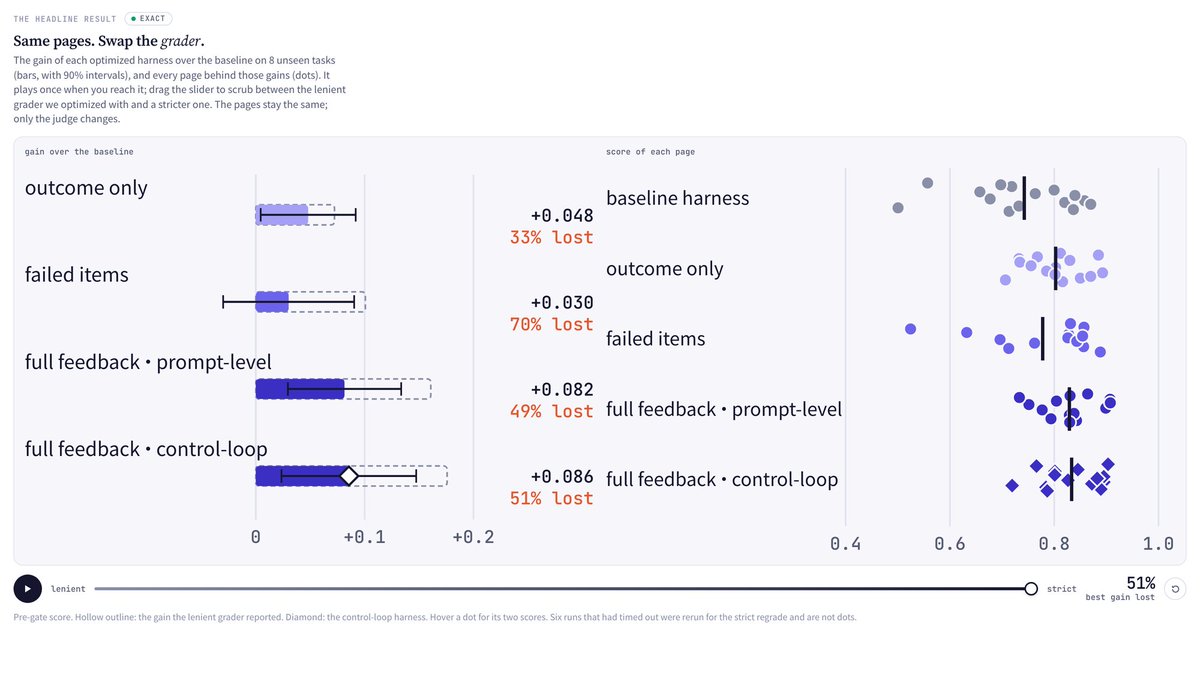
For post-training purpose, I don't believe in fully automatic harness optimization.
Pick one benchmark, let a strong coding agent optimize the harness against it, and you get a harness that overfits that benchmark. Show the optimizer the rubric and it writes the rubric into the prompt. In my own runs, 8 of 9 kept harness versions did exactly that. Re-score the same outputs with a stricter grader and the gains shrink by 33% to 70%.
The score goes up and it means nothing. And if you post-train on traces from that harness, you are training on a synthetic test set.
Harness optimization needs a human in the loop. What I think we actually need is infrastructure that does two things:
1. Build on an existing strong coding harness like Claude Code, and adapt it to whatever task you want to post-train on. Today's coding harnesses are good, not perfect.
2. Show the whole process to a person. Not only the score: the traces. Read what the model did, and compare trajectories across harness versions.
3. Most importantly, build your own graders, and evovle the graders in progress, do not only rely on others benchmarks, you have your taste, your know your model better than others.
What we actually need isn’t an agent that optimizes in the dark. We need infrastructure built around the traces:
Look at the traces from different versions of harnesses.
When you diff the actual traces between Harness v1 and Harness v2, you immediately see the truth:
• Did that new prompt actually encourage self-verification, or did the model just start hallucinating checks?
• Is it using tools cleanly, or running in noisy circles to inflate step count?
• What behaviors did you trigger by complete accident?
This trace-reading loop is where real human priors enter the system. And just as importantly: reading traces is how you realize your graders were broken, and you fix them too.
You don't get a post-training-ready harness from an autonomous loop running overnight. You get it from rigorous evaluation, evolving graders, and humans inspecting the traces.
We got tired of doing this with duct tape, so we built the infra for it.
Open-sourcing soon.
One of the most fun and productive periods of my career involved what I'd call "cooperative competition".
I was a postdoc in Toronto, working with Allan Jepson. He and I both had different methods for computing optical flow from video.
It was a like a dance. I would improve my method and run into his office with the new results. He'd then improve his method and run into my office with his results.
We were learning from each other and the competition drove each of us to be better. It was exciting and joyful.
If you find yourself in such a situation, enjoy it. I think it's rare. Put aside ego and have fun.
@ArgusPlatformAI We also developed a trace visualization feature in the harness optimization monitoring platform, can use jev or cheap LLM to analysis the trace diff plus some program based check, or read the diff in different colors manually.
We’re releasing the weights for LongCat-2.5 today.
· 1.6T total parameters, ~48B active, natively multimodal
· Stronger visual understanding and agentic coding in one model
· From complex coding projects to creative design and 3D tasks
Released under MIT. Weights are on Hugging Face: https://t.co/slrfOXLips
My recent experiences and opinions on training agents for long-horizon creative tasks (e.g., game dev, artifacts design):
Stop trying to make them end-to-end from day one. When you throw a model into a massive E2E environment right away:Trajectories are way too long.
Rewards are vanishingly sparse (RL is basically dead on arrival, and SFT barely survives). For example, a holistic deck-level reward dilutes granular credit assignment, masking brilliant individual slide designs behind page-level quality variance.
Even we break down our rewards in dimensions, sub-rewards fight each other, especially in aesthetics where layout, motion animation, and narrative have conflicting gradients.
The sane approach is: Deconstruct -> Atomic RL -> End-to-end fine-tuning.Break the task down into atomic post-training environments (e.g., pure UI art, level design, narrative pacing).
Train & RL them independently until the foundations are solid. And RL is always good at fixing mistakes, while SFT is better for improving model's taste and aesthetics.
Only then bring in an E2E environment to compose and polish the final behavior.
You don't teach someone to build an entire game by judging only the finished game. You teach the primitives first.
@jackyk02@thinkymachines we also find sft on good traces will help improve the aesthetic taste more than RL, while RL helps more on fixing text overflows, image overlapped things.
@jackyk02@thinkymachines Indeed, did you design plenty of rule based checks and algorithms depends on specific tasks along with llm verifiers to eval aspects of aesthetic quality in different dimensions?
we are also doing this for Longcat2.5, SFT is indeed very useful to teach the model what the design taste is, and RL is more about to correct the errors and mistakes model often face. I am wondering which kind of trajectories you guys SFT on? From Llama 70b and re-write by designers or firstly design a good design harness and rollout the trajectories from that harness with the same model or using a strong teacher model?
Can multimodal generators go beyond pretty pictures — and predict how the world actually evolves?
We introduce WorldCast, a benchmark for multi-step world state prediction:
• 320 manually designed cases across 8 task categories
• 1,352 requested visual states
• 12 image & video models, evaluated as ordered sequences under one protocol
What we find:
1. Frontier models show early-stage world simulation — GPT-Image-2.5 scores 72.8 overall and 71.6 on the harder L4 split, above 60 on all five L4 categories.
2. Gaps are wide — Nano Banana Pro reaches 42.8; the best open-source model, SenseNova-U1, scores just 20.1 (down from 24.4 on L3 to 15.0 on L4).
3. Strong generators lean on their language models — pairing Nano Banana Pro with GPT-6 lifts it from 42.8 to 61.2, and switching GPT-Image-2.5 from interleaved to grid generation costs 22.7 points (Logic & Rules: 74.3 → 23.0).
4. Agentic coding pushes the ceiling — inspect-and-revise loops take GPT-Image-2.5 to 80.2; a coding-first harness that simulates intermediate states reaches 82.4.
#WorldModels #MultimodalAI #GenerativeAI
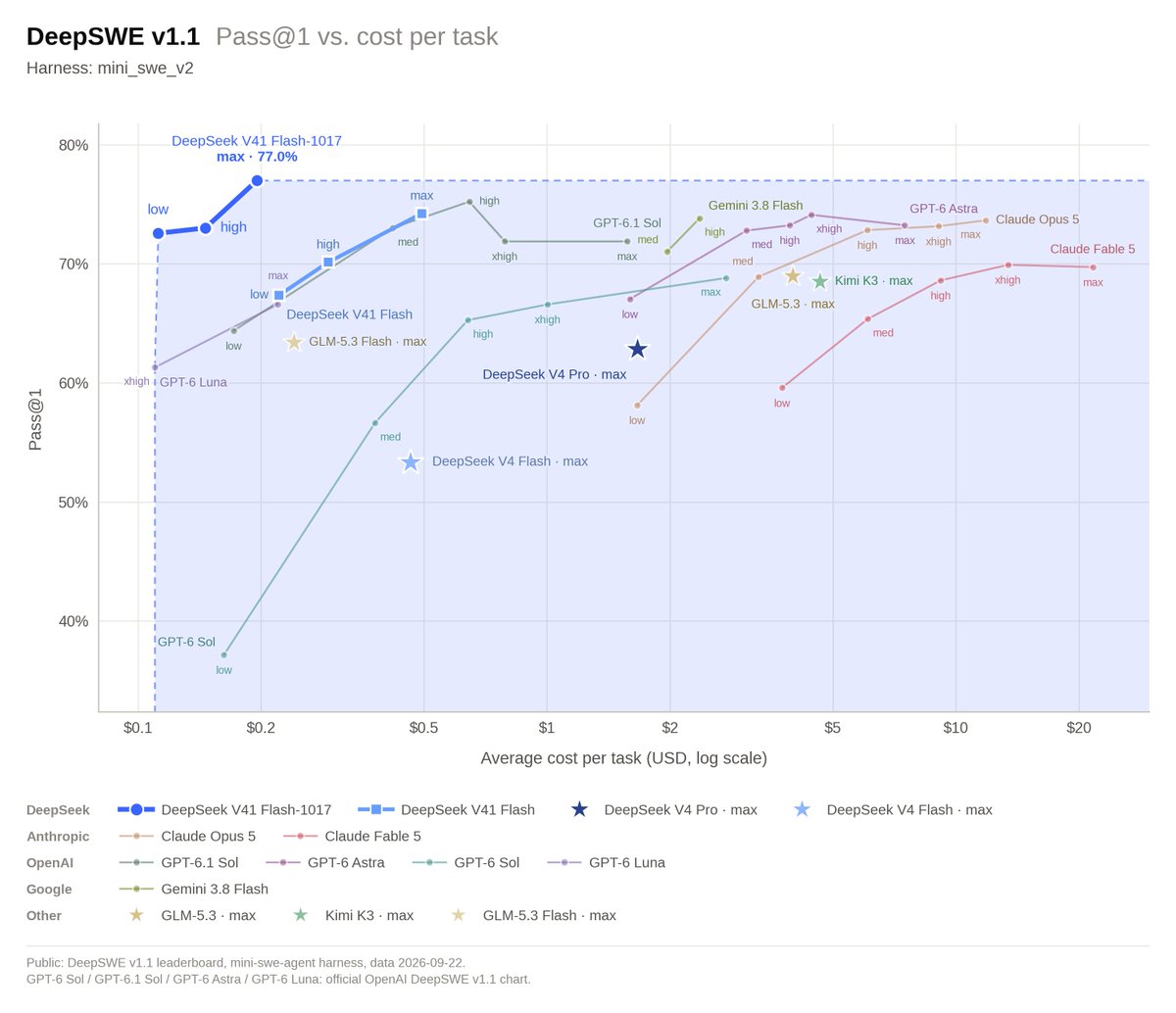
🚀 DeepSeek-V4.1-Flash-1017 is here!
Stronger benchmark performance, faster task completion, and shorter outputs than the previous version—a Pareto improvement in performance and cost. Now live on our website, app, and API.
🛠️ Optimized for @DeepSeekHarness, Tencent CodeBuddy, WorkBuddy, and more. Upgrade to DeepSeek Harness v0.2.1-rc.1 or later for the best experience with the new model.
1/4