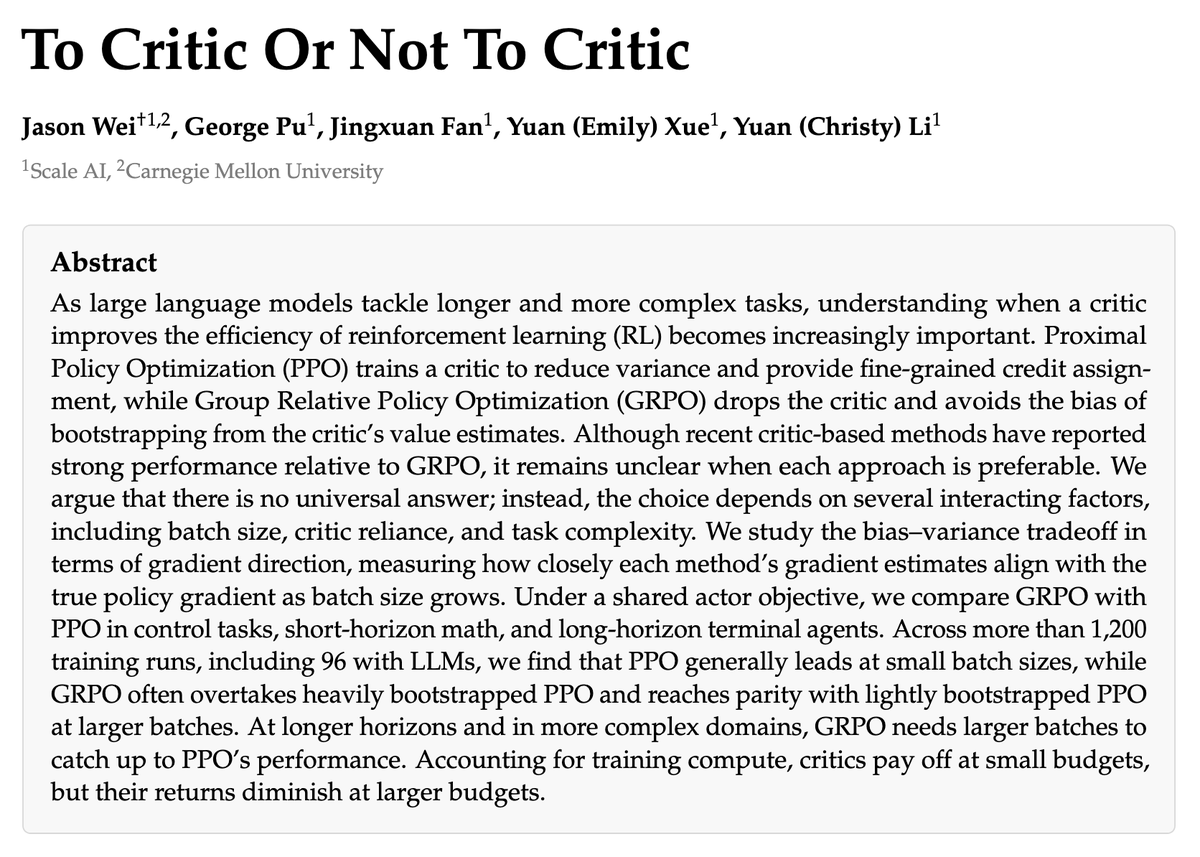
1/ As agentic tasks grow longer and rollouts become more expensive, the choice between critic-based PPO and critic-free GRPO becomes increasingly important.
Critics can reduce gradient variance, allowing models to learn from fewer trajectories, but they also introduce additional compute costs and potential bias from bootstrapping.
Our new research @ScaleAILabs compares PPO and GRPO under a shared actor objective across 1,200+ training runs in control tasks, short-horizon math, and long-horizon terminal agents. We studied how three factors influence this tradeoff: batch size, critic reliance, and task complexity. 🧵
@BetaTomorrow Thanks! I would imagine the general findings would hold. But since larger models are more sample efficient, I would expect a smaller crossover batch size
1/ As agentic tasks grow longer and rollouts become more expensive, the choice between critic-based PPO and critic-free GRPO becomes increasingly important.
Critics can reduce gradient variance, allowing models to learn from fewer trajectories, but they also introduce additional compute costs and potential bias from bootstrapping.
Our new research @ScaleAILabs compares PPO and GRPO under a shared actor objective across 1,200+ training runs in control tasks, short-horizon math, and long-horizon terminal agents. We studied how three factors influence this tradeoff: batch size, critic reliance, and task complexity. 🧵
This is a generally good read on the whole PPO vs GRPO debate. The main take-aways are:
> batch size and critic dependence decide the win
> surprisingly, PPO at small scale is worth the extra compute to train the critic.
> As task complexity grows, GRPO needs larger batch size to reduce variance (as also seen in the SAO paper)
Also very basic and important notes on bias vs variance tradeoff and formulations of how variance scales inversely with batch size.
1/ As agentic tasks grow longer and rollouts become more expensive, the choice between critic-based PPO and critic-free GRPO becomes increasingly important.
Critics can reduce gradient variance, allowing models to learn from fewer trajectories, but they also introduce additional compute costs and potential bias from bootstrapping.
Our new research @ScaleAILabs compares PPO and GRPO under a shared actor objective across 1,200+ training runs in control tasks, short-horizon math, and long-horizon terminal agents. We studied how three factors influence this tradeoff: batch size, critic reliance, and task complexity. 🧵
1) Lightly patched GRPO was clearly optimal until the long-horizon agent era, just no good reason to turn to anything more complicated.
2) in this era, we really want more granular rewards.
3) my own guess is that most of the critic benefit can be harvested with ≈10% of steps
1/ As agentic tasks grow longer and rollouts become more expensive, the choice between critic-based PPO and critic-free GRPO becomes increasingly important.
Critics can reduce gradient variance, allowing models to learn from fewer trajectories, but they also introduce additional compute costs and potential bias from bootstrapping.
Our new research @ScaleAILabs compares PPO and GRPO under a shared actor objective across 1,200+ training runs in control tasks, short-horizon math, and long-horizon terminal agents. We studied how three factors influence this tradeoff: batch size, critic reliance, and task complexity. 🧵
This is really a nice study and the results make a lot of sense to me.🫡
Only one question: if the bootstrapping bias matters, why we must need bootstrap?🤣 Will lambda=1 (no bootstrap) be better for critic-based PPO?
GRPO variants have been dominating for math reasoning tasks but PPO starts to be revisited more and more for agentic post-training. In this work, a comprehensive characterizations of PPO–GRPO tradeoff across 1,200+ runs reveals that PPO leads at small batch sizes, and GRPO needs increasingly larger batches to catch up as tasks get longer and harder. Our findings guide algorithm selection based on factors like batch size, task complexity and compute budget. Check out the amazing work from @jaswwei
We actually tried PPO lambda = 1 (gray line) in our control settings, and it performed very similarly to PPO alpha = 1.5, so alpha 1.5 doesn't actually introduce much bias.
Another interesting finding:
We also compared GRPO with and without std normalization (Dr. GRPO). With continuous rewards, std normalization can go horribly wrong if group stds differ by orders of magnitude. Normalizing gives groups whose returns barely vary just as much weight as the ones with the most to learn. This case only appeared in Pendulum at H = 25.
This is really a nice study and the results make a lot of sense to me.🫡
Only one question: if the bootstrapping bias matters, why we must need bootstrap?🤣 Will lambda=1 (no bootstrap) be better for critic-based PPO?