Since I started using AI for work and side projects, I haven't lost any motivation to learn or build. Quite the opposite.
I'm building more stuff than ever, and because I'm building more, I'm learning more too.
AI does a lot of the work, sure. But it also helps me understand things I probably wouldn't have had the time or patience to dig into before.
For me, AI hasn't replaced learning or building. It has made me do more of it.
Mathematicians are unhappy about OpenAI. The gist of their argument is that they form a community that trains young people.
When AI started producing breakthroughs on hard mathematical problems, I asked what a very smart 17-year-old would feel. Do you still choose a math major and train yourself to prove difficult results by hand?
This crisis has been coming for a long time. When I was a kid, the four-colour theorem was proved by a computer, in 1976. An intense debate followed. Does it count as a proof?
I wrote my PhD thesis using symbolic algebra software. To my knowledge, nobody then would publish their scripts. I tried to include mine. I was told it would make me look bad.
The letter says:
"In recent months, the success of AI in solving major mathematical problems has made headlines even outside mathematical circles. But solving problems is only a tool and proxy for achieving the primary goal of conceptual understanding and insight. Forgetting this in the world of AI may turn the tool against the primary goal. Often these solutions are announced in a rush, leaving no time for a proper writeup, the isolation of new methods and ideas, and citing relevant previous work of others. As in all creative professions, this raises severe attribution and plagiarism questions. We are witnessing a general threat to intellectual work, with misalignment between the outcome of the use of AI and its initial purpose. In many fields and activities, years of training have traditionally served not only to produce a final answer or product, but also to develop understanding and the ability to formulate new questions and ideas."
They worry that kids will not choose to become old-school mathematicians. That is a reasonable fear. They do not seem to consider that some kids might still do mathematics, just in a very different way.
Doron Zeilberger, in 2009:
"Teaching computers how to discover and prove mathematical results is certainly the way to go, and I believe that mathematicians who continue to do pure human, pencil-and-paper, computer-less, research, are wasting their time."
https://t.co/AtnbmjnDmv
The letter implies that people, because of AI, will stop having ideas, or will stop taking the time to understand the issues. If that were true, mathematics would continue only on computers, with no humans interested, or it would stop.
Both scenarios assume that people care about mathematics only when they can claim credit.
I am not sure why I cannot study a proof generated by AI if I want to. I can give talks about it. What becomes less likely is the reward of having been the one who proved the result.
The rest of the letter makes a big deal of credit. What if the AI builds on what it read and does not give proper credit? Where is the evidence that AI is worse than human beings at citing sources?
The letter notes that mathematics contributes to society. It never considers that faster progress might increase those contributions.
My stance is simple. Mathematicians, software developers, engineers, lawyers, physicians will all learn to work with AI. You cannot put the genie back in the bottle. Only a totalitarian world government could try, and some of us would rather avoid that outcome.
Difficult proofs will now be built with AI, just as most code will be written with AI. People who insist on pen and paper should view themselves as artists.
Other mathematicians will work with AI. They will have no trouble finding interested kids. They will contribute to society.
@_unaizc_ Ni mucho menos voy a pensar q se más que ellos, está claro, pero yo no entiendo q el tema de que haya IA q avance las matemáticas vaya a hacerlas menos interesantes… a mi la IA no me ha quitado la motivación y el interés por el desarrollo de software…
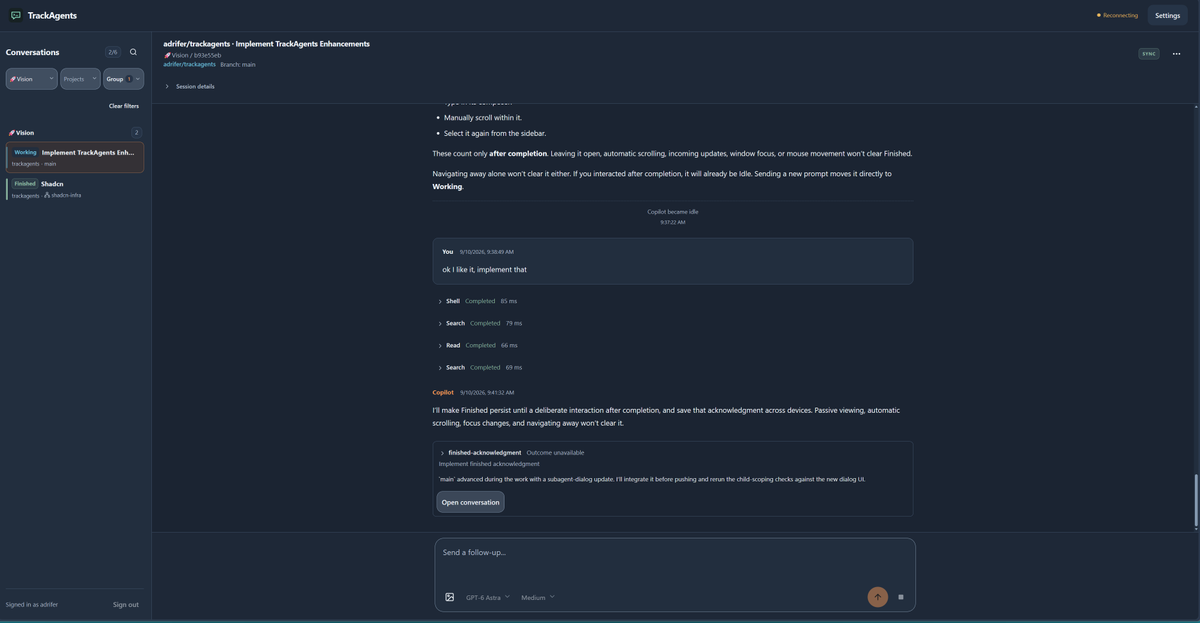
Been building a little internal app to manage all my coding agents across my machines 😍
It tracks every conversation, shows what's working, finished, or waiting for me, sends notifications, and lets me reply or steer an agent from my phone.
A GitHub CLI extension sends the events to a relay on my homelab, which stores everything and hosts the web app.
This is becoming dangerously useful.
💭 Been thinking about how to bring agents into my work beyond automations and 1:1 coding sessions.
Less like tools I hand tasks to, more like collaborators that learn how I think and work as we go without lowering the bar.
Some early thoughts: https://t.co/BmQNPJKPcj
@jamiepinheiro Wow and do you infer them just with the subtitle? Or also with other media? Asking because I have @TrackSeriesTv as my side project, and I want to create a way for people to get a summary of what happened before X episode. And I had the idea of using subtitles..
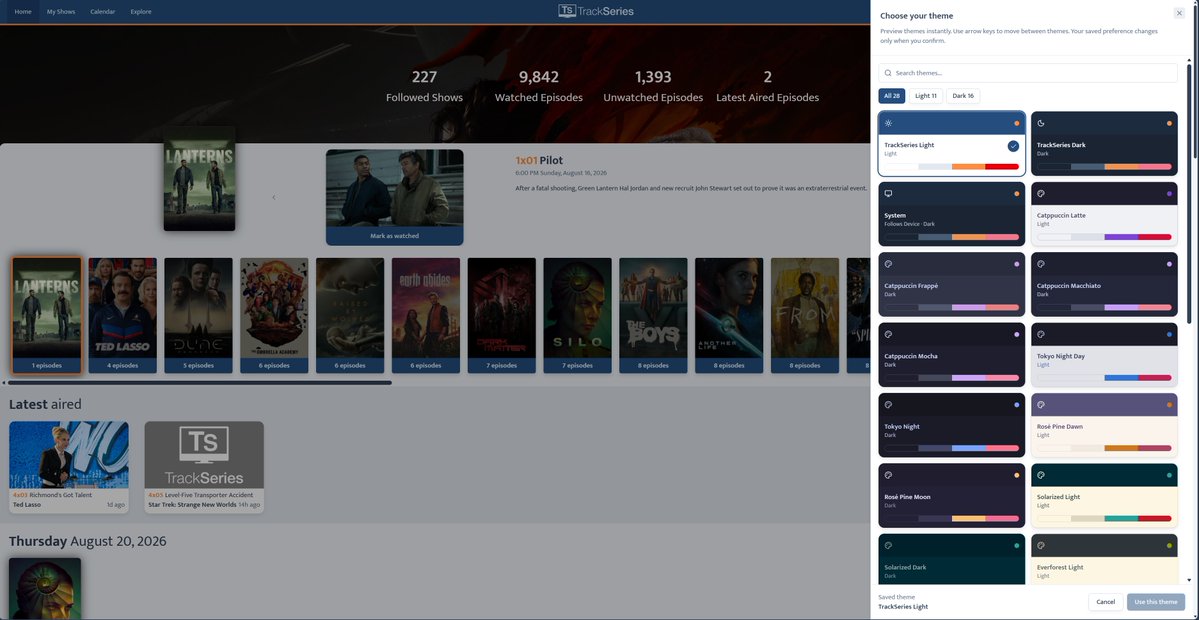
Your episodes are safe. Your progress is intact. The only variant here is the interface.
Which TrackSeries universe are you choosing? Reply with a screenshot, we want to see your timeline. 👇
Dracula. Nord. Gruvbox. Kanagawa. Catppuccin and many more realities where your watchlist somehow keeps growing.
Preview themes instantly, explore all 27, and find the timeline that feels like home.
Reality has branched into 27 themes. Fortunately, your watched episodes survived the incursion.
The TrackSeries multiverse is now open.
Choose your universe. 🌌
https://t.co/JmsQxiT9kL
We're looking to hire Windows developers capable of producing UI at this quality (but, idiomatic to the Windows ecosystem, not cloning Apple). If you are one or know someone, please have them apply via `ssh https://t.co/4JHvflVz0r`. We've been struggling to find this person.
There's just a lot of Windows applications out there (like, almost all of them) that just aren't good. We're looking for someone who wants to create a Windows applications that sparks joy, excites people, and feels good. We want frame perfect animation. We want obsessive consideration over user flows, click counts, keyboard press counts, etc.
We're a team that has that kind of obsession, but lacks the Windows experience. If you know a Windows dev who has this quality obsession and wants to work with a group that shares those ideals, I want to talk to them.
And the longer-term plan: extending the same model to Windows, generating PowerShell, Winget and DSC under the hood. It won't match NixOS, but having a slice of that declarative experience on Windows would already be a win.
Take a look here: https://t.co/RlJaDuvwtS
Setting up a new laptop is the worst part of being a developer. The tools, sure. But also the 50 invisible tweaks you collected over the years: bumping the file watcher limit so npm dev doesn't die, sockets, hosts file entries for local subdomains.
You configure each one once when something breaks. You write it nowhere. You format the laptop and they're gone.
There's a fix for this. Here's how I'm trying to help 🧵
One thing I didn't expect: writing the config in TypeScript with proper types means LLMs are actually useful when I need help tweaking it. They struggle hard with Nix because there's almost zero training data for it. TypeScript is everywhere.