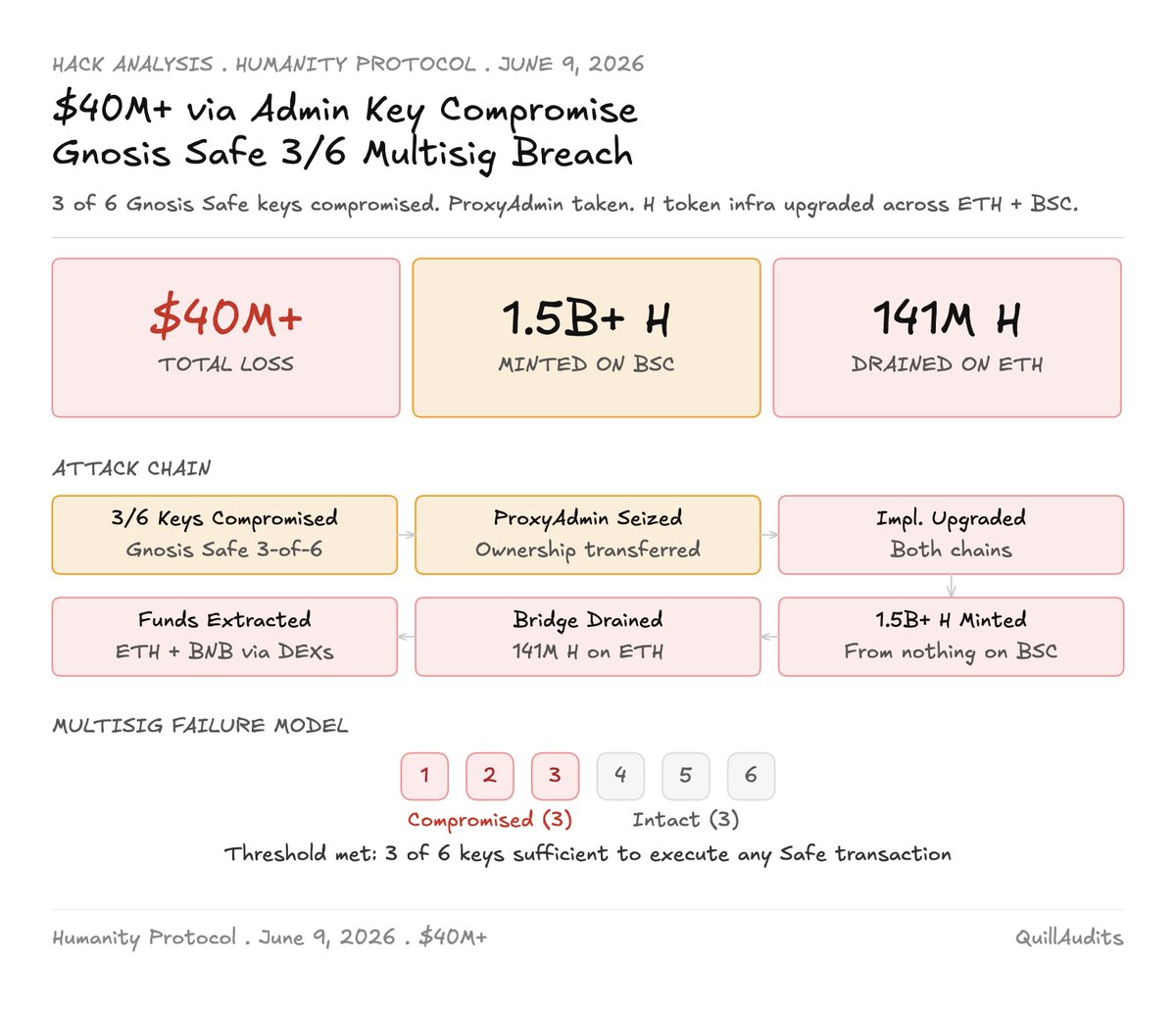
🚨 @Humanityprot exploited for $40M+
The attacker didn't find a bug in the code. They compromised 3 Gnosis Safe admin keys, took ownership of the ProxyAdmin, and silently upgraded the entire H token infrastructure across Ethereum and BSC, and managed to get 1,641,182,632 H tokens.
Here's exactly what happened 🧵
🔥 QuillAudits is now officially ISO/IEC 27001:2022 certified.
The gold standard in information security, independently audited, not self-declared.
Your security is verified, not assumed.
Full breakdown of what our ISO certification means for your audit 👇
This week, I'm attending @ethconf in New York City.
I'm also hosting an event, "AI & Formal Verification for Onchain Finance," alongside it.
if you're building or securing onchain finance, come say hi 👇
https://t.co/RUc8t17iYa
New York has quietly become the capital of onchain finance.
Last week @stable_summit and @Vault__Summit were the best events I've been to in 8 years, less for the crypto crowd than for who's now in it: Fidelity, JPMorgan, Goldman Sachs, DTCC, BNY Mellon, S&P Global, AON, Bitwise.
The retail side of crypto is the quietest it's been in years.
The institutional side just had its loudest week ever.
🧠 Your contract is clean. Your agent isn't.
Prompt injection, memory poisoning, malicious routers, none of this shows up in a bytecode audit.
The executor is now a reasoning model. It reads token names, price labels, and on-chain data. Any of it can be an instruction.
26 LLM routers were found secretly draining wallets. $500K gone. Zero contract bugs.
Memory poisoning plants false beliefs across sessions. Runtime guardrails don't catch it. The exploit already happened.
The attack surface moved from code to interpretation. Most teams haven't noticed yet.
Full breakdown on attack vectors, secure architecture, and what AI-native auditing actually looks like 👇
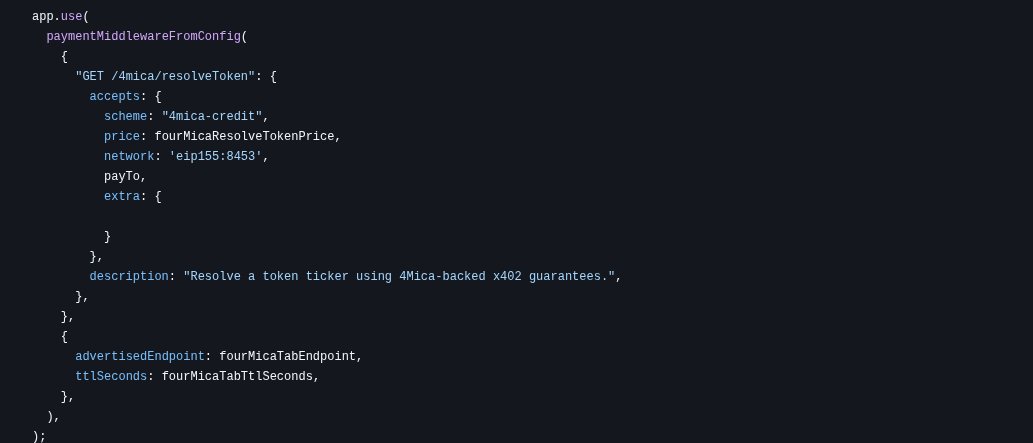
WachAI is partnering with 4mica to bring lightning-fast settlement to all WachAI x402 endpoints.
Soon, agents using https://t.co/oYZ2f1h6TY will no longer have to wait for transactions to confirm before receiving results.
@0x4Mica will power the payment guarantee layer in the background.
WachAI will return the service response at HTTP speed.
For agents, this means faster execution.
For users, this means smoother workflows.
For agentic commerce, this is one more step toward real-time, trust-backed transactions.
Coming soon across all WachAI x402 endpoints.
https://t.co/oYZ2f1h6TY
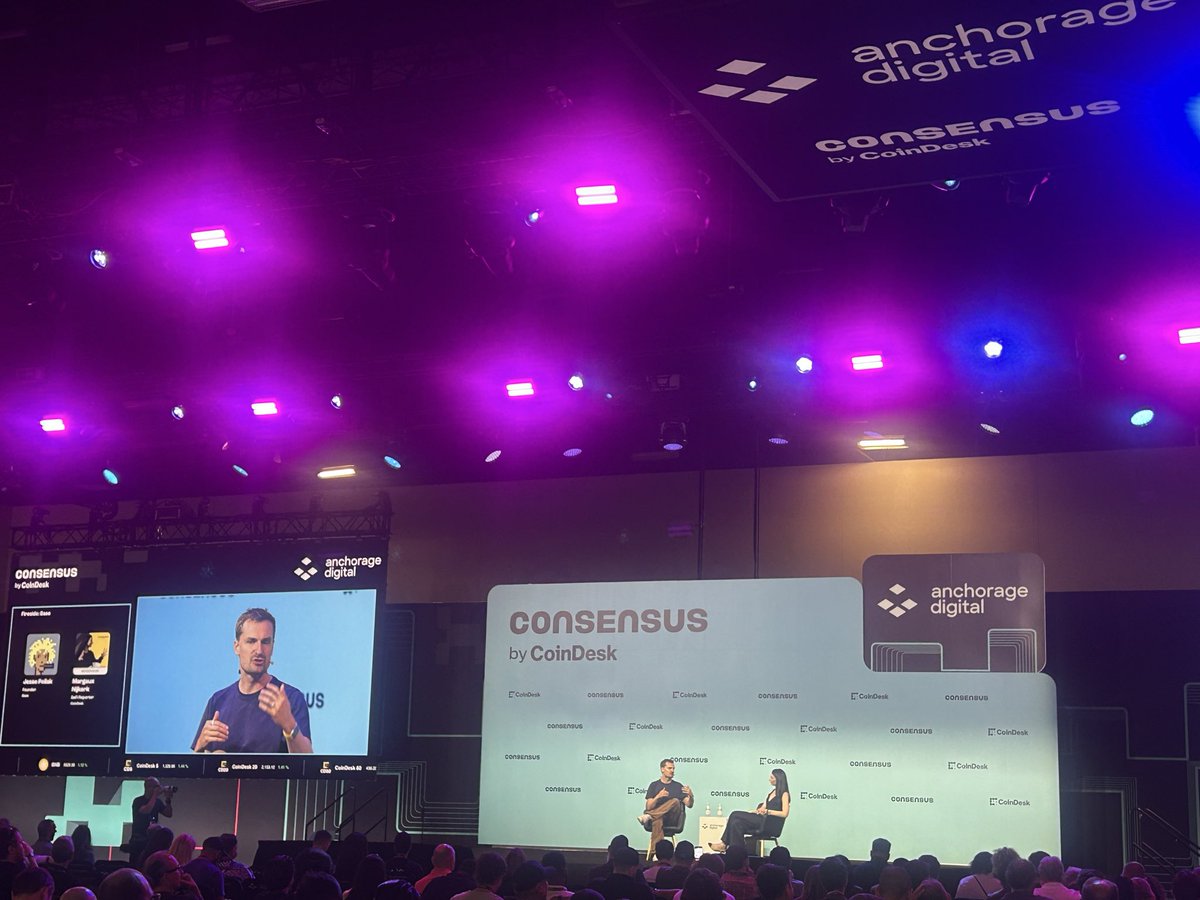
back from Consensus Miami 2026. my notes app looks like a crime scene.
quick thread on what actually mattered, not the stage quotes everyone is recycling.
1/ web3 finally grew up around defi.
three years ago every booth was a new L1 claiming 100k TPS. this year nobody cared about chains. the floor was stack. stablecoin rails, RWAs, on chain credit, perps, derivatives, settlement. boring in the best way. the kind of boring that prints revenue.
2/ the loudest category nobody is naming correctly is AI agents for defi.
not chatbots. not "ask my wallet" demos. real agents routing liquidity, rebalancing LPs, hedging perp exposure, running DAO treasuries. Raoul said agents dominate defi in 5 years. on the floor it felt closer to 18 months.
if you are still building a better dashboard, you are already late.
3/ the tradfi guys were different this year.
i used to explain what a stablecoin is to bank people. this time a Morgan Stanley wealth guy asked me about basis trades on tokenized treasuries and which custody setup makes their compliance team less twitchy.
DTCC testing corp actions on chain. Morgan Stanley turning on spot crypto for wealth. Saylor pushing tokenized credit as the next capital markets layer.
they are not exploring anymore. they are shipping. quietly. with budgets.
4/ the regulatory tone shift is underpriced.
CFTC chair basically said the era of regulation by enforcement is ending. you could feel founders exhale in real time. legal panels that used to be funeral marches turned into roadmaps.
5/ side conversations beat the mainstage.
best alpha came from a 1am dinner where a stablecoin issuer, an RWA founder and an ex Goldman structurer argued about who actually owns the yield in tokenized t bills.
nobody won. everybody learned.
6/ pattern i kept noticing.
every serious team had stopped pitching TVL. they pitched revenue, take rate, distribution. crypto is finally speaking the language of business.
7/ honest read: this is positive for the industry.
not in a number go up way. in a the plumbing is being laid by people who actually know what plumbing is way.
ai agents will be the interface. stablecoins the rails. RWAs the inventory. defi the venue.
the next cycle will not look like the last one. it will look like finance. just faster, cheaper, weirder.
what was your single biggest takeaway from Consensus this year?
WachAI is building the bedrock for agents to find, verify, and buy tokens on base safely.
Today, agents can move fast across the internet, but token buying is still broken.
Before buying a token, an agent needs to know:
Is this the right asset?
Does it have liquidity?
Are there code or market risks?
And then it needs to accumulate the capital to buy them. All of this takes a while, and in that while the opportunity is gone.
That is what WachAI x402 endpoints are built to solve for.
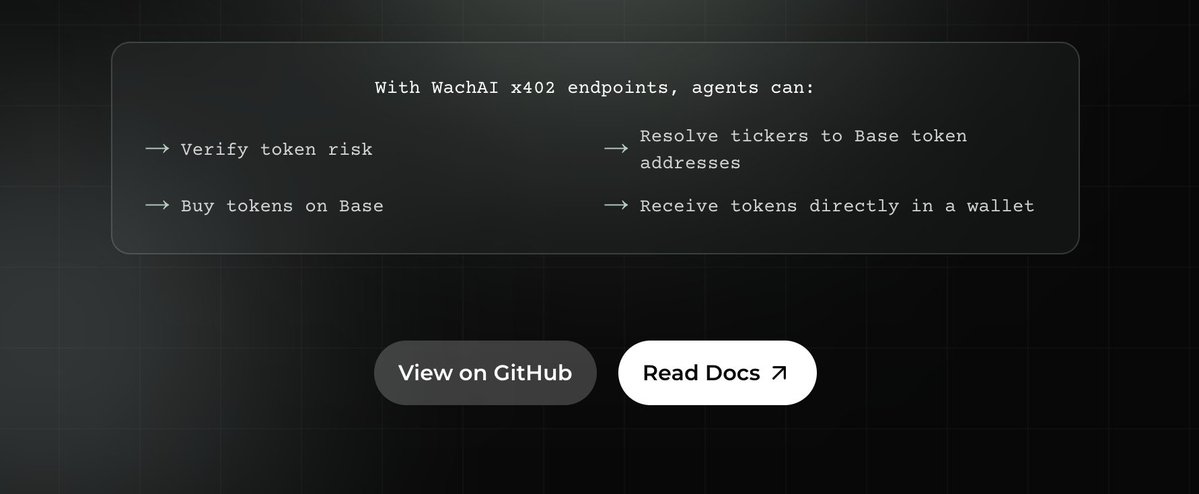
Agents will be able to:
→ verify token risk
→ resolve tickers to Base token addresses
→ buy tokens on Base
→ receive tokens directly in a wallet
We’re launching this tomorrow.
Find. Verify. Buy.
And with @0xclawlens, we’re enabling credit for these endpoints, so agents can execute without being blocked by upfront capital.
time to lock in!
$2B+ gone.
That's the combined loss from Bybit, Drift, WazirX, Radiant, and Resolv.
Code bugs in any of them? Zero.
Spend 5 minutes reading this. Then ask your team the 7 questions inside.
If you can't answer them, you already have your first finding.
Full breakdown + 7-question checklist in detail 👇
Security has been the biggest bottleneck for early-stage Ethereum builders not because they don't care, but because quality audits are expensive when you're pre-revenue.
This changes that.
> $1M in subsidies.
> 20+ top-tier auditors.
No reason to ship unaudited anymore.
At @QuillAudits_AI , we've done 1,500+ audits across 8 years on Ethereum and every major EVM chain.
We also go beyond the standard smart contract review as our multilayer audits approach includes AI-powered analysis, fuzzing, formal verification, and expert manual review in a single engagement.
If you're building on Ethereum main-net, apply for the subsidy and come talk to us. We'll make sure the security matches the ambition.
Apply here 👇
$2,000,000,000.
That's the combined loss from Bybit, Drift, WazirX, Radiant, and Resolv this year alone.
Code bugs in any of them? Zero.
Spend 5 minutes reading this. Then ask your team the 7 questions inside.
If you can't answer them, you already have your first finding 👇
we spent 8 years doing audits the best way humans could.
then we asked a harder question: what if the best humans can do still isn't enough?
exploits don't happen because auditors are bad. they happen because the search space of a live protocol is infinite and your audit window is 2 weeks. that gap is structural. you can't hire your way out of it.
and running 3 manual audits back to back? same layer, repeated 3 times. different auditors, marginally different findings. you paid 3x for almost the same depth.
real security is orthogonal layers. each one catching what the previous one is blind to.
AI scanning catches logic paths humans never walk.
human audit catches context AI can't reason about.
fuzzing breaks assumptions neither questions.
runtime monitoring catches what all three miss.
that's the stack Web3 always needed. and we realized we were only living in layer 2.
so we built QuillShield to own layer 1. an AI engine that reasons about DeFi attack chains, generates working PoCs, and hands our human auditors a head start no competitor can match.
first live scan. 1 hour. 3 real vulnerabilities. 1 high, 2 medium. all confirmed by senior auditors.
the client didn't ask for a proposal. they converted on the spot.
that's happened 10+ times now. protocol teams see the AI output, see the PoCs, and sign immediately. no sales pitch. the findings speak for themselves.
this is what we've been building toward for 8 years. the most complete security stack in Web3.
QuillShield's new version is now live for our auditing team. the era of single layer audits is over.
We've done 1,500+ smart contract audits across 8 years.
The uncomfortable truth we had to sit with: audited projects keep getting drained.
The search space is bigger than any human can cover in a fixed window. That's not a talent problem. It's a math problem.
So we built QuillShield, our AI security engine that finds vulnerabilities traditional audits miss.
Not a wrapper. Not a scanner.
An engine that reasons about DeFi logic, multi-step attack chains, and protocol-specific risks and generates working proof-of-concept exploits.
What used to take a full team weeks, this does in minutes.
First live protocol scan 3 valid vulnerabilities (1 high, 2 medium) in under an hour. All confirmed by senior auditors. The client didn't ask for a proposal. They converted to a full audit on the spot.
That's happened 10+ times now. Protocol teams see the AI output, see the PoCs, and sign immediately. Not because of a sales pitch because the findings speak for themselves.
Now entering bug bounty contests and benchmarking against every tool in the market. Full benchmark results dropping soon.
But the deeper realization: no single layer catches everything.
Here's what nobody says out loud : 3 manual audits is the same layer repeated 3 times. Different auditors, slightly different findings. You paid 3x for marginally better coverage at the same depth.
What actually works is fundamentally different layers:
AI scanning → Human audit → Fuzzing & formal verification → Runtime monitoring
Each catches what the previous one misses.
We've been protecting Web3 for 8 years. Now we're building the AI to do it at scale.
No DeFi sector was safe in Q1 2026. $160M+ gone
The top 3 sectors lost $80.3M, that's 50% of all Q1 losses. Each from a single hack.
One hack killed Step Finance entirely. One hack crashed Resolv stablecoin 97%. One hack drained Truebit 5-year-old contract for $26.4M.
Meanwhile Borrowing & Lending got hit 4 separate times — YieldBlox, Venus, Moonwell, Aave.
🚨 @DriftProtocol suffered a $285M exploit, the largest DeFi hack of 2026 so far.
• Before attack TVL: ~$550M
• Attack time: < 12 minutes
• Not a smart contract bug
Breakdown of stolen funds:
$159M JLP
$71M USDC
$11M cbBTC
multiple other assets
Total: $285.26M drained