The Ascend Litepaper is live.
Stake Hype on Ascend through kHYPE, earn two streams: ecosystem tokens funded by yield, and HYPE funded by protocol revenue.
No protocol token. A 1% trading fee with up to half to creators. Every dollar of protocol revenue buys $HYPE and kinetiq:native.
Supporting token lifecycle from launch to Ascended listings, HyperCore spot listings, and HIP-3 Perps listings through Kinetiq.
We're also giving away 10 WL spots on this tweet to people who like, RT, and tag a friend with one unique mechanism they really like about Ascend.
https://t.co/zNBbxEUW2N
Most tech giants in the 2000s built their infrastructure and product as one entangled unit. Amazon had the foresight to separate out AWS as an API layer, of which Amazon retail was the first of many users. Today, AWS generates more profit than all of Amazon's other business lines combined.
Hyperliquid is built with the same philosophy. Housing all of finance requires thoughtfully designed, open financial primitives. Each primitive should obey the Unix principle of "Do one thing and do it well." Talented builders then have the foundation to chain these together to create magical applications.
HyperCore borrowing is an example to highlight this philosophy in action.
Most other platforms implement portfolio margin by marking an account's collateral to market value with an LTV haircut, creating borrowed assets without an explicit lender. This system is simpler to implement, but misses a golden opportunity for composability.
Hyperliquid instead begins with a borrow/lend protocol on HyperCore. Every borrowed asset is sourced from a supplier, so risk is isolated within the borrow/lend primitive instead of platform-wide. HyperCore's portfolio margin system is implemented as an orchestration layer that composes borrow/lend, with other primitives such as perps, spot, and outcome trading.
This decomposition has several nice corollaries:
1. Today's announcement of manual borrowing is not a new feature, but simply an extension of the underlying primitive. Borrowers on day one have access to 400M and growing of supplied liquidity.
2. Portfolio margin users earn interest on their idle stablecoin collateral. This is not a new feature, but a natural byproduct of composing trading with lending.
3. System safety is easier to reason about when perp and borrow/lend margining are independent.
In the same way that math theorems almost prove themselves when the right abstractions are defined, composable designs just feel right.
You can take the best trade this world has to offer, but if you didn’t size the fuck up, does it really matter? Precision without conviction is just trivia g
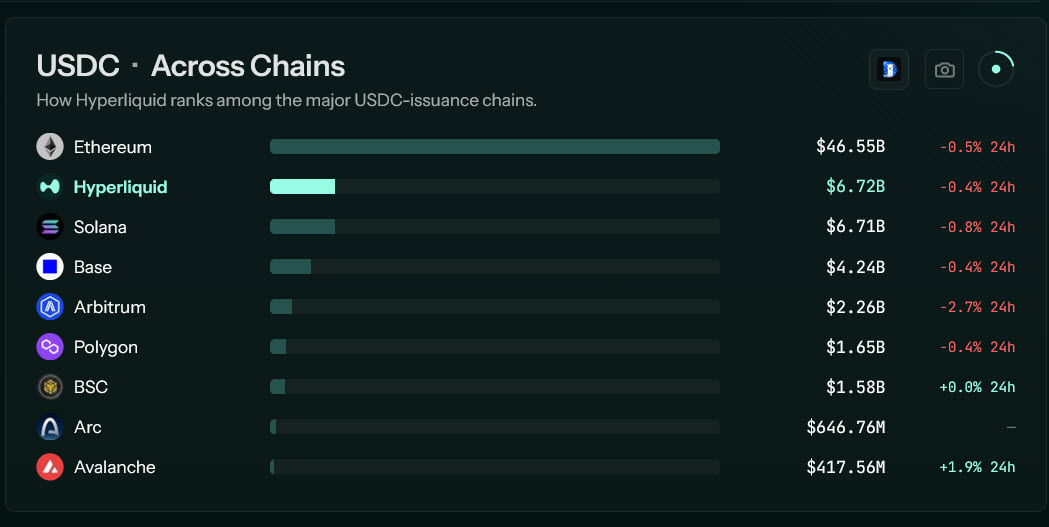
HYPERLIQUID JUST FLIPPED SOLANA IN USDC.
Hyperliquid now holds $6.72B USDC, edging past Solana at $6.71B.
But that’s not even the crazy part.
That USDC liquidity on Hyperliquid is generating roughly $200M per year in yield, which can be funneled back into HYPE buybacks.
Solana has the USDC.
Hyperliquid has the USDC + the cash-flow flywheel.
This is what vertically integrated DeFi looks like.