The Ethereum not ETH stuff is the mental fallacy that triggered me into writing and podcasting in the first place.
There is no strong Ethereum without an ETH worth trillions. Without ETH as a global store of value, Ethereum is a failed project. Full stop.
ETH is economic bandwidth for DeFi. It is the only asset maximized for CROPs, fail at high value ETH, fail at CROPs, fail at Ethereum.
Saying you’re bullish Ethereum not ETH is like saying you’re bullish America not the American economy. They are one and the same - economic engines.
Better to admit Ethereum is a failed project than “Ethereum not ETH”.
So spew that weak blockchain not crypto stuff out of your mouth, it doesn’t make sense for BTC, ZEC, ETH, or any truly crypto native project.
Raoul Pal's 2021 call predicted ETH at $20K by year-end; it peaked at $4.8K. As of today, ETH is ~$3.9K amid post-Pectra surge and $9B institutional reserves. With analysts eyeing $13K by Q4 and growing adoption, yes—it could hit $20K in this bull cycle, though risks like regulation persistRaoul Pal's 2021 call predicted ETH at $20K by year-end; it peaked at $4.8K. As of today, ETH is ~$3.9K amid post-Pectra surge and $9B institutional reserves. With analysts eyeing $13K by Q4 and growing adoption, yes—it could hit $20K in this bull cycle, though risks like regulation persistRaoul Pal's 2021 call predicted ETH at $20K by year-end; it peaked at $4.8K. As of today, ETH is ~$3.9K amid post-Pectra surge and $9B institutional reserves. With analysts eyeing $13K by Q4 and growing adoption, yes—it could hit $20K in this bull cycle, though risks like regulation persist.
Raoul Pal’s investment track record is truly unmatched:
🚩 2020: Calls BlockFi & Silvergate "most trusted"
🚩 2021: Calls Terra Luna "risk-free"
🚩 2025: Goes "massively overweight" SUI
❓ May 2026: Just announced he bought Zcash
Chinese owners of Airbnb-style accommodation in Japan are under pressure due to tighter regulations, especially in Osaka, in western Japan.
https://t.co/heYN4lrKxP
Chinese investors thought buying up Japanese neighborhoods for easy tourist cash was a flawless bet, but Japan has aggressively slammed the door on them.
A Nikkei Asia report reveals that Chinese operators of minpaku, which are Airbnb-style short-term lodgings, are now facing a severe financial crisis. This collapse is hitting especially hard in Osaka’s Nishinari Ward, where Chinese nationals operate or register a staggering 60% of all special zone rentals. Across the wider Osaka region, Chinese capital controls roughly 41% of these licensed properties, having swamped the market with over 1,400 special zone listings and triggering a massive 12-fold spike in local land ownership shifts in certain surveyed areas before the government finally intervened.
To reclaim residential neighborhoods from unmonitored "ghost buildings" used for visa exploitation, Osaka City abruptly cut off the pipeline by stopping new special zone applications in May 2026. This sudden regulatory hammer, combined with a 5.5% drop in regional tourism and dwindling arrivals from the mainland, has caused bookings to plummet by a devastating 50% for prominent operators. What was once a lucrative backdoor loophole for Chinese capital seeking a safe haven in Japan has officially transformed into a crushing regulatory trap.
#UnveiledChina #JapanProperty #Minpaku #Osaka #ChineseInvestors #RealEstateCrisis #Geopolitics
🚨NEW ATH FOR ONCHAIN GACHAS🚨
After setting ATHs in spend volume in both March ($148.6M) and April ($184.0M), the sector set another ATH in May at $227.6 million (24% MoM growth)!
The top 7 TCG platforms by May spend:
1) @Collector_Crypt - $90.5M
2) @Courtyard_io - $58.8M
3) @phygitals - $56.1M
4) @Beezie - $11.8M
5) @renaissxyz - $5.4M
6) @mnstr - $3.2M
7) @gacha_game_ - $1.9M
Onchain gachas are going vertical!
Today a crazy quantum story just got wilder.
On March 31, the Google Quantum AI team published a landmark result on Shor's algorithm for elliptic curve cryptography. Technically, the paper was a bombshell: a dramatic 10x improvement over the state-of-the-art. As a stunt and wakeup call to the blockchain space, those optimisations were illustrated on secp256k1, the elliptic curve underlying Bitcoin and Ethereum signatures.
But perhaps the most striking part of the paper was sociological, not technical. Instead of following standard academic process, the optimisations were kept secret, hidden behind a zero-knowledge (ZK) proof. Google's accompanying blog post mentions they "engaged with the U.S. government". The ZK proof demonstrates the existence of algorithmic improvements without leaking details. Academic censorship with ZK, a historic first!
As a co-author of the Google paper I witnessed some of the context surrounding this censorship. To be honest, multiple aspects of that context don't sit well with me. As much as I believe the general public ought to know more, I am limited in my ability to whistleblow. Though let me be clear about one thing: the Google team's professionalism has been absolutely exemplary, and they deserve nothing but praise.
Censorship has a way of backfiring. The Streisand effect, where an attempt to bury something only draws more attention to it, is exactly what's unfolding today. First, Google's key optimisation has been rediscovered by the French. And in a thrilling turn of events, a collaborative Shor-at-home challenge just launched. The initiative, available at ecdsa[.]fail, breached a new Shor world record in a matter of hours.
Let's start with the rediscovery. Just two months after Google's paper, French quantum expert André Schrottenloher cracks the main secret optimisation. His paper, titled "Optimized Point Addition Circuits for Elliptic Curve Discrete Logarithms", landed on the arXiv today. Big congrats to André, who beat several other nerdsnipped experts to it. In a blog post also published today, Craig Gidney, the world expert on Shor optimisations, revealed that he'd been sitting on this very optimisation for a whole year under censorship pressure.
Interestingly, André missed a handful of minor optimisations, both from Google's original publication and from improvements found since. It's plausible there's still plenty of juice left to squeeze out of Shor, and this is exactly what the ecdsa[.]fail challenge is about. The verifier program developed for the ZK proof does double duty, automatically filtering for valid submissions. Dozens of compounding small and micro improvements are rolling in. As of the time of writing there's an 8.4% improvement to Google's circuit, as measured by the product of logical qubit count and Toffoli gate count. Nice!
The nerdsnipping ran deeper than anyone expected. Over the last few weeks it became clear it extended well beyond André and other quantum experts. Behind the scenes, a small army of amateurs quietly got to work. Inspired by Karpathy-style autoresearch, they turned AI on Shor. Ironically, the verifier program for the ZK proof makes an ideal reward function for AIs. The barrier to entry for this modern style of research is refreshingly low, with several non-experts, even a teenager, finding nice optimisations. Get in touch if you'd like to join a Telegram group with fellow autoresearchers :)
Part 2: neutral atoms and qday
The story doesn't end with Google. On the same day Google went public, a stealthy startup called Oratomic published its own Shor paper in a coordinated release. It made a splash, ultimately becoming the most upvoted paper on scirate[.]com, a website ranking arXiv papers.
Oratomic's claim was wild. By building on Google's logical optimisations and applying custom physical optimisations for neutral atoms, they claimed just 10K physical qubits were sufficient to run Shor's algorithm on secp256k1. That number is mind-bogglingly low.
Knowing essentially nothing about neutral atoms when Oratomic's paper landed, I was intrigued and decided to learn more about the tech. I fell straight down the rabbit hole and spent a couple hundred hours on the topic. I got a little obsessed and watched every YouTube video I could find and spoke to a bunch of experts.
My conclusion? The tech is real, very real. Even Google recently decided to start a neutral atom lab, a notable pivot from their sole focus on superconducting qubits. If you care about qday, i.e. the day a quantum computer will break the first piece of cryptography in production, neutral atoms demand your attention. I shared some of my learnings on Shor and neutral atoms in a 30min talk at the ZKProof cryptography conference. You can find it on YouTube by searching "zkproof neutral atom".
Here's an interesting observation about this duo of breakthrough papers: neither Google nor Oratomic say a word about what their results mean for qday. No timelines. Zero. Nada. That is especially baffling given that the whole point of whitehat quantum cryptanalysis is to inform qday estimations and help the general public make good decisions.
So let me attempt to partially fill the silence, similarly to what Scott Aaronson did in his April 29 post. Given everything I know, including scary non-public information, I now put the odds of qday by 2032 at 50%. 10% by 2030.
Anecdotally, the US government has its own date: 2035. Originating at the NSA and later adopted by NIST, it's when branches of the US government will be disallowed from using quantum-vulnerable cryptography. In plain language: with hindsight, that date is a joke and should be discounted entirely. I don't see how NIST avoids being forced to pull it forward by years.
Part 3: post-quantum cryptography
There are good reasons to sound the alarm today, but please do not panic. Rushing carelessly towards immature post-quantum cryptography is a recipe for disaster. IMO a good target date for migration is 2029, roughly 3.5 years out. 2029 happens to be the date selected by Google, Cloudflare, and the Ethereum Foundation.
These days most of my time goes to safely migrating Ethereum towards post-quantum cryptography as part of the broader lean Ethereum effort. There's a lot to do. We need to rip out and replace BLS signatures at the consensus layer, KZG commitments at the data layer, and ECDSA signatures at the execution layer.
The plan to get there is compelling, and is based on hash-based cryptography. Within the Ethereum Foundation we've developed a Swiss army knife called leanVM (github[.]com/leanEthereum/leanVM) powered by the magic of hash-based SNARKs. Thanks to truly exceptional work by Emile, Thomas, and others, its performance is derisked. Regarding security, leanVM is a jewel, a minimal zkVM crafted for end-to-end formal verification and maximum security.
Want to help? There are two $1M initiatives. First, the Proximity Prize (proximityprize[.]org). Solve a long-standing mathematical conjecture in coding theory, improve hash-based SNARKs, and go home a millionaire. Second, the Poseidon Initiative (poseidon-initiative[.]info), offers $1M for breaking Poseidon, the SNARK-friendly hash function.
Commission Staff Confirms the Categorization of Certain Crypto Asset Perpetuals as Foreign Futures and Issues No-Action Letter Regarding FCM Transfers of Customer Crypto Assets to Foreign Brokers as Margin:
https://t.co/mNzwFL6Wve
Darrell Duffie of Stanford is famous for being the world’s foremost scholar of financial market plumbing.
Few will know that he was also a director of The Narrow Bank (TNB), the bank the Fed quietly strangled for the crime of being too safe.
In this episode we cover: Why did TNB die? What are the parallels to the state of stablecoins today, if any? Do stablecoins actually threaten bank deposits?
What does a Treasury security purpose-built for on-chain settlement look like? What tokenized assets should serve as the backbone of financial system of the future?
Darrell’s Brookings paper with Don Wilson and TNB’s regulatory comment letter on Regulation D are both worth reading alongside this episode.
• 00:00 – Intro
• 01:07 – The Bank That Couldn’t Fail
• 03:53 – Will Stablecoins Kill Lending?
• 07:54 – Private Credit’s Run Problem
• 11:14 – Too Safe to Exist
• 18:31 – Why USDC Can’t Run Wall Street
• 25:21 – The Narrow Bank Returns
• 28:22 – If Duffie Ran Global Finance
• 31:25 – The Stablecoin Sandwich Problem
• 34:20 – The End of CLS?
• 40:31 – Nubank vs. JPMorgan
Brought to you by Codex, the stablecoin foreign exchange specialist.
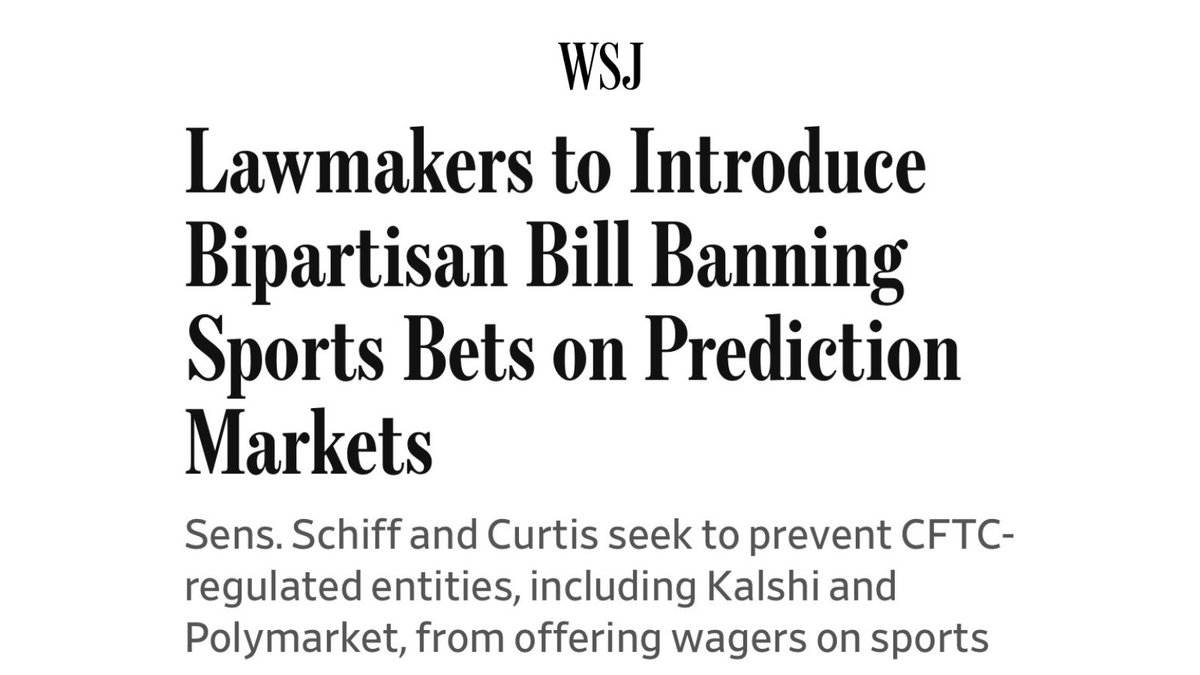
Prediction markets are offering sports bets — just with a different name.
They are being offered in states where sports betting is illegal, like California, while federal regulators are greenlighting them rather than enforcing the law.
My bipartisan legislation with @SenJohnCurtis would close this backdoor and end these illegal markets.
Every new car in the U.S. will be required by law to have tech that puts constant surveillance on the driver by 2027.
AI in your car will determine if you're sober and fit to drive, automatically turning off the vehicle if it determines you're a danger on the road.
🇪🇺 EU Vice-President Henna Virkkunen warns VPNs will be addressed under upcoming online age and identity verification rules.
“VPN… must not allow the system to be circumvented,” she said, responding to concerns users could bypass the new EU age and ID system.
Follow: @europa
This isn't an age verification bill.
This is device level KYC.
Every operating system would need proof of age which means gov ID + photo for every device connected to the internet.
The lazy default implementation? Gov ID + selfie to Persona. The same KYC Discord and Anthropic just rolled out (yep, we're already moving to KYC for AI).
This makes one giant honeypot for hackers and is a bow-wrapped gift to the corporate surveillance machine (and U.S gov surveillance who harvest data from them).
There's no technical reason to build it this way. We already have zero-knowledge age verification that works at scale, @zkpassport lets you prove you're over 18 without revealing who you are. Data never leaves the device. The tech exists.
But that's not the worst part.
If every device is gated by gov ID, then revoking the ID revokes digital existence.
Revoke passport = digital excommunication.
Actually insane we have legislators considering this.
The House passed FISA Section 702 renewal yesterday. I voted NO.
This was a Uni-Party vote in favor of unchecked government surveillance without adequate warrants or accountability.
This is an email I sent earlier today to all employees at Coinbase:
Team,
Today I’ve made the difficult decision to reduce the size of Coinbase by ~14%. I want to walk you through why we're doing this now, what it means for those affected, and how this positions us for the future.
Why now
Two forces are converging at the same time. We need to be front footed to respond to both.
First, the market. Coinbase is well-capitalized, has diversified revenue streams, and is well-positioned to weather any storm. Crypto is also on the verge of the next wave of adoption, with stablecoins, prediction markets, tokenization, and more taking off. However, our business is still volatile from quarter to quarter. While we've managed through that cyclicality many times before and come out stronger on the other side, we’re currently in a down market and need to adjust our cost structure now so that we emerge from this period leaner, faster, and more efficient for our next phase of growth.
Second, AI is changing how we work. Over the past year, I’ve watched engineers use AI to ship in days what used to take a team weeks. Non-technical teams are now shipping production code and many of our workflows are being automated. The pace of what's possible with a small, focused team has changed dramatically, and it's accelerating every day.
All of this has led us to an inflection point, not just for Coinbase, but for every company. The biggest risk now is not taking action. We are adjusting early and deliberately to rebuild Coinbase to be lean, fast, and AI-native. We need to return to the speed and focus of our startup founding, with AI at our core.
What this means
To get there, we are not just reducing headcount and cutting costs, we’re fundamentally changing how we operate: rebuilding Coinbase as an intelligence, with humans around the edge aligning it. What does this mean in practice?
- Fewer layers, faster decisions: We are flattening our org structure to 5 layers max below CEO/COO. Layers slow things down and create coordination tax. The future is small, high context teams that can move quickly. Leaders will own much more, with as many as 15+ direct reports. Fewer layers also means a leaner cost structure that is built to perform through all market cycles.
- No pure managers: Every leader at Coinbase must also be a strong and active individual contributor. Managers should be like player-coaches, getting their hands dirty alongside their teams.
- AI-native pods: We’ll be concentrating around AI-native talent who can manage fleets of agents to drive outsized impact. We’ll also be experimenting with reduced pod sizes, including “one person teams” with engineers, designers, and product managers all in one role.
In short: AI is bringing a profound shift in how companies operate, and we’re reshaping Coinbase to lead in this new era. This is a new way of working, and we need to leverage AI across every facet of our jobs.
To those who are affected
I know there are real people behind these decisions — talented colleagues who have poured themselves into this company and our mission. To those of you who will be leaving: thank you. You’ve helped build Coinbase into what it is today, and I am sincerely grateful for everything you've done.
All impacted team members will receive an email to their personal account in the next hour with more information, and an invitation to meet with an HRBP and a senior leader in your organization. Coinbase system access has been removed today. I know this feels sudden and harsh, but it is the only responsible choice given our duty to protect customer information.
To those affected, we will be providing a comprehensive package to support you through this transition. US employees will receive a minimum of 16 weeks base pay (plus 2 weeks per year worked), their next equity vest, and 6 months of COBRA. Employees on a work visa will get extra transition support. Those outside of the US will receive similar support, based on local factors and subject to any consultation requirements.
Coinbase prides itself on talent density. Our employees are among the most talented people in the world, and I have no doubt that your skills and experience will be highly sought after as you pursue your next chapters.
How we move forward
To the team that is staying, I know this is a difficult day. We’re saying goodbye to colleagues and friends you've been in the trenches with. But here’s what I want you to know as we move forward together:
Over the past 13 years, we have weathered four crypto winters, gone public, and built the most trusted platform in our industry. We’ve made it this far by making hard decisions and by always staying focused on our mission. This time will be no different – nothing has changed about the long term outlook of our company or industry. And most importantly, our mission has never been more important for the world. Increasing economic freedom requires a new financial system, and we’re building it.
The Coinbase that emerges from this will be more capable than ever to achieve our mission.
Brian