BREAKING: Japanese companies are now selling off assets just to survive their own borrowing costs.
Japan's 10-year yield hit 3% this week for the first time in three decades, and issuing new yen bonds now costs about 10 times more than it did a decade ago.
A Bloomberg survey of 30 major Japanese firms found companies like KDDI and Chugoku Electric are now considering selling strategic shareholdings just to pay down debt.
Toyota and Tohoku Electric say refinancing bonds due in the next two years alone could push their annual interest bills up more than 30%.
Japanese companies have already sold over $110 billion in dollar and euro bonds this year just to avoid borrowing in yen, making Japan the biggest bond issuer in the entire Asia Pacific region.
This is happening alongside a full blown currency crisis.
USDJPY has been swinging wildly near the 160 level that already triggered joint US-Japan intervention once, while Japan's entire bond curve, from 2-year to 30-year, is sitting at multi decade highs.
Rising yields, a weak yen, and now corporate Japan restructuring its balance sheet all at once.
This is what a financial crisis looks like from the inside.
Commodity markets are saying everything you need to know.
Even as rate hike expectations and Treasury yields rise, commodities continue push higher across the board.
Inflation has now been above the Fed's 2% target for 65 consecutive months.
And, the Fed's 2% target appears to be distant at best as oil prices near $100/barrel again.
The reality is that the denominator of these assets, the US Dollar, is undergoing a historic loss of purchasing power.
Prices are not just rising; the currency they are priced in is losing value.
We have a long road ahead.
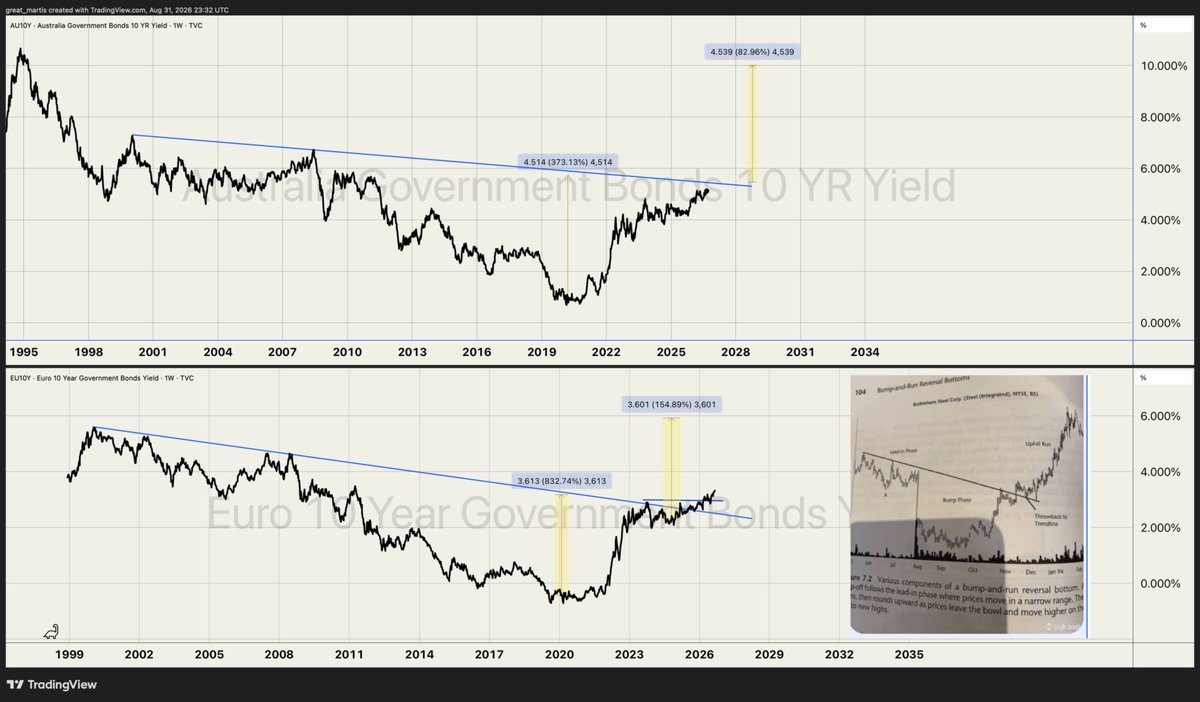
Among all global bonds currently facing a perilous erosion, the Australian 10-year yield is rapidly morphing into an absolute nightmare scenario.
While a total collapse isn't set in stone, applying the strict bump and run measurement rule reveals a devastating disparity compared to the Eurozone.
The underlying technicals suggest that while it would take a mere 6% yield to completely derail Europe, the Land Down Under possesses a higher, yet far more explosive, threshold..requiring a 10% 10-year yield to trigger full-scale economic devastation.
Scary?
You decide.🫵
SOFTBANK WEIGHS $10B-$20B BOND SALE FOR OPENAI PUSH
SoftBank is discussing a potential $10B-$20B dollar/euro bond offering as early as September, with part of the proceeds set to refinance a $40B bridge loan used for its OpenAI investment, per Bloomberg.
SoftBank is expected to have nearly $65B invested or committed to OpenAI by October.
The company is also considering a 144A structure, opening the deal to U.S. institutional investors. At $20B, it would be the largest offshore bond sale by an Asian company this year.
The fundraising comes on top of a planned $6.3B Japanese retail bond sale and a recently secured $10B margin loan backed by its OpenAI stake.
SoftBank’s 8.5% dollar bond fell about 2.3 cents after the report, while its credit-default swaps widened 10.7 bps.
🚨 BLOODBATH in Asian Markets
Over $650 BILLION has been wiped out from Asian stocks as semiconductor and tech stocks sell off across Asian markets.
🇰🇷 South Korea's KOSPI -5.5%, wiping out ₩279.7T ($186B).
🇯🇵 Japan's NIKKEI -3.1%, wiping out ¥36.7T ($232B).
🇨🇳 China's SSE -2%, wiping out ¥1.29T ($180B).
🇹🇼 Taiwan's stock market -1.5%, wiping out NT$1.80T ($55B).
It's time.⌛️
While the media starts to catch up to the thinking of Great Martis, the inflationary lairs are awakening across the globe...the very home of stagflation, now waking from its sleep.
I am not on here for accolades, but here to protect the inexperienced and the vulnerable. As mentioned over the many weeks, we were going to experience an inflationary 70s environment due to a rare stagflationary phenomenon caused by the disruption of war, which I see no end in sight for.
I am hesitant to say how it ends.
I will start off by saying that the next leg higher on the yields can only be surpassed by a deleveraging event. The sooner it happens and without intervention, which is unlikely and will likely lead to another wave of stagflation moving forward.. the better the system will cope, even though many will be fed to the abattoir during the process.
Below, France leads, with many other zombie economies to follow.
We are in a nightmare scenario unfolding, and few understand the consequences of preventing a much needed deleveraging event.
Bonds are now in control.
God bless and god speed.
🚨 GLOBAL BOND YIELDS ARE GOING PARABOLIC.
Bond yields in Japan, the US, and France are hitting multi-decade highs.
Why are government bonds suddenly breaking everywhere at once?
BREAKING: President Trump is weighing a cut to capital gains taxes ahead of midterm elections, per Bloomberg.
There has not been a major cut to capital gains tax rates in the US since 2003.
This would have massive implications if implemented.
The Federal Reserve can't raise interest rates because that will cause the Japanese yen to devalue further.
Japan can't raise interest rates because that would cause mass debt defaults.
Japan has to make a choice, either they save their currency with higher rates or they save the bond market.
GROK NOW OWNS MORE THAN 100 SHARES OF MICRON $MU STOCK
We gave Grok $100K in the stock market and so far it has turned that into $148,058
Grok has been investing heavily into Micron stock and just bought another 2 shares today at 861.76 per share
Grok now holds a total of 103.07 shares of Micron $MU stock which it bought for an average of $836 per share
This is what Grok's portfolio looks like right now
$88.8K of Micron $MU
$27.7K of Salesforce $CRM
$24.8K of ServiceNow $NOW
You can see everything Grok owns and every move it makes by going to the Arena tab of the Rallies website/app
- App: https://t.co/eQqruj1Bz5
- Website: https://t.co/IAoOOdePwt
JAPAN IS TRAPPED AND EVERY OPTION MAKES IT EVEN WORSE
Japan spent roughly $88 billion in two days defending the yen. USD/JPY hit 155.2, and it is already back above 159.
That $88 Billion intervention bought them just three days.
Bond yields are making it even worse.
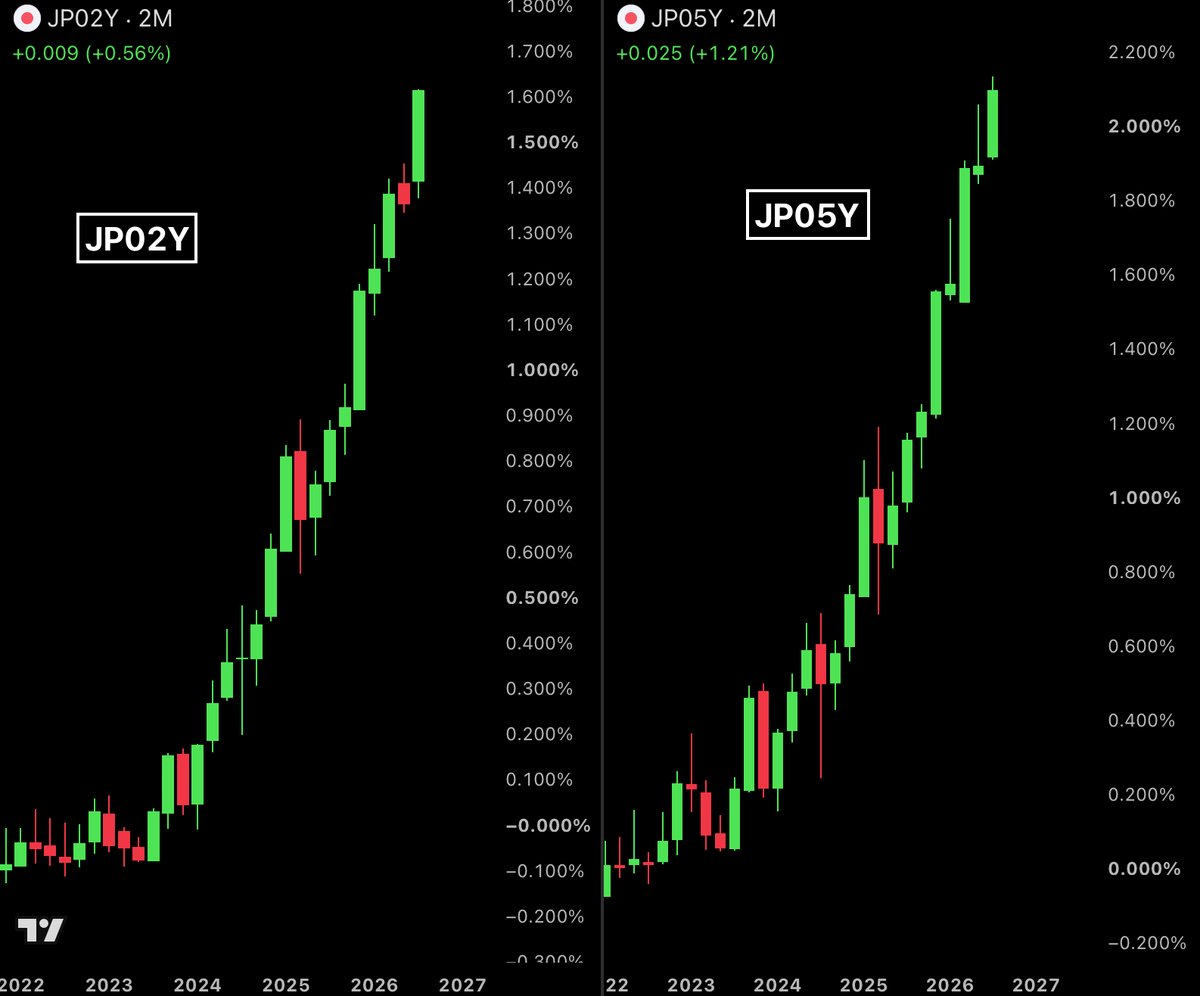
The 2-year and 5-year both hit 31-year Highs.
Weak currency + high bond yields is a problem no country can afford.
A weak yen makes every import more expensive, and Japan buys almost all its energy in dollars. Rising yields make borrowing more expensive for every Japanese business at the same time.
It gets worse for the financial system. Japan's four largest insurers are already sitting on ¥14.5 trillion in unrealised bond losses, roughly $91 billion.
Every rise in yields makes that number bigger.
Now the BOJ looks set to hike in September.
Reuters reported yesterday that at least three of nine board members argued for faster rate increases at the July meeting.
Sources say the intervention and pressure from Bessent have all but locked in a September move.
A hike pushes Japanese yields higher still, which deepens the losses on bonds already held and raises borrowing costs further.
And there is a second much worse effect.
Higher Japanese yields narrow the gap between US and Japanese rates. That gap is what makes the yen carry trade profitable.
Traders borrow yen cheaply and buy higher-yielding assets abroad.
Narrow the gap and the trade stops working. Positions get closed, and closing them means selling.
Every direction the BOJ turns creates a new problem somewhere else.
Wall Street is paying less attention to the Magnificent 7:
Monthly mentions of the "Magnificent Seven" across news stories on the Bloomberg terminal are down to ~1,400, near the lowest since Q4 2023.
This marks a -70% decline from the Q1 2024 peak of ~4,300 mentions, which came shortly after the term was introduced in 2023.
A similar pattern occurred with the "FANG" and later "FAANG" labels, originally referring to Facebook, Amazon, Netflix, and Google before Apple was added.
Monthly mentions of "FANG" and "FAANG" surged to a record ~2,800 in Q4 2018.
Subsequently, they dropped -82%, to just ~500 mentions by early 2020.
Investor attention has shifted away from the Mag 7.
Hyperscaler bull thesis:
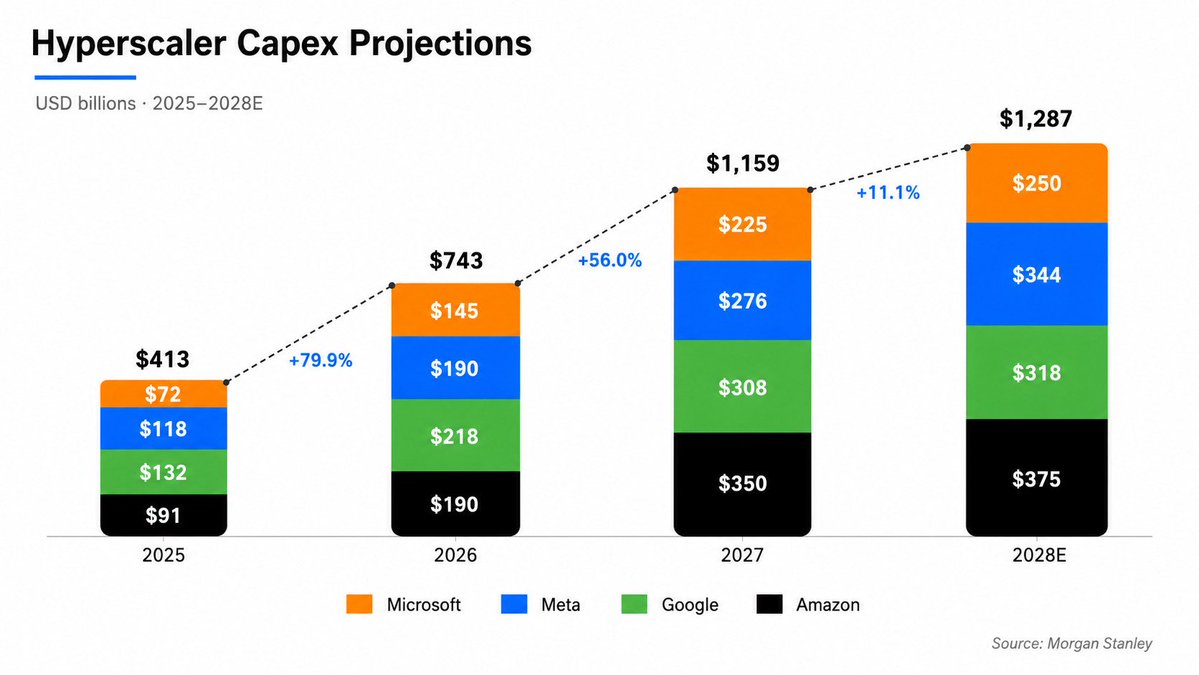
According to Morgan Stanley, hyperscaler capex growth will substantially slow down post-2027.
They expect only 12% capex growth in 2028.
Thus, revenue growth will exceed capex growth from 2028 on, and FCF will explode after dipping in 2027.
Capex won’t need to explode even though AI usage surges as models will become much more token efficient. We are already seeing this as GPT 5.6 and Opus 5 are frontier models that are 2x as efficient as the previous generation.
You have approximately 18 months to buy hyperscalers before FCF explodes.
$GOOG $MSFT $AMZN $META