Where does ES open tonight at 6pm et?
Closest guess (Dec ES) wins:
✓ FREE month of VS Pro
✓ FREE Dealer Hedging Dynamics course
($1,097 value)
1. follow @VolSignals
2. retweet this
3. reply with your guess
Replies close 5:45pm et
this is ES, not SPX
good luck 🍻
SUMMARY OF FED CHAIR WARSH'S STATEMENT (9/16/26):
1. Warsh says the decision to hike rates comes at a time when the economy is "strengthening"
2. Warsh says he is "hard-pressed to call financial conditions restrictive"
3. The view that conditions are not restrictive was "widely shared by the FOMC"
4. Warsh says the predominant focus of the Fed is on price stability
5. Warsh says he did not submit a dot for the Fed's dot-plot
6. The Fed "must be confident that inflation is moving to our 2% objective"
The Fed is highly committed to obtaining 2% inflation.
FED WARSH AT JACKSON HOLE (Summary):
On policy:
• He gave no timetable for a rate hike and said the speech should not be viewed as forward guidance or a formal reaction function
• Short-term interest rates remain the Fed’s main policy tool
• A “good majority” at the July meeting thought waiting was the wiser course
• Longer-term Fed task-force recommendations will have no bearing on current policy decisions
• The Fed needs market signals to remain “as unfiltered as possible”
On Macro:
• Economy “appears to have strengthened”
• Consumer spending remains healthy, labor markets stable
• Business investment is rising rapidly
• Financial conditions are hard to describe as restrictive
• Credit and loan markets show few signs of policy restraint
On inflation:
• Price stability is the Fed’s “predominant focus” right now
• Summer inflation data were better than expected, but underlying trends have not meaningfully improved
• Progress on inflation over the past two years has been modest
• Fed’s 2% PCE target is “firm and fixed”
• If the Fed cannot be confident inflation is moving toward 2% “clearly and at sufficient speed,” Warsh said “we have work to do”
• Inflation expectations remain broadly stable, but “tend to look durable until they don’t” and must be watched closely
Also:
• Wage growth is moderate, but Warsh does not view wages as a reliable predictor of future inflation
• Market pricing still shows confidence that the Fed will ultimately deliver price stability
TLDR: Warsh did not explicitly call for a hike, but he made clear that current policy does not look particularly restrictive and that persistent inflation would require the Fed to act.
The $VIX is below 15. It must be a great opportunity to buy volatility, right?
Here comes the problem: you can’t actually buy the $VIX index.
The closest tradable instrument is $VIX futures, and the front-month future is around 17.
Products like $VXX and $UVXY get their exposure through short-term $VIX futures, mainly the first and second month contracts.
So think about what you are actually buying:
Spot $VIX: below 15
Front-month $VIX future: around 17
You are already paying a significant premium to spot volatility.
And when the futures curve is in contango, that premium creates a constant headwind for products like $VXX and $UVXY because they have to keep rolling their futures exposure.
So ironically, a very low $VIX does not automatically mean VIX futures, $VXX or $UVXY are cheap.
From a purely structural point of view, contango actually favors the short side of $VIX futures, $VXX and $UVXY over time, not the long side.
I’m not suggesting you short them. Volatility can explode very quickly.
Just food for thought.
AI compute is going to orbit. 🚀
@SpaceX’s Starmind AI1 satellite compute payload is powered by NVIDIA Vera Rubin NVL72, bringing AI factory compute closer to the stars.
The next chapter of AI infrastructure boldly goes where no AI compute has gone before.
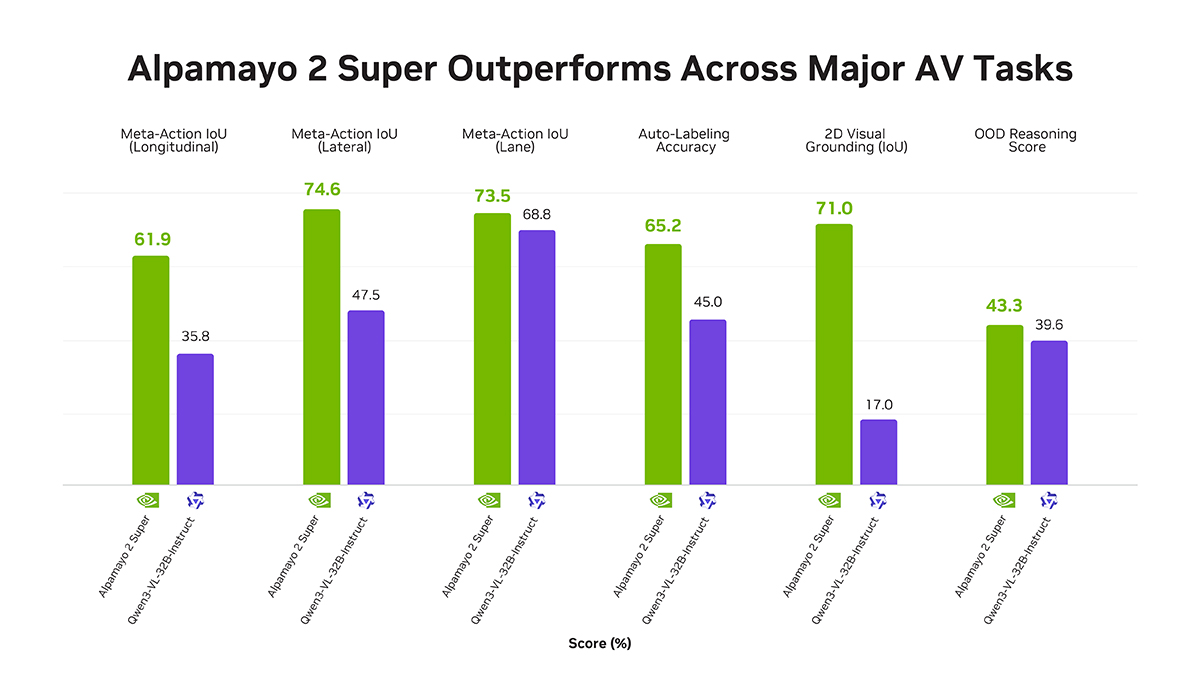
Today, we’re launching Alpamayo 2 Super, our frontier open reasoning model for autonomous vehicles.
Beyond seeing, Alpamayo understands and reasons through the complex world - thinks before it acts.
It’s a powerful backbone for robotaxis, trucks, shuttles, delivery vans, tractors and the long tail of mobile robots—billions of autonomous machines someday.
We’re releasing it for commercial use under OpenMDW-1.1 so teams can inspect it, fine-tune it and deploy it—open models advance safety and security.
The next wave of AI is robotics—and it starts with autonomous vehicles.
Great work, Alpamayo team!
https://t.co/2PYCCXWjZh
SPX GEX LEVELS: Jun 29
The oscillation pattern is still in effect. The OPEX did what the pattern predicts. The question is whether the post-OPEX window extends this time.
Friday's OPEX eased GEX from -$452M to -$325M. The 7,400 accelerator collapsed from -$87M to -$3M — the exact clearing pattern we've documented at every OPEX since June 18. The near-dated puts that institutions loaded at 7,400 during the negative gamma sessions expired. The obstacle removed itself. The flip narrowed from 51 points to 31 points. Over the last four sessions: 103 → 71 → 51 → 31. The flip is converging toward spot.
The flash crash at 15:59 was the negative gamma regime producing its most extreme signature. SPY dropped from $724 to $716.58 in under one second, a 1% move on the final tick of the session. In negative gamma, market-on-close order imbalances amplify because dealers are short gamma and their hedging cascades into thin end-of-day liquidity. The print recovered immediately but the mechanics that produced it are the same mechanics that have defined this regime since June 22.
The structure improved but remains negative. The 7,300 accelerator at -$103M is 54 points below and still the heaviest concentration. Below that: 7,200 at -$70M, 7,100 at -$43M. The accelerator chain from 7,100 to 7,300 didn't clear with the OPEX because those puts are on longer-dated expirations. The floor of the cage held. The walls near spot were removed.
The flip at 7,385 is 31 points above the close. If Monday opens above 7,385, the regime flips positive and the magnets at 7,450 (+$17M) and 7,500 (+$33M) engage. This is the post-OPEX window the oscillation pattern produces. The tide went out on the near-spot accelerators. The magnets above can pull without interference for a brief period.
The test for the pattern: the first two post-OPEX windows lasted three sessions and two sessions respectively before institutions reloaded. If this window lasts four or more sessions, the oscillation is stabilizing. If it lasts two or fewer, the oscillation is tightening further and the structure is deteriorating toward something more persistent.
Shortened trading week. Markets closed Friday July 3 for the July 4th holiday. Four sessions this week with thinner participation as the holiday approaches. Thin holiday liquidity amplifies moves in any regime. In the oscillation regime, thin liquidity makes the flash crash mechanics from Friday's close more likely during regular hours.
A note on 8,000. The 8,000 strike flipped to -$8M on Friday, the first negative reading at that level. Put OI at 8,000 now exceeds 567K. That's far above spot but the institutional activity at distant strikes tells you the hedging is extending further out and further down the calendar. The hedging behavior that defines the oscillation regime isn't confined to near-spot weeklies anymore.
Monday's expected range: 7,275 – 7,425. The flip at 7,385 is the pivot. Above it, the post-OPEX window opens and magnets pull toward 7,450-7,500. Below it, the 7,300 accelerator at -$103M remains loaded. The oscillation pattern predicts a brief positive window. This week tests whether it extends.
Structural floor: 6,910 (-6.0%).
$SPY $QQQ
EDUCATIONAL POST:
🚨MARKET MECHANICS | THE GAMMA PIN BREAK
SPY traded an $16.82 range in a single minute at the close today. $733.40 to $716.58 and back to $729.09. In 60 seconds. 4.7 million shares. Here's exactly what happened and why.
THE TWO-DAY PATTERN:
Thursday: SPY crossed green-to-red 32 times across the full session. Price oscillated at $734 for 6.5 hours. Net change: $0.02. The gamma pin held. Dealers bought every dip and sold every rip at the pinned strike. The market went nowhere because the mechanics forced it nowhere.
Friday: SPY crossed green-to-red 18 times but all 18 were packed into a 2 hour 43 minute window between 11:29 AM and 2:12 PM. Then it broke. The 9th and final green-to-red flip at 2:12 PM was the last time SPY traded above $734.30. It never came back.
THE DIAGNOSTIC:
Crossings spread evenly across the day = pin holds. Crossings clustered in a tight window = pin is being tested and will break. The break direction matches which side of the pin price spends more time on during the cluster window. Friday, SPY spent more cumulative time below $734 during the cluster. That foreshadowed the breakdown.
THE BREAKDOWN SEQUENCE:
2:12 PM: Final flip. SPY drops below $734.30 permanently.
2:12 to 3:58 PM: Slow drift from $734 to $733. Dealers who had been buying at the pin start selling as delta hedges flip from the positive side to the negative side of the strike.
3:59 PM: The cascade.
THE 3:59 PM FLASH:
One minute. One candle. Everything breaks.
Open: $733.40
Low: $716.58
Close: $729.09
Range: $16.82
Volume: 4.7 million shares (8.1x the prior minute's 577K)
For context, a normal 1-minute SPY range is $0.20 to $0.50. A CPI surprise or Fed announcement produces $3-5. Today's closing minute produced $16.82. Three to four times what a major economic event generates.
THE MECHANIC:
This is a closing-cross gamma cascade. Here's the sequence:
First: SPY lost the $734 gamma pin at 2:12 PM. Dealers had been net-long at the pin level all day, buying dips and selling rips to stay delta-neutral. Once the pin broke to the downside, their positioning flipped. Long delta became a liability. They started selling.
Second: The MOC (market-on-close) imbalance feed published a SELL imbalance. Quarter-end rebalancing flow from pension funds compounded with the dealer selling. The passive funds needed to sell SPY at the close. The dealers needed to sell SPY to stay hedged. Both sellers arrived in the same 60-second window.
Third: 0DTE put gamma cascaded. As price dropped through $730, $725, $720, each strike's put gamma went deep in-the-money. Dealers short those puts had to sell shares to hedge. Each dollar lower forced more selling. The gamma feedback loop accelerated.
Fourth: At $716.58, institutional bids stepped in. The real buyers were waiting at $716-$720. The snap-back from $716 to $729 happened in seconds. The flash lasted less than 30 seconds before the buy orders absorbed it.
THE CLOSING PRICES:
The official NYSE closing auction printed $731.13. That's the price-matched auction result, not the intraday low. Financial sites will show different numbers depending on which close they use. The flash to $716 was an intra-auction event that resolved before the official match.
WHO MADE MONEY:
Anyone holding 0DTE $720 puts bought for pennies saw them briefly hit $3.42 of intrinsic value ($720 minus $716.58) during the flash. A $0.05 lottery ticket briefly worth $342 per contract. The same mechanic as the MRVL $310 put we documented last week. The pattern repeats: extreme gamma concentration at expiration creates violent closing-minute moves that reward positioning at strikes nobody expects to get hit.
THE FRAMEWORK:
We now have three documented closing-auction patterns:
1. Gamma Pin Hold: 30+ crossings spread across full session. Closes flat. The pin wins. Dealers suppress all movement. (Thursday June 25)
2. Gamma Pin Break: 15-20 crossings clustered in a tight window, then directional move. The pin loses. Dealers switch from suppressing to amplifying. (Friday June 26)
3. Inclusion Arb Flush: Arb inventory exceeds passive demand at the MOC. Forced selling cascades through the closing cross. (MRVL June 18)
All three are driven by the same underlying mechanic: dealer gamma positioning at concentrated strikes creates forced buying or selling at the close. The direction and magnitude depend on the positioning imbalance and the MOC flow.
The data tells you the setup. The close resolves it.
$SPY $QQQ $IWM
SPY UPDATE | Thursday June 25, 2:00 PM
$732.80. Down 0.06%. SPY has crossed green to red 8 times today. The oscillation regime in its purest form.
THE PIN:
Eight crossings of the $733.24 flatline in five hours. The tightest trading range of the week. Price can't go up because there are zero magnets pulling. Price can't go down because the $730 accelerator at -$182M and the put unwind provide a floor. The result: $1 range, 8 crossings, perfect mechanical equilibrium.
THE ENGINE: FIFTH REVERSAL:
Monday AM: +73.2M
Monday PM: +45.8M
Tuesday AM: -19.0M (reversed)
Tuesday PM: -3.3M
Wednesday AM: +524K (crossed zero)
Wednesday PM: -29.0M (reversed)
Thursday AM: +16.6M (crossed positive)
Thursday PM: -12.8M (reversed)
Five reversals in four days. The engine can't hold a direction for more than 12 hours. The institutions reload puts every afternoon. The structure flips negative every session. The tape we described Monday night is completely gone. The switch flips back and forth faster than at any point in the cycle.
THE RELOAD:
4.93M new put positions opened today. Premium flipped put-heavy for the first time in days at -$63M (49% call). $1.23B of put premium. The institutions used MU's pre-market rally to reload their hedge book at higher strikes. The morning pop was the opportunity. The afternoon reload was the response. Same pattern. Faster execution.
THE STRUCTURE:
GEX: -$1,561M. Worsened from -$1,003M this morning. The morning improvement from MU evaporated by afternoon. The negative gamma structure is persistent.
Zero near-term magnets. Nine of ten levels are accelerators. $730 at -$182M is at price. $735 at -$145M above. $725 at -$145M below. $720 at -$141M. The downside chain is symmetric around current price. No directional pull. Just amplification in both directions.
Max pain: $731. At price. The expiration gravity and the actual price converged. The market is sitting exactly where the options mechanics say it should.
IV skew: -0.84% bullish. Still. The fifth consecutive session of bullish skew. The persistent call demand hasn't broken despite five engine reversals, record bearish flow, and zero magnets. Someone keeps paying for upside.
THE COUNTDOWN:
Tomorrow: June 26 OpEx. 1.16M contracts. 818K puts. The put clearing that briefly opens the positive window.
Monday: June 29. Penultimate trading day of the rebalancing window.
Tuesday: June 30. 1.67M contracts. 1.37M puts. Quarter-end. The forced selling ends. The largest put-heavy OpEx of the month strips the hedge book.
Wednesday July 1: The headwind expires. July seasonality begins. The falling wedge breakout at $753 is the target. 97% historical success rate.
2 trading days of rebalancing remain after today. The oscillation regime has an expiration date. The switch stops flipping when the tape gets rebuilt. The tape gets rebuilt when the forced selling stops. The forced selling stops Tuesday.
$737 is the flip. $733 is at price. $731 is max pain. $730 is the accelerator. 2 days.
$SPY $QQQ $IWM