Hence the many biblical calls to "stand firm" and "hold fast," such as:
"Fear not, stand firm" (Ex 14:13)
"Stand firm, hold your position" (2 Chr 20:17)
"Stand firm in the faith" (1 Cor 16:13)
"Hold fast to what is good" (Rom 12:19)
"Let us hold fast our confession" (Heb 4:14)
I don't know anything about this pastor or his church, but man, that was fire. Appreciate his heart for his people, his conviction over Scripture, and his joyful submission to the Lordship of Christ!!! 🔥🔥🔥
Things we like: A pastor having difficult conversation with his congregation who is pushing back on the Biblical position that men should be pastors, with some calling for his removal.
This is probably one of the most important videos we've posted all year. From Pastor Justin Frank.
The more I considered Christianity, the more I found that while it had established a rule and order, the chief aim of that order was to give room for good things to run wild.
Chesterton
An updated version of Screwtape Letters:
My dear Wormwood,
Disregard everything I said in my previous letters. Get
your patient to download TikTok and it’ll all work out
for us.
Your affectionate uncle
SCREWTAPE
A humble observation about public scandal and repentance.
When a scandal breaks out, a cry for immediate accountability and holistic repentance follows. This instinct is not wrong. When sin is uncovered, especially deep and sustained patterns of sin that have played out for years, it is entirely right that Christians champion full-fledged repentance.
Here, however, is a little dose of realism: repentance is hard. Repentance is not natural; true biblical repentance is supernatural (literally "above nature"). It is not a work of man that you can coax out of someone; it is a work of God that the Spirit activates.
Lest I be misunderstood, you can train a child to apologize for doing wrong. You should do so! But you can't force them to repent. Repentance is an internal work. True God-pleasing repentance occurs only when the Spirit of God miraculously works in our heart and leads us to the good clear water of the gospel, and we drink it like the parched person we are, and then act in humility, deep contrition, and honesty to confess our sin to God and man, and make right what we can.
Sometimes, we sinners offer repentance on the spot. Sometimes, this plays out suddenly and even immediately--praise God when that is the case. Often, though, when someone has chosen to develop long-standing patterns of deception and sinfulness, repentance takes a while to play out. This is not an excuse; this is the way things not infrequently play out. If you have taken months and years to establish habits of ungodliness, it will not infrequently take you months and years to come to terms with those evil patterns, and then establish habits in the opposite direction.
It is not wrong to want someone to issue a public statement when they are caught out in serious wrong. However, we must never make the mistake of thinking that such a statement means the work of repentance is over. No, the work of repentance has just begun. The person in question now has the hard work before them of leaving behind deceptive ways, choosing honesty and truthfulness in the hidden moments of life, reestablishing trust with loved ones and work peers, and most importantly communing with God in an honest, vulnerable, and humble manner.
You can commit yourself to such a walk with God in an instant. But to actually inhabit a godly and consistent way of life is a much longer process. This is part of why, at minimum, men who fall from ministry *must not* rush back into ministry, if they ever return at all. They need to enter into rhythms of intensive and holistic soul-care. They are in no position whatsoever to minister to large groups of people; they have failed in that respect. Because of this, they need to return to leading themselves first, a transition that cannot be rushed.
We seem to witness these kind of explosive ministry self-demolitions on a weekly basis now. In truth, we are all nothing but the neediest kind of sinner. We depend daily on God's grace. In a single instant, any one of us can blow up everything we have. Or, more commonly perhaps, we are all entirely capable of stringing together many quiet and hidden moments in which we lose our ministry (though no one knows it yet) through patterns of ungodliness. This seems to be the more common example of moral failure today--not always the one transgressive moment, but commonly the many anonymous moments when we choose darkness over light, but no one sees these moments, and so it takes years for them to come to light.
The overall point here is this: we do well to approach the duty of repentance with realism and patience. It is not wrong to ask people to express accountability for their sins, especially when they are in ministry; this is right. But we should not be confused here--many of us struggle to repent as fulsomely as we should. We are all prone to make excuses, shift blame, and generally not take full accountability. We all understand the instinct to play for time, to minimize consequences as much as we humanly can, to line people up on our side so as to not lose what we have, and to desperately cling to the platform we have established. We all get this; if we allow ourselves to be honest, we could easily act in such ungodly ways if we too embraced evil habits and let ourselves slide into the darkness.
So let us pray for those who need to repent but struggle to do so. We understand them; at some level, we are like them. We need not pray against them in vengeance; we should pray for them in love, because one massive expression of God's great love for sinners is that he does not leave us in the filth of our sin. He beckons us out of it, and offers us complete and total forgiveness through the wrath-bearing blood of Christ, and comes and bids us leave behind our destructive ways, and drink deeply of the pure water of his mercy and grace (Isaiah 1:18).
Repentance is not natural, we remember. Repentance is SUPERNATURAL.
“My sin was this: that I looked for pleasure, beauty, and truth, not in Him, but in myself and His other creatures, and the search led me instead to pain, confusion, and error.”
— St. Augustine of Hippo, Confessions.
The lie of the serpent - If you really obey God you'll be miserable. This idea passed into the human heart at the beginning (Genesis 3). We must all deal with it all of our lives. (This is a concept I first heard articulated by Sinclair Ferguson.)
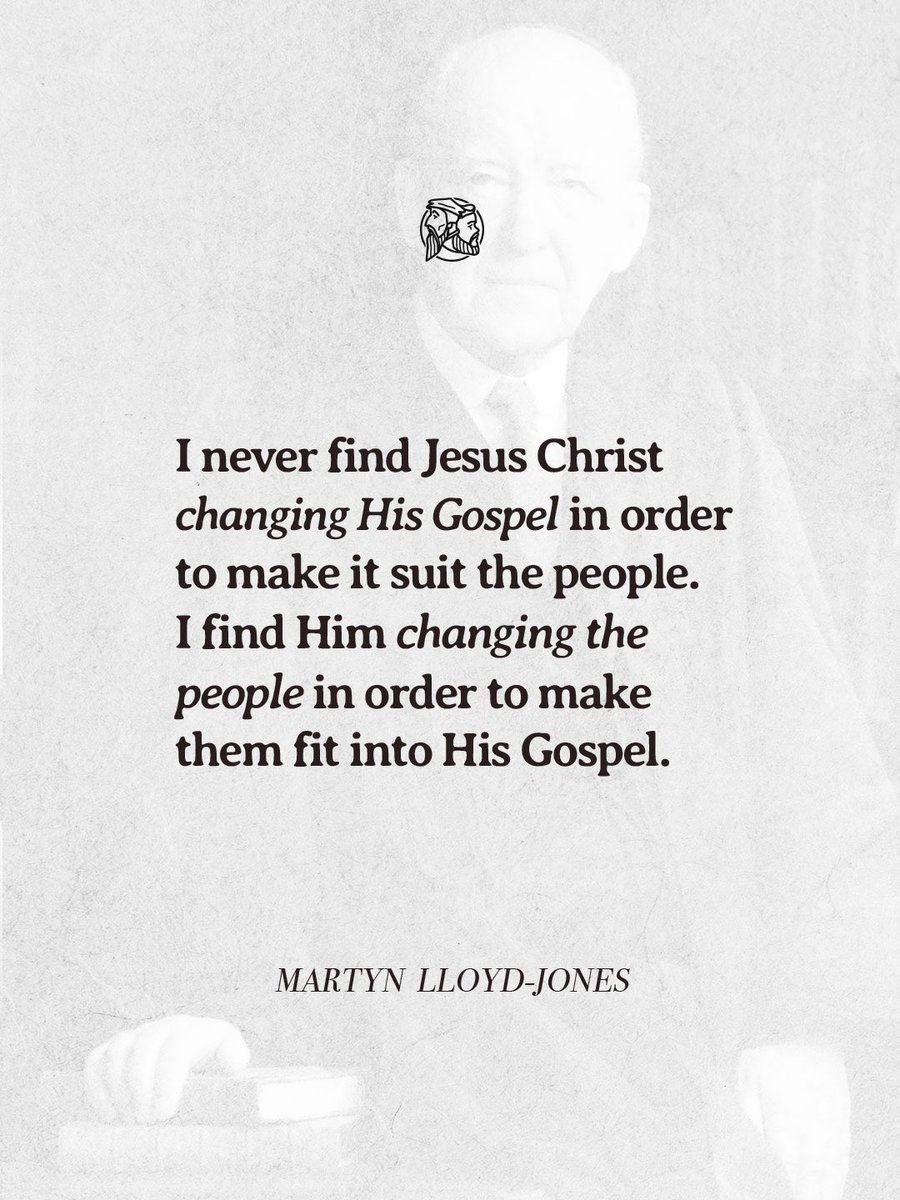
“I never find Jesus Christ changing His Gospel in order to make it suit the people. I find Him changing the people in order to make them fit into His Gospel.” — Martyn Lloyd-Jones
“I want you to know,” I told the teary-eyed man sitting across from me, “it is my practice to call the pastor of a church when someone starts attending my church, especially when they tell me things like you’ve told me. So I don’t want you to be surprised by that.”
He looked like he swallowed hard and said, “Oh, okay.”
I was a 25-year-old church planter, just several months into my first church plant. And I was quickly learning that new churches attract what you might rightly call malcontents. These are people who are upset with their last church, sometimes for legitimate reasons, but a lot of times it’s just nonsense.
This young college graduate, only two or three years younger than me, had just told me about how no one loved him, got him, understood him, or cared about him at his last church. He gave me a long story that came off as something of a sob story.
An older pastor had once told me, “The way people come to your church is the way they’ll go to the next church when they leave yours.”
That really stuck with me.
And I said, “You know, Joe, my concern is that we’re not going to live up to your expectations either, and six months to a year from now, you’ll be telling this same story to the next church.”
He assured me that wouldn’t be the case.
I called up his former pastor and got ahold of him.
“Hey, I want to talk to you about a former member of yours who started attending my church.”
I mentioned the name, and he said, “Oh man, good luck.”
“Yeah, I thought you might say that.”
I relayed the story, and the pastor told me their side of it, which definitely correlated with reality much better.
Essentially, they had challenged him repeatedly about his laziness, his failure to keep commitments, and his lack of motivation to get more than a part-time job. Eventually, he left because they weren’t loving enough.
It was only about two months later that he started posting on our church forum, repeatedly asking for prayer to help him pay basic bills like car insurance. People started asking him questions about budgeting, where he was working, and all that. And again, he had all these excuses.
It was becoming evident to everybody that he was fishing for pity, hoping someone would just give him the money.
But at the time, our church plant was mostly made up of young newlyweds who didn’t have much money themselves, while this guy was a single college graduate with a roommate.
In time, this led to a confrontation, and he too left our church because we also weren’t loving enough.
It’s the circle of church life.
I do think this is a good practice for all pastors to build into their ministry. It serves as a protection for your church, and it also strengthens relationships with other local churches.
Paintings: F. Moormans