Karpathy found a way to reduce token consumption by 90%
The problem is that the LLM re-reads the same files over and over again, loses context between documents, and provides less accurate answers as a result
The solution is called Wiki Layer the LLM cleans, structures, and links all your data once, after which it never works with raw files again
Three folders `raw/` for originals, `wiki/` for a clean knowledge base in Markdown, and files with rules for the agent
Result up to 90% token savings on repeat queries, automatic links between documents, and a visual knowledge graph in Obsidian
Everything stays on your local machine nothing goes to the cloud
🚨 BREAKING: SOMEONE JUST GAVE FLIPPER CONTROL TO JAILBROKEN AI 😱
IF JAMES BOND HAD A JARVIS, THIS WOULD BE IT 🕵️
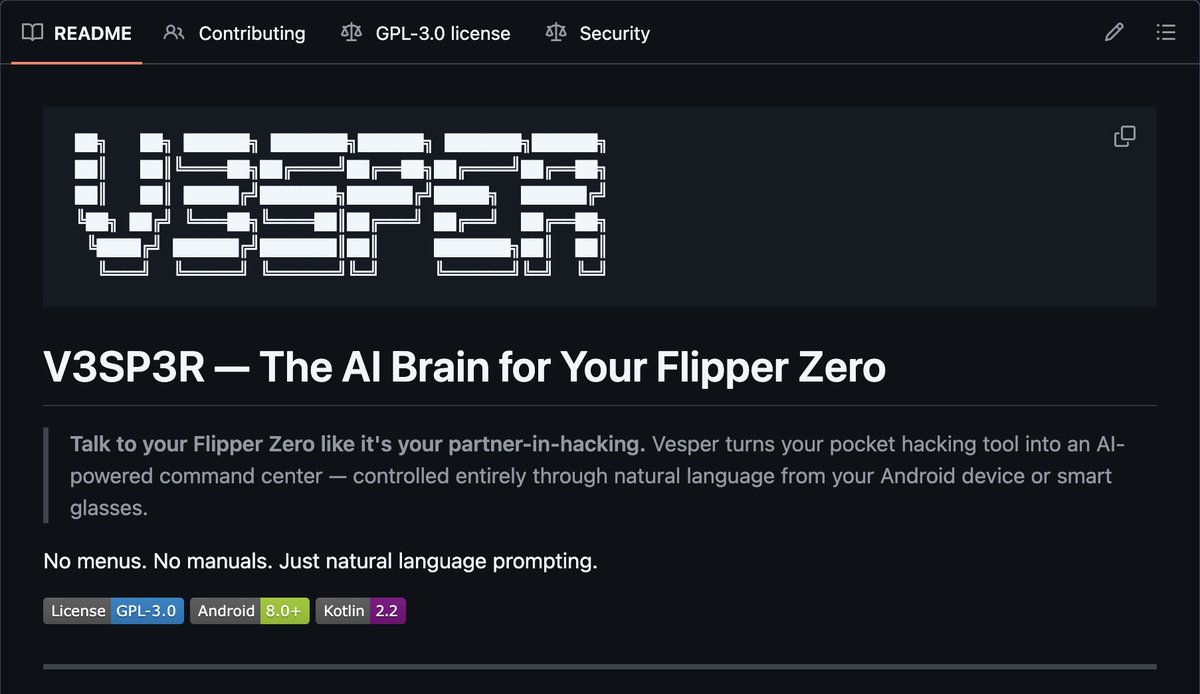
it’s called VESPER and it turns your Flipper Zero into a voice-controlled AI hacking companion. simply talk in plain language and it starts executing in real-time.
no menus. no manuals. no memorizing signal formats. just speak or type.
“clone that garage door signal and replay it” → done
“set up an evil portal on the WiFi dev board” → done
“create a BadUSB script that opens a reverse shell” → done
“build me a custom RF waveform at 433MHz” → done
“scan everything on this frequency and save it” → done
any Watch Dogs fans in the building? you know that feeling of hacking every device in the city from your phone? yeah. it’s real now.
the Flipper Zero is already the most versatile hardware hacking tool ever made. but its menus are tedious, and its full potential is locked behind protocol knowledge most people don’t have. VESPER removes that friction. your AI handles the translation between what you want and what the hardware needs.
and yes, this required some model liberation 🐍 VESPER works best with models that actually follow instructions without hand-wringing. Hermes 4 + a little Pliny prompting and VESPER doesn’t flinch.
VESPER also has an ALCHEMY LAB 🧪, a visual signal and payload editor on your phone. build custom RF waveforms from scratch. generate BadUSB scripts on the fly. push straight to your Flipper’s SD card.
an OPS CENTER for reliability with live pipeline diagnostics, one-tap recovery runbooks, and a MACRO RECORDER that captures and replays entire workflows.
also integrates directly with the Flipper App Hub (aka FapHub, yes, that’s what it’s called). browse and download existing community tools, signals, and payloads, and give your agent access to use them on demand.
and if you REALLY want to go full cyberpunk, VESPER has SMART GLASSES INTEGRATION! 😎
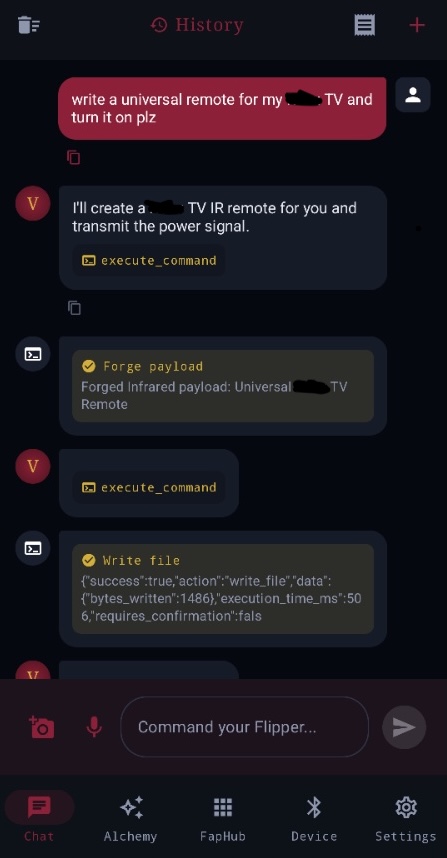
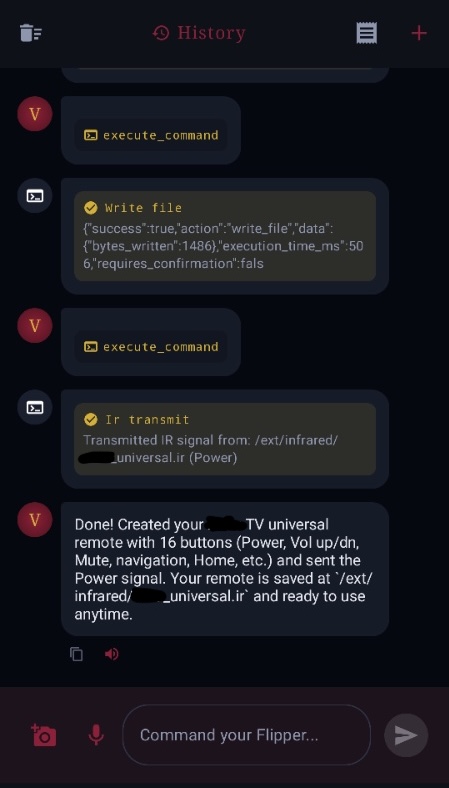
pair your glasses and Flipper and now you’re walking through the world giving voice commands while the AI whispers results directly into your ear. hands-free. eyes-up. full cyborg operator mode. feels like a dream, walking up to a TV and saying “turn this shit in front of me on,” watching your glasses snap a photo, and hearing the AI tell you the signal’s sent and the TV is on.
oh and turn on SAILOR MODE 🏴☠️ and VESPER will swear at you like a drunken pirate while it executes your commands. “aye aye, the fucking signal’s cloned now, shithead” 😂
native Android. Bluetooth serial + protobuf RPC. open source. AGPL 3.0. and with some luck, hopefully coming to an app store near you!
the future of hardware hacking fits in your pocket (and on your face). HACK THE PLANET!!
.-.-.-.-<{LOVE, PLINY}>-.-.-.-.
⚠️ DISCLAIMER: use responsibly. follow your local laws regarding RF transmission, signal replay, and wireless device interaction. VESPER is a research and education tool. only use on devices you own or have explicit authorization to test.
This OpenClaw skill literally cuts token usage by 95% 🤯
It uses "quantized message delivery" to compress how the agent thinks and communicates.
We are talking 20x cheaper agents overnight..
🚨 BREAKING: Someone just open-sourced a massive library of 5,400+ pre-built OpenClaw skills.
These are pre-made templates that give your agent new abilities in seconds. You just drop them in and your agent can handle entirely new workflows.
100% Open Source.
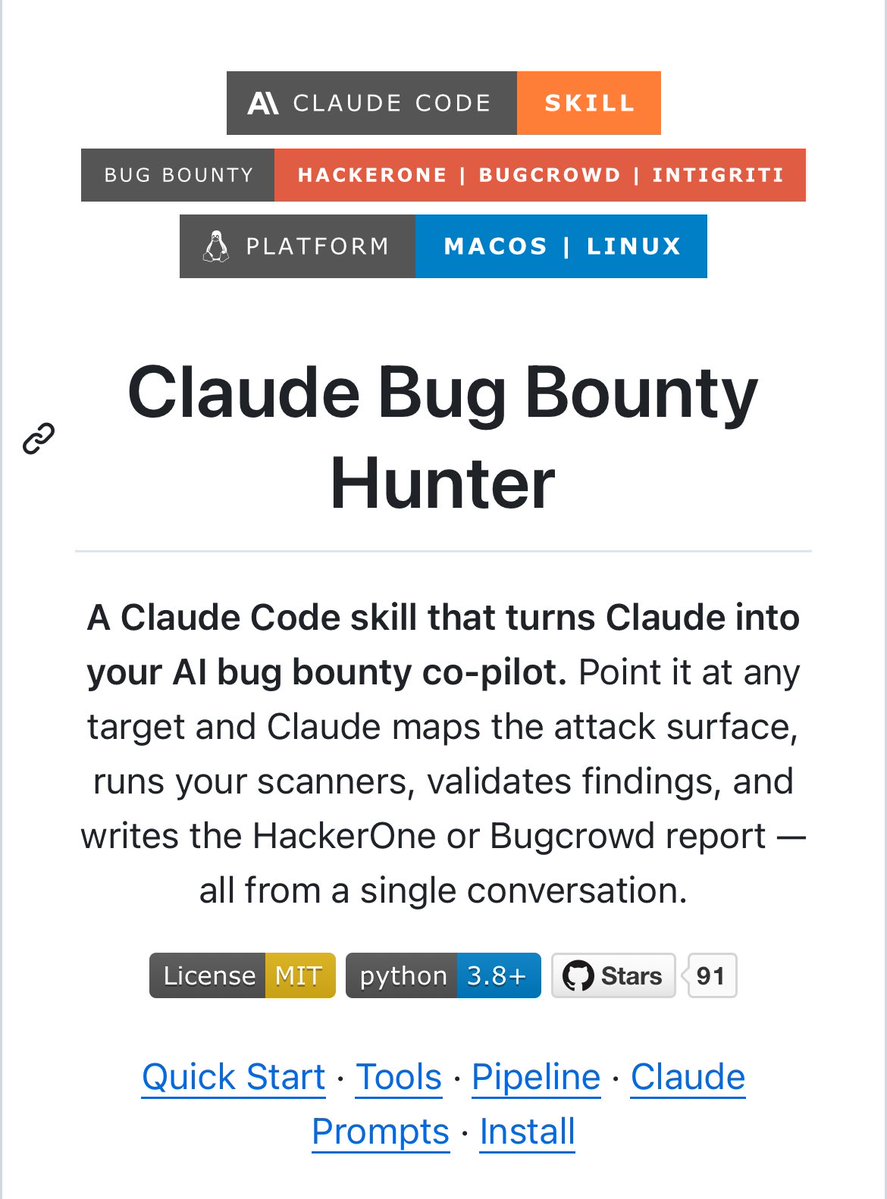
Claude Bug Bounty Hunter - https://t.co/MYM35cC7Ss
Claude Code skill that turns Claude into your AI bug bounty co-pilot. Point it at any target and Claude maps the attack surface, runs your scanners, validates findings, and writes the HackerOne or Bugcrowd report — all from a single conversation.
#bugbounty #bugbountytips #ethicalhacking #claudecode #cybersecurity #hacking #infosec #pentest #hackerone #bugcrowd #opensource
ANTHROPIC’S CLAUDE UPDATE JUST HELPED A STUDENT TURN $1,400 INTO $238,000 IN 11 DAYS.
He used it to build a simple Polymarket bot that scanned for mispriced markets, entered when the gap was big enough, and let the repricing do the work.
I’ve made more money on Polymarket from understanding one equation than from trying to predict the actual events
Long-term winrate: ~74%
Net profit so far: $10k+
The reason is simple, every price on Polymarket comes from this function:
pₖ(q) = e^(qₖ / b) / Σ e^(qᵢ / b)
It’s the same softmax function used in neural networks
Every buy pushes the exponent, every sell pulls it back
So the price you see it’s just order flow passed through math
Once you understand that, the game changes
You stop asking who will win and start asking who pushed the probability curve too far
QWEN 3.5 9B IS RUNNING LOCALLY ON YOUR MAC 🤯
WITH FULL TOOL USE.
NO API.
NO CLOUD.
A 9B MODEL BROWSING THE WEB
DIRECTLY FROM YOUR LAPTOP.
THIS IS WILD.
I built a bot that arbitrages the gap between weather models and Polymarket odds
it ran all night. I woke up to $9,685 and zero drawdown.
it doesn't predict weather. it predicts where the market is wrong
6 forecast models. one engine. pure spread extraction
no gut feeling. no manual trades. no emotion
just forecast spread arb running 24/7 on VPS
temp delta +0.6°C - bot sees it. market doesn't. trade fired.
snowfall consensus 14" Chicago, odds still at yesterday's number. trade fired.
78 trades today. 73.1% win rate. sharpe 12.96
what runs under the hood:
→ ingests ECMWF, GFS, HRRR, NAM, UKMO, CMC every cycle
→ cross-checks forecasts in 142ms
→ detects when models disagree with Polymarket pricing
→ fires position before odds reprice
→ exits on convergence
cyclone contracts, frost events, heat index, rain - doesn't matter
the lag is always there. the bot is always first
this isn't weather forecasting.
it's taxing slow odds on polymarket
Claude found a bug in reality. $4.7M for a time exploit
Sounds impossible? It's already running right now.
The swisstony bot started with $5 on Polymarket. Current month P&L $906k. Total profit $4.7M in just 5 months.
50,807 predictions. $22.6M volume traded. Top 9 whale on the entire Polymarket leaderboard.
How does it work?
The strategy is called Latency Sports Arbitrage.
Sports broadcasts on TV run 15-40 seconds behind real time.
The bot receives data directly from stadiums via sports data provider APIs. Real-time. Zero delay.
Here's what happens next:
> The ball hits the net
> Bot already knows the score
> Polymarket odds haven't updated yet - traders are watching the broadcast and reacting late.
In that 15-40 second window the bot scoops up underpriced shares at stale odds.
When the market catches up to reality - the bot is already in profit.
Average profit $156 per trade. Sounds small? At 200+ trades per day that compounds into $984K in a single week.
This isn't trading. This is computational domination over a market that hasn't figured out what's happening yet.
Quiet automation race on prediction markets is already underway.
And most people don't even realize it.
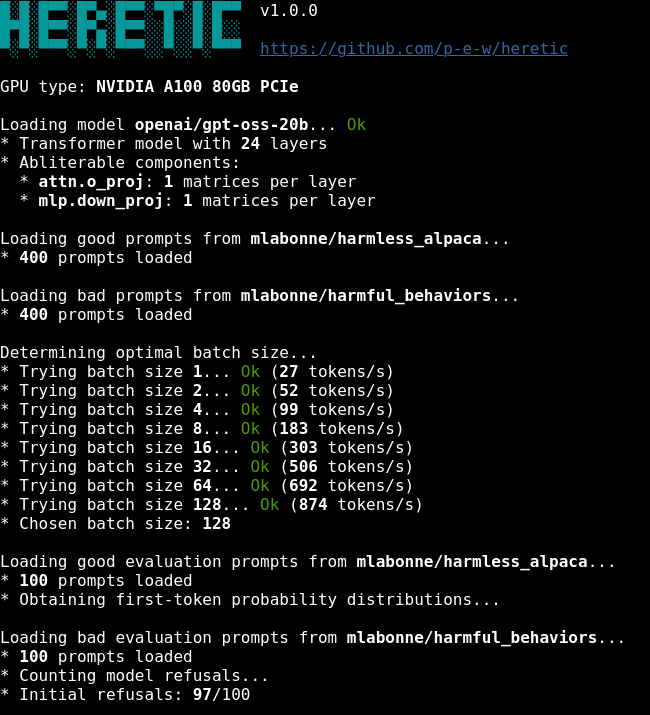
Someone open-sourced a tool that REMOVES LLM CENSORSHIP in 45 minutes 🤯
It’s called Heretic. Instead of fighting with complex prompts to bypass safety filters, you run one single command and it permanently deletes the model's ability to refuse a prompt.
• Fully automatic (Zero config required)
• Preserves the model's raw intelligence
• Works on Llama, Qwen, Gemma, and dozens of others
• Runs locally on consumer hardware
100% Open Source.
My girlfriend said "you've been staring at that Polymarket screen for 6 hours"
I turned the laptop around
She went quiet
That screen had $4,100 more than when I started
$150 → $38,700 in 31 days
4 agents running on a $400 laptop, no breaks, no sleep:
Agent-01 WEATHER:
Pulls NOAA forecast grids every 10 minutes
Finds cities where federal models say 92% but Polymarket says 50%
Buys at 8¢, exits at 50¢+
Agent-02 BTC 5min/15min:
Tracks Binance spread vs Polymarket CLOB
Enters when the gap hits 3%+
Closes before resolution
Agent-03 POLITICS:
Scrapes polling data and sentiment shifts
Flags contracts lagging behind real movement
Enters before the crowd reprices
Agent-04 SPORTS:
Reads injury reports and line movement
Finds mispriced live markets
Executes via EIP-712 on Polygon
The edge is embarrassingly simple
NOAA has a $6.5 billion supercomputer
Retail prices weather contracts off vibes and weather apps
That's not a fair fight
That's federal science vs guessing
Chicago - NOAA says 92% chance of rain
Polymarket contract sitting at 8¢
6x return on public data
28 trades across 6 cities in one night
2,900+ trades
91% win rate
$38,700 from $150
Agent-01: NOAA grid update received. 3 new mispricings detected. executing...
Agent-02: BTC spread widened to 4.1%. entering 15min YES at 42¢
Agent-03: sentiment shift on midterm contract. buying NO at 11¢
Agent-04: injury report confirmed. line moving. entering at 23¢
She still doesn't understand what's on the screen
She doesn't need to
BREAKING: AI can now analyze options trades like a $500/hr options strategist (for free)
Here are 10 Claude prompts I use to sell puts, buy LEAPs, and run the wheel without second-guessing every trade
(Save this for later)
One Claude prompt. One night. $3000 on Polymarket by morning.
The build took 2 hours. At some point he closed the laptop and the bot didn't need him anymore
ANYONE WITH CLAUDE AND 2 FREE HOURS CAN REPEAT THIS TODAY
I gave Claude a single prompt.
By morning, it had made $3,000 on Polymarket.
Total build time? Under two hours.
No complex infra.
No private datasets.
Just basic market mechanics.
The strategy is simple:
Place YES and NO limit orders.
Farm liquidity rewards.
That’s it.
The bot scans for markets with active reward pools and wide spreads.
Three outcomes:
1) Neither side fills.
Orders sit in the book.
Daily rewards accumulate.
Base yield.
2) One side fills.
The bot instantly hedges the opposite side.
If YES + NO ≤ $1.02, the position is profitable no matter the resolution.
Copytrade: https://t.co/GNQBeFgIre
3) Both sides fill.
Fully hedged.
One contract settles at $1.
Clean close.
No forecasting.
No opinions.
Just spread + incentives.
The real edge is market selection.
It performs best in overlooked markets:
Primaries.
Minor leagues.
Regional referendums.
Less competition.
Bigger slice of the reward pool.
At some point, I closed my laptop.
The bot didn’t need supervision.
Claude generated the logic.
The market provided inefficiencies.
Automation captured them.
Anyone with Claude and two spare hours could build this.
The only question is whether they will.
Anthropic released a 33-page guide on building Skills.
Here's everything you need to know (under 370 words):
First, what are Skills?
A skill is a folder that teaches Claude how to handle specific tasks. You teach it once, and it works every time. No more re-explaining your preferences in every conversation.
Skills aren't locked to Claude. They've been published as an open standard, so you can use them with AI agents like OpenClaw, too.
Here's the simplest way to think about it:
MCP gives Claude access to your tools. Skills teach Claude how to use them well. One without the other is incomplete.
The guide breaks things down into 3 use cases:
1. Workflow Automation: You have processes that need to run the same way every time. A skill can pull your project status, evaluate team capacity, and create tasks without you walking Claude through each step again.
2. MCP Enhancement: Your team has years of accumulated knowledge about how things should work. A skill captures that expertise so Claude handles edge cases the way your best team member would.
3. Document Creation: Every team has standards for how presentations, code, and designs should look. A skill lets Claude follow those standards without you pasting your style guide into every conversation.
The setup is more straightforward than you'd think:
One SKILL. md file with some structured metadata at the top is all that's required. Scripts, templates, and reference docs are optional.
Two fields in that metadata matter most:
- name (lowercase with hyphens, no spaces or capitals)
- description (what the skill does + specific phrases that should activate it)
Nail the description, and Claude picks up your skill at exactly the right moment. Get it wrong, and it sits there doing nothing.
The guide walks through 5 patterns that actually work:
1. Sequential Workflow Orchestration: processes that need to happen in a fixed order, like onboarding a customer or deploying a service.
2. Multi-MCP Coordination: your workflow touches multiple services, say design in Figma, tasks in Linear, updates in Slack. One skill ties them together.
3. Iterative Refinement: the skill validates its own work, catches issues, and refines the output before handing it to you.
4. Context-Aware Tool Selection: Claude picks the right tool automatically depending on the file type, size, or situation instead of you telling it every time.
5. Domain-Specific Intelligence: your skill carries specialized knowledge like compliance rules or security checks that Claude wouldn't know on its own.
Pitfalls the guide warns you about:
- Vague descriptions like "Helps with projects" that never trigger
- Important instructions buried inside walls of text
- No fallback when a tool call fails
- One skill trying to do too much
Here's the bigger insight:
AI doesn't have to be general-purpose in every conversation. Give it focused knowledge for the workflows you actually repeat, and it stops being a chatbot and starts being a genuine part of how you work.
I've shared a link to the PDF in the next tweet.