1/12. How do cortical interneurons select specific pyramidal cells during development? Julie Jezequel in @Rico_lab has identified specific cellular and molecular codes that interneurons use to target pyramidal cell types @NatureComms@dev_neuro@MRC_CNDD@KingsIoPPN
Are you interested in the development of the human brain? One postdoctoral position is opened with #WT funds in @RicoLab to investigate the development of inhibitory circuits in the human cerebral cortex.
Experience: Molecular Biology (scRNA seq, RNAseq).
Please RT!
Are you interested in the development of the human brain? Funded by @wellcometrust we are recruiting two postdoctoral researchers (ephys, scRNAseq, molecular biology) to investigate the formation of inhibitory circuits in humans. Please RT!
New preprint by the twitterless Tessa Herzog & colleagues: Individual cones of the vertebrate eye are exceptionally reliable and precise, but functionally heterogeneous as a population: https://t.co/aiwSwJu64S @TaYoshimatsu@neonsynapse@JosMoyaDaz1 BenJames
Our exploration of the mechanism regulating the terminal differentiation of PV interneurons in the mouse cortex. Exciting new work from Monika Moissidis and colleagues @dev_neuro@MRC_CNDD
How do neurons integrate excitatory and inhibitory inputs in a developing circuitry with remarkable neuronal diversity? If you are interested, do not miss our latest paper preprint in BioRxiv by my exceptional postdoc Tim Kroon in @Rico Lab, #synapses, #interneurons, #cortex.
Are you interested in #synapses, #interneurons, and inhibition of Pyramidal cells? If so, do not miss our latest paper preprint by the outstanding @jez_julie in @Rico_lab https://t.co/7Cbkp3h0jr
One week after the memorable #ERM2023 👏🙏@teulerlab we are still buzzin ! Congrats to Colin Wakeham @Tridencius Vitor Corredor Simona Francia for the outstanding poster presentations! 🙏#EberhartZrenner Silke Haverkamp @kfrankelab @gonschorek_d and jury!
https://t.co/YQ7Bt71lmM
Our Postdoc Symposium is still going strong!
Join us now at Chowen Theatre for a career panel discussion and a talk by our keynote Prof Tom Welton (Imperial) on Sustainable Chemistry.
The point of inhibition is to chisel out useful functions from excitatory circuits, right? Not always. Sometimes it may be there to “rescue” preexisting functions as evolution builds new circuits on top of old ones. Now out https://t.co/hU00riYzXS @XinweiWang1017@neonsynapse &co
Interested in how PV+ interneurons regulate their own activity? Read all about the changes in connectivity, and which neuropeptides are involved, in our newest preprint from the @MarinLab, now online at @biorxivprint:
https://t.co/1rMLCpdKJS
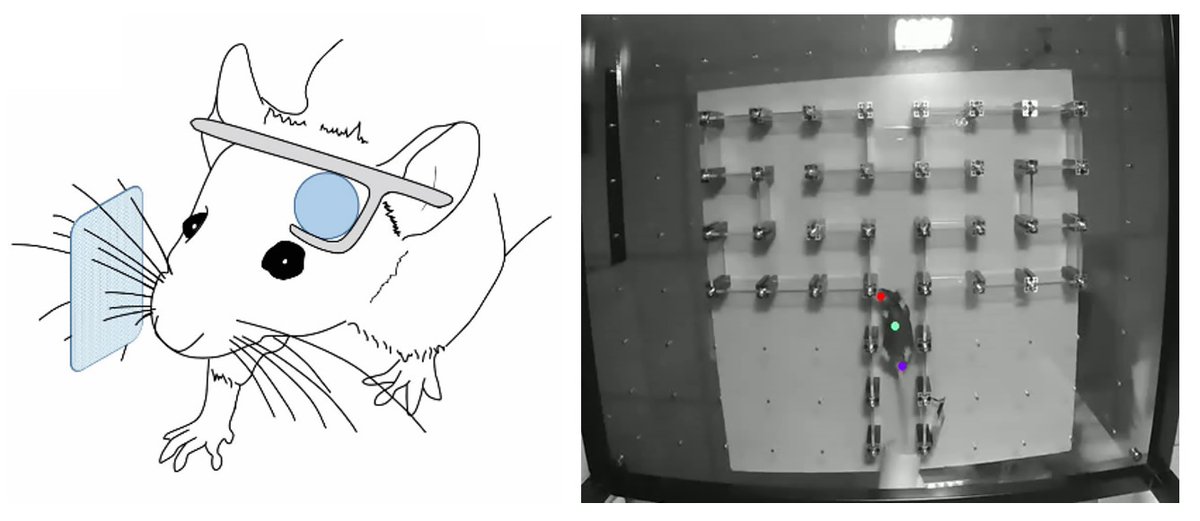
Postdoc open to investigate sensory and task-dependent neural activity in mice performing goal-directed whisker-guided tasks. Two designs: head-fixed with 2-photon imaging or a novel modular maze for free exploration. Get in touch! https://t.co/aB8qx2GLwk, [email protected]
How does the brain change its mind? Please check out the first preprint from the Khan lab! Driven by the incredible @ndcoleneuro. We find that mice can switch 'one-shot' between distinct rules, driven by prediction-error signals in the ACC. https://t.co/fHIcz9LMIA Tweetprint:
1/8 Are all synapses created equal? @clembrnrd in @Rico_lab and @Marinlab has found that the building of new synapses is controlled in a cell-type and even synapse-type-specific manner. This is the story @ScienceMagazine https://t.co/TiTUzJwmJg ⬇ thread @dev_neuro@MRC_CNDD
@LevantatePiensa@MayorofLondon@BloombergUK Si, hasta ahora no ha subido muchisimo mi factura. Por lo que he leido van a aumentar el maximo que las empresas pueden cobrar:
https://t.co/eClp6R0iA8