They say books won’t change the world. Tell that to every colonizer who burned them. To every enslaved person who was punished for reading. Literacy is resistance. Literacy is liberation. The library is a battlefield.
@Phil_Lewis_ “Agribusiness Totals: In recent election cycles, Taylor Fresh Foods and its affiliated donors have contributed over $1.2 million to agribusiness PACs and committees, leaning heavily toward conservative candidates”
the outrage and focus that comes from white folks being killed by ICE and the silence that follows black and brown folks being killed by ICE is disgusting and unforgivable. we see how a lot of y’all be moving.
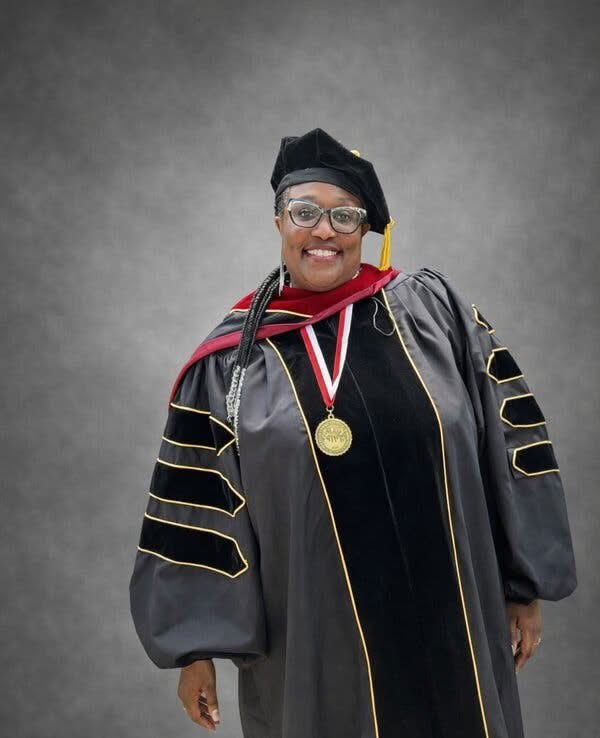
dr. linda davis is another victim of ICE 🕊️
Rest in power to our elder Denise Oliver-Velez. Although the Young Lords has been framed as a Puerto Rican organization, 25 percent of its membership was African American and many of its members, especially the NYC branch were Afro Latino. @DeniseVele49788
“The students who cannot read a 20-page article today are the voters who will not be able to read a bill, or the jurors who cannot follow a closing argument, tomorrow.”
This kid on the train just screamed YO EVERYBODY and we all thought “Showtime” was for sure happening and he screamed MY FRIEND GOT INTO CORNELL while hugging his friend and now the whole train car is screaming and clapping lol 😭
New York City just made history. 🗽
Proud of my friend @EdwinRaymondNYC 🙏🏾
Mayor Zohran Mamdani has appointed Edwin Raymond, former NYPD Lieutenant, whistleblower, and author of An Inconvenient Cop, as the new Sheriff of New York City.
Edwin Raymond didn’t just survive the system. He fought it from the inside. He led the largest civil rights lawsuit in NYPD history challenging illegal arrest quotas. He exposed racial profiling when it was career suicide to do so. And he wrote the book — literally — on what real accountability in policing looks like.
Now he’s running the office.
This is what it looks like when a mayor chooses justice over politics. Mayor Mamdani called him “principled, courageous and deeply committed to justice” and the record backs every word of that.
The city is watching. The country is watching. And for once, the right person is in the room. 👊🏾
📖 Read his story: An Inconvenient Cop: My Fight to Change Policing in America
À 23 ans, elle guérit la lèpre. À 24 ans, elle disparaît.
Et pendant 90 ans, un homme blanc s'attribua le mérite de ses travaux.
Voici l'histoire d'Alice Augusta Ball, le génie qu'on a tenté d'effacer.
Elle grandit à Seattle au début du XXe siècle, dans une famille qui croyait au potentiel des Noirs.
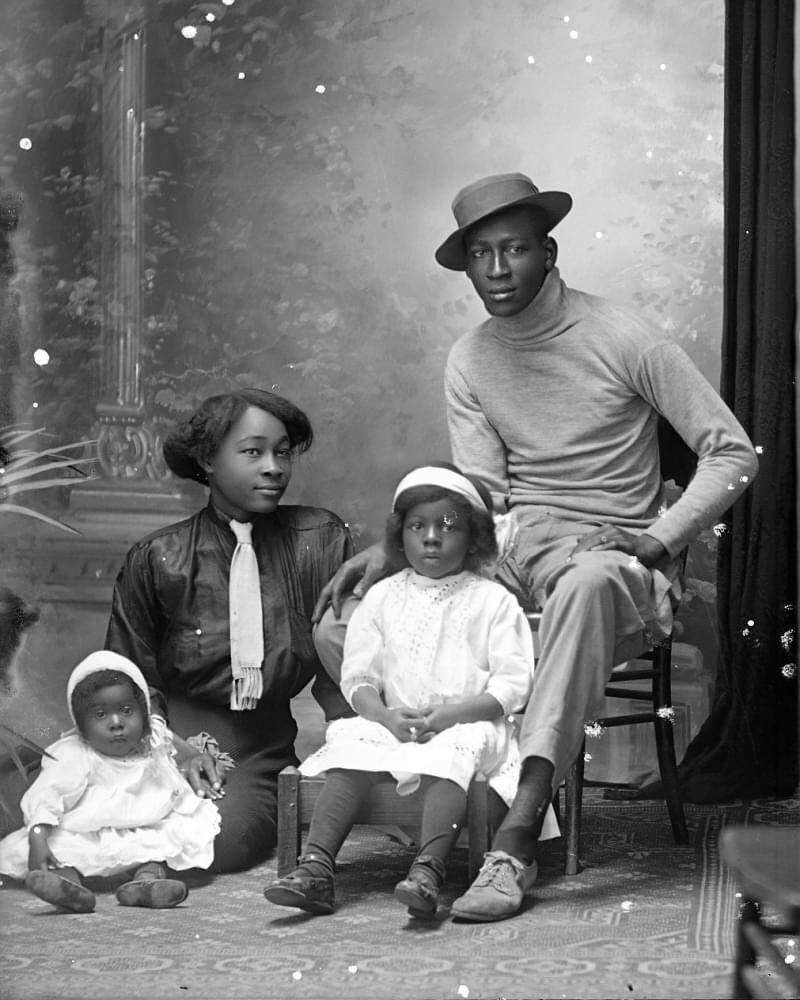
Son grand-père fut l'un des premiers photographes noirs d'Amérique.
Sa mère lavait les sols pour pouvoir offrir un microscope à Alice.
Ce cadeau changea le monde.
Alice dévorait la chimie comme l'oxygène.
Elle obtint deux licences.
Elle publia des recherches alors qu'elle était encore étudiante.
Puis elle s'installa à Hawaï et devint :
📷 La première femme à obtenir une maîtrise en chimie à l'Université d'Hawaï
📷 La première femme noire à obtenir ce diplôme
📷 La première femme professeure de chimie de l'histoire de l'université
Elle avait 23 ans.
Mais pendant qu'elle enseignait, elle fut confrontée à une urgence bien plus grande que le monde universitaire :
La maladie de Hansen, la lèpre.
Un diagnostic signifiait l'exil.
Arraché à sa famille, on était déporté sur une île pour y mourir seul.
Il existait un traitement :
une huile amère et collante, peu efficace et extrêmement douloureuse.
Nombreux furent ceux qui le refusèrent. Nombreux furent ceux qui moururent.
Alice refusa de baisser les bras.
Dans son laboratoire, elle trouva la solution que personne d'autre n'avait trouvée :
Elle transforma cette huile épaisse en une forme assimilable par le corps.
Une injection révolutionnaire qui sauva enfin des vies.
Les patients commencèrent à guérir.
Des familles furent réunies.
Des personnes condamnées guérirent subitement.
Sa découverte devint la méthode Ball.
Elle changea l'histoire de la médecine avant même que la plupart des gens n'aient terminé leurs études.
Et puis… elle disparut.
À seulement 24 ans, un mystérieux accident de laboratoire lui coûta la vie.
Elle ne vit jamais le miracle qu'elle avait accompli.
Puis vint le vol.
Le président de l'université, un chimiste blanc nommé Arthur Dean, s'appropria ses recherches, en retira son nom et les rebaptisa :
« La Méthode Dean ».
Pendant des décennies…
📷 Son nom figurait dans les manuels scolaires.
📷 Son nom était encensé par les médecins.
📷 Son nom était attribué à la seule reconnaissance de ses mérites.
Son nom a failli disparaître complètement de l'histoire.
Un vol si discret que la plupart des gens ignoraient même qu'un crime avait été commis.
Il fallut 90 ans pour que la vérité éclate enfin.
Des chercheurs ont mis au jour les documents originaux d'Alice.
Son travail.
Son génie.
Ses découvertes majeures.
Les projecteurs se sont braqués sur elle. Le mensonge s'est effondré.
Et aujourd'hui, le monde le sait :
C'était la Méthode Ball – TOUJOURS.
Alice Ball a guéri une maladie qui avait ravagé des vies pendant des siècles.
Elle a libéré des familles.
Elle a sauvé des milliers de personnes de l'isolement et de la mort. Et elle a accompli tout cela en une seule année.
Imaginez ce qu'elle aurait pu faire en une vie entière.
Alice Ball méritait un prix Nobel.
Elle méritait des statues.
Elle méritait que son nom soit sur toutes les lèvres des étudiants en sciences.
Au lieu de cela, elle a été étouffée par le silence…
Jusqu'à aujourd'hui.
Nous prononçons son nom parce que l'histoire a refusé de le faire.
Nous l'honorons parce que d'autres ne l'ont pas fait.
Nous nous souvenons d'elle parce qu'elle l'a mérité.
Alice Augusta Ball (1892-1916)
La chimiste qui a changé le monde avant même d'avoir eu le temps d'y vivre.
Jeff Bezos paid $500M for his super-yacht and $75M for his super-yacht’s mini-yacht — both of which he’s allowed to write-off on his taxes.
That alone would cover $180 in classroom supplies for every public school teacher in the U.S.
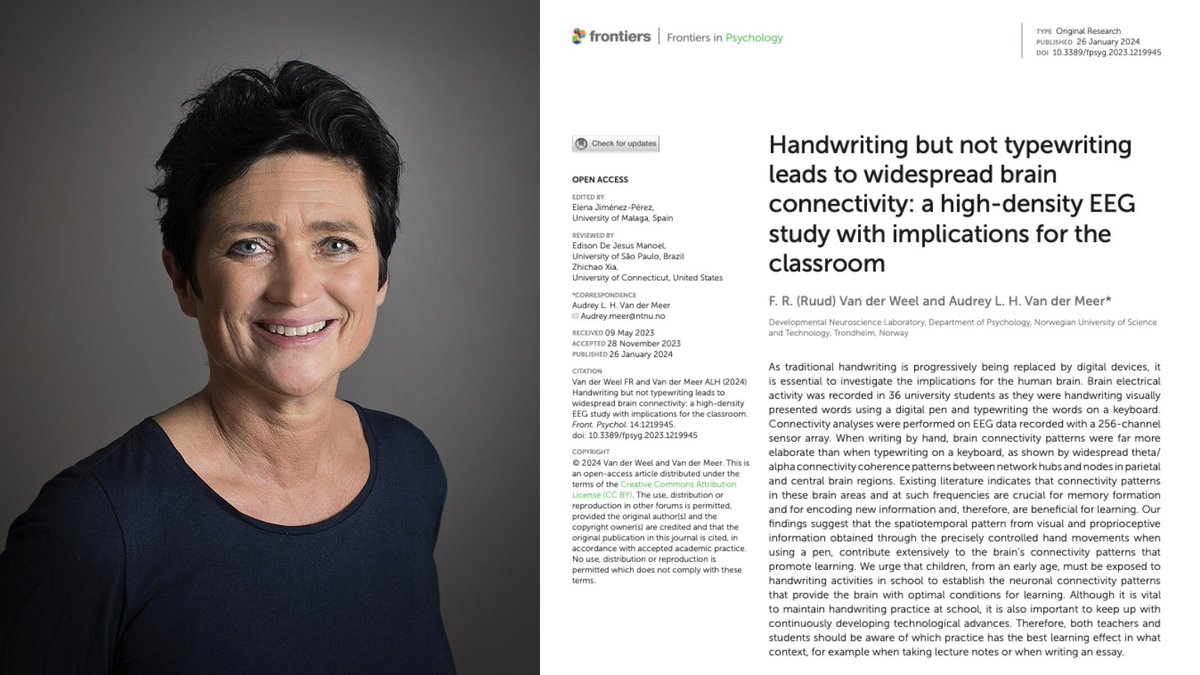
A Norwegian neuroscientist spent 20 years proving that the act of writing by hand changes the human brain in ways typing physically cannot, and almost nobody outside her field has read the paper.
Her name is Audrey van der Meer.
She runs a brain research lab in Trondheim, and the paper that closed the argument was published in 2024 in a journal called Frontiers in Psychology. The finding is brutal enough that it should have changed every classroom on Earth.
The experiment was simple. She recruited 36 university students and put each one in a cap with 256 sensors pressed against their scalp to record brain activity. Words flashed on a screen one at a time.
Sometimes the students wrote the word by hand on a touchscreen using a digital pen, and sometimes they typed the same word on a keyboard. Every neural response was recorded for the full five seconds the word stayed on screen.
Then her team looked at the part of the data most researchers had ignored for years, which is how different parts of the brain were communicating with each other during the task.
When the students wrote by hand, the brain lit up everywhere at once.
The regions responsible for memory, sensory integration, and the encoding of new information were all firing together in a coordinated pattern that spread across the entire cortex. The whole network was awake and connected.
When the same students typed the same word, that pattern collapsed almost completely.
Most of the brain went quiet, and the connections between regions that had been alive seconds earlier were nowhere to be found on the EEG.
Same word, same brain, same person, and two completely different neurological events.
The reason turned out to be something nobody had really paid attention to before her work. Writing by hand is not one motion but a sequence of thousands of tiny micro-movements coordinated with your eyes in real time, where each letter is a different shape that requires the brain to solve a slightly different spatial problem.
Your fingers, wrist, vision, and the parts of your brain that track position in space are all working together to produce one letter, then the next, then the next.
Typing throws all of that away. Every key on a keyboard requires the exact same finger motion regardless of which letter you are pressing, which means the brain has almost nothing to integrate and almost no problem to solve.
Van der Meer said it plainly in her interviews.
Pressing the same key with the same finger over and over does not stimulate the brain in any meaningful way, and she pointed out something that should scare every parent who handed their kid an iPad.
Children who learn to read and write on tablets often cannot tell letters like b and d apart, because they have never physically felt with their bodies what it takes to actually produce those letters on a page.
A decade before her, two researchers at Princeton ran the same fight using a completely different method and ended up at the same answer. Pam Mueller and Daniel Oppenheimer tested 327 students across three experiments, where half took notes on laptops with the internet disabled and half took notes by hand, before testing everyone on what they actually understood from the lectures they had watched.
The handwriting group won by a wide margin on every question that required real understanding rather than surface recall.
The reason was hiding in the transcripts of what the two groups had actually written down.
The laptop students typed almost word for word, capturing more total content but processing almost none of it as they went, while the handwriting students physically could not write fast enough to transcribe a lecture in real time, which forced them to listen carefully, decide what actually mattered, and put it in their own words on the page.
That single act of choosing what to keep was the learning itself, and the keyboard had quietly skipped the choosing and skipped the learning along with it.
Two studies. Two countries. Same answer.
Handwriting makes the brain work. Typing lets it coast.
Every note you have ever typed instead of written went into your brain through a thinner pipe. Every meeting, every book highlight, every idea you captured on your phone instead of on paper was processed at half depth.
You did not forget those things because your memory is bad. You forgot them because typing never woke the part of the brain that would have made them stick.
The fix is the thing your grandmother already knew.
Pick up a pen. Write the thing down. The slower road is the faster one.
In 1957, Marlon Green, an Air Force pilot, applied to be a Continental Airlines pilot. Green had applied to other airlines but was rejected each time. When he filled out his application for Continental, he left the “race” box unchecked. Green made it to the final round of interviews but was not hired, even though he had more flight time than the other candidates who were white.
Green filed a complaint with the Colorado Anti-Discrimination Commission, a landmark case that ended up in the United States Supreme Court which ruled in Greens favor and helped dismantle racial discrimination in the American passenger airline industry.
While David Harris was the first Black pilot hired with a major airline, Marlon Green’s fight for the right to be in the flight deck cleared a path for generations of Black pilots to come. In 2010, Continental dedicated a 737 named for Captain Marlon Green. The aircraft, N77518, still flies for United today.
Thank you, Marlon Green for your contributions towards Black History and paving the way for many to follow 🧑🏾✈️✈️