Hollywood just made a movie about 19-year-old Anthony Bourdain finding his calling in a Provincetown kitchen in 1975.
What the movie can't show is that the calling kept him broke for the next 24 years.
Bourdain spent his 20s and 30s as a line cook and a heroin addict. At 42 he was running the kitchen at a Manhattan bistro with no health insurance, months behind on rent, and he couldn't qualify for a credit card.
So he wrote an essay about the ugly truths of restaurant kitchens. His mother, an editor at the New York Times, sent it to The New Yorker without telling him.
It ran in April 1999. A publisher offered $50,000 to expand it into a book. Kitchen Confidential spent 44 weeks on the bestseller list and got translated into more than 20 languages.
Bourdain opened his first savings account at 44. The same age he became the most famous food voice in America.
The kid in this movie believes the Provincetown summer is where his story begins. It took another quarter century, and 2,000 words his mom mailed behind his back, before the world agreed.
Spending a week with my family and working most of it! Being a few hours ahead of US markets has given me some time to digest a lot of incredible markets discourse on X - there is too much to try and consume about AI but not enough about leverage. We are seeing a classic head hunt of the most levered players in the equity and convert market re AI globally. Hyperscaler and associated credit spreads in IG are wider as they should be (portfolio construction by notional and duration matter in credit because we don’t have the payout that equity does) and debt is being added to compute and power as another constraint on the AI theme. Govt regulation remains a massive wildcard but a longer cycle isn’t necessary a worse one. I would look for the forced sellers of assets trading at or below contract value with counterparties you feel good about that have positive optionality on growth opportunities. Think about the impact on spot and next 1-2 year curves for compute, power, and shell - those who are long and don’t need financing + can term out contracts now are materially advantaged. If this is the whole cycle being elongated and the curve flattened there are a lot of interesting securities to buy from forced sellers. More time for competition and technology to emerge in the intermediate term isn’t necessarily a bad thing for many infrastructure assets. I started my career in the middle of the early 2000s telecom cycle - Nortel, Lucent, Cisco, etc were financing their customers. There have been some very astute comments on this platform from people who understand the AI echosystem far better than I do about Nvidia and Broadcoms business model decision to become the working capital bank of the AI build - bridging the industry to revenue and cash flow. My sense is the focus in credit markets right now is too much on Meta Google Amazon etc and not enough on that business model change which liquifies the compute roll out in the near term and shifts the credit risk to those large semiconductor companies. It’s fun to seeing liquidity having a price again and god forbid IG companies cost of debt having to compete with their cost to equity.
Absolutely incredible.
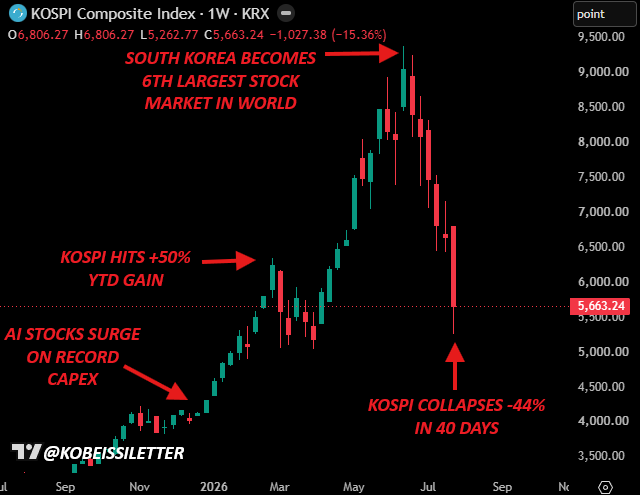
In an unprecedented move, South Korea's stock market just collapsed -44% in 40 days, erasing -$2 trillion in market cap.
Now, South Korea's finance ministry has announced plans to "stabilize" the market.
What is happening? Let us explain.
(a thread)
New research: We studied every NBA Achilles tear from 2014-2025 (19 players) to find out what happens in the games right before the injury.
The finding: minutes played spiked significantly in the 10-15 games before rupture — even though season-long workload looked totally normal.
7 Achilles tears in 2024-25 alone.
3 of those tears occurred in the playoffs.
This is a real, growing problem in the league.
Full paper: https://t.co/xIcfJJRxui