매년 조 단위에 이르는 외국인 관광객 부가세 환급금이 관광객의 출국과 함께 해외로 빠져나갑니다. 한국 관광 경제의 구조적 누수입니다. Trixa는 이 환급금이 한국을 떠나기 전에 즉시 돌려주는 인프라로, 기존 환급 생태계 위에 올라가 비효율 지점을 통합/보강하고 RLUSD 등으로 즉시 정산합니다!
이번 주는 제도적 리스크 점검과 프론트엔드 정교화 두 가지에 집중했습니다.
1. 제도적 리스크 점검
Trixa의 핵심은 환급금을 출국 전에 즉시 지급하는 선환급 구조입니다. 이번 주에는 이 모델의 법적 근거인 「외국인관광객 등에 대한 부가가치세 및 특별소비세 특례규정」 제10조의2를 중심으로 정합성을 재검토했습니다. 구체적으로 ① 환급창구운영사업자 지정 요건, ② 카드 가결제(약 110% 승인보류) 담보 처리, ③ 세관 반출확인 전산 연계라는 세 가지 규제 관문을 점검했고, 담보·정산 구조의 여신전문금융업법 정합성과 개인정보 처리의 적법성을 함께 검토했습니다. 본 모델은 신규 제도의 창설이 아니라 현행 제도가 이미 예정한 구조의 디지털화입니다.
2. 프론트엔드 정교화
환급 신청부터 즉시 수령, 그리고 수령 채널(RLUSD·현금·카드) 선택까지 이어지는 사��자 플로우의 화면과 인터랙션을 다듬었습니다.
6월 25일 KFIP 2026 본선 데모데이에서 진전된 결과를 선보이겠습니다.
#KFIP2026 #XRPLKorea #SFL #서울핀테크랩 #XRPL #BuiltOnXRPL #Trixa @xrplkorea
Every year, trillions of won in VAT refunds owed to foreign tourists leave the country the moment those tourists fly home — a structural leak in Korea's tourism economy. Trixa is the infrastructure that returns those refunds before they ever leave Korea. We layer on top of the existing refund ecosystem, consolidating and reinforcing only the points where it falls short, and settle instantly through RLUSD and other rails.
This week, we focused on two fronts: reviewing regulatory risk and refining the frontend.
1. Regulatory risk review
At its core, Trixa runs on an advance-refund (pre-refund) model: the refund is paid out before the tourist departs. This week we re-examined the model's regulatory alignment, anchored on Article 10-2 of the Special Taxation Provisions for Foreign Tourists, which serves as its legal basis. Specifically, we reviewed three regulatory gates — ① qualifying for designation as a licensed tax-refund operator, ② handling the card pre-authorization (an ~110% hold) used as collateral, and ③ the electronic linkage to customs export confirmation — and we also checked the collateral-and-settlement structure against the Specialized Credit Finance Business Act, along with the lawfulness of our personal-data handling. This is not the creation of a new regulatory regime; it is the digitization of a structure that current law already anticipates.
2. Frontend refinement
We refined the screens and interactions across the full user flow — from refund request, to instant payout, to selecting the payout channel (RLUSD, cash, or card).
We'll share our progress at the KFIP 2026 Finals Demo Day on June 25.
#KFIP2026 #XRPLKorea #SFL #SeoulFintechLab #XRPL #BuiltOnXRPL #Trixa @xrplkorea
KFIP 2026 is co-hosted by Seoul Fintech Lab and XRPL Korea, with @Ripple as main sponsor.
Judging panel:
→ Ripple
→ XRPL Korea
→ Hashed (@hashed_official)
→ ITCEN Global
→ Toss (@toss__official)
→ KORFIN(Korea Fintech Industry Association)
📌Final Pitch Day → June 25, 14:00-17:00 KST
📍Venue → Two IFC Seoul, The Forum 3F
Open to the public. Sign up via the link below 🇰��
https://t.co/ZFqle3evaR
The 12 finalists ship across 4 frontiers of finance on the XRP Ledger:
→ Payments & FX
→ Credit & Trade Finance
→ Collateral & Liquidity
→ AI-Powered Finance
Each team brings production-grade implementations, with several already operating on mainnet ahead of Demo Day.
🇰🇷 Korean fintech is moving to XRPL.
270+ builders applied. 12 finalists are taking the stage on June 25 at Two IFC Seoul.
KFIP 2026 has become Korea's largest XRPL-native accelerator program to date.
Meet every team here 👇
@anam145official — ANAM145
@goo9801 — Blue Nomad
@connectfit0403 — CONNECTFIT
@gomtak_dari — DARI
@yeatuofficial — EverTreasure
@KYvC67 — KYvC
@sivax_official — RiskX
@sbtplus_ — SBT Plus
@xrft_official — Transfarmer
@helloTFlow — KAB Labs
@Trixa_kr — Trixa
Verna Technologies — CareXpo
📚 Check out the Finalists’ Weekly Contents: https://t.co/68EVfaxIMB
#KFIP2026 #XRPLKorea #XRPL #BuiltOnXRPL
현행 면세 환급 제도의 비효���과 Trixa의 접근법
현행 면세 환급 제도에 대해서 알고 계신가요?
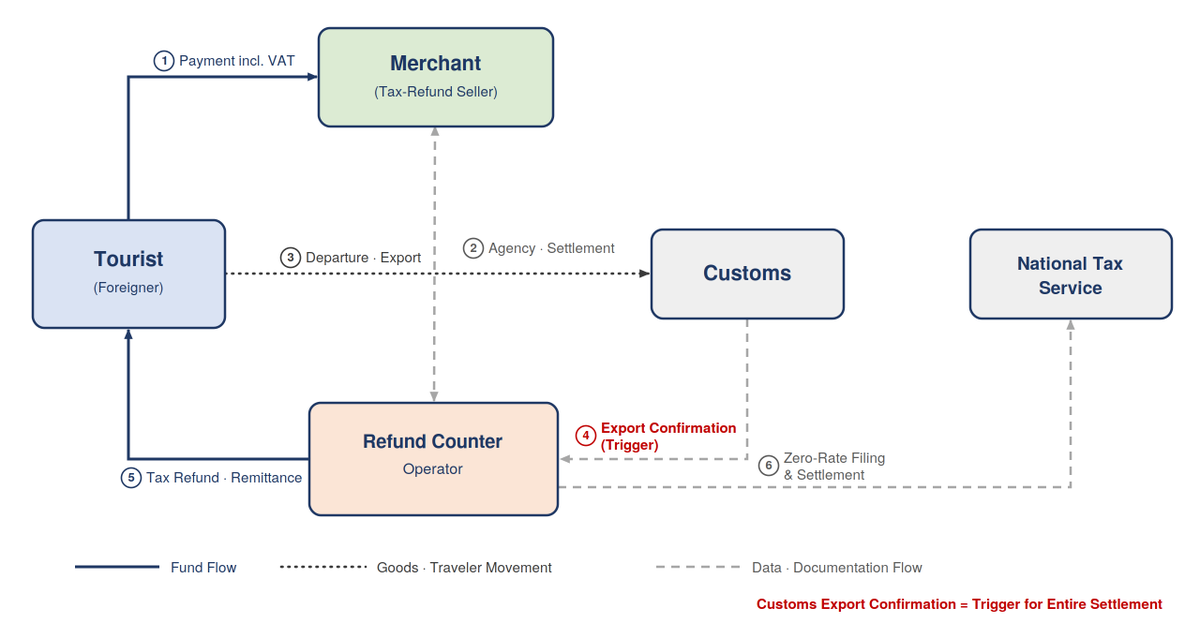
현행 외국인 관광객 대상 환급 절차는 다음과 같이 진행됩니다. 관광객이 가맹점에서 물품을 구매할 때, 가맹점은 해당 물품을 면세 상태로 판매할 수 없으므로 부가가치세를 포함한 정상 가격으로 판매합니다. 이 부가세를 사후에 환급하는 것이 제도의 골자이며, 환급은 가맹점이 직접 수행하지 않고 글로벌블루·GTF 등 환급창구 운영사업자가 대행합니다. 또한 일련의 정산은 관광객이 실제로 물품을 반출하여 출국하였음을 세관이 확인한 시점에 비로소 개시됩니다. 그림에 적시된 '세관 반출확인 = 전체 정산의 트리거'가 이를 의미합니다. 결과적으로 현행 면제 환급 제도 전반은 '관광객이 향후 물품을 반출할 것'이라는 미실현 사실에 대한 신뢰를 전제로 작동합니다.
문제는 이 신뢰를 보완하는 과정에서 다층적 비효율이 발생한다는 점입니다.
관광객 측면에서는 가맹점>환급 창구>출국 단계마다 여권과 카드를 반복 제시해야 합니다. 또한 가맹점별로 제휴 환급사업자가 상이하여 이용 앱, 창구, 수령 방법과 수단이 분산되며, 1회 거래 1만 5천 원 미만의 소액 구매는 환급 대상에서 제외됩니다.
그 시내환급의 경우 환급액을 선지급하는 대신 환급액의 110%를 카드에 가승인으로 설정하고, 미반출 시 해당 금액을 재청구합니다. 더불어 구매 후 3개월 이내 출국, 시내환급 시 25일 이내 반출확인 등 각종 기한을 소비자가 사업자별로 직접 관리해야 합니다. 최종 수령 단계에서는 운영사업자 수수료와 외화 환전 마진이 차감되�� 실수령액이 감소하며, 송금형의 경우 1~2주 이상이 소요됩니다.
가맹점 측면에서는 면세 ���매가 불가하여 부가세를 포함해 판매한 자금이 영세율 정산 확인 시점까지 묶이며, 별도의 증빙 관리 부담이 수반됩니다. 과세·관세 당국 측면에서는 환급 절차의 서류 기반 검증과 환급 사기 탐지에 행정 비용이 발생합니다.
Trixa는 이러한 비효율의 근본 원인을 다음과 같이 진단합니다. 현행 제도는 '관광객이 물품을 반출할 것'이라는 미래 사실에 대한 신뢰를 카드 담보/서류 증빙/기한 관리라는 절차적 장치로 보완하고 있습니다. Trixa는 이 검증 자체를 전자여권 NFC 기반 분산 신원(DID)으로 실시간·이식 가능하게 전환하고, 선환급 모델에서는 담보·정산 기능을 직접 수행합니다.
1. 신원 레이어는 다음과 같이 구성됩니다.
휴대폰으로 전자여권의 NFC 칩을 판독하고 face-liveness를 거쳐 XRPL 기반 분산 신원(DID)을 발급합니다. 여권 사진 촬영만으로는 진본 확인이 불가능하기에, 복제가 불가능한 전자여권 칩의 암호화 정보를 직접 판독함으로써 진본 및 본인 사실 여부가 검증됩니다. 전자여권은 ICAO 국제 표준에 따라 발급국과 무관하게 동일 구조를 ���지므로 외국인 여권에도 그대로 적용됩니다. 1회 발급된 DID는 이후 모든 사업자 및 세관에서 재사용되어 반복 신원확인의 불편함에서 벗어나게 됩니다.
2. 환급 레이어는 두 가지 경로로 구성됩니다.
첫째는 가맹점별로 상이한 환급사업자의 환급 내역을 DID를 키로 통합 조회하는 중립 라우터 방식으로, 분산된 앱과 창구를 단일 인터페이스로 통합합니다. 둘째는 Trixa가 환급액을 즉시 선지급하고 카드 가결제(약 110%)로 담보를 설정한 후 반출확인 시 정산/환수하는 선환급 방식입니다. 선환급은 외국인관광객 특례규정 제10조의2가 명시적으로 허용하는 구조로, 신규 제도의 창설이 아니라 현행 제도의 디지털화에 해당합니다. 또한 환급금을 RLUSD 등 원하는 화폐로 즉시 수령하게 하여 환전 마진과 송금 지연을 압축합니다.
Trixa는 기존 인프라를 대체하지 않습니다. '세관 반출확인이 전체 정산의 트리거'라는 기존 골격은 유지하되, 그 위에 신원·증빙·추적 레이어를 부가하여 비효율 지점만을 선별적으로 개선합니다. 시장의 비효율성, Trixa가 해결해보겠습니다.
#KFIP2026 #XRPLKorea #SFL #서울핀테크랩 #XRPL #BuiltOnXRPL @xrplkorea
Inefficiencies in the Current Tax-Refund System and Trixa's Approach to Solving Them
How well do you actually know the current tax-refund system?
The refund process for foreign tourists currently works as follows. When a tourist buys goods at a participating merchant, the merchant cannot sell those goods tax-free and therefore sells them at the full price, VAT included. Refunding that VAT after the fact is the essence of the system, and the refund is handled not by the merchant directly but on its behalf by tax-refund operators such as Global Blue and GTF. Furthermore, the entire settlement only begins once customs confirms, at the point of departure, that the tourist has actually carried the goods out of the country. This is what the diagram labels "customs export confirmation = the trigger for all settlement." As a result, the current tax-refund system as a whole runs on trust in an unrealized future fact — that the tourist will, at some later point, take the goods out of the country.
The problem is that shoring up this trust introduces inefficiency at multiple layers.
From the tourist's side, the passport and card must be presented again and again at every stage — merchant, refund counter, and departure. Because each merchant is tied to a different refund operator, the apps, counters, and methods of receiving the refund are all fragmented, and purchases of less than KRW 15,000 per transaction are excluded from eligibility altogether. With downtown refunds, rather than simply paying the refund out, the operator places a pre-authorization hold of about 110% of the refund amount on the card and re-charges that amount if the goods are not exported. On top of this, the consumer must personally track a range of deadlines operator by operator — departure within three months of purchase, customs export confirmation within 25 days for downtown refunds, and so on. At the final payout stage, operator fees and currency-exchange margins are deducted, lowering the amount actually received, while remittance-type refunds take a week or two, and often longer.
From the merchant's side, since tax-free sales are not permitted, the proceeds from a sale made with VAT included are locked up until zero-rate settlement is confirmed, accompanied by a separate burden of managing supporting documentation. From the side of the tax and customs authorities, the document-based verification of refunds and the detection of refund fraud generate administrative costs.
Trixa diagnoses the root cause of these inefficiencies as follows. The current system props up its trust in a future fact — that the tourist will export the goods — with procedural devices such as card collateral, paper documentation, and deadline management. Trixa converts that verification itself into something real-time and portable through a decentralized identity (DID) built on e-passport NFC, and, in the advance-refund model, performs the collateral and settlement functions directly.
1. The identity layer is structured as follows.
Using a smartphone, the e-passport's NFC chip is read and a face-liveness check is performed to issue an XRPL-based decentralized identity (DID). Because merely photographing the passport cannot verify authenticity, directly reading the encrypted data on the uncopyable e-passport chip verifies both the document's authenticity and that the bearer is the genuine holder. Because e-passports follow the ICAO international standard and share an identical structure regardless of issuing country, this applies to foreign passports without modification. Once issued, the DID is reused across all operators and customs thereafter, freeing the user from the inconvenience of repeated identity checks.
2. The refund layer comprises two paths.
The first is a neutral-router model that uses the DID as a key to consolidate and look up refund records across the different operators tied to each merchant, unifying the fragmented apps and counters into a single interface. The second is an advance-refund model in which Trixa pays the refund amount out immediately, sets collateral through a card pre-authorization (about 110%), and then settles or recovers it upon export confirmation. The advance refund is a structure expressly permitted under Article 10-2 of the Special Taxation Provisions for Foreign Tourists; it is not the creation of a new system but the digitization of the existing one. It also allows the refund to be received instantly in the currency the user prefers, such as RLUSD, compressing exchange margins and remittance delays.
Trixa does not replace the existing infrastructure. It keeps the existing framework intact — customs export confirmation as the trigger for all settlement — and adds identity, documentation, and tracking layers on top, selectively improving only the points of inefficiency. Market inefficiency is exactly what Trixa intends to solve.
#KFIP2026 #XRPLKorea #SFL #서울핀테크랩 #XRPL #BuiltOnXRPL @xrplkorea
Trixa: 한국을 방문한 친구의 고민에서부터 시작됐습니다.
외국인 친구가 한국에 올 때마다 같은 장면이 반복됐습니다. 매장에서 여권을 꺼내고, 공항 키오스크에서 다시 스캔하고, 환급 데스크에서 또 여권과 카드를 내밀고, 그러고도 환급이 됐는지 몇 주를 기다려야 했습니다. 여행자로서 우리도 똑같이 파편화된 환급을 겪었습니다. 그래서 단순한 질문 하나를 계속 던지게 됐습니다. "이렇게 디지털화된 나라에서, 외국인은 왜 매번 종이로 자신을 증명해야 할까?" Trixa는 그 질문에 대한 대답을 주고 싶었습니다.
무엇을 만들고 있나요?
Trixa는 Tax-Free 환급에서 출발하지만, 환급 앱이 아닙니다. 외국인이 한국에서 거쳐야 하는 거의 모든 절차를 여권 한 번의 태깅으로 잇는 레이어입니다. 한 번의 태깅으로 신원을 검증하면, 그 증명이 면세 환급은 물론 호텔 체크인, 렌터카 인수와 보증금 예치, 환전, 여행자보험, 그리고 "당신이 누구인지"를 묻는 모든 결제·서비스 시점으로 그대로 이어집니다. 매 창구에서 KYC를 반복하는 대신, 외국인은 재사용 가능한 하나의 신원으로 여행 전체를 통과합니다. 면세점, 환급사업자(eTRS), 관세청, 카드 PSP, 호텔, 렌탈사를 대체하지 않습니다. 그 위에 얹혀, 파편화된 수십 번의 신원·결제 순간을 하나의 월렛으로 묶는 신뢰 레이어입니다. 환급은 입구일 뿐, 우리가 그리는 것은 여행 경험 전체입니다.
어떤 문제가 있나요?
한국을 방문하는 외국인은 폭발���으로 증가중에 있습니다. 2024년 방한 외국인은 전년 대비 48.4% 늘어난 1,637만 명으로 코로나 이전의 94%까지 회복했고, 외국인 면세 소비는 연간 10조 원 이상으로 추정됩니다. 그러나 환급 경험은 그 속도를 따라가지 못합니다. 환급 한 건을 위해 여권을 세 번 따로 제시하고, 한 번의 여행에서 같은 신원 정보를 평균 4~6회 노출하며, 카드 청구 시점인 12주 뒤에야 결과를 확인하고, 출국 피크에는 공항 데스크에서 40분을 기다립니다. 환급사업자는 파편화돼 있고, 기존 모바일 신분증은 내국인 중심이라 외국인 여권·ARC를 아예 지원하지 않습니다.
어떻게 동작하나요?
사용자는 여권을 한 번만 태깅(NFC/OCR + face-liveliness)해 검증 가능한 자격증명을 발급받고, 이후 같은 신원을 다시 제출하지 않습니다. 구매·반출 확인·지급·취소까지 환급의 각 단계는 이벤트 영수증으로 발급되어, 사용자의 월렛 안에서 hash로 연결된 proof chain으로 누적됩니다. 여권·영수증·카드 정보 같은 민감 데이터는 오프체인에 암호화 저장하고, 신뢰 검증에 필요한 최소 정보(발급자 DID, 공개키, 스키마·정책 해시, 커밋먼트)만 XRPL에 anchor합니다. 근데 왜 XRPL일까요? XRPL은 결제·정산·DID(XLS-40)가 프로토콜에 내장돼 있고, 수수료가 예측 가능하며(평균 약 $0.0002), Ripple의 NYDFS 규제 스테이블코인 RLUSD가 발행되어 5~7%의 환전·송금 수수료와 수일의 지연 대신 1% 미만 비용의 즉시 국경 간 환급 정산을 가능하게 합니다.
우리의 목표는?
단기적으로는 핵심 루프(여권 → W3C VC → 선택적 증빙 → 즉시 환급)를 검증해, 기존 30~45일의 환급 대기를 60초 미만으로 압축합니다. 중기적으로는 별도 하드웨어 없이 기존 POS에 얹는 SDK로 면세점·호텔·렌터카·여행 플랫폼을 위한 B2B 환급 인프라로 확장합니다. 장기적으로 Trixa는 단일 환급 서비스에서 외국인 전용 종합 금융 레이어로 성장해, 스테이블코인 제도화에 맞춰 환전·예치·여행자보험을 같은 지갑 위에 더하고, 사람을 넘어 물품 단위 DID/VC로 무역 트레이서빌리티까지 확장��� 모색합니다.
Trixa는 환급에서 시작하지만, 결국 한국을 찾는 모든 사람에게 가장 편한 여행 경험을 제공하는 토탈 트래블 트러스트 레이어가 되는 것을 목표로 합니다. 입국에서 출국까지, 누구나 번거로움 없이 한국을 온전히 즐기게 하는 것. 그것이 Trixa가 그리는 마지막 그림입니다.
#KFIP2026 #XRPLKorea #SFL #서울핀테크랩 #XRPL #Trixa
Trixa — It started with a friend's frustration in Korea.
Every time a foreign friend came to Korea, the same scene repeated: pulling out a passport at the store, scanning it again at the airport kiosk, handing over a passport and card one more time at the refund desk — and then waiting weeks just to find out whether the refund even went through. As travelers ourselves, we lived the same fragmented process. So we kept asking one simple question: "Why does a country this digital still make foreigners prove who they are, over and over, on paper?" Trixa is the answer we wanted to give.
What are we building? Trixa starts with tax-free refunds, but it isn't a refund app. It's a layer that connects almost everything a foreigner has to do in Korea with a single passport tap. Verify your identity once with one tap, and that same proof carries straight through tax refunds, hotel check-in, rental cars and deposits, currency exchange, travel insurance, and every payment or service that asks "who are you?" Instead of repeating KYC at every counter, a visitor moves through their entire trip on one reusable identity. We don't replace duty-free stores, refund operators (eTRS), customs, card PSPs, hotels, or rental companies — we sit on top of them as a trust layer that ties dozens of fragmented identity-and-payment moments into one wallet. Refund is just the entry point; what we're drawing is the entire travel experience.
What's the problem? Inbound demand is exploding. In 2024, foreign visitors to Korea grew 48.4% year-over-year to 16.37 million — a 94% recovery to pre-pandemic levels — and foreign duty-free spending is estimated at over 10 trillion won a year. But the refund experience hasn't kept up with that pace. A single refund means presenting a passport three separate times, exposing the same identity an average of 4–6 times in one trip, learning the result only 1–2 weeks later when the card is billed, and waiting 20–40 minutes at the airport desk during peak departure hours. Refund operators are fragmented, and existing mobile ID services are built for Koreans — they don't support foreign passports or ARCs at all.
How does it work? A user taps their passport just once (NFC/OCR + face-liveness) to receive a verifiable credential, and never re-submits the same identity again. Each refund step — purchase, export confirmation, payout, cancellation — is issued as an event receipt and accumulates as a hash-linked proof chain inside the user's wallet. Sensitive data like passport, receipt, and card information is stored encrypted off-chain, while only the minimum needed for trust verification (issuer DID, public key, schema/policy hashes, commitments) is anchored on XRPL. But why XRPL? On XRPL, payment, settlement, and DID (XLS-40) are built into the protocol, fees are predictable (around $0.0002 on average), and Ripple's NYDFS-regulated stablecoin RLUSD is issued natively — enabling instant cross-border refund settlement at under 1% cost, instead of 5–7% FX-and-remittance fees and days of delay.
What's our goal? In the short term, we validate the core loop (passport → W3C VC → selective disclosure → instant refund), compressing the conventional 30–45 day refund wait into under 60 seconds. In the mid term, we expand into B2B refund infrastructure for duty-free stores, hotels, rental, and travel platforms through an SDK that drops onto existing POS with no new hardware. In the long term, Trixa grows from a single refund service into a comprehensive financial layer for foreigners — adding currency exchange, deposits, and travel insurance onto the same wallet as stablecoin regulation matures, and exploring an extension beyond people to item-level DID/VC for trade traceability.
Trixa starts with refunds, but its ultimate goal is to become a total travel-trust layer that gives everyone visiting Korea the easiest possible journey. From arrival to departure, letting anyone enjoy Korea fully, without the friction. That is the final picture Trixa is drawing.
#KFIP2026 #XRPLKorea #SFL #서울핀테크랩 #XRPL #Trixa