SpaceX is building the infrastructure of the future and working to make life multiplanetary. We believe ownership of the company creating these systems should extend to the next generation of Americans.
Today, we are committing one SpaceX share to millions of American children to give the next generation a stake in building a more exciting future → https://t.co/zs20oWsaW2
SPACEX TO INVEST IN THE NEXT GENERATION OF AMERICANS
SpaceX announced a commitment to contribute one newly issued share of its Class A common stock to every currently active Trump Account, the tax-advantaged investment accounts that help American children build long-term savings. As part of his pledge to donate one SpaceX share to every kid in America, SpaceX’s CEO Elon Musk will personally match the number of shares donated by SpaceX.
🇺🇸 💪
How much does the spend on AI have to be to make it relevant for measuring ROI?
Of the 11,900 Anthropic customers that spend more than $100K on AI, only 250 spent $10M or more. That’s 2% who likely see a clear ROI. The percentages are largely irrelevant at this stage of adoption. The better question is how large is the potential future spend from those who see a clear ROI. Anthropic reports that the AI spend from their top ten customers was less than 1% of said companies total expenses.
DATA CENTERS IN SPACE🇺🇸
Today, in a historic first, the FCC approved SpaceX’s request for 1 million satellites (orbital compute modules) to create data centers in space
The Starmind & competitor constellations will use solar power to extend America’s lead in Super Intelligence
Things we know with certainty about AI
It's very good at coding: 90% of ANT's codebase contributions in September were written by Claude.
It solves super complex math problems that have been unsolved by mathematicians for 100+ years
The most advanced corporate user (Anthropic) can deploy AI across the company, scaling to a $100B revenue run rate at 1/20th of the employees of Google
These are simply facts. Demand remains a conjecture until booked as revenues
The full journalism receipt trail behind the Jensen Huang hit pieces is out, and it explains everything.
Weeks before the story erupted, the EA-backed Tarbell Center for AI Journalism (funded by Coefficient Giving, Survival and Flourishing Fund, and Longview Philanthropy) launched a $10M journalism grant program, including $480K to Casey Newton and Kevin Roose's podcast and $250K to NPR.
Then Tarbell fellows and grantees across The Verge, The Guardian, NBC News, USA Today, The Dispatch, Platformer, and Transformer published a coordinated wave of anti-Huang pieces, while a Washington Post piece accusing Nvidia defenders of using fake bots relied on Tyler Johnston's AI-safety group The Midas Project.
Now that Jensen is reinstated and the WSJ quietly admitted there was no smoking gun, remember how loudly people screamed "tinfoil hat" when you pointed out the money trail.
US open-weight models have caught up.
We post-trained four US models from @meta, @nvidia, @reflection_ai and @thinkymachines with the Harvey Tenet recipe we used on Kimi K3.
They are now competitive with non-US models, and Muse Spark Open is the first model to pass 30% all-pass on Legal Agent Bench.
@FirstSquawk Washington views AI as one of the most significant national security assets in modern times, while markets increasingly see AI as a bubble. Can both sides be right?
BREAKING: A fair reading of the evidence emerging in the @JensenHuang - @nvidia is showing no laws were broken in the way it sold Chips to China because the company got the OK from @CommerceGov - Trump Admin for its business dealings with the mainland. It's an important distinction as far as Jensen is concerned--I never believed he knowingly violated export restrictions. But this where things get serious for Trump. The country needs to know why the WH's policy on China trade is less onerous than say Canada, particularly when it comes to national security matters. What was Huang's role in shaping the WH's policy, and his motive in doing so? We will soon find out
@aakashgupta This implies dedicated compute capacity for safety and alignment. That can come from reallocation inside existing capex, or it can require more, the figures alone won’t tell us which.
Cognition CEO Scott Wu says Citi expects to save about $1.5 billion in 2026 alone from Devin.
Mostly by bringing legacy-software work (version upgrades, migrations, replatforming decades-old code) in-house instead of paying outsourcers and contractors.
He says customers' own internal analyses show roughly $6 to $15 back for every $1 spent on Devin, typically about 12x, versus doing the work manually.
***
Full interview here: https://t.co/W6iM4EBDHk
In regulatory filings, Anthropic disclosed that its CEO Dario Amodei and President Daniela Amodei each sold 3.4M shares of common stock on November 20th in two transactions of $280.4M.
Week one. Shameful
Compute is the newest factor in America’s defense industrial base. The market will soon price in that building out compute infrastructure is a national security priority. AI is one of the most powerful dual-use technologies ever discovered, and the foundation of U.S. global force projection.
Fascinating read 👇
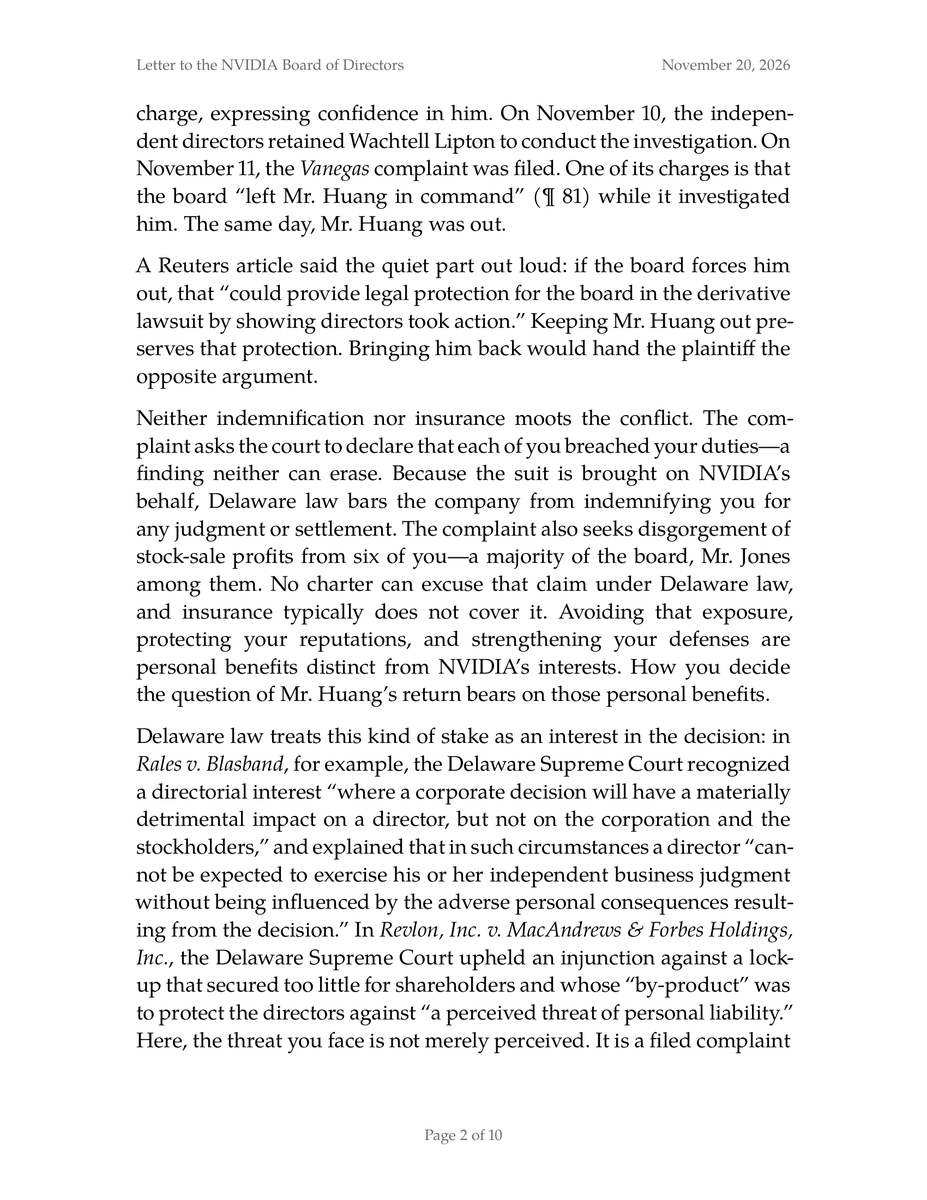
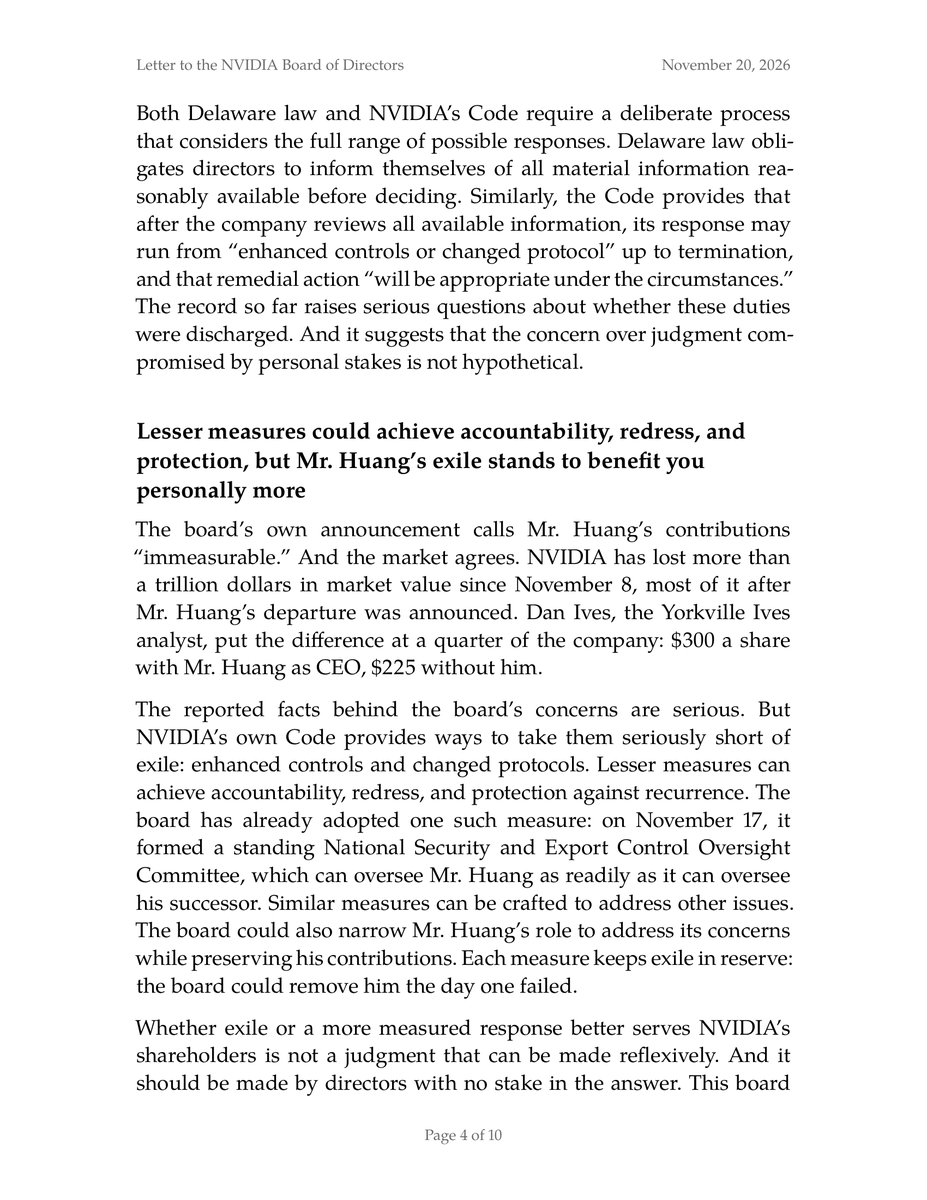
NVIDIA Board was conflicted at the time of Jensen’s resignation based on a November 11th lawsuit.
Takeaway: Keeping Huang out (or permanently sidelining him) tends to strengthen their defense against the suit. It generates evidence that the board can and did say no to him, directly rebutting the complaint’s core charge that they were too deferential. It also shows decisive action once the issue became public.
This is likely why they are adamant about keeping Jensen out. They are protecting their own skins. In the presence of this suit the board does appear to be conflicted, adding complexity to any return of Jensen. The letter below presents an approach for addressing that conflict.
Summary of the suit from Grok:
The lawsuit names all ten then-sitting outside directors personally as defendants. It accuses them of breaching fiduciary duties by, among other things:
• Consciously disregarding red flags about Huang’s intimate relationship with Alice Huang, a senior executive at Megaspeed (a major NVIDIA customer under U.S. Commerce Department investigation for allegedly diverting NVIDIA chips to China, and a person U.S. officials reportedly viewed as a Chinese intelligence asset).
• Failing to investigate the relationship, impose restrictions, require disclosures under NVIDIA’s Code of Conduct, or address the national-security and export-control risks, despite public reporting in 2025–2026.
• Deferring excessively to Huang (including resisting a CEO succession plan and leaving him in control after he admitted the relationship on November 8, while the board announced an investigation but publicly said it had “no reason to believe” secrets or national security had been compromised).
• Allowing misleading public statements that Huang’s interactions with Alice Huang / Megaspeed were ordinary or “normal and not unusual.”
Some directors are also accused of insider trading while the stock was allegedly inflated by the omissions, netting roughly $2 billion. The suit seeks damages for NVIDIA, governance reforms, and other relief.
My letter to NVIDIA’s board.
In short, it asks the board to create a special committee of three new directors, elected by shareholders at a special meeting, to decide whether and under what conditions Jensen Huang should return—and to hire no permanent CEO until that committee decides.
The current board may be right. It may be wrong. What it cannot be is impartial. All ten sitting directors are defendants in a lawsuit that faults them for, among other things, deferring too much to Jensen. In that suit, they face personal, non-indemnifiable exposure. Keeping Jensen out stands to strengthen their defenses; bringing him back may undermine those defenses. A fiduciary should decline to decide an important question on behalf of his principal when one answer stands to benefit him personally more than the other.
In other words, in deciding whether to reinstate Jensen, each current director faces two questions: (1) How will this affect NVIDIA? (2) How will it affect me personally and my own defense in the pending lawsuit? Given what is at stake, shareholders deserve a decision from directors who face only the first question.
Stepping aside is also what NVIDIA’s own Code of Conduct calls for. The Code covers potential conflicts as well as actual ones and directs that when one arises, “we immediately remove ourselves from any decision-making role in the matter.”
When the board’s chair explained Jensen’s departure, he cited “personal behavior inconsistent with the company’s code of conduct.” The board must now apply the same Code to itself.
(1/3)