🚀 PhD Position (100%) | Cross-platform Social Media Mining
We are looking for a doctoral candidate for a project at the intersection of computational social science, communication science, and AI on group-specific disinformation in the digital space.
https://t.co/YffDStP6tL
Join us at BeyondFacts 2026—the 6th International Workshop on Computational Methods for Online Discourse Analysis—collocated with @TheWebConf.
📅Submission deadline: 18 December 2025.
👉 https://t.co/ndYTstXXxD
w/ @stefandietze@pavlos098 Konstantin Todorov
#TheWebConf2026
Some aspects of AI discourse seem to come from a different planet, oblivious to basic realities on Earth. AI for science is one such area. In this new essay, @sayashk and I argue that visions of accelerating science through AI should be considered unserious if they don't confront the production-progress paradox.
=========
AI leaders have predicted that it will enable dramatic scientific progress: curing cancer, doubling the human lifespan, colonizing space, and achieving a century of progress in the next decade. Given the cuts to federal funding for science in the U.S., the timing seems perfect, as AI could replace the need for a large scientific workforce.
It’s a common-sense view, at least among technologists, that AI will speed science greatly as it gets adopted in every part of the scientific pipeline. But many early common-sense predictions about the impact of a new technology on an existing institution proved badly wrong. The Catholic Church welcomed the printing press as a way of solidifying its authority by printing Bibles. The early days of social media led to wide-eyed optimism about the spread of democracy worldwide following the Arab Spring.
Similarly, the impact of AI on science could be counterintuitive. Even if individual scientists benefit from adopting AI, it doesn’t mean science as a whole will benefit. When thinking about the macro effects, we are dealing with a complex system with emergent properties. That system behaves in surprising ways because it is not a market. It is better than markets at some things, like rewarding truth, but worse at others, such as reacting to technological shocks. So far, on balance, AI has been an unhealthy shock to science, stretching many of its processes to the breaking point.
Any serious attempt to forecast the impact of AI on science must confront the production-progress paradox. The rate of publication of scientific papers has been growing exponentially, increasing 500 fold between 1900 and 2015. But actual progress, by any available measure, has been constant or even slowing. So we must ask how AI is impacting, and will impact, the factors that have led to this disconnect.
Our analysis in this essay suggests that AI is likely to worsen the gap. This may not be true in all scientific fields, and it is certainly not a foregone conclusion. By carefully and urgently taking actions such as those we suggest, it may be possible to reverse course. Unfortunately, AI companies, science funders, and policy makers all seem oblivious to what the actual bottlenecks to scientific progress are. They are simply trying to accelerate production, which is like adding lanes to a highway when the slowdown is actually caused by a toll booth. It’s sure to make things worse.
Contents
1. Science has been slowing — the production-progress paradox
2. Why is progress slowing? Can AI help?
3. Science is not ready for software, let alone AI
4. AI might prolong the reliance on flawed theories
5. Human understanding remains essential
6. Implications for the future of science
7. Final thoughts
Full essay (about 6,500 words) https://t.co/aycitbnKzW
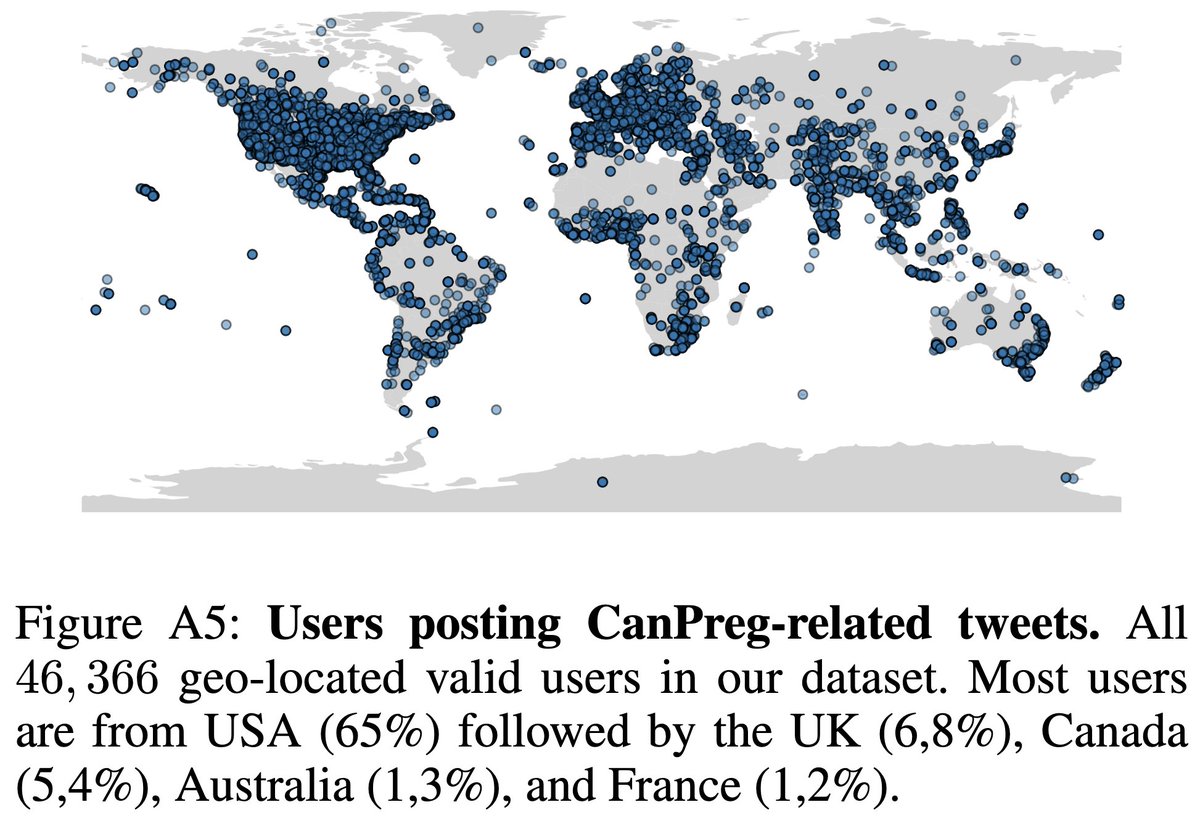
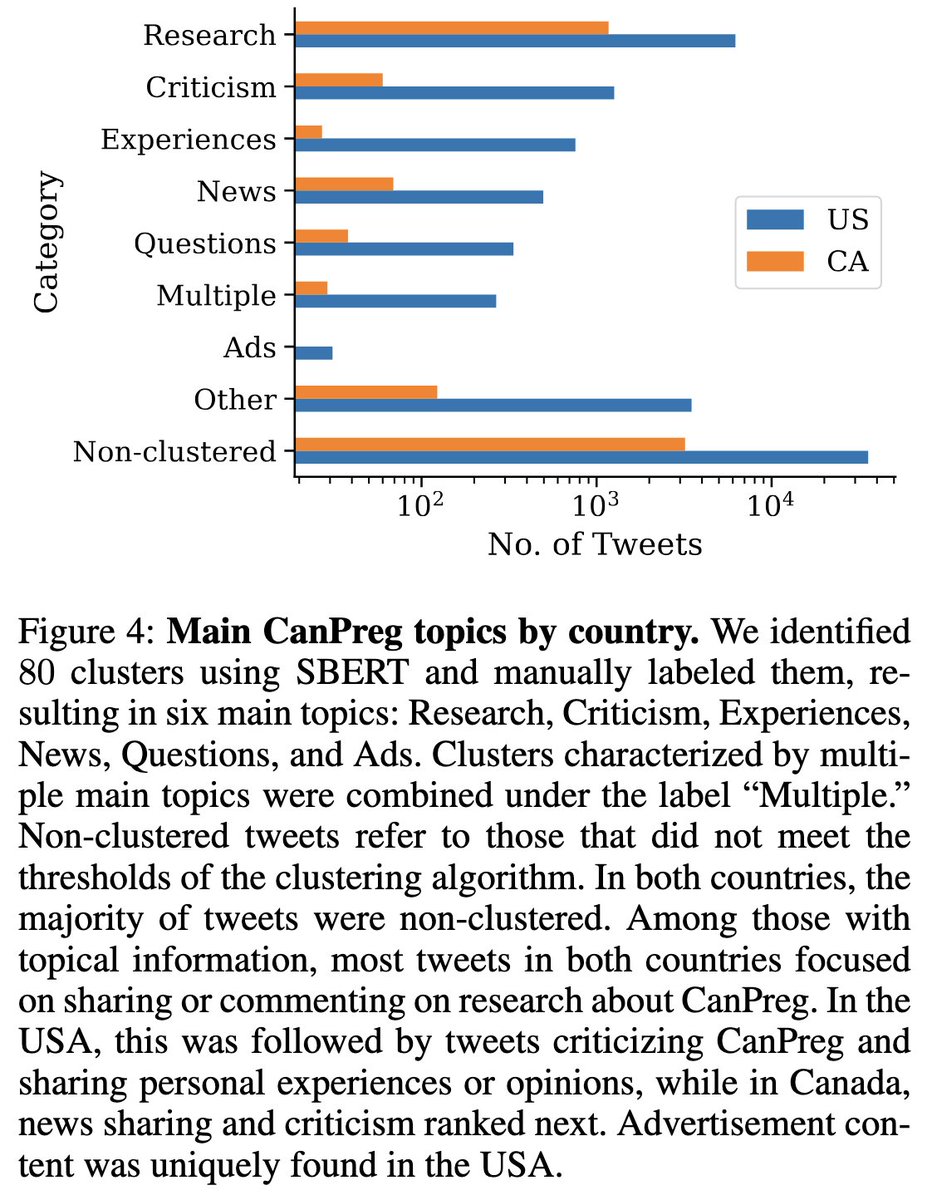
With Nikou Farsiu (@CSHVienna summer intern 2024), @MartonKarsai and @djcorsi, we explored a decade of online conversations about cannabis use during pregnancy on Twitter in USA and Canada. Coming to @icwsm 🌿🤰🏽
🎉 My colleague Dimitar Dimitrov (@trovdimi) and I are heading to ICWSM 2025 in Copenhagen 🇩🇰 to present our poster on
TeleScope: A Longitudinal Dataset for Investigating Online Discourse and Information Interaction on Telegram
Come 💬 with us!
#ICWSM2025#GESIS
🏆💥 Our work "Topo Goes Political: TDA-Based Controversy Detection in Imbalanced Reddit Political Data" received Best Paper Award at BeyondFacts https://t.co/bjEQqMJl4g @TheWebConf
📜Paper: https://t.co/pTS5RFJMIY
X 🧵 https://t.co/8XOcVmyKhl
#TheWebConf2025#ProfGiri
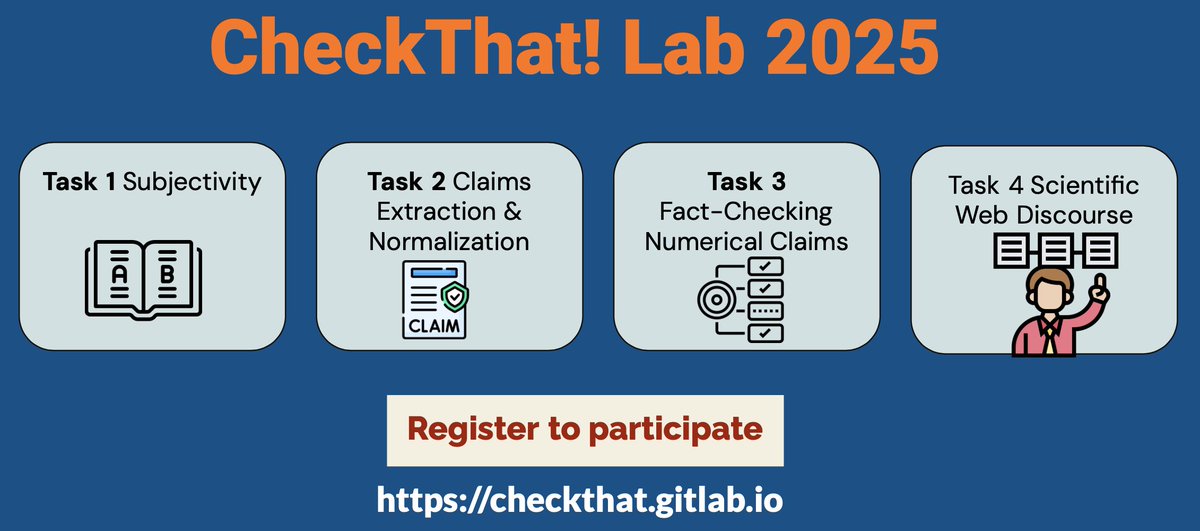
🚀 Registration for CLEF 2025 Labs is NOW OPEN! Don’t miss your chance to participate in this year’s CheckThat! Lab, where we tackle some of the most critical challenges in fact-checking and information verification.
🔥 Why Join CheckThat! Lab?
This year, we bring you four cutting-edge tasks designed to advance the boundaries of Natural Language Processing and Multilingual Fact-Checking:
🔍 Task 1: Subjectivity
Detect subjective text and pave the way for a refined fact-checking pipeline.
🌍 Languages: Arabic, English, Bulgarian, German, Italian, and Multilingual
✏️ Task 2: Claims Extraction & Normalization
Simplify and normalize social media claims across 20 languages!
🌍 Languages Include: English, Arabic, Hindi, Spanish, Thai, and more
📊 Task 3: Fact-Checking Numerical Claims
Verify numerical claims.
🌍 Languages: Arabic, English, Spanish
🔬 Task 4: Scientific Web Discourse
Classify online scientific discourse and retrive the mentioned paper from a pool of candidate papers
🌍 Language: English
🎓 Who Should Join?
Researchers, students, and professionals in NLP, AI, and fact-checking eager to make an impact.
👉 Register Now: https://t.co/B99pcsvhuP
👉 Learn More: https://t.co/Y9cjAEEOR9
👉 Access Data & Code: https://t.co/JdyN8RaMPK
🗓️ Key Dates to Remember:
November 2024: Registration opens
December 2024: Training materials released
April–May 2025: Evaluation cycle
#MeetTheExperts#mte
New #video on #YouTube: Meet our experts @MattEagle09 and @trovdimi who present the new service "Web Data for the Social Sciences" with three key components: 1) Data Collection, 2) Data Offers, and 3) Community Engagement
https://t.co/GVFKNDF862
Big Milestone for TweetsKB & the GESIS 1% Random Sample #TwitterArchive!
The 1% random sample #Twitter archive we host at GESIS now contains more than 14B tweets in 80+ languages, collected over 10+ years—until the public Twitter API closure in June 2023: https://t.co/VNs8YCSBph
We just opened a new team leader position at the Computational Social Science department at @gesis_org please spread the news and contact me or @SebStier for questions https://t.co/dpr853QUel
Exciting position as team lead & senior researcher working on computational social science methods and infrastructures based on #NLP, #machinelearning and #bigdata at #KTS department @gesis_org in Cologne. Details at https://t.co/aQacR09X6j. PM me for questions. @HeiCAD_HHU
My colleague Stephan Linzbach will be presenting our latest paper /w Laura Kallmeyer, Kilian Evang, @hajiraajabeen , and @stefandietze at #NAACL2024 in 🇲🇽 Mexico City this week! Meet him at the in-person poster session 3 on June 17th at 4 pm.
Paper: https://t.co/U3CAOlvP5W
Exciting senior researcher position in #KTS department at @gesis_org at the intersection of computational social science and #nlp. Tenure options available. Contact me or @hajiraajabeen for details. https://t.co/ArqjJvfS8u @HeiCAD_HHU @trovdimi @GabriellaLapesa
@alenyshkaxx Thanks, Olga! I was not able to attend, but Susmita Gangopadhyay who is working hard on our Telegram data collection is at the conference. Feel free to reach out! 😊
@trovdimi hey, we couldn't locate you. Who is distributing the advertisement? 😂
I will leave this here too. For those interested, please, follow the QR-codes.
#WebSci24
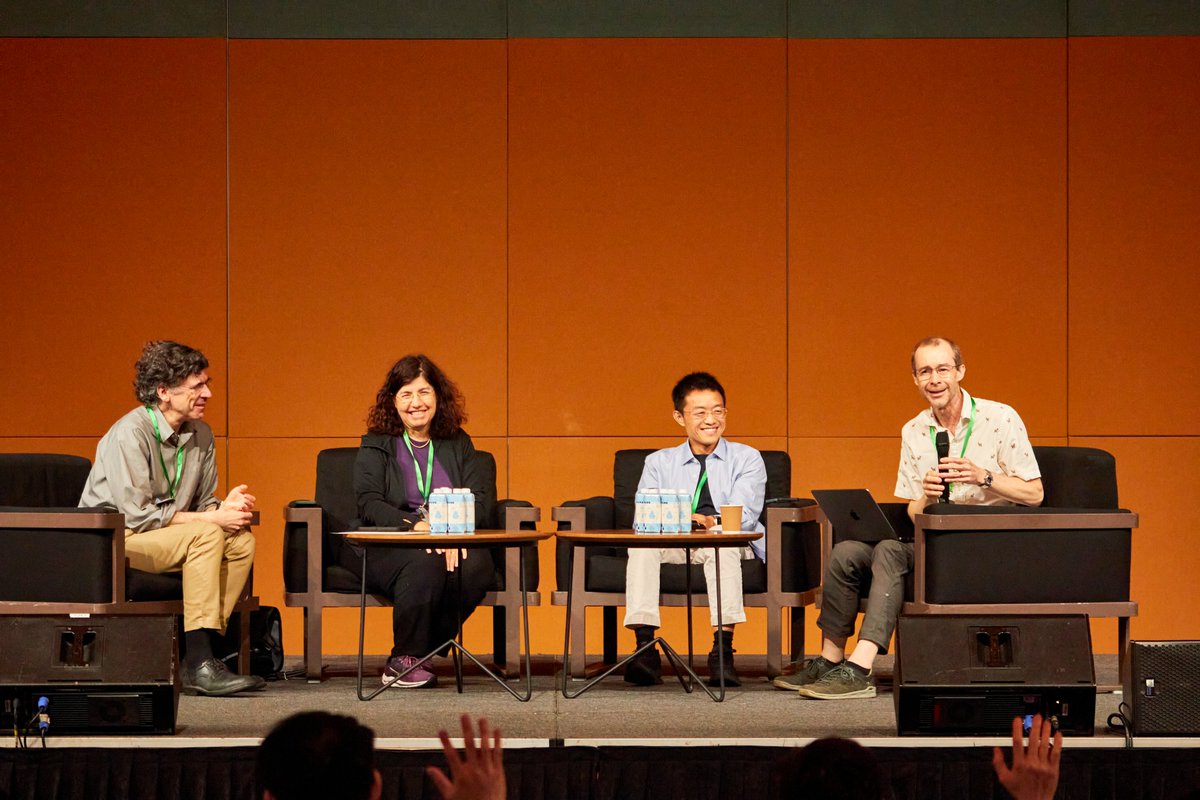
#TheWebConf24: Day 3 of The ACM Web Conference on May 15, 2024. After the Opening Ceremony and a keynote by Jie Tang and Bo Zhang, we broke into seven parallel sessions and posters, before coming together again for a panel discussion on LLM Impact on the Web.