Facial reconstructions of 2,700-year-old Hurro-Urartian women from Van and Urmia
The Hurro-Urartians were an ancient people who inhabited parts of Anatolia, the Levant, Mesopotamia, and the Zagros Mountains.
The Urartian individual was a noblewoman from Chavushtepe in eastern Turkey, also known as Sardurihinili. The site is located approximately 25 kilometers southeast of Van. Sardurihinili consists of fortification walls and the remains of an Urartian royal palace, built between 764 and 735 BC during the reign of King Sarduri II, at the height of the Urartian Empire's power.
According to Assyrian sources from the 9th–8th centuries BC, the state of Urartu gradually emerged in the Armenian Highlands. Early texts mention the "lands of Uruatri," a tribal confederation that resisted Assyrian expansion and was linked to the Hurrians and Subarians. Urartu was a vast but ethnically diverse state that united many peoples by force; the Urartians themselves likely constituted only the ruling elite. During the Iron Age, the Urartians became a major regional power. The territory of the Kingdom of Urartu encompassed parts of present-day Turkey, Iran, Iraq, and Armenia. They were closely related to the Hurrians and spoke a language belonging to the same family. The Urartians were a sophisticated people, renowned for their craftsmanship, military prowess, and durable fortifications that have withstood the test of time. Urartu was also noted for its military campaigns against neighboring states.
The second individual, also known as "SK59", was found in Hasanlu, an archaeological site of an ancient city located in northwestern Iran, in the province of West Azerbaijan, just south of Lake Urmia.
The settlement was likely associated with the Mannaeans, a people inhabiting the region who likely spoke a Hurrian language. The site is best known for its catastrophic destruction. At the end of the 9th century BC, Hasanlu was violently sacked and burned, preserving a single moment in time much like Pompeii. Buildings, artifacts, and even human remains were sealed beneath layers of ash and collapsed debris. The attackers were most likely the Urartians.
Excavations uncovered the remains of more than 285 people, many of whom were killed during the assault or executed afterward. Several bodies showed signs of mutilation, while the positions of others revealed desperate attempts to escape. Among the thousands of objects discovered in situ were weapons, ornaments, and household items, all abandoned amid the chaos. This destruction layer is one of the most important archaeological contexts of the early Iron Age Near East. Following the devastation, the city's High Mound was repurposed as the site of a Urartian fortress.
Reconstructions commissioned by @shoresh03
“The deportation began some six weeks ago with 180 families from Zeitoun, since which time all the inhabitants of that place and its neighbouring villages have been deported. . .”*
8 June 1915: As 1000s of Zeytun Armenians are deported, Ottoman govt renames the town Süleymanlı.
Modern Armenians are essentially an amalgamation of the Urartian & Etiuni (Armenia MLBA) components, with statistically more weight toward the Urartian end of admixture. The minor differences between the Eastern and Western Highlands is fascinating.
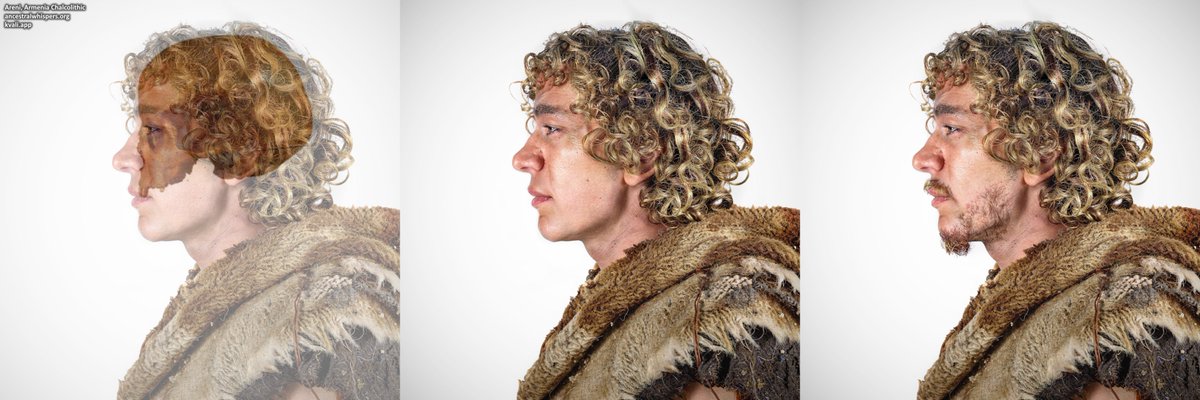
Facial reconstruction of a 6,000-year-old man from Areni, Armenia
Areni-1 Cave, is the site of the world’s oldest known winery. Excavations begun in 2007 uncovered Chalcolithic-era vessels, some containing adolescent skulls, along with evidence of ancient winemaking facilities such as fermentation vats, wine storage jars, and grape remains.
The cave’s stable temperature and low humidity preserved remarkable organic finds, including the world’s oldest known leather shoe. The 5,500-year-old shoe, 24.5 cm long (European size 37), made for the right foot, was crafted from a single piece of leather. Its laces also survived. The shoe had been stuffed with grass, probably to help maintain its shape. It remains unclear whether the shoe belonged to a man or a woman. Straw skirt and fragments of a human brain were also found in the cave.
According to some specialists, nobody actually lived inside the cave, and wine consumption there was ritualistic in nature. Some cave finds suggest that the local wild tribes practiced ritual cannibalism. Deep within Areni Cave, near food storage containers, archaeologists discovered the remains of children and adults buried in clay pots, which were relatively well preserved. Three skulls belonged to young individuals died most likely from whip blows. According to one expert, researchers proposed a working hypothesis that parts of the sacrificed bodies were eaten by participants in a religious ritual. In this way, they believed they were communicating with the world into which the innocent victims had passed.
The reconstructed individual was 18 ± 3 years old. He had a medium cranial length of 177.5 mm, a medium-large cranial width of 145 mm, and a very narrow face/bizygomatic breadth of 113 mm. His nasomalar and zygomaxillary angles - 141° and 135° - were on the higher end of Caucasoid ranges and closer to Mongolid values. The individual was brachycephalic.
In craniological samples from the Bronze and Iron Ages of Armenia, no cases of brachycrania had previously been encountered (A. Yu. Khudaverdyan, B. Z. Gasparyan, R. Pinhasi, A. S. Kananyan, N. A. Hovhannisyan, 2017).
Genetically, all sampled male individuals from Areni-1 Cave belonged to Y-DNA haplogroup L1a1. Their mtDNA lineages included K1a8 and H2a1. Autosomally, they were predominantly of Mesopotamian ancestry, with some Steppe Eneolithic ~25% or Nalchik-related ~ 40% admixture, the source of which is not yet fully understood. They also carried genes associated with light hair and blue eyes. Older Neolithic individuals from Azerbaijan with fully Mesopotamian ancestry, such as those from Polutepe and Mentesh Tepe, likewise carried genes for light hair and blue eyes.
These people were later succeeded by the Kura-Araxes culture, which is associated with Northeast Caucasian speakers.
This is the Hurrian Hymn, the oldest preserved song ever recovered, dating to ~1400 BC & discovered in Ugarit, now in Latakia governorate, Northern Syria. It's in a roughly diatonic scale with a modal framework not unlike folk melodies from Armenia as Tigran Hamasyan explored.
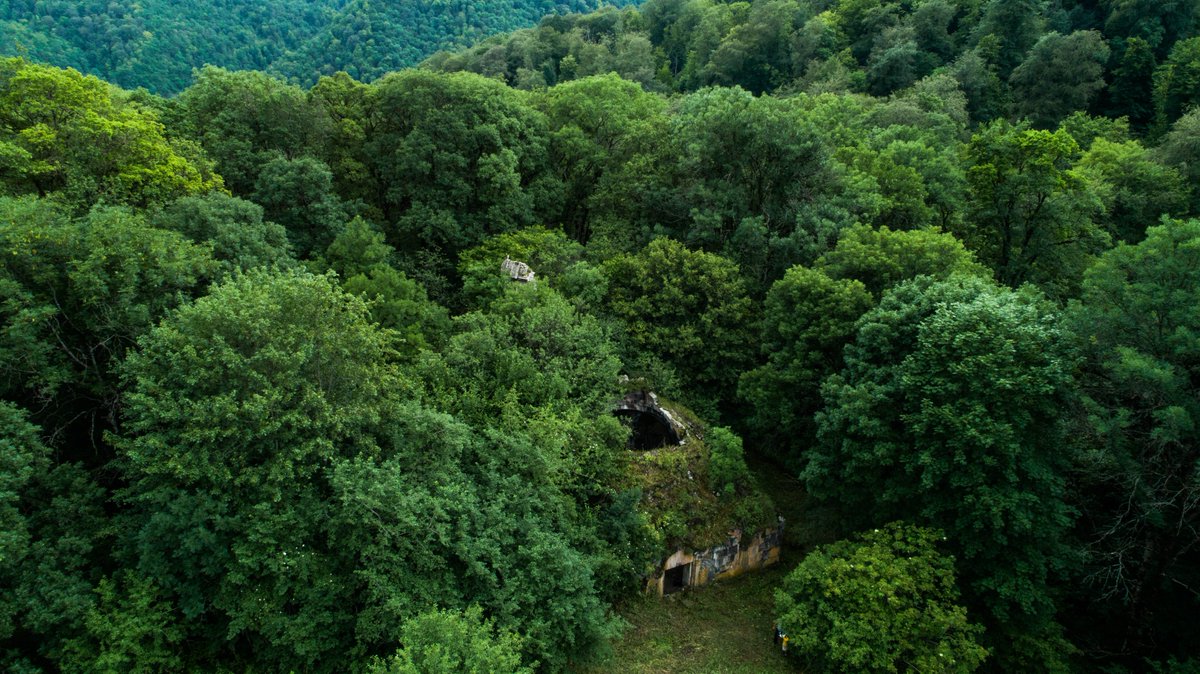
Zvartnots Cathedral is located in the Ararat valley, 3km south of Echmiadzin, Armenia 🇦🇲. This historical site once was a famous place of worship in the pre-Christian period. During the excavations, the foundation of an Urartian temple was revealed, as well as an altar for sacrifice and a cuneiform inscription of King Rusa II, which testifies the construction of the Hrazdan River canal were found.
The ancient pagan temple was dedicated to Tir - the God of written language and schooling. After adopting Christianity the pagan temple was turned into a Christian church. Supposedly Zvartnots temple was built between 643-652 AD.
According to historian Sebeos, the name of the cathedral is derived from the old Armenian word "Zvartun" which means “an angel”. Thus the temple was called “a cathedral of angels”. Perhaps the name of the cathedral was connected with its architectural style, as the abundance of sunlight entering through a multitude of windows made an impression that angels flew into the windows.
Interestingly only Sebeos names the cathedral “Zvartnots”. In all the other records it is mentioned as St. Grigor. The temple stood until the end of the 10th century and was most likely destroyed by an earthquake. Until the excavations in 1901 the ruins of the cathedral were covered in the ground.
Zvartnots Cathedral was a unique architectural structure of impressive dimensions. Instead of cross-domed or basilica type structure characteristic of the period, Zvartnots introduced an entirely new style. It had three levels and the central dome rested on one complete circle. It was also one of the tallest structures of its time (45-49m).
In 1989 the cathedral was included in the UNESCO World Heritage List.
#archaeohistories
“. . .an effort is being made to stamp out the Armenians.”
“Young Turks around Tarsus are trading Armenian girls for horses and modern repeating rifles.”
7 May 1909: Various US news outlets* report on Adana massacres of Armenians; Vali and other Turkish officials are accused of “showing the most criminal indifference.”
*Incl. Jasper Weekly Courier (Ind.); Putnam County Courier (N.Y.); Cooper Review (Tex.)
Right…
“Eastern Anatolia” a 20th century term used to replace Western Armenia and had been majority Armenian for millennia.
Kurds began arriving as settlers in the 16th century and only became a majority after assisting the Turks in the Armenian Genocide.
Stay in school.
Inevitably in a country with an architectural tradition in stone dating back to Urartian times, the craftsmen who so carefully carved blocks of stones for walls, fortresses, and sanctuaries had acquired the skill to sculpt stone as relief decorations for buildings or as independent works of art. Little sculpture has survived, however, from the pre-Christian period because of the excessive zeal of St. Gregory and the newly convert royal court of Armenia in destroying all vestiges associated with earlier pagan religions. The major exception is a series of extremely large carved monolithic stones found in various parts of Armenia and often associated with water sources. They resemble large tailless whales. On them are fish-like designs, but they are know as vishap-k'ar, dragon stones. They date from 2nd-1st millennia BC.
Excavations have uncovered a miscellany of sculptures from the Artaxiad and the Arsacid periods, roughly 2nd Century BC to 4th Century AD. The famous bronze head of Aphrodite, found at Satala near Erzinjan, now in British Museum, or the small female torso in white marble dug up at Armavir, testify to popularity of Hellenistic sculpture in Armenia. Other stone heads, anonymous but no doubt of Armenian nobility, display a static pose far removed from classical style. Nearly a dozen boundary markers of king Artaxias I (Artashes) from early 2nd Century BC have also been uncovered in various areas of Armenia, but these are more important for their Aramaic inscriptions than for their art. Temple of Garni from 1st Century AD offers an enormous repertory of sculpted lion heads, acanthus friezes and geometric and floral reliefs associated with Ionic order of Hellenistic temple architecture.
There is a relative paucity of wooden and ivory sculpture perhaps because these materials were precious commodities in Armenia in historical times; furthermore, stone, especially the easily carved tufa, was very plentiful. The most important piece of ivory carving preserved in Armenia is the binding, with upper and lower plaques, each in five fitted sections, of Etchmiadzin Gospels. These were probably carved in 6th Century in Byzantine workshop and later imported into Armenia. The upper cover shows shows the Virgin with Christ with scenes from her life, including the Presentation of the Magi at the bottom. The lower cover has a beardless Christ in the central panel with scenes from His life.
There are also a number of finely carved ivory bishop's crosiers often with twin dragon heads. Wood was a much more fragile medium than stone or metal and much of what must have been produced has been burned or otherwise destroyed. We know, however, that wood carving was as favored a craft in ancient times as it is today in modern Armenia.
What remains of sculpted or carved wood from medieval Armenia are church doors, capitals used on columns of a 9th Century church, an important carved plaque of the Crucifixion, and a few miscellaneous items including lecterns. Most important carved wooden doors are dated by inscriptions: 1) 1134, double paneled door, Monastery of the Holy Apostles, Mush, now in Erevan, Armenian Historical Museum; 2) 1176, single panel door, Monastery of the Holy Apostles [ 26], Sevan, Erevan, Armenian Historical Museum; 3) 1253, single panel door, Monastery of Tat'ev; 4) 1327, double paneled door, Church of the Nativity, Jerusalem; 5) 1355/6, double paneled door, entrance to Chapel of St. Paul, Armenian Patriarchate, Jerusalem; 6) 1371, double-paneled door, from Armenian church in Crimea, now in the Hermitage, Leningrad; 7) 1486, single panel door, Church of Holy Apostles, Sevan, now in Erevan, Armenian Historical Museum. Borders or frames of all of these are covered with geometric bands or vine scrolls. Those of Mush show mounted warriors at top either fighting or hunting exotic animals; on sides there are rows of animals, too.
📷 : One of doors of 9th Century AD, Sevanavank Monastery Complex, Armenia.
#archaeohistories
THE ARMENIAN-GREEK PAPYRUS
The Armenian-Greek Papyrus is a papyrus found in Egypt in the late 19th century containing Greek text in Armenian letters. Dating from between the 5th and 7th centuries, it is the oldest surviving manuscript and the only papyrus written in Armenian script, leading it to be sometimes referred to simply as the "Armenian Papyrus."
The papyrus was acquired in the late 19th century by the French scholar Auguste Carrier from an Arab merchant. The merchant did not disclose the origin of the papyrus, but Carrier believed it was found during excavations in El Fayum. In 1892, he reported the discovery to the Armenian Mekhitarists in Vienna and Venice, sending a photograph of part of the papyrus.
The Mkhitarists actively engaged in its study: the first fragments of the text were published by G. Alishan in 1892, and in 1897-1898, articles by Ya. Tashyan appeared exploring the manuscript's significance for Armenian paleography. These early studies were published in Armenian and remained inaccessible to the international community.
In the 1930s, the discovery attracted the attention of the Swiss Armenologist Georges Couendé, the Belgian linguist Maurice Leroy, and the papyrologist Claire Préaud, but the papyrus had by then been lost. Unable to locate the original, they began studying the text from Carrier's photographs and published the first results of their decipherment.
In 1993, the papyrus was "rediscovered" in the Oriental Manuscripts Collection of the Bibliothèque Nationale de Paris by the American scholar Dikran Kouyoumdjian. There, Kouyoumdjian also discovered a complete transcription of the text, apparently made by Carrier. This time, the manuscript attracted the attention of broad academic circles. Kouyoumdjian and the British linguist James Clackson undertook a detailed study of the text.
Given that the manuscript was clearly written in Byzantine Egypt, the latest possible date (terminus ante quem) should be considered to be 640 (the Arab conquest of Egypt). A natural lower limit for the dating (terminus post quem) is the invention of the Armenian alphabet (c. 400). A more precise dating of the papyrus is fraught with certain difficulties.
The meager Armenian manuscript heritage of the 5th-7th centuries does not allow for definitive conclusions based on paleographic data. The contents of the papyrus also provide no information about the time of its composition.
However, comparing it to early medieval inscriptions, Kouyoumdjian concluded that the papyrus's letterforms are most similar to those of fifth-century inscriptions, and proposed dating the papyrus to the late fifth or sixth century. Klaxon's linguistic research also supports this earlier dating.
And a special spotlight for Armenia’s love of France and Macron, guy is living like a rockstar in Armenia.
Fun fact: Armenia’s last kings were of mixed Armenian-French ancestry, and Armenia’s last King, Levon V, is buried in Saint Denis Basilica, alongside the Kings of France.
the phrase "crimes against humanity" was first used in international diplomacy in May 1915 in a joint declaration by Russia, Britain, France as reports of Armenian massacres emerged












![archeohistories's tweet photo. Inevitably in a country with an architectural tradition in stone dating back to Urartian times, the craftsmen who so carefully carved blocks of stones for walls, fortresses, and sanctuaries had acquired the skill to sculpt stone as relief decorations for buildings or as independent works of art. Little sculpture has survived, however, from the pre-Christian period because of the excessive zeal of St. Gregory and the newly convert royal court of Armenia in destroying all vestiges associated with earlier pagan religions. The major exception is a series of extremely large carved monolithic stones found in various parts of Armenia and often associated with water sources. They resemble large tailless whales. On them are fish-like designs, but they are know as vishap-k'ar, dragon stones. They date from 2nd-1st millennia BC.
Excavations have uncovered a miscellany of sculptures from the Artaxiad and the Arsacid periods, roughly 2nd Century BC to 4th Century AD. The famous bronze head of Aphrodite, found at Satala near Erzinjan, now in British Museum, or the small female torso in white marble dug up at Armavir, testify to popularity of Hellenistic sculpture in Armenia. Other stone heads, anonymous but no doubt of Armenian nobility, display a static pose far removed from classical style. Nearly a dozen boundary markers of king Artaxias I (Artashes) from early 2nd Century BC have also been uncovered in various areas of Armenia, but these are more important for their Aramaic inscriptions than for their art. Temple of Garni from 1st Century AD offers an enormous repertory of sculpted lion heads, acanthus friezes and geometric and floral reliefs associated with Ionic order of Hellenistic temple architecture.
There is a relative paucity of wooden and ivory sculpture perhaps because these materials were precious commodities in Armenia in historical times; furthermore, stone, especially the easily carved tufa, was very plentiful. The most important piece of ivory carving preserved in Armenia is the binding, with upper and lower plaques, each in five fitted sections, of Etchmiadzin Gospels. These were probably carved in 6th Century in Byzantine workshop and later imported into Armenia. The upper cover shows shows the Virgin with Christ with scenes from her life, including the Presentation of the Magi at the bottom. The lower cover has a beardless Christ in the central panel with scenes from His life.
There are also a number of finely carved ivory bishop's crosiers often with twin dragon heads. Wood was a much more fragile medium than stone or metal and much of what must have been produced has been burned or otherwise destroyed. We know, however, that wood carving was as favored a craft in ancient times as it is today in modern Armenia.
What remains of sculpted or carved wood from medieval Armenia are church doors, capitals used on columns of a 9th Century church, an important carved plaque of the Crucifixion, and a few miscellaneous items including lecterns. Most important carved wooden doors are dated by inscriptions: 1) 1134, double paneled door, Monastery of the Holy Apostles, Mush, now in Erevan, Armenian Historical Museum; 2) 1176, single panel door, Monastery of the Holy Apostles [ 26], Sevan, Erevan, Armenian Historical Museum; 3) 1253, single panel door, Monastery of Tat'ev; 4) 1327, double paneled door, Church of the Nativity, Jerusalem; 5) 1355/6, double paneled door, entrance to Chapel of St. Paul, Armenian Patriarchate, Jerusalem; 6) 1371, double-paneled door, from Armenian church in Crimea, now in the Hermitage, Leningrad; 7) 1486, single panel door, Church of Holy Apostles, Sevan, now in Erevan, Armenian Historical Museum. Borders or frames of all of these are covered with geometric bands or vine scrolls. Those of Mush show mounted warriors at top either fighting or hunting exotic animals; on sides there are rows of animals, too.
📷 : One of doors of 9th Century AD, Sevanavank Monastery Complex, Armenia.
#archaeohistories](https://pbs.twimg.com/media/HHo2ki3asAAsaWX.jpg)





