🚨🚨🚨🚨Today the U.S. House passed the Sunshine Protection Act, advancing legislation that would make Daylight Saving Time permanent nationwide.
This is the biggest legislative step this issue has taken in years but it is not law.
The bill now moves to the U.S. Senate, where there is still an opportunity for it to be debated, amended, or rejected. If you care about health and circadian biology, this is the time to speak up.
The scientific case against permanent DST has become increasingly strong:
• Morning light is the most powerful signal for synchronizing the human circadian clock.
• Permanent DST delays sunrise for much of the year, especially in winter, reducing exposure to morning light when our brains need it most.
• Later sunrises are associated with chronic circadian misalignment, sleep loss, poorer mood, reduced alertness, and increased cardiometabolic risk.
• Studies comparing western versus eastern portions of time zones consistently show worse health outcomes where people experience later sunrises despite sharing the same clock time.
• The American Academy of Sleep Medicine and numerous sleep and circadian experts recommend permanent Standard Time, not permanent DST, as the option that best aligns with human biology.
The argument for permanent DST is largely one of convenience and preference for lighter evenings. The argument for permanent Standard Time is one of physiology and public health.
If you believe our laws should reflect the best available scientific evidence, now is the time to respectfully contact your U.S. Senators. Tell them that while ending the twice-yearly clock changes is a worthy goal, permanent Daylight Saving Time is not the healthiest solution. Ask them instead to support permanent Standard Time, which preserves the morning light our circadian system depends on.
Please REPOST this. The Senate has not yet voted, and informed voices can still make a difference.
@LeaderJohnThune is the Senate majority leader that will determine when this legislation comes to the Senate for debate. He should know how you feel.
@TechOperator I was fortunate to learn in my 30s that I wanted to to only work to live, not live to work. No more climbing the ladder, running the rat race. Now I work from home in my forest oasis. ❤️🌲🏡🌳
@rhensing This same thing has been happening at my house for months. He wakes me up at my bedroom window every morning and then goes to the storm door on the front porch. I wondered what he was trying to tell me even before seeing the movie. 😱 Will keep an open mind and heart and wait...
Life with ALS or a spinal cord injury often means navigating a gradual or sudden loss of independence.
Neuralink aims to restore autonomy to those with unmet medical needs—starting with device control and communication, and expanding toward vision and other applications.
He drives a school bus in Dallas, Texas. But the kids on his route call him something else — Dad.
Every morning before the sun is fully up, Curtis Jenkins pulls his yellow school bus to the curb and waits. Not just to pick up kids. To see them.
For seven years, Curtis noticed things other people missed. The little girl who folded her paper lunch bag perfectly every day but left it on the bus — because there was nothing inside. The boy whose shoes were too small. The kids who got on quiet, eyes down, carrying weight no child should have to carry alone.
So Curtis did something simple. He made his bus a community.
He gave every child a job — a greeter, an assistant, a "police officer" keeping order in the aisles. Every morning he'd call out, "We're going to care about each other and love everybody, right?" And 50 small voices would answer back.
But it didn't stop there.
Over the years, Curtis spent thousands of dollars of his own money — money he saved by skipping his own Christmas gifts with his wife — on birthday cards, bikes, backpacks, turkeys at Thanksgiving, and 70 hand-wrapped Christmas presents. He didn't buy random gifts. He asked each child what they wanted. Then he went and got exactly that.
No donation page. No announcement. No cameras.
When the story finally got out and people questioned how a bus driver could afford it, Curtis just smiled.
"It doesn't take money. It takes discipline."
But here's the part that will stay with you.
When a reporter asked the kids what they loved most about Curtis — not one of them mentioned the gifts.
A fifth grader named Ethan, whose parents had divorced when he was four, looked up and said quietly:
"He's the father that I always wanted. In some ways, I wish my dad could have been like that."
Curtis heard it. Didn't flinch. Just nodded.
"That's the paycheck right there," he said later. "If I can get that, you can keep the money."
He wasn't looking for a medal. He wasn't going viral on purpose. He was just a man who decided, every single morning, that his bus would be the safest place those kids walked into all day.
Sometimes the person who changes a child's life forever isn't a teacher or a coach or a counselor.
Sometimes it's the person behind the wheel of a yellow bus at 7 a.m. — who chose to show up, and chose to care, when nobody was asking him to.
Tag someone who needs to read this today. 💛
Given that I have built two companies in widely different fields to trillion dollar plus valuations simultaneously, I am might be getting a few things right once in a while
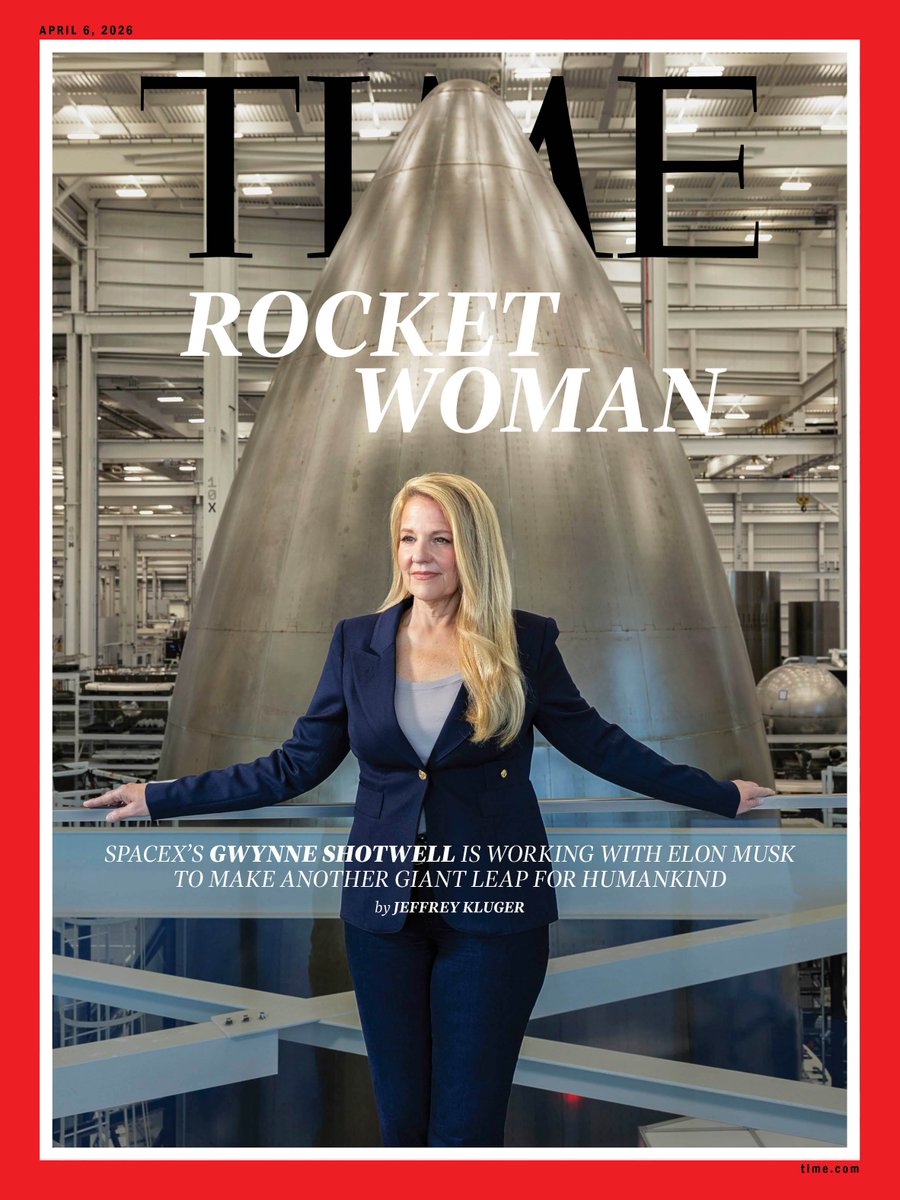
TIME’s new cover: SpaceX is racing to build its most powerful rockets yet with the goal of returning humans to the moon. Gwynne Shotwell is leading the charge alongside Elon Musk. Read it here: https://t.co/b4Wb6H6BTQ