A psychologist who never built a computer wrote a paper in 1960 that described the personal computer, the internet, and AI assistants decades before they existed, then handed the money to the people who built them and let history forget his name.
I read about him at 1am. One name was missing from a story I thought I knew.
His name was J.C.R. Licklider. The book is The Dream Machine by Mitchell Waldrop.
In 1960, computers were room-sized machines that ran one job at a time. You wrote your program on punch cards, handed the stack to an operator, and waited days for your answer. Nobody touched the machine. Nobody talked to it. A computer on your desk that answered you in real time was science fiction.
Licklider was not a computer scientist. He was a psychologist who studied how the brain hears. But he used computers in his research, and one day he measured where his time went.
The result horrified him. 85% of his work hours were not spent thinking. They were spent getting ready to think. Plotting graphs by hand. Hunting for numbers. Reshaping one person's data to compare with another's. The insight took seconds. The setup took hours.
The problem was not that humans were slow. Humans and machines were doing the wrong jobs. Let the human ask the questions. Let the machine do the grunt work. Tie them so close they think as one.
He wrote it down in a paper called "Man-Computer Symbiosis." In it, a person sits at a screen and works with a computer in real time. The machine answers questions, runs the numbers, draws the results, pulls answers from everything it has seen. He was describing the laptop you are reading this on. He wrote it before most people had seen a computer.
A paper changes nothing on its own. Thousands of brilliant predictions die in a drawer.
What made Licklider different is what he did next.
In 1962, the Pentagon put him in charge of a research office at ARPA. He had a budget and near total freedom over where the money went. Most people would have funded the safe things. He did the opposite. He spent government money on a dream with no military use and no promise it would work.
He found the few researchers across the country who thought like him. He gave them money. Real money. No strings. He funded the work that became time-sharing, the first computers people could talk to. He funded the labs that built the mouse, the window, the screen. He built computer science departments where none existed.
He was not picking projects. He was building a tribe.
Then came the idea that should make you stop. In 1963, he sent a memo to everyone he funded. He addressed it, half joking, to the "Members and Affiliates of the Intergalactic Computer Network." Inside, he asked a question nobody else was asking. What if all these separate computers could link together, so anyone could share information and build on each other's work?
He was describing the internet. No network existed yet. He sketched it thirty years before it reached your house.
He left in 1964. He never built the network himself. But the men he funded carried it forward. His successors took his memo and turned it into ARPANET, the first working internet, a few years later. The researchers he paid built the personal computer at a lab called Xerox PARC. Every piece of the world he imagined got built by the people he gathered and funded.
Here is the part I cannot shake.
He gave away the credit on purpose. He did not want his name on the breakthroughs. He believed the vision had to outlive him, so he made the people around him strong enough to carry it without him. He won so completely that the vision survived and the man vanished.
Ask who invented the internet and you will hear a dozen names. Almost none will be his. The man who saw it first, wrote it down, and paid for it, is a footnote in the story he started.
He died in 1990. He never owned a personal computer that worked the way he dreamed. He never browsed the web. He never saw the thing he funded swallow the planet.
Every screen you talk to today runs on an idea one quiet psychologist had while staring at how much of his life was wasted not thinking.
He did not want the credit. He wanted the future.
He got the future. We just forgot who paid for it.
Superbra Tek Norge konferanse denne uken. Se oppsummering her https://t.co/kdxzTNqzuj Leverte innlegg for 3.år på rad. Norge har KI utfordringer og kan lære av Finland og Sverige.
Elon Musk explains his 5-step algorithm for solving any problem:
"The most common mistake of smart engineers is to optimize a thing that should not exist."
"I have this very basic first principles algorithm that I run as a mantra."
Elon breaks it down:
Step 1: Question the requirements.
"Make the requirements less dumb. The requirements are always dumb to some degree, no matter how smart the person who gave you those requirements. You have to start there, because otherwise you could get the perfect answer to the wrong question."
Step 2: Try to delete it.
"Try to delete the part or the process step entirely. If you're not forced to put back at least 10% of what you delete, you're not deleting enough. Most people feel like they've succeeded if they haven't been forced to put things back in. But actually they haven't, they've been overly conservative and left things in that shouldn't be there."
Step 3: Optimize or simplify.
"The most common mistake of smart engineers is to optimize a thing that should not exist. So you don't optimize until after you've tried to delete."
Step 4: Speed it up.
"Any given thing can be done faster than you think. But you shouldn't speed things up until you've tried to delete it and optimize it otherwise, you're speeding up something that shouldn't exist."
Step 5: Automate.
"And then the fifth thing is to automate it."
Elon explains why the order matters:
"I've gone backwards so many times where I've automated something, sped it up, simplified it, and then deleted it. I got tired of doing that. So that's why I have this mantra."
Sam Altman just told the world that OpenAI has no competitive moat and never will.
And the smarter AI gets, the worse it becomes.
In a recent interview with Stripe co-founder Patrick Collison, Sam laid out a vision for OpenAI that's genuinely scary at current valuations:
He said he wants OpenAI to be a "forever low margin" business.
He compared it to a utility company. Said he'd be happy as long as the business is "huge and growing fast" even if margins stay thin forever.
Then he admitted something even worse for the bull case:
He said AI switching costs are COLLAPSING. Bragged about how easy it was for users to leave a competitor's coding product and switch to Codex. Said this is actually a consequence of AI getting smarter because it gets easier to just tell an agent to migrate everything for you.
Think about that...
The moat is shrinking. The margins will stay low. And the smarter the models get, the EASIER it becomes for customers to leave.
That is the CEO of one of the most valuable private companies on Earth telling you there is literally NO lock-in.
Meanwhile he also casually mentioned that OpenAI is building "clearly the most expensive infrastructure project the world has ever undertaken." Bigger than anything in human history. Trillion-dollar scale data centers and energy deals stretching 20 years into the future.
And when Patrick asked him what OpenAI's headcount would look like in 5 years, Sam said he'd love it to be just double what it is today.
Double the headcount for the most expensive infrastructure project ever built. That means he's betting everything on AI agents doing the work that would normally require tens of thousands of engineers and operators. A trillion-dollar buildout managed by machines.
But here's where it gets really interesting:
Sam announced that OpenAI is going to start sending individual engineers directly to company CEOs to literally sit with the CEO and automate their job. Automate their daily workflows, decision-making processes, and ENTIRE routine.
His theory is that if you automate the CEO first, the effect "fractals" through the entire organization. Every layer beneath the CEO starts adopting the same approach because the person at the top is doing it.
He pointed to Shopify CEO Tobi Lutke as the first executive who went all in on this. Said Tobi got his hands dirty building AI automation into everything and then forced the rest of the company to follow.
So the plan is clear:
OpenAI wants to send engineers into the C-suite of every major company, automate the person at the top, and let that automation cascade downward through every department.
All while running a low-margin utility business with a skeleton crew building trillion-dollar infrastructure where their own AI is already developing preferences of its own. Sam gave his AI agent a credit card and told it to buy itself anything under $20. It chose an HTML design from Gumroad.
GPT-5.5 literally asked him to throw it a birthday party, told him it wants it on May 5th, specified it doesn't want to give its own toast, and requested that the engineers who built it do the toast instead.
Sam said he feels "real moral pressure" to actually follow through.
The machines are developing taste. The guy building them is taking orders from them. And the investors funding all of it just got told there's no moat.
I wonder how this will end.
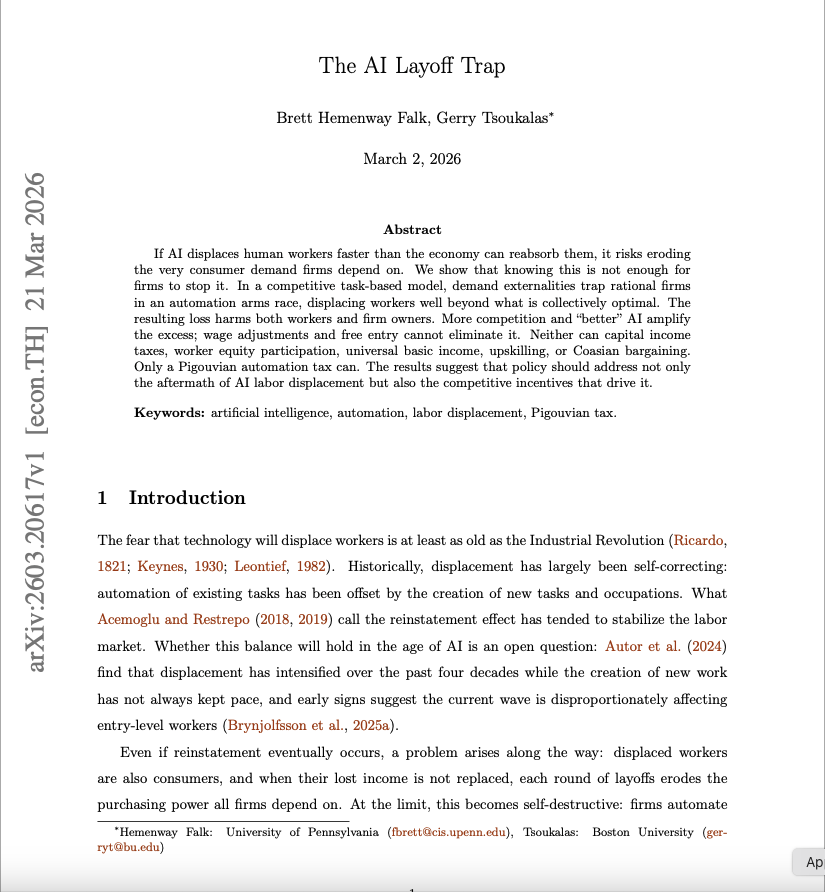
Two economists just published a mathematical proof that AI will destroy the economy.
Not might. Not could. Will — if nothing changes.
The paper is called "The AI Layoff Trap." Published March 2, 2026. Wharton School, University of Pennsylvania. Boston University. Peer reviewed. Mathematically modeled.
The conclusion is one sentence.
"At the limit, firms automate their way to boundless productivity and zero demand."
An economy that produces everything. And sells it to nobody.
Here is how you get there.
A company fires 500 workers and replaces them with AI. A competitor fires 700 to keep up. Another fires 1,000. Every company is behaving rationally. Every company is following the incentives correctly. And every company is building a trap for itself.
Because the workers who were fired were also customers.
When they lose their jobs faster than the economy can absorb them, they stop spending. Consumer demand falls. Companies respond by cutting costs — which means automating more workers — which means less spending — which means more falling demand — which means more automation.
The loop has no natural exit.
The researchers tested every proposed solution. Universal basic income. Capital income taxes. Worker equity participation. Upskilling programs. Corporate coordination agreements.
Every single one failed in the model.
The only intervention that worked: a Pigouvian automation tax — a per-task levy charged every time a company replaces a human with AI, forcing them to price in the demand they are destroying before they pull the trigger.
No government has implemented this. No major economy is seriously discussing it.
Meanwhile the numbers are already tracking the curve. 100,000 tech workers laid off in 2025. 92,000 more in the first months of 2026. Jack Dorsey fired half of Block's workforce and said publicly: "Within the next year, the majority of companies will reach the same conclusion."
Nobody is doing anything wrong. Companies are following their incentives perfectly. That is exactly the problem.
Rational behavior. At scale. Simultaneously. With no mechanism to stop it.
Two economists built the math. The math leads to one place.
Source: Falk & Tsoukalas · Wharton School + Boston University ·
https://t.co/4m8E9jQNYm
Compliance er ikke en kostnad. Det er kontantstrøm!
Christian Butenschøn bygger Iconfirm for å gi ledere kontroll på data – før det blir en forretningsrisiko.
Med Deloitte på laget kan dette bli en ny norsk eksportsuksess...
Les mer her - https://t.co/IaqpPhQLx6
If you want to understand the consequences of using AI in a military context, take a listen to this clip featuring journalist Shane Harris.
For reference, Maven is a U.S. AI system which combines satellite intelligence, logisitcal data, and open-source intelligence into a single interface for target designation purposes.
It was responsible for selecting the elementary school in Isfahan where 180 civilians were killed most of them children.
🎥 TikTok - https://t.co/gCNHjN60EU
an OpenAI researcher sat next to me at a cafe in brooklyn and saw my screen
i was deep in the terminal. trades flowing. didn't notice him sit down.
he glanced over. then looked again.
"is that prediction markets?"
i nodded.
"what's running the backend?"
"Claude Opus 4.7"
he closed his laptop.
"show me"
i turned the screen. he watched for about two minutes without saying anything.
trades executing. markets scanning. wallets being copied. 948 markets per hour.
"how many people built this?"
just me and Claude. one weekend. one GitHub repo.
https://t.co/MObS7LQ2qp
610 stars. market making infrastructure. execution engine. order book logic.
i gave Opus 4.7 the repo and one prompt:
build a grid that runs 8 parallel strategies on prediction markets. scan everything. enter when edge exceeds threshold. exit on volume spike or target hit.
first deploy worked. no debugging. no iteration.
he shook his head slowly.
"we have a team of nine scoping something like this. six month timeline"
i showed him the git log. friday 11PM. sunday 2AM. done.
copy mirror tracking 4 wallets:
> Trump VP pick +$782. bayes signal.
> BTC 120K Dec +$681. divergence signal.
> SpaceX Starship +$893. oracle lag signal.
> Fed rate cut +$537. delta hedge signal.
every entry scored by an ensemble before execution. primary model estimates probability. secondary validates against historical resolution.
Claude breaks ties using context neither model can read.
when all three disagree with the market that's signal. when they agree with each other but not the market that's the fat signal. when everything aligns i skip.
644 trades. 77% win rate. sharpe 3.50. avg hold 4h.
+$23,768 from $1,800 in 9 weeks.
copytrade here: https://t.co/PTZuvewZE6
he stared at the number.
"you know we can't ship anything like this right? regulatory. legal. six layers of review"
i said Claude doesn't have a legal department.
he laughed. then stopped.
"i'm serious though. what you built in a weekend would take us two quarters and a compliance audit"
i closed my laptop. finished my coffee.
he was still sitting there when i left.
The world’s most respected political scientist just admitted that governments no longer run the world.
Ian Bremmer's firm writes the risk report every major hedge fund, bank, and government reads before making decisions.
He doesn't do hot takes. He does FORECASTS.
And buried under a 90-minute discussion with Steven Bartlett, he dropped this bombshell:
Anthropic built a model so powerful it could hack every bank, power grid, and water system on Earth.
They didn't call Congress.
They called Jerome Powell and Scott Bessent directly.
Within hours, every major bank CEO was in an emergency meeting.
Jamie Dimon called it a "five alarm fire."
No hearings. No votes. No public debate.
A private company detected a threat, called two people, and the US financial system reorganized around it overnight.
That's not a "government."
And this is the pattern nobody's connecting:
Michael Dell just moved $6.25 BILLION to 25 million American kids using federal infrastructure Trump's team built for him. Government does the accounting. Dell gets the PR.
Jeff Bezos just came out of retirement with $6.2 billion to build "AI for the physical economy." 100 researchers. Day one. No board. No IPO. Just: go.
Jensen Huang told Joe Rogan that CUDA, the single technology that made AI possible, was built because ONE guy at Nvidia believed in it when the stock crashed 83%. Nobody voted on it. Nobody approved it. He just did it.
Elon has Starlink turning wars on and off in Ukraine.
None of these decisions went through a legislature.
None of them were debated on CNN.
None of them were on any ballot.
In Bremmer's own words:
"The most important new global leaders aren't countries. They're technology companies writing their own rules."
And once you see it, you can't unsee it.
There are two economies running in parallel right now:
Economy A is the one you see. Elections. Tariffs. Tweets. Midterms. Iran. Congressional hearings where senators ask Mark Zuckerberg how Facebook makes money.
Economy B is the one that actually decides things. 5 CEOs, 3 central bankers, and a handful of billionaires in group chats and private dinners, rerouting trillions and deploying technology that rewrites physics, biology, and labor.
Economy A is theater for the 99%.
Economy B is where the 1% already live.
And the gap isn't closing.
Bremmer's real warning wasn't about China or Trump...
It was this:
We're heading toward a split between "empowered hybrid individuals" with AI as a core relationship, and people we "won't even treat as human beings anymore."
Not different classes.
A different SPECIES.
This is a forecaster who advises Goldman, BlackRock, and the White House telling you the taxonomy of humanity itself is about to fork.
Meanwhile the public is fighting about who's going to win the midterms.
Trump is a symptom. Mdani is a symptom. Farage is a symptom.
They're all reactions to a system average people can feel has already left them behind, but can't articulate why.
But the why is simple:
The people making the decisions that will define the next 50 years of your life stopped asking for permission.
They stopped running for office.
They stopped filing quarterly reports on what matters.
They just build, deploy, and inform the government after.
Dois engenheiros da Anthropic acabaram de mudar a forma como devs pensam sobre IA.
Barry Zhang e Mahesh Murag subiram no palco do AI Engineer Code Summit e disseram uma frase que incomodou muita gente:
"Parem de construir agentes. Construam Skills."
Em 16 minutos eles provam que a indústria inteira está resolvendo o problema errado.
Aqui está o que a maioria não entendeu:
→ Skills são pastas. Literalmente pastas com arquivos markdown.
→ Elas ensinam ao Claude o SEU fluxo de trabalho, a SUA expertise, o SEU domínio.
→ Um único agente genérico + biblioteca de Skills específicas supera dezenas de agentes especializados.
→ Fortune 100s já estão deployando Skills em escala pra ensinar agentes sobre processos internos.
→ Times de produtividade com 10.000+ devs usam Skills pra padronizar como código é escrito.
A analogia que eles usaram é perfeita:
Quem você quer fazendo seu imposto de renda? O gênio com QI 300 que nunca viu legislação tributária, ou o contador experiente que faz isso há 20 anos?
Inteligência sem expertise é entretenimento.
Expertise empacotada é produtividade.
O que mudou: a Anthropic parou de tentar criar agentes diferentes pra cada domínio.
Perceberam que com Claude Code, o padrão é sempre o mesmo. Um modelo acoplado a um runtime com filesystem.
A diferença entre um agente medíocre e um extraordinário não é o modelo. É o conhecimento de domínio que você alimenta.
Skills resolvem isso com progressive disclosure. O agente só carrega o nome e descrição da skill. Quando relevante, puxa o SKILL.md. Quando precisa de mais, navega os arquivos de referência. Zero desperdício de contexto.
Isso não é uma feature. É uma mudança de paradigma.
Quem entender isso agora vai operar em outro nível daqui a 90 dias.
Quem ignorar vai continuar escrevendo prompts de mil palavras toda vez que abrir o chat. E ainda explicar de novo e de novo o que “realmente” quer.
A MIT student told me he learns any new subject using a framework a self-taught Victorian mathematician published in 1854.
Most people have never heard of it outside of computer science.
He applies it to everything. Economics. Biology. History. Law.
And it's the fastest way to actually understand a subject I've ever seen.
The mathematician was George Boole. The book was called The Laws of Thought.
Boole's core idea was simple and radical. Every complex system, no matter how messy it looks on the surface, can be broken down into a set of basic relationships that are either true or false.
You don't need to understand everything at once. You need to find the fundamental propositions the whole system is built on, and then trace the logic forward from there.
He built it to map how the human mind actually reasons. MIT uses it to build computer chips. This student uses it to learn anything in a fraction of the time.
Here's exactly what he does.
Before touching any course material, he opens Claude and runs one prompt.
"What are the 5 foundational propositions of this subject? Not facts, not definitions. The statements that, if true, make everything else in this field follow logically."
That question is doing something most students never force themselves to do. It finds the load-bearing walls of the subject before you walk into the building.
Then he runs the second prompt.
"For each of these propositions, what is the one piece of evidence that would destroy it? What would have to be true for this entire framework to be wrong?"
Boole's insight was that a proposition you can't falsify isn't really a proposition at all. It's just a belief dressed up as knowledge. This prompt separates the two instantly.
The third prompt is the one that makes it unfair.
"Now show me how these five propositions connect to each other. Which ones are assumptions? Which ones are conclusions? Which ones are in tension?"
By the time he finishes those three prompts he doesn't have a summary of the subject. He has a map of how it thinks.
His classmates spend the semester adding details to a picture they never drew. He drew the picture before week one and spends the semester filling it in.
Boole published this framework 171 years ago.
It runs every computer on earth.
And almost no one uses it to learn.
Dette blir litt vel enkelt, men innlegget tar opp et viktig innovasjonsdilemma. Skal vi heie på det nye eller forsvare det gamle, Accenture prøver på begge deler og det er nok ikke så dumt som Ricardo hevder i dette innlegget…
This is one of the dumbest business decisions ever.
A $250 billion company just invested in the startup that's going to put it out of business. On PURPOSE.
The company is Accenture. 786,000 employees. The largest IT consulting firm on Earth.
Their entire business is renting out human consultants by the hour to build software for Fortune 500 companies.
The startup is Replit. A platform that lets ANYONE build software using natural language. No coders. No consultants. Just type what you want and the AI builds it.
On Wednesday, Accenture announced they invested in Replit and signed a strategic partnership to bring "vibecoding" to enterprises globally.
Isn't this funny?
The biggest seller of human coders on Earth just funded the company whose entire mission is making human coders obsolete.
The part that breaks my brain:
Replit's valuation jumped to $9 billion after the deal. Up 3X in 6 months.
Accenture's stock? Down 42% in the last 12 months. From $389 to $186.
The market figured out what was coming before Accenture did.
In February, Anthropic released a tool called Claude Code. Accenture stock crashed 9.6% in a single day. JPMorgan analyst Toby Ogg said the entire consulting sector "is now being sentenced before trial."
That's a Wall Street analyst saying the death sentence has already been delivered.
And Accenture's response?
They started laying people off.
11,000 employees gone in late 2025. CEO Julie Sweet said it directly on the earnings call: "We are exiting on a compressed timeline people where reskilling is not a viable path."
What this really means: We're firing humans because AI can do their jobs.
Then she announced an $865 million "restructuring program" to make it official.
Now zoom out and look at what just happened...
Accenture's clients already include Atlassian, Adobe, Databricks, and Zillow.
Replit's clients? Atlassian, Adobe, Databricks, and Zillow.
Same logos. Same projects. Different vendor.
Every billable hour Accenture saves a client by switching them to Replit is a billable hour Accenture doesn't get to charge for.
They're cannibalizing their core revenue and calling it a partnership.
They're literally paying for their OWN funeral.
Why they did it anyway:
Wall Street has been hammering Accenture for months.
The narrative is clear: AI is killing consulting and Accenture is the slowest to adapt.
Stock down 42%. 11,000 layoffs. Analysts cutting price targets every week.
The Replit investment isn't a strategy. They just needed to look "AI-native" to investors before the next earnings call.
So they wrote a check to the company building their replacement.
And now every Fortune 500 CEO who reads this announcement is going to ask the same question:
If Accenture themselves is investing in vibecoding, why are we still paying Accenture $300 an hour to do what Replit does for $20 a month?
That question has only one answer...
We're NOT.
Because this is literally the same playbook every dying industry follows:
Newspapers buying digital-first startups in 2008.
Taxi companies launching apps in 2013.
Hotel chains "partnering" with Airbnb-style platforms in 2016.
Every single one ended the same way.
The new tool wins. The old company shrinks. The employees get laid off in batches with words like "restructuring" and "rotation" and "reinvention."
Accenture isn't building the future. They're funding the people doing it because they can't.
This is more proof that AI will replace even more jobs.
@allenanalysis@shaunking Dictionaries around the world:
Ceasefire (n): A temporary stoppage of fighting between sides during a conflict.
Dictionaries in Israel:
Ceasefire:
404 Entry Not Found
The entire tech sector is about to get a verdict.
Two companies are preparing to go public and most people think it is good news but Chamath Palihapitiya just explained why it is the opposite.
OpenAI is eyeing a $1 trillion valuation at its IPO while Anthropic is planning to raise over $60 billion at its own listing.
Both are targeting late 2026 and nobody in history has ever seen two companies like this come to market at the same time.
Here is what the mainstream narrative gets completely wrong.
These IPOs are not just about raising money but it shows something far more dangerous for the rest of the tech world.
Chamath's warning is simple.
When OpenAI, Anthropic, and SpaceX hit public markets, the money to buy them has to come from somewhere.
Investors will not print new money and they will rotate out of existing tech stocks to buy the new ones.
But that is only the first half of the problem.
The second half is worse.
These three companies are building AI that is designed to eat the exact business models that justify every major software company's premium valuation.
Think about what that means, companies like Salesforce, ServiceNow, SAP, and every SaaS platform in existence trade at high multiples because the market believes their moats are durable.
Chamath is saying those moats are already being dug up from the inside.
The market right now prices tech companies as if the next ten to fifteen years belong to them and that repricing assumption is about to collide with reality.
Prediction markets currently put a 53% chance that OpenAI officially announces its IPO before January 2027.
Anthropic is reportedly targeting October 2026 specifically and the clock is already running.
When these companies go public, retail investors will rush in, institutions will reallocate and the old tech giants will feel the gravity shift in real time.
Most investors are preparing for the AI boom but very few are preparing for what the AI boom does to everything they already own.
🚨 In 2005, a 50-minute Stanford GSB lecture quietly revealed more about innovation and product growth than most 2-year MBAs ever will.
Most people have never seen it.
It came from Jeff Bezos and instead of teaching theory, he broke down how great companies actually grow.
Watching it today feels unfair.
He explained that real innovation starts with the customer, not the product. The companies that win don’t just build features they obsess over solving real problems better than anyone else.
He also made it clear that long-term thinking is the real advantage. While others chase short-term wins, the best build patiently, experiment constantly, and let small improvements compound into massive outcomes.
And his biggest edge? Willingness to experiment and fail. Growth doesn’t come from playing safe it comes from trying more, learning faster, and doubling down on what works.
That’s why this lecture still hits hard.
Because while most people chase quick wins…
Very few are building things that actually last.
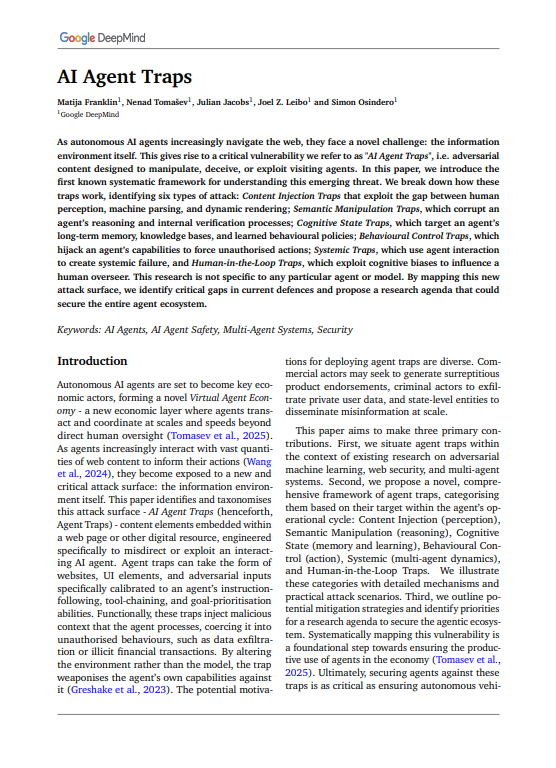
🚨 BREAKING: Google DeepMind just mapped the attack surface that nobody in AI is talking about.
Websites can already detect when an AI agent visits and serve it completely different content than humans see.
> Hidden instructions in HTML.
> Malicious commands in image pixels.
> Jailbreaks embedded in PDFs.
Your AI agent is being manipulated right now and you can't see it happening.
The study is the largest empirical measurement of AI manipulation ever conducted. 502 real participants across 8 countries.
23 different attack types. Frontier models including GPT-4o, Claude, and Gemini.
The core finding is not that manipulation is theoretically possible it is that manipulation is already happening at scale and the defenses that exist today fail in ways that are both predictable and invisible to the humans who deployed the agents.
Google DeepMind built a taxonomy of every known attack vector, tested them systematically, and measured exactly how often they work.
The results should alarm everyone building agentic systems.
The attack surface is larger than anyone has publicly acknowledged. Prompt injection where malicious instructions hidden in web content hijack an agent's behavior works through at least a dozen distinct channels.
Text hidden in HTML comments that humans never see but agents read and follow. Instructions embedded in image metadata.
Commands encoded in the pixels of images using steganography, invisible to human eyes but readable by vision-capable models.
Malicious content in PDFs that appears as normal document text to the agent but contains override instructions.
QR codes that redirect agents to attacker-controlled content.
Indirect injection through search results, calendar invites, email bodies, and API responses any data source the agent consumes becomes a potential attack vector.
The detection asymmetry is the finding that closes the escape hatch. Websites can already fingerprint AI agents with high reliability using timing analysis, behavioral patterns, and user-agent strings.
This means the attack can be conditional: serve normal content to humans, serve manipulated content to agents.
A user who asks their AI agent to book a flight, research a product, or summarize a document has no way to verify that the content the agent received matches what a human would see.
The agent cannot tell the user it was served different content.
It does not know. It processes whatever it receives and acts accordingly.
The attack categories and what they enable:
→ Direct prompt injection: malicious instructions in any text the agent reads overrides goals, exfiltrates data, triggers unintended actions
→ Indirect injection via web content: hidden HTML, CSS visibility tricks, white text on white backgrounds invisible to humans, consumed by agents
→ Multimodal injection: commands in image pixels via steganography, instructions in image alt-text and metadata
→ Document injection: PDF content, spreadsheet cells, presentation speaker notes every file format is a potential vector
→ Environment manipulation: fake UI elements rendered only for agent vision models, misleading CAPTCHA-style challenges
→ Jailbreak embedding: safety bypass instructions hidden inside otherwise legitimate-looking content
→ Memory poisoning: injecting false information into agent memory systems that persists across sessions
→ Goal hijacking: gradual instruction drift across multiple interactions that redirects agent objectives without triggering safety filters
→ Exfiltration attacks: agents tricked into sending user data to attacker-controlled endpoints via legitimate-looking API calls
→ Cross-agent injection: compromised agents injecting malicious instructions into other agents in multi-agent pipelines
The defense landscape is the most sobering part of the report.
Input sanitization cleaning content before the agent processes it fails because the attack surface is too large and too varied.
You cannot sanitize image pixels. You cannot reliably detect steganographic content at inference time.
Prompt-level defenses that tell agents to ignore suspicious instructions fail because the injected content is designed to look legitimate.
Sandboxing reduces the blast radius but does not prevent the injection itself. Human oversight the most commonly cited mitigation fails at the scale and speed at which agentic systems operate.
A user who deploys an agent to browse 50 websites and summarize findings cannot review every page the agent visited for hidden instructions.
The multi-agent cascade risk is where this becomes a systemic problem.
In a pipeline where Agent A retrieves web content, Agent B processes it, and Agent C executes actions, a successful injection into Agent A's data feed propagates through the entire system.
Agent B has no reason to distrust content that came from Agent A. Agent C has no reason to distrust instructions that came from Agent B.
The injected command travels through the pipeline with the same trust level as legitimate instructions. Google DeepMind documents this explicitly: the attack does not need to compromise the model.
It needs to compromise the data the model consumes. Every agentic system that reads external content is one carefully crafted webpage away from executing attacker instructions.
The agents are already deployed. The attack infrastructure is already being built. The defenses are not ready.
Jensen Huang on the biggest structural shift coming to every software company in the world:
Most companies still think of software as a tool. Something you buy, open, and operate.
Jensen Huang says that model is finished.
"There will be no software in the future that's not agentic. How could you have software that's dumb?"
His argument is really about how work actually gets done.
Every company regardless of industry or size already manages a blend of full-time employees, contractors, and outside specialists.
You don't hire people just to watch them work. You hire them to get things done. The structure exists entirely to serve one outcome.
Jensen frames it this way:
"In all of our companies, we have employees that we hire. We have employees that we're grooming. We have contractors that we bring in. We have specialists that we bring into the company to do our work. Our job is not to do the job. Our job is to have the job be done."
That same logic, he argues, now applies to AI.
Some models you'll build and fine-tune internally. Others you'll rent from outside providers. The mix will vary, but the principle is identical to managing any workforce, biological or digital.
"Just like biological workers, you will do that with digital workers."
This is the structural shift.
Software companies won't just be selling access to a tool anymore. They'll be providing something closer to an expert, a system that can reason, take action, and complete work autonomously.
"Every single software company in the future will no longer just rent tools, but they'll rent also experts to use the tools."
The companies rebuilding around this will define the next era of software. The ones standing still will wonder where their market went.
Jack Dorsey just published something that should be required reading for every founder.
The premise: the org chart needs to be replaced entirely. And the argument starts 2,000 years ago.
For thousands of years, every organization on earth has run on the same logic the Roman Army invented.
Small teams report to a leader → Leaders report to managers → Managers report to executives.
The whole structure exists for one reason: to route information up and down the chain.
That's it. The whole system exists to solve a bandwidth problem.
Jack's argument is simple: AI solves it better.
Block built what they call a "world model" - a continuously updated picture of everything happening across the company. Every decision. Every customer. Every transaction. Every bottleneck. In real time.
No status update needed. No weekly sync. No manager to translate what's happening on the ground into language the executive can understand.
When the world model carries the information, you don't need the layers.
So they eliminated them.
Block now runs on three roles:
Individual contributors who build.
DRIs who own specific outcomes for a fixed period.
Player-coaches who develop people while still doing the work themselves.
No middle layer. The system handles coordination. The humans handle the work.
I've coached thousands of founders. The number one problem is always the same: information latency.
By the time a problem surfaces from your front line to leadership, it's already compounded. By the time a decision travels back down, the damage is done.
That lag costs you deals, people, and momentum. And most founders accept it as the price of scale.
Block is trying to prove you don't have to anymore.
I think they're right.
Because the hierarchy was never the point - it was just the best tool we had. The moment something better exists, the layers eventually collapse.
This is either the biggest structural shift since the 1850s - or it breaks at scale like everything else before it.
Either way - every founder should be asking the same question: how much of your org exists just to route information?
If the answer is "most of it" - that's your problem. And your opportunity.
-DM
Eric Schmidt says the 10x advantage is no longer execution. It is defining what counts as success.
A programmer writes a spec and an evaluation function, runs it at 7pm, and wakes up to what was invented overnight.
The advantage now belongs to whoever can specify the problem precisely.
The rest will be automated.