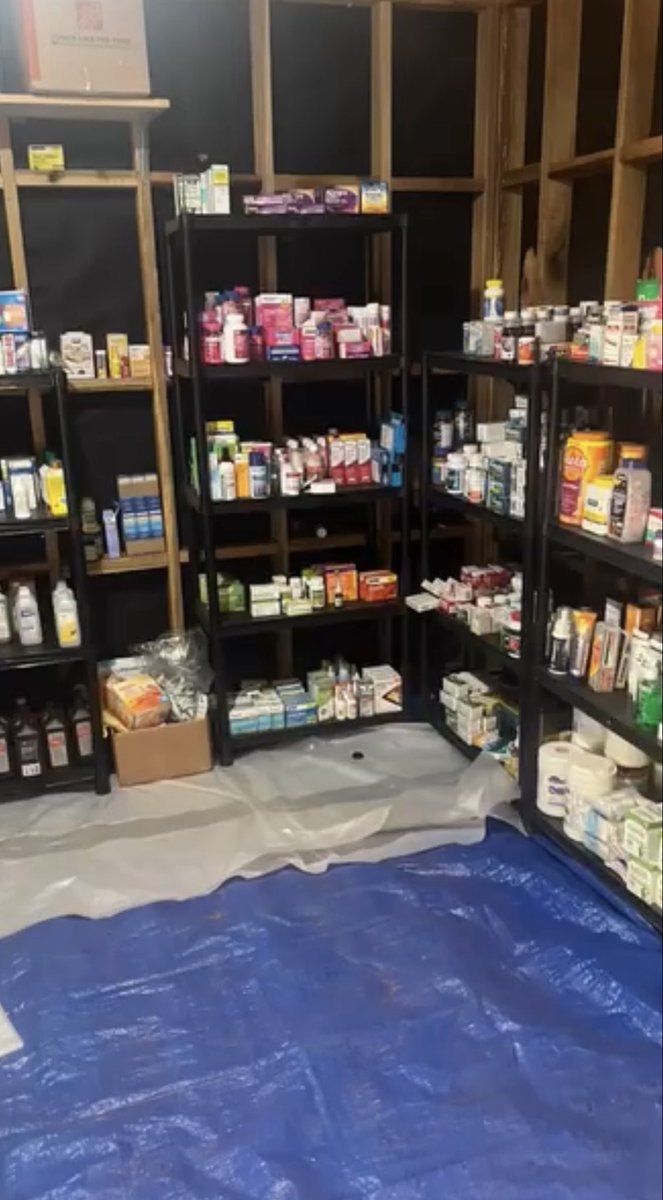
This was a pharmacy I ran during Hurricane Helene- deep in the Appalachians on private land (No FEMA).
I had a doctor and me. Treating patients here, with no EHR, insurance, or admin was life changing.
Who won? The patients.
@DutchRojas I read what I could in a few articles and will consider subscribing! Do you have an article on an owned FQHC pharmacy? That is what we do. No contract pharmacy, and only service patients of the FQHC in rural Appalachia. It really feels like the OG mission of 340B?
@DutchRojas I beg to differ on this one. Without it - they would have had no med. I have followed you for a long time and appreciate everything you do, but you need to be able to separate FQHC’s from 340 B hospitals.
@LighthouseDPC To bill Medicare in the pharmacy for glucose monitors and strips you lose money so you might as well just give them the strips in the monitor for free because it’s cheaper! Lol
@MaryBowdenMD@zsazsa721 Isn’t this what us medical freedom fighters want? We want people to be able to have choices and make their own choices? We can’t fight for that on one hand and criticize when someone makes a choice on the other.
UnitedHealth just earned a $3.9 billion bonus from taxpayers. For a job well done, supposedly.
The 2026 Medicare Advantage quality bonus payouts are out, and the federal government is handing insurers at least $13.4 billion this year. That is roughly $700 million more than last year, and more than four times what the program paid in 2015. Since 2015, these bonuses have totaled over $87 billion.
Now here is the part that should stop you. These are called quality bonus payments. They are supposed to reward plans for delivering better care. But the share of Medicare Advantage members enrolled in a plan that qualifies for the bonus actually fell this year, from 75% down to 68%, the lowest level since 2018. If this program truly tracked quality, a drop like that should shrink the bill. Instead the bill went up. That tells you the giants have not gotten better. They have gotten better at gaming the system.
The way you unlock the bonus is by hitting 4 or more stars in the CMS Star Ratings program. Reach that threshold and your federal payments get bumped up. Sounds reasonable until you learn the ratings are scored at the contract level rather than the individual plan level, which makes the number something you can consolidate, manage, and engineer. Critics have been flagging this for years. The Congressional Budget Office estimated that simply ending the quality bonus program would save taxpayers nearly $100 billion over a decade. MedPAC has proposed replacing it outright.
I do not work deep in the star rating world, but I have felt its edges at my own counter. A doctor once pushed a patient to leave my pharmacy and go back to a big chain, where she paid about $30 more every single month. Why would a doctor do that? Because independent pharmacies like mine do not always count toward a plan's star measures. Steering her elsewhere helped protect the bonus. She paid more so a giant could chase a check. Needless to say, I am not a fan.
Look at who actually cashes these checks.
UnitedHealth Group is set to collect $3.9 billion, about 29% of the entire pool, while covering roughly 26% of enrollees. Humana lands around $1.5 billion after its star scores slipped. And the biggest jump per person goes to Kaiser Permanente at an extra $577 per enrollee, because nearly all of its members sit in 4-star-plus plans. At Kaiser's scale, $577 a head adds up fast.
So here is my honest question. This is a quality bonus. Reviews of the research keep finding little evidence that Medicare Advantage members actually receive meaningfully better care than people in traditional Medicare. Did any of you notice $13 billion worth of better care this year? Or did all these bonuses add up to nothing for the actual patient?
And remember where the money comes from. Taxpayers fund it, and it flows through in premiums and drug costs. When you pay cash at a transparent pharmacy, there is no bonus machine buried in your receipt. You just pay for the medicine.
The most profitable lie in healthcare is that physicians should not want ownership.
Not because ownership corrupts physicians.
Because ownership frees them.
A physician with wages can be managed.
A physician with capital can leave.
A physician with infrastructure can compete.
A physician with patients can build.
The system did not teach humility.
It taught surrender.
An orthopedic surgeon calls insurance companies "parasites" and says the records system every doctor uses "isn't meant for note-taking, it's meant for billing." So he cut all of it.
Daniel Paull spent nine years training to do exactly what everyone else does: take a hospital job or join a large group, accept insurance, see a high volume of patients, run the standard machine. He looked at the machine and refused to build it.
His reasoning is the part worth sitting with, because it is structural, not sentimental.
To accept insurance, he says, he would have to hire roughly five full-time people and rent more office space. That overhead does not appear from nowhere. It has to be earned back, and the only way to earn it back is volume: more patients, less time with each one, shorter visits, less of the relationship he thinks is the actual core of medicine.
Then there is the software. When he says the electronic records system "isn't meant for note-taking, it's meant for billing," he is naming a design incentive most patients never think about. The technology in the exam room is optimized for the payer, not for the encounter. It exists to justify a claim, not to help a doctor think.
So he removed the whole apparatus. No hospital administration. No insurance company deciding how long he is allowed to spend with a patient. Just the doctor and the person in front of him.
What that buys on the patient side is not abstract. Same-day or next-day appointments instead of a two-month wait. The doctor's actual phone number, texts answered directly. If he is running late to you, he texts you himself. Compare that to the standard version everyone has learned to accept: wait two months, sit for two hours, and often be seen by the PA anyway.
His verdict on the layers he cut out is one line. They are parasites, and they are gone.
Here is the uncomfortable reframe worth bookmarking: much of what a patient waits through is not clinical necessity. It is the operational cost of the payment layer, passed down the line as delay.
Two years in, he runs an office, does surgeries, makes roughly fifty house calls, and says he is happier than he ever was inside the system.
Listen to the full conversation on The Podcast by KevinMD. Link in the replies.
What is the single layer between you and your doctor that you have never understood the purpose of?
#DirectCare #ThePodcastbyKevinMD